
Introduction
AI in Food Processing Statistics: AI in food processing is being used to improve product inspection, sorting, grading, traceability, predictive maintenance, production planning, food safety monitoring, and waste control. In 2026, adoption is being supported by pressure on labor availability, rising quality expectations, stricter traceability needs, and the need to reduce production losses.
The food processing sector is well suited for AI because it produces large volumes of repeatable operational data from sensors, machines, vision systems, ERP platforms, and quality records. In the U.S., food manufacturing employed about 1.77 million people in June 2026, while the sector had more than 43,300 private establishments in Q4 2025, showing the scale of operations where automation and AI can be applied.
Editor’s Choices
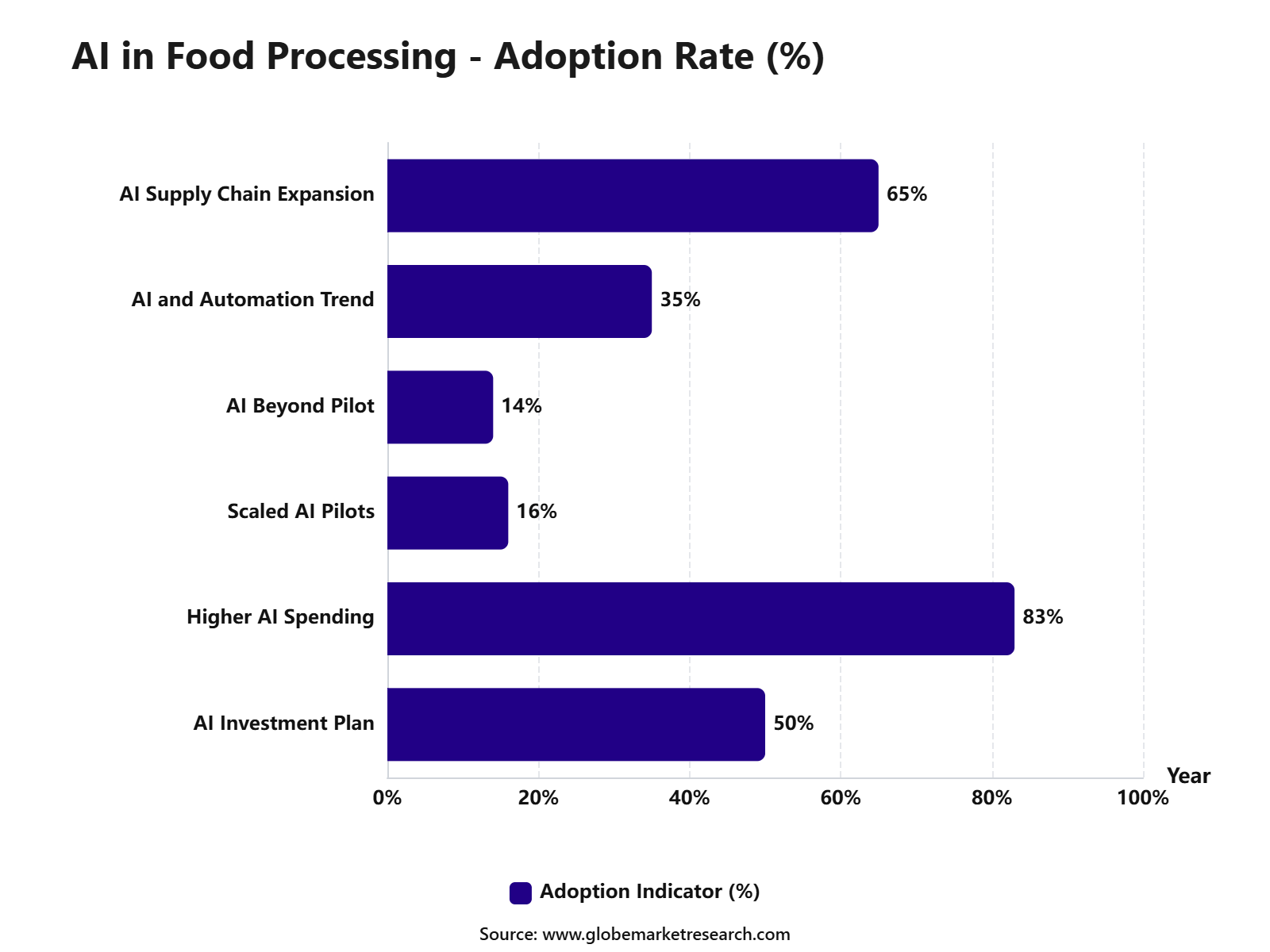
Based on our Survey, 35% of food manufacturing survey respondents said AI and automation were a major trend in 2025
AI and automation as a major trend increased from 27% in 2024 to 35% in 2025
U.S. food manufacturing employment was about 1.77 million in June 2026
U.S. food manufacturing labor productivity declined 2.1% in 2025
Global robot installations are expected to reach about 575,000 units in 2025
WHO estimates 866 million people fall ill from contaminated food each year
Unsafe food causes about US$310 billion in global productivity and medical losses each year
The world wastes about 1.05 billion tonnes of food at consumer-level stages
AI in Food Processing Market Size
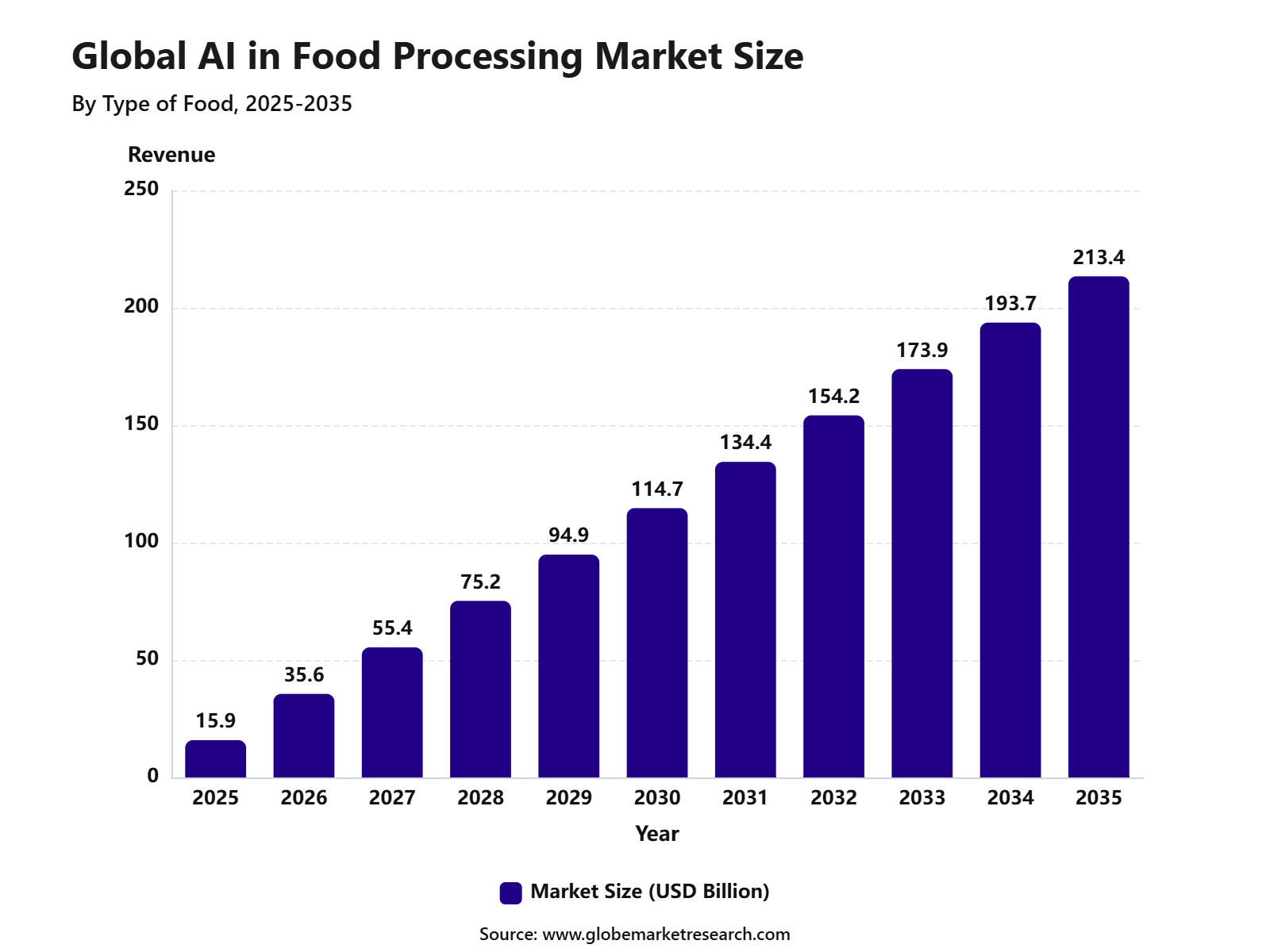
According to Globe Market Research, The Global AI in Food Processing Market is expected to show strong expansion from USD 15.9 billion in 2025 to USD 35.6 billion in 2026 , reflecting rapid early adoption of automation, machine vision, predictive analytics, and quality control systems across food manufacturing operations. The market is projected to continue rising steadily, reaching USD 94.9 billion by 2029 and USD 114.7 billion by 2030 , as food processors increase the use of AI to improve production efficiency, reduce waste, support traceability, and maintain consistent product quality.
By 2035, the market is forecast to reach USD 213.4 billion , showing a strong long-term growth path from 2025 to 2035. This growth can be attributed to wider deployment of AI-powered inspection systems, smart processing lines, robotics, demand forecasting tools, and supply chain optimization solutions. Rising pressure to improve food safety, manage labor shortages, reduce operational losses, and meet changing consumer demand is expected to support continuous investment in AI-enabled food processing technologies.
Leading Segment Share Statistics
Convenience food and snacks led the food type segment with 33.5% share . Growth was supported by high production volumes, changing eating habits, and rising demand for ready-to-eat food products.
Quality control and safety compliance accounted for 35.9% share by application. The segment was driven by faster inspection needs, contamination detection, and consistent food quality requirements.
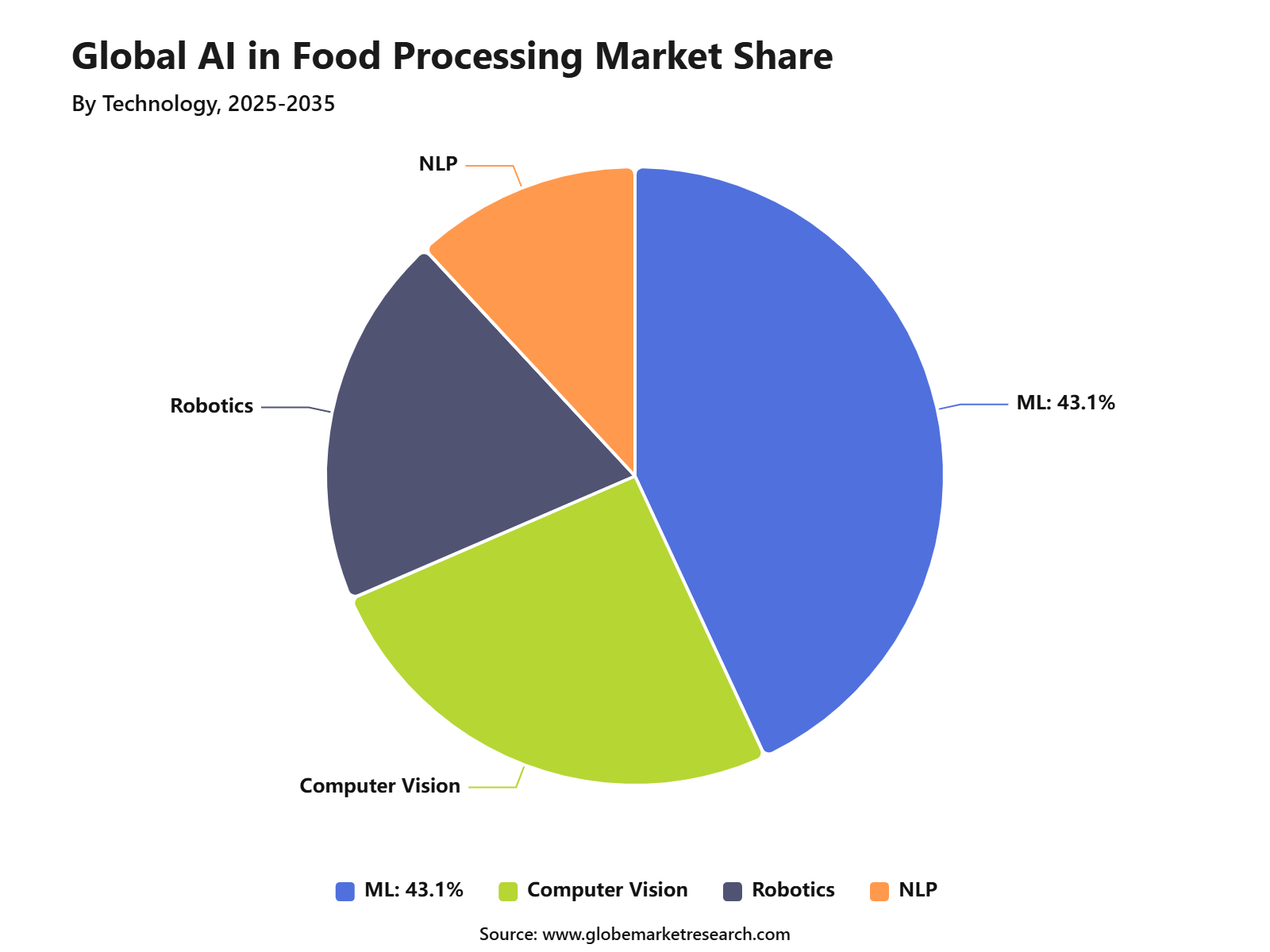
Machine learning and deep learning held 43.1% share by technology. Their use increased across defect detection, process automation, demand forecasting, and recipe optimization.
Software captured 50.5% share by component. Growth was supported by wider use of AI platforms for monitoring, analytics, production planning, and quality management.
Cloud deployment accounted for 59.9% share . Adoption was driven by easier data access, lower infrastructure requirements, and flexible integration across food processing facilities.
Food manufacturers held 63.8% share by end user. Growth was supported by rising automation, strict food safety standards, and the need to improve production efficiency.
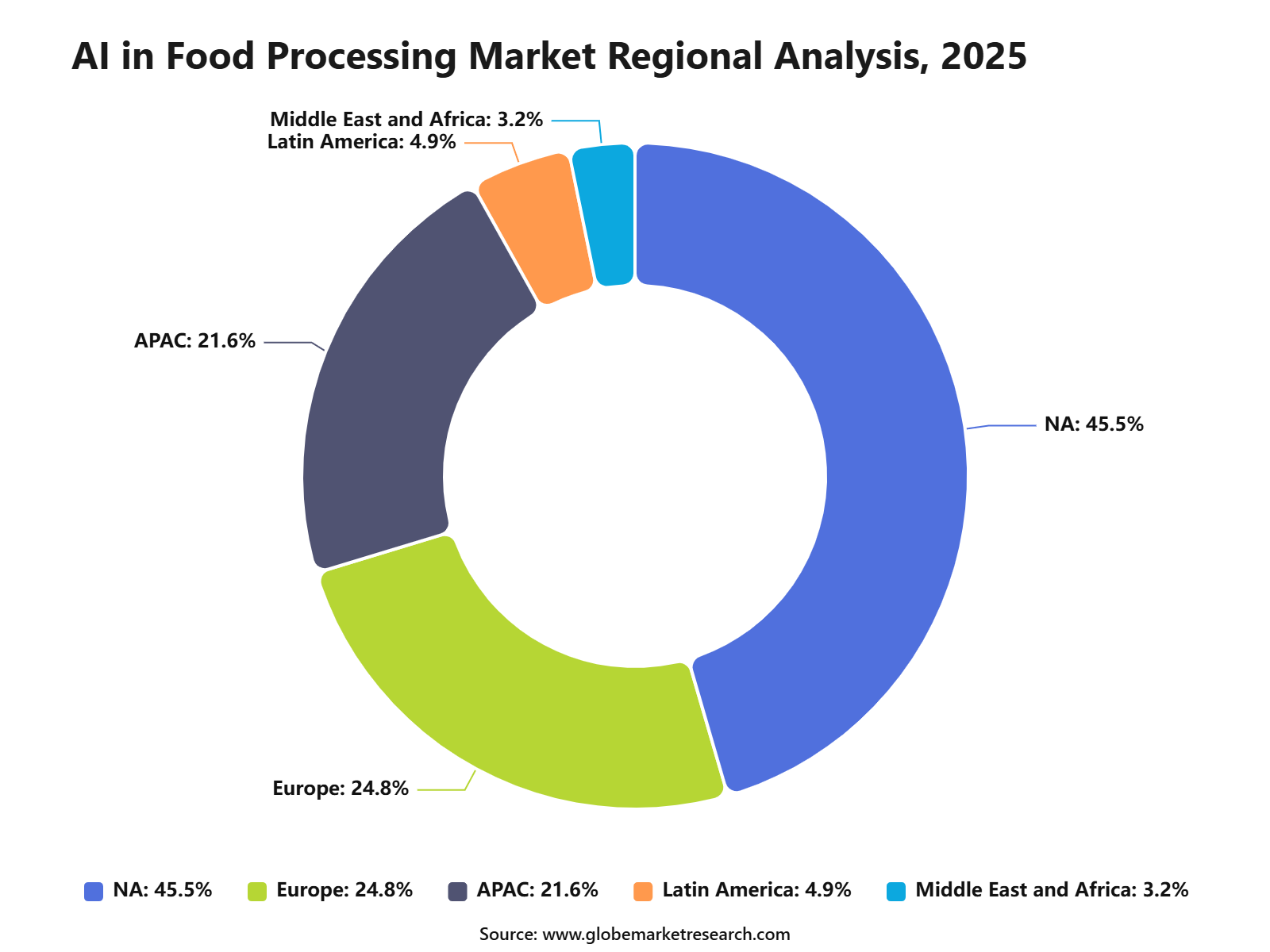
North America led the AI in food processing market with 45.5% share . The region benefited from advanced food manufacturing systems, strong technology adoption, and high investment in automation.
AI Adoption, Impact and Barriers Statistics
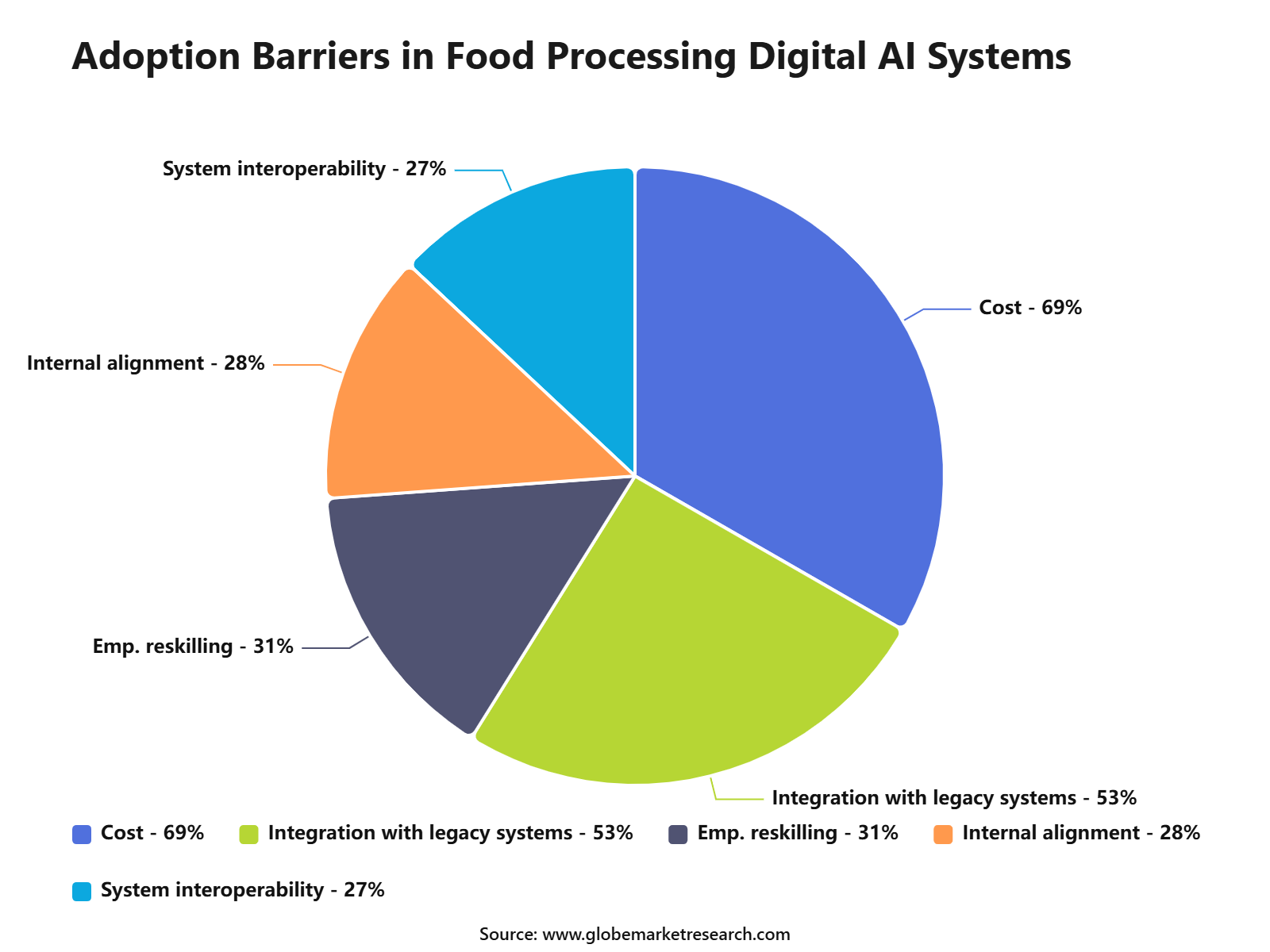
Plant Efficiency & Resource Optimization
U.S. food manufacturing had 1.40 million production and nonsupervisory employees in June 2026, showing a large workforce exposed to repetitive plant tasks where AI and automation can assist.
Average weekly hours for all U.S. food manufacturing employees were 39.6 hours in June 2026, reflecting a full-scale production environment where scheduling and line efficiency matter.
Average weekly hours for production and nonsupervisory workers were 40.5 hours in June 2026, supporting the need for AI tools that reduce fatigue-related errors and improve line planning.
Packaging and filling machine operators accounted for 168,370 jobs in U.S. food manufacturing in 2025, making packaging automation and machine monitoring major AI use cases.
Food batchmakers accounted for 144,690 jobs in 2025, showing strong relevance for AI-based recipe control, batching accuracy, yield management, and production consistency.
U.S. food manufacturing recorded 3.3 injury and illness cases per 100 full-time workers in 2024, which supports automation in high-risk and repetitive tasks.
Cases involving days away from work, job restriction, or transfer stood at 2.3 per 100 full-time workers in 2024, making worker safety a practical driver for AI-enabled robotics.
Supply Chain & Waste Reduction
About 13% of global food, equal to around 1.25 billion tonnes, is lost between harvest and retail, creating a strong case for AI-based grading, demand forecasting, and cold-chain monitoring.
A further 19% of food, equal to about 1.05 billion tonnes, is wasted at the consumption stage across households, food service, and retail.
Households account for nearly 60% of global food waste, showing that better forecasting, packaging, portioning, and shelf-life prediction can support downstream waste reduction.
UNEP reported that food waste reached 132 kg per person at the retail, food service, and household level in 2022.
Food service accounted for 28% of global food waste, while retail accounted for 12%, supporting the use of AI for inventory planning and dynamic replenishment.
Food waste equals more than 1 billion meals per day, showing the scale of opportunity for AI-based waste measurement and demand planning.
A 2025 computer vision food waste study found that at least one model approached or surpassed 90% distributional pixel agreement for each food type tested, showing practical potential for automated waste measurement.
Demographic & Consumer Acceptance
Purdue’s August 2025 Consumer Food Insights survey included 1,200 U.S. consumers and found that consumers generally support AI tools used to improve food and agricultural production.
Almost two-thirds of consumers said it is very or extremely important for food producers to disclose when AI is used in production or decision-making.
Among consumers unlikely to choose an AI-assisted food product, 70% cited trust in AI’s ability to maintain food safety as a concern.
Among consumers likely to choose an AI-assisted food product, 53% believed AI can improve food safety.
The average diet quality score among surveyed U.S. adults was 62.2, placing more consumers in the “intermediate” diet quality category, which supports AI use in nutrition guidance and product development.
Only 17% of respondents were classified as having a healthy diet, showing scope for AI-driven personalized nutrition, reformulation, and product recommendation tools.
13.5% of surveyed households reported difficulty accessing enough food, while the rate was 24.1% among adults aged 18 to 34 and 3% among adults aged 65 and older.
Food Safety & Compliance Drivers
Unsafe food causes more than 200 diseases, ranging from diarrhoea to cancers, which supports AI use in hazard detection and preventive quality control.
WHO estimated 57.1 million healthy life years are lost globally each year due to unsafe food.
Children under five carry about 29% of the health burden from unsafe food and accounted for 143,000 deaths in 2021.
The earlier WHO estimate covered 31 hazards, while the 2026 update expanded the evidence base and burden estimates for foodborne disease.
The original FDA traceability compliance date was January 20, 2026, but enforcement was moved to July 20, 2028.
The FDA proposed a 30-month extension for the Food Traceability Rule, giving processors additional time to prepare digital records and traceability systems.
The traceability rule requires covered entities to maintain records for Critical Tracking Events and Key Data Elements, making AI and data platforms more relevant for compliance readiness.
Region Analysis
North America led the regional segment with 45.5% share, supported by strong AI investment, advanced food manufacturing infrastructure, mature cloud adoption, and strict food safety standards. The region also benefits from a large base of food processors, technology providers, research institutions, and regulatory systems that support digital quality control and traceability.
The U.S. remains the key growth driver in the region. Stanford’s 2026 AI Index reported that U.S. private AI investment reached USD 285.9 billion in 2025, with 1,953 newly funded AI companies. This strong AI ecosystem is helping accelerate the use of computer vision, predictive analytics, automation software, and cloud platforms across food processing operations.
Primary Applications
AI is being used most strongly in food sorting, grading, quality control, safety compliance, production planning, packaging, and maintenance. Sorting and grading accounted for 29.75% of AI application share in 2025, making it the leading use case. This reflects strong demand from fruit and vegetable processing, grain cleaning, meat inspection, bakery lines, beverage packaging, and ready-to-eat food production.
Computer vision is the most important enabling technology, with 41.95% share in 2025. It is used to detect color variation, foreign materials, broken products, wrong labels, fill-level errors, seal defects, and packaging damage. Predictive maintenance is also expanding quickly because it helps reduce unplanned downtime and machine failure risk.
Application | How AI is Used? |
|---|---|
Sorting and Grading | Detects size, color, ripeness, shape, and surface defects. |
Quality Control | Identifies defects, contamination risks, labeling errors, and packaging faults. |
Food Safety Compliance | Tracks process deviations, hygiene risks, and recall triggers. |
Predictive Maintenance | Monitors motors, conveyors, pumps, compressors, and filling lines. |
Production and Packaging | Optimizes line speed, fill accuracy, batch control, and downtime. |
Supply Chain Planning | Improves demand forecasting, inventory planning, and cold-chain monitoring. |
Product Development | Supports recipe testing, sensory prediction, and ingredient optimization. |
Conclusion
AI in food processing is becoming an important tool for improving quality, safety, productivity, and waste control across modern food plants. The adoption of AI is being supported by rising food safety concerns, labor pressure, declining productivity, higher traceability requirements, and the need for faster inspection across large-scale production lines.
In 2026, the strongest AI use cases are expected to remain quality inspection, predictive maintenance, robotics, supply chain planning, food safety monitoring, and waste reduction. As food processors continue to digitize operations, AI will play a larger role in reducing errors, improving consistency, supporting compliance, and helping companies produce safer food with better operational efficiency.