
Introduction
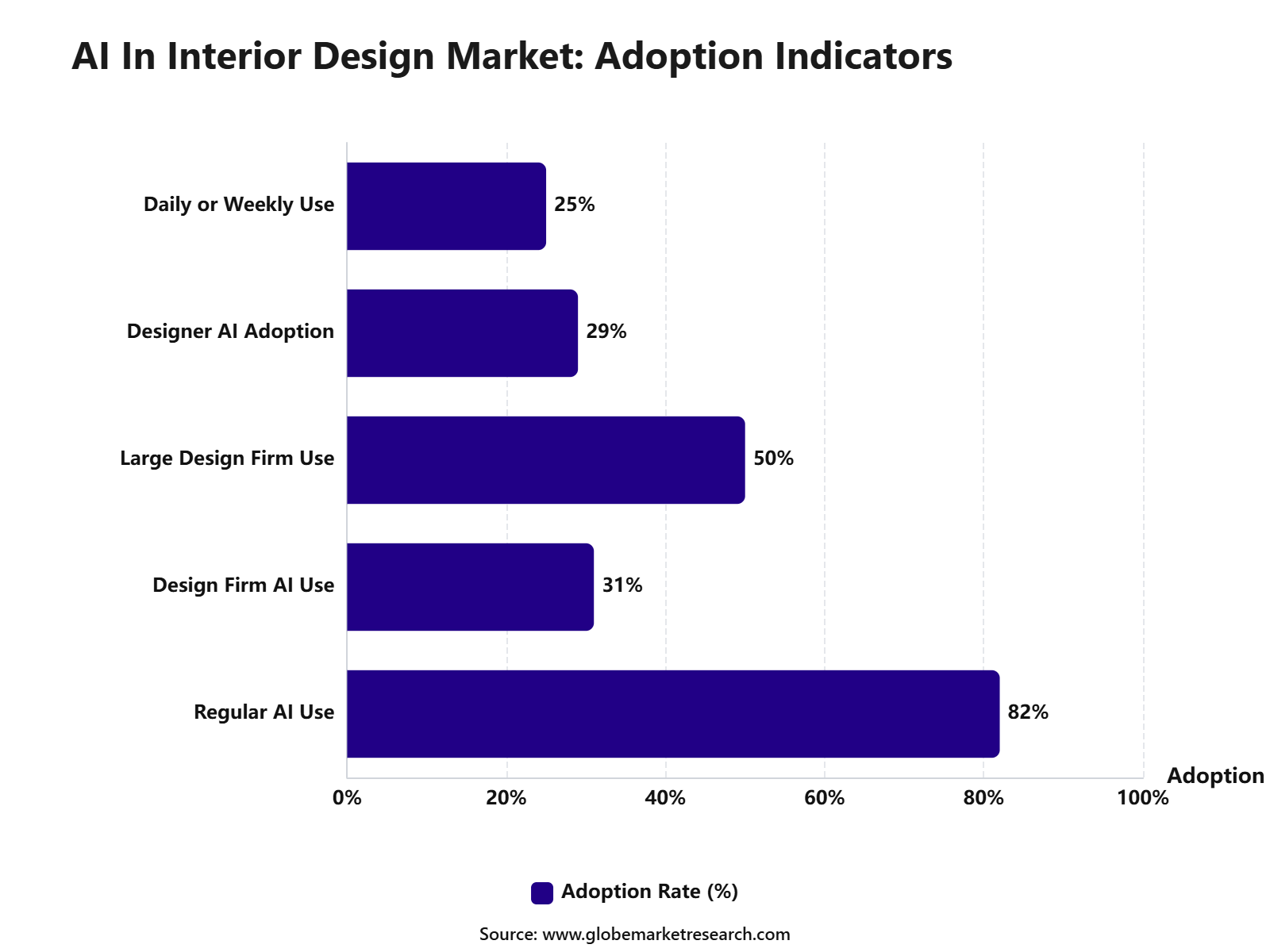
AI In Interior Design Statistics: AI in interior design is moving from experimental use to practical workflow support. It is being used for concept visuals, mood boards, client communication, product research, estimates, marketing content, and administrative work. Current statistics show that adoption is growing quickly, but the strongest use is still in back-office and early-stage design support rather than full creative decision-making. In 2025, AI use among interior designers reached 29% , up from 9% in 2023, while another 20% of designers said they planned to adopt AI tools.
The rising use of AI in interior design can be seen in areas such as improved design accuracy, shorter project turnaround time, better customer engagement, and more realistic previews before final execution. AI-based platforms allow users to test different room styles, materials, furniture arrangements, and décor options within minutes. As a result, interior design is becoming more data-led, interactive, and personalized, while reducing repeated revisions and helping users make confident design choices.
Editor’s Choices
According Houzz, to 31% of design firms are already using AI tools, while 69% still do not use AI in everyday business tasks. Among larger design firms, adoption reaches 50% , showing that AI use is becoming more common where project volume and workflow complexity are higher.
70% of AI-using design firms apply AI for administrative work, followed by 59% for sales and marketing, 34% for planning and design, 15% for business operations and reporting, and 14% for project and client management. This shows that AI is first being used in lower-risk tasks before being applied to complex design and client-facing work.
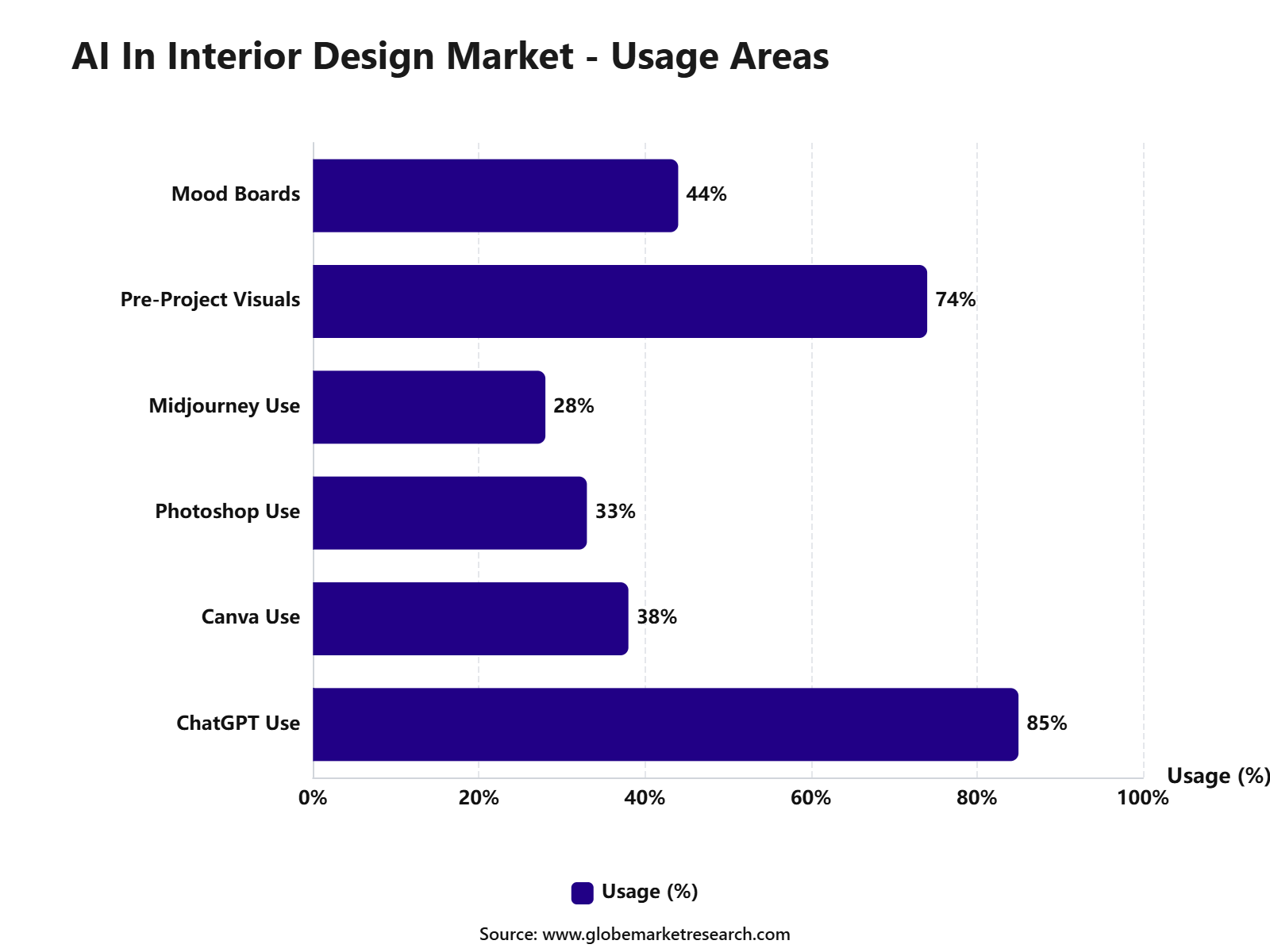
74% of designers using AI for planning and design use it to create pre-project visuals. Other major uses include mood boards at 44% , floor plans at 41% , product or material recommendations at 33% , photo analysis or tagging at 22%, and takeoffs at 19%.
3 hours per week are saved on average by designers using AI tools . In firms with 10 or more employees, average savings rise to 3.5 hours per week, while 18% of designers report saving more than five hours weekly.
70% of designers using AI tools are satisfied with them, while 28% remain neutral and only 2% report dissatisfaction. This suggests that AI is already delivering practical value, although many firms are still testing how deeply it should be used in creative and client workflows.
AI In Interior Design Market Size
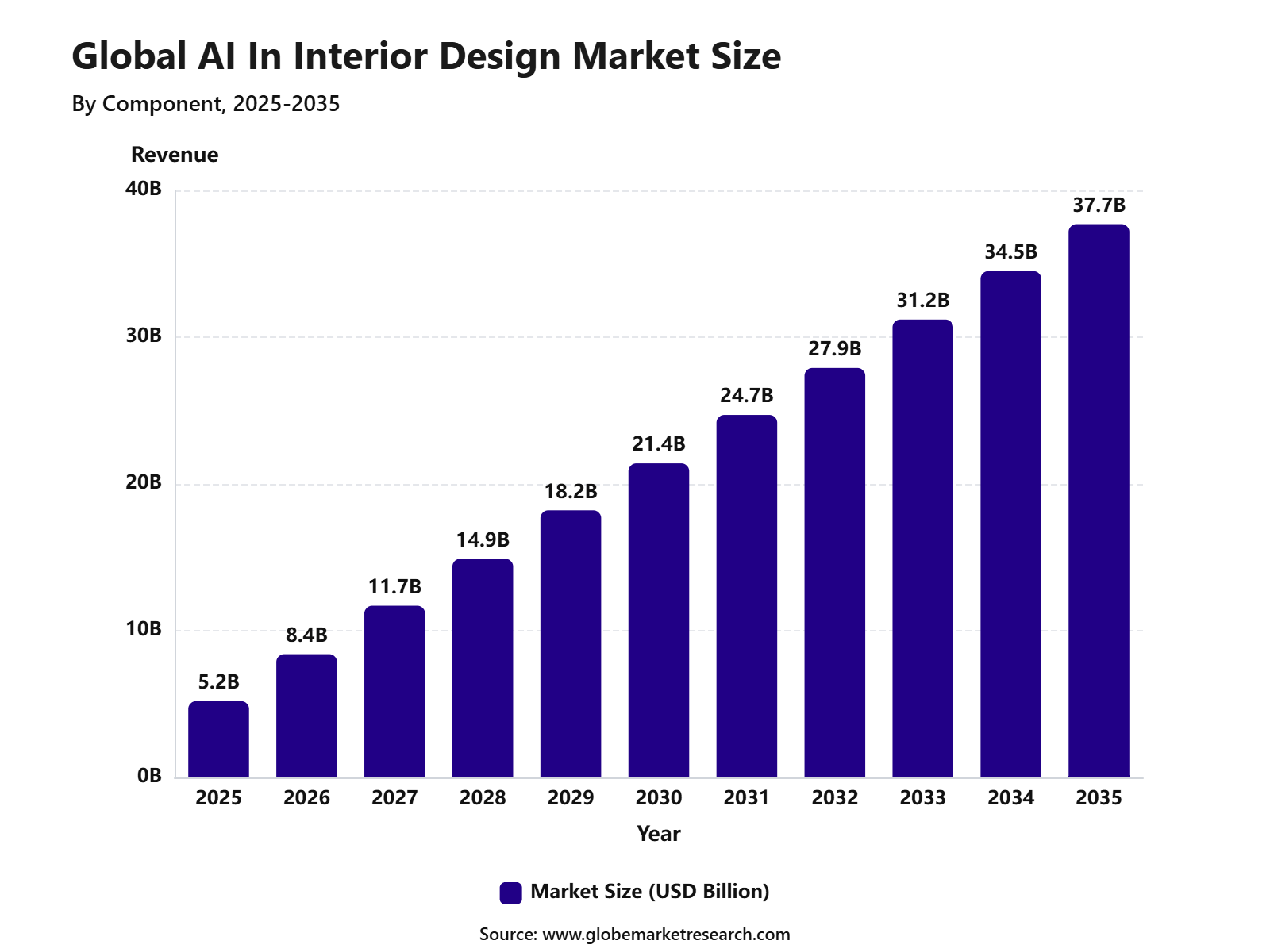
According to Globe Market Research, The Global AI In Interior Design Market is expected to show strong growth from USD 5.2 billion in 2025 to USD 37.7 billion by 2035, expanding at a CAGR of 21.9% during 2025 to 2035. The market is projected to nearly double between 2025 and 2027, rising from USD 5.2 billion to USD 11.7 billion , which reflects fast adoption of AI-based design tools, virtual room planning, automated layout generation, and personalized interior visualization platforms.
Steady growth is expected throughout the forecast period, with the market crossing USD 21.4 billion in 2030 and reaching USD 31.2 billion by 2033. This upward trend can be attributed to higher use of AI by interior designers, architects, furniture retailers, real estate firms, and homeowners for faster design decisions, cost optimization, improved customer experience, and realistic 3D visualization. By 2035, AI is expected to become a key part of digital interior design workflows, supporting both professional and consumer-led design projects.
Leading Segment Share Insights
Solutions led the component segment with 62.1% share. Growth was supported by demand for AI design platforms, layout tools, automation, and digital visualization.
Cloud deployment held 70.5% share. It was driven by easy access, faster updates, scalable storage, and smooth team collaboration.
Interior designers accounted for 42.3% share by user type. AI tools are being used for concepts, space planning, mood boards, and client presentations.
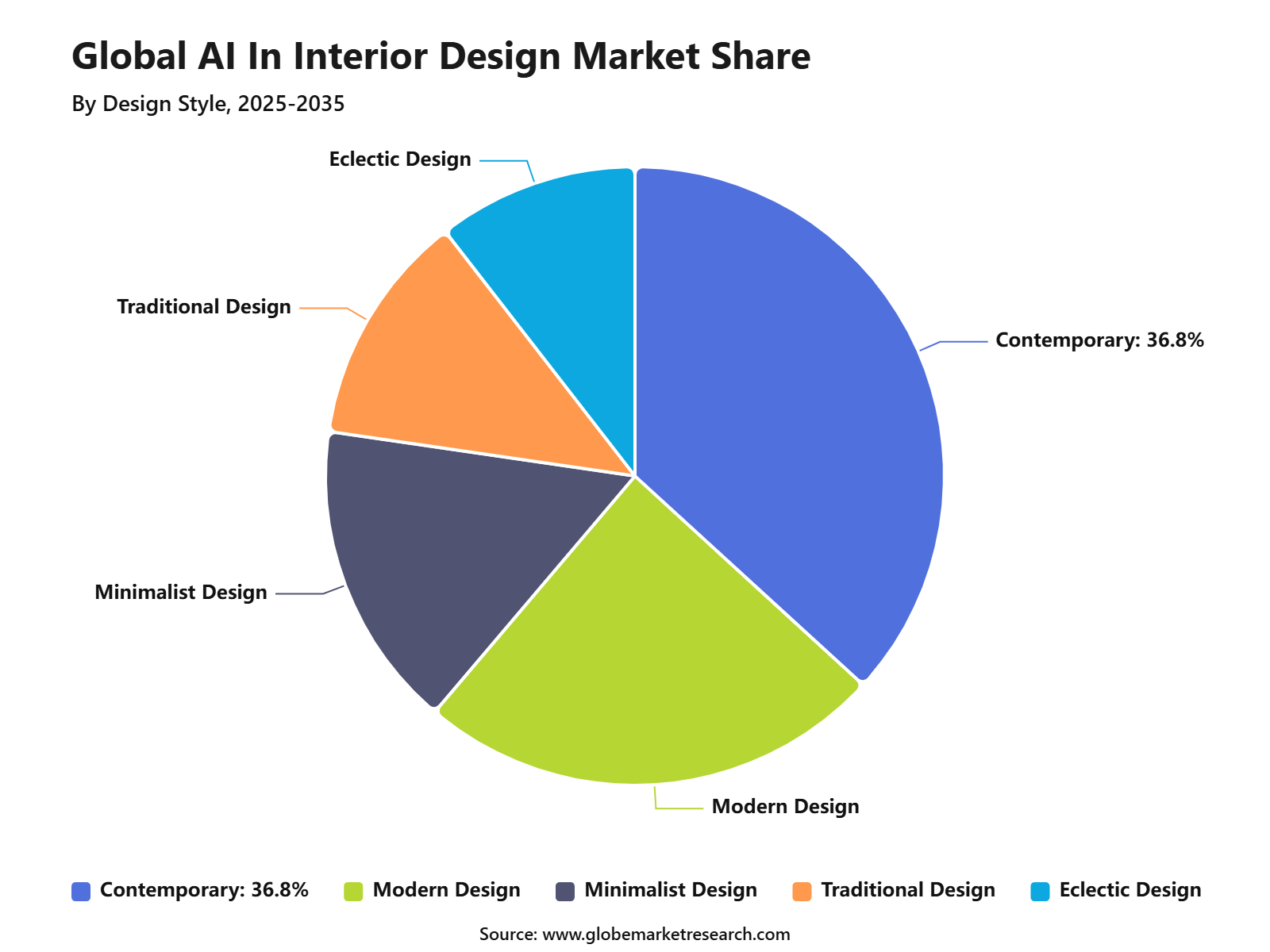
Contemporary design captured 36.8% share by design style. Demand was supported by clean layouts, modern furniture, functional spaces, and personalized design.
3D visualization tools held 37.2% share by technology integration. These tools improve design accuracy, client understanding, and realistic space previews.
Residential design accounted for 41.1% share by application. Growth was driven by home renovation, personalized interiors, smart home planning, and digital design services.
Subscription-based pricing captured 42.3% share. It offers flexible access, lower upfront cost, and better value for designers and small studios.
North America led the market with 40.6% share. Growth was supported by strong digital design adoption, high home improvement spending, and rising use of AI design tools.
Top Funding and Investment
Investment activity in AI in interior design is being led by platforms that combine design automation, visual AI, workflow management, virtual staging, and home renovation planning. Funding is moving toward tools that reduce manual design work, improve client visualization, and connect design, pricing, product sourcing, and project delivery in one digital flow.
Company / Platform | Funding Amount | Year / Round | Investment Focus |
|---|---|---|---|
Flipspaces | USD 50 million | 2025, Series C | The capital was raised to expand operations, strengthen supply chain capability, and improve AI-driven design technology across India, the U.S., and other markets. |
Collov Labs | USD 23 million | 2026, Series A | Funding was directed toward visual AI systems that allow images and camera inputs to support real-world design and commerce actions. |
Drafted | USD 16 million | 2026, Seed | The startup raised funding to build AI-driven home design tools that convert user ideas into floor plans and 3D layouts. |
Collov AI | USD 10 million | 2024, Series A | The funding supported its AI interior design platform, with focus on AI-based home furnishing and design visualization. |
Raanro Interior Technology | ₹4.12 crore | 2026, Pre-seed | The company raised capital to build an AI-powered workflow platform covering lead generation, design creation, pricing, execution, and delivery. |
₹3 crore | 2025, Pre-seed | Funding was raised to build an AI-led interior discovery and shopping platform, with investment support for product development and user growth. |
Industry Adoption & Usage
AI adoption in interior design is strongest in practical, low-risk work. In the UK, design firms using AI apply it mainly to administrative tasks, where usage reaches 88% . Sales and marketing follows at 48% , planning and design at 40% , project and client management at 36% , and business operations and reporting at 24% . This shows that AI is first being trusted for repeatable support tasks before it is used for deeper design decisions.
Interior design-specific adoption also shows strong momentum. A 2026 designer trends survey found that AI use among interior designers rose from 9% in 2023 to 29% in 2025, and another 20% of designers planned to adopt AI in 2026. This indicates that nearly half of surveyed designers may become active or near-term AI users, although resistance remains among professionals who are cautious about creativity, originality, and client trust.
In the U.S., a 2025 Houzz study found that 31% of design businesses were using AI tools, while larger design firms were ahead, with 50% of firms with 10 or more employees using AI. This confirms that adoption is higher among firms with more staff, stronger digital systems, and more capacity to test new tools.
AI Use Cases in Interior Design
Pre-project visuals are one of the most used AI applications in design workflows. Among UK design firms using AI for planning and design , 57% use it for pre-project visuals, while 43% use it for mood boards. This makes AI especially useful during early client discussions, when designers need to present style directions, room concepts, color palettes, and visual options quickly.
AI is also being applied to product and material recommendations. The same data shows that 38% of design firms use AI for product or material recommendations, 24% use it for floor plans, and 24% use it for photo analysis or tagging. This supports faster sourcing, image organization, and early layout review, but final specification still requires professional judgment.
Marketing has become another clear use case. In UK design firms, 100% of AI users applying AI to sales and marketing use it for social media content creation, while 30% use it for advertising and 30% for lead management. For interior designers, this is important because project visibility, portfolio storytelling, and client education are now closely linked to digital content.
Efficiency & Productivity
Efficiency is the strongest adoption driver. Among UK design firms, 68% say increasing efficiency and productivity would motivate them to adopt AI. This is the highest-ranked motivation, ahead of staying competitive, improving accuracy, reducing operating costs, and improving customer satisfaction.
AI saves time by reducing repetitive work such as formatting documents, writing captions, preparing first-draft proposals, organizing images, summarizing client notes, and creating early visual directions. U.S. data also shows that designers use AI for routine tasks such as document formatting, scheduling, and content generation, while adoption remains lower in complex areas such as business strategy and client management.
The productivity impact is strongest when AI is used regularly. UK design firms show a higher daily or weekly usage level than construction firms, with 31% of design firms classified as frequent users. This suggests that designers are finding value in recurring tasks such as visual ideation, social content, mood boards, and client-facing presentation support.
Cost Reduction & Business Impact
Cost reduction is an important but secondary AI driver in interior design. Among UK design firms, 23% cite reduced operational costs as a motivation to adopt AI, while 34% cite freeing up time for higher-value tasks. This means designers are not only looking for cheaper workflows, but also for more time to spend on creativity, sourcing, client service, and project coordination.
The annual financial benefit is already measurable for firms using AI. UK data estimates an average annual financial gain of £13,000 per design firm, based on self-reported time savings and average revenue assumptions. This is relevant for small design studios because even modest weekly time savings can improve proposal speed, content output, and administrative capacity.
AI can also support better material decisions, but it should not replace expert review. Since 38% of AI-using design firms already apply AI to product or material recommendations, the opportunity is clear in faster sourcing, alternative product discovery, and style matching. However, sustainability claims, safety, durability, lead times, and supplier details still need human validation.
Consumer Satisfaction & Client Experience
Client experience is becoming a major reason for AI adoption. Among UK design firms, 34% say enhancing customer experience and satisfaction would motivate AI adoption. Another 34% cite improving accuracy and reducing errors, which is important because clients expect clear visuals, reliable estimates, and fewer misunderstandings before work begins.
AI improves client communication mainly through faster visualization. Mood boards, pre-project visuals, and AI-assisted image edits help clients understand design direction before detailed drawings or procurement decisions are made. This reduces friction in the early stage, especially when homeowners struggle to imagine layouts, colors, materials, and furniture combinations from verbal descriptions alone.
Satisfaction levels among design firms are also positive. In the UK, 60% of design firms using AI say they are satisfied with their AI tools, while 36% are neutral. This shows that designers see value, but many are still waiting for better reliability, more personalized outputs, and smoother integration into professional workflows.
Key Challenges
Reliability and accuracy remain the biggest concern. Among UK design firms, 33% cite reliability and accuracy as their top AI concern, followed by 16% citing lack of training and 11% citing lack of personalized service. This is highly relevant in interior design because wrong scale, poor material assumptions, unrealistic lighting, or unsuitable furniture proportions can create client confusion.
Training is still a gap, but it is not the only barrier. U.S. data shows that one-third of designers are concerned about AI reliability and accuracy, while only 14% cite lack of training as a concern. This suggests that the main issue is not just learning how to use AI, but trusting whether the output is accurate enough for professional client work.
Conclusion
AI in interior design is best understood as a workflow support tool, not a replacement for professional designers. The strongest use cases are pre-project visuals, mood boards, content creation, product recommendations, administrative work, and client presentation support. Adoption is rising quickly, but accuracy, personalization, and trust remain the main barriers. Firms that use AI with professional review are likely to gain the most value, especially through faster concept development, better client communication, lower manual workload, and improved project efficiency.