
Introduction
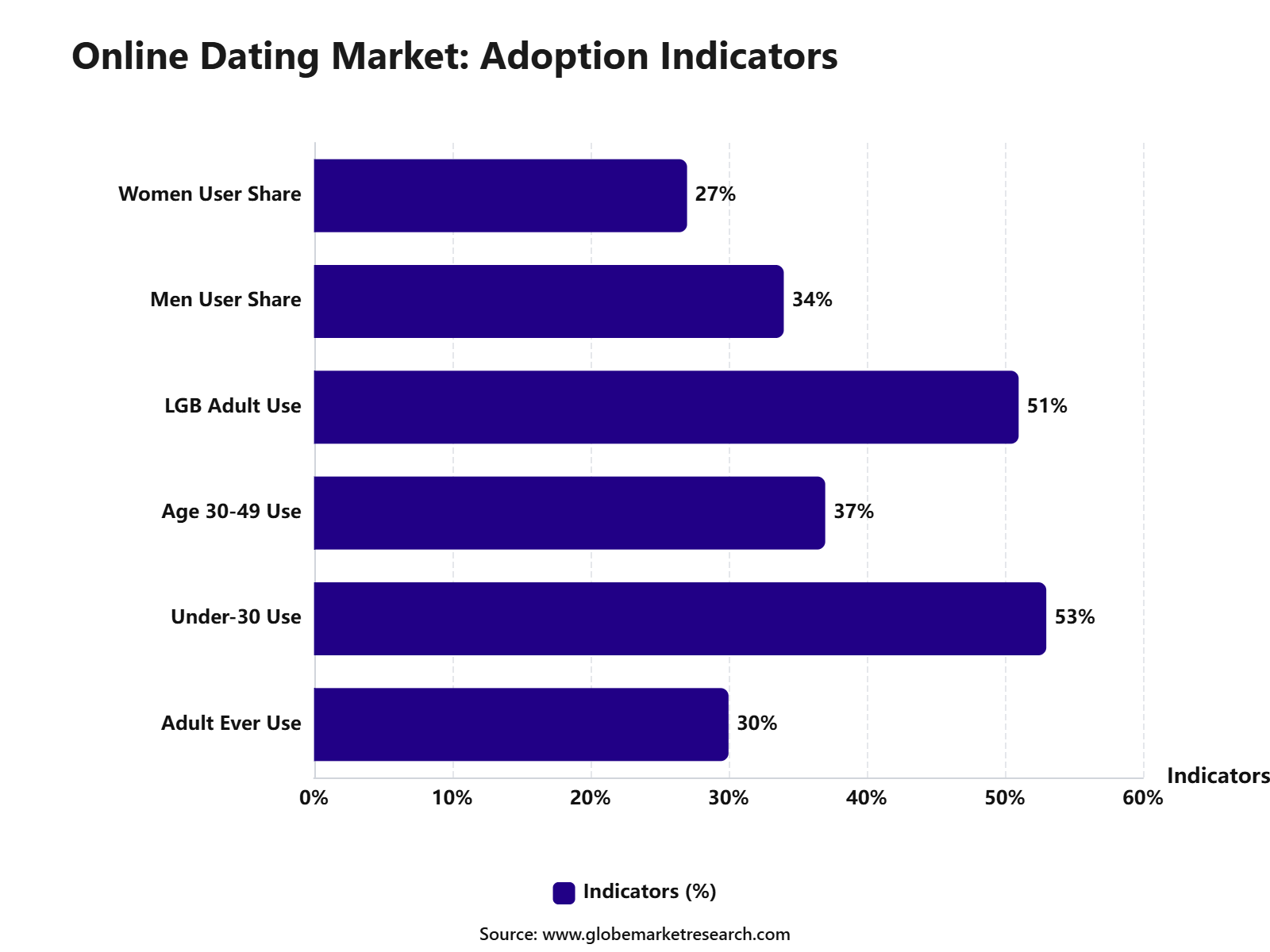
Online Dating Statistics: Online dating in 2026 is no longer viewed only as a casual way to meet people. It has become a normal part of modern relationship formation, especially among younger adults, busy professionals, LGBTQ+ users, and people who prefer wider dating choices outside their immediate social circles. In the U.S., about 30% of adults have used a dating site or app, while usage rises to 53% among adults under 30, showing that digital dating is strongest among younger users.
The online dating experience is mixed. Many users still see dating apps as useful for meeting long-term partners, casual dates, and new social connections. At the same time, fatigue, ghosting, scams, harassment, and safety concerns are shaping how people use these platforms. In 2026, AI is becoming more visible in profile writing, match filtering, conversation support, fraud detection, and user verification, but most singles still prefer AI as a support tool rather than a replacement for human connection.
Editor’s Choices
Online dating is most common among younger adults, with 53% of adults under 30 having used a dating site or app.
About one in ten partnered adults met their current spouse or partner through a dating site or app.
Among partnered adults under 30, 20% met their current partner through online dating.
Around 35% of online dating users have paid for dating apps or extra features.
Tinder remains the most widely used dating platform among online daters, with 46% of online dating users reporting that they have used it.
Dating fatigue is widespread, as 78% of recent dating app users said they felt emotionally, mentally, or physically exhausted by apps at least sometimes.
Women report higher dating app burnout than men, at 80% vs. 74%.
Among users, 38% have received unwanted sexually explicit messages or images, while 30% have faced continued contact after saying they were not interested.
About 52% of online dating users say they have encountered someone they believed was trying to scam them.
AI adoption is rising fast in dating, with nearly half of Gen Z singles reporting that they have used AI for dating-related tasks such as profiles, openers, or compatibility screening.
Online Dating Market Size and Valuation
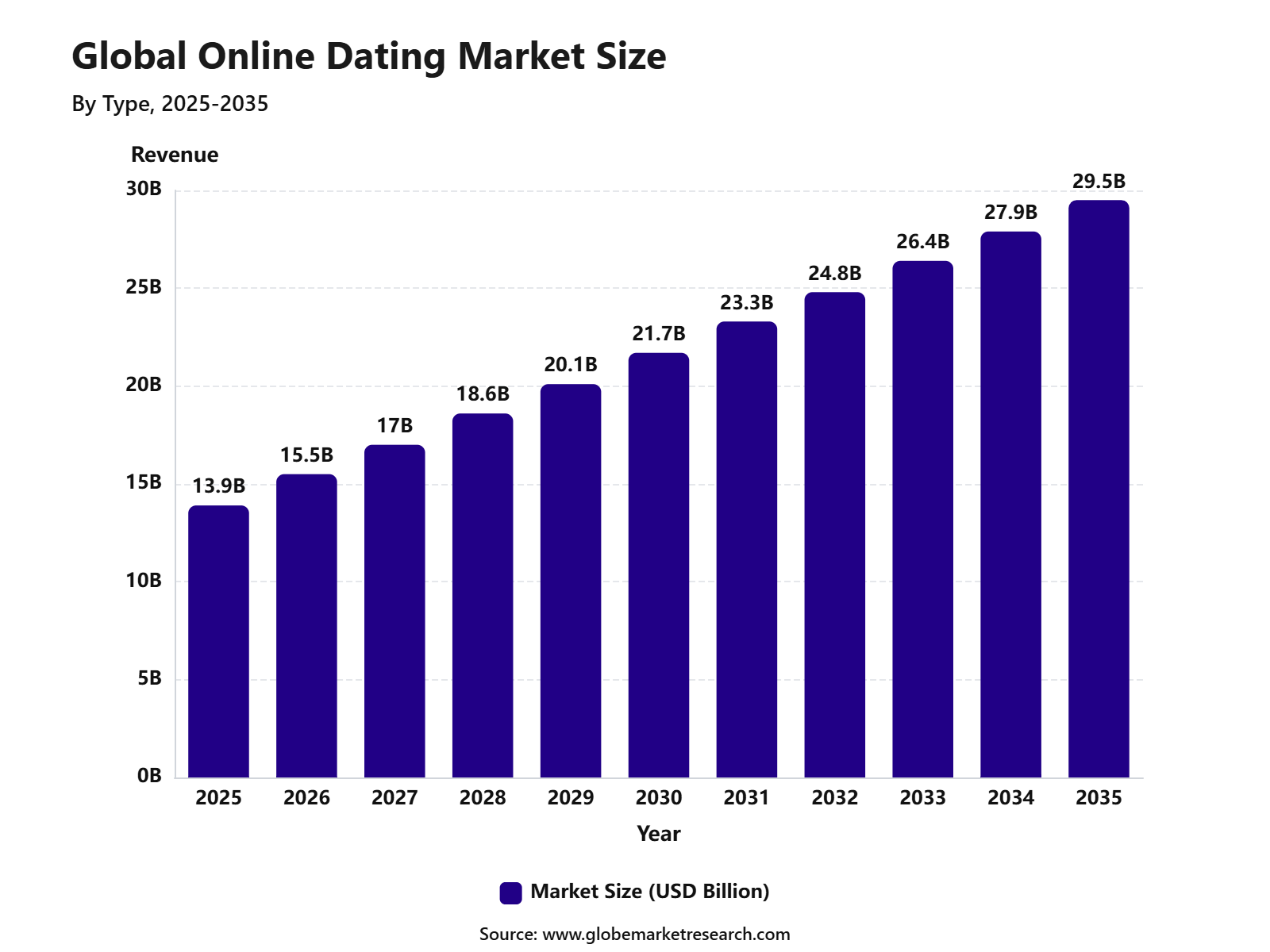
According to Globe Market Research, The Global Online Dating Market is expected to grow steadily from USD 13.9 billion in 2025 to USD 29.5 billion by 2035. The market shows consistent year-on-year growth, reaching USD 15.5 billion in 2026, USD 20.1 billion in 2029, and USD 24.8 billion in 2032. This upward trend reflects rising digital adoption, wider smartphone use, changing social behavior, and growing acceptance of online platforms for relationship building.
Growth is expected to remain strong through 2035 as dating apps continue to improve user experience through AI-based matching, safety features, video interactions, and personalized recommendations. The market is also supported by increasing demand among younger users, busy professionals, and people seeking flexible ways to meet compatible partners. By 2035, online dating platforms are likely to become more advanced, secure, and data-driven, helping the market reach nearly USD 30 billion.
Largest Share Statistics
Paying online dating dominated the type segment with 70.5% share. The segment was supported by demand for premium matching, advanced search filters, ad-free use, profile boosts, and improved privacy features.
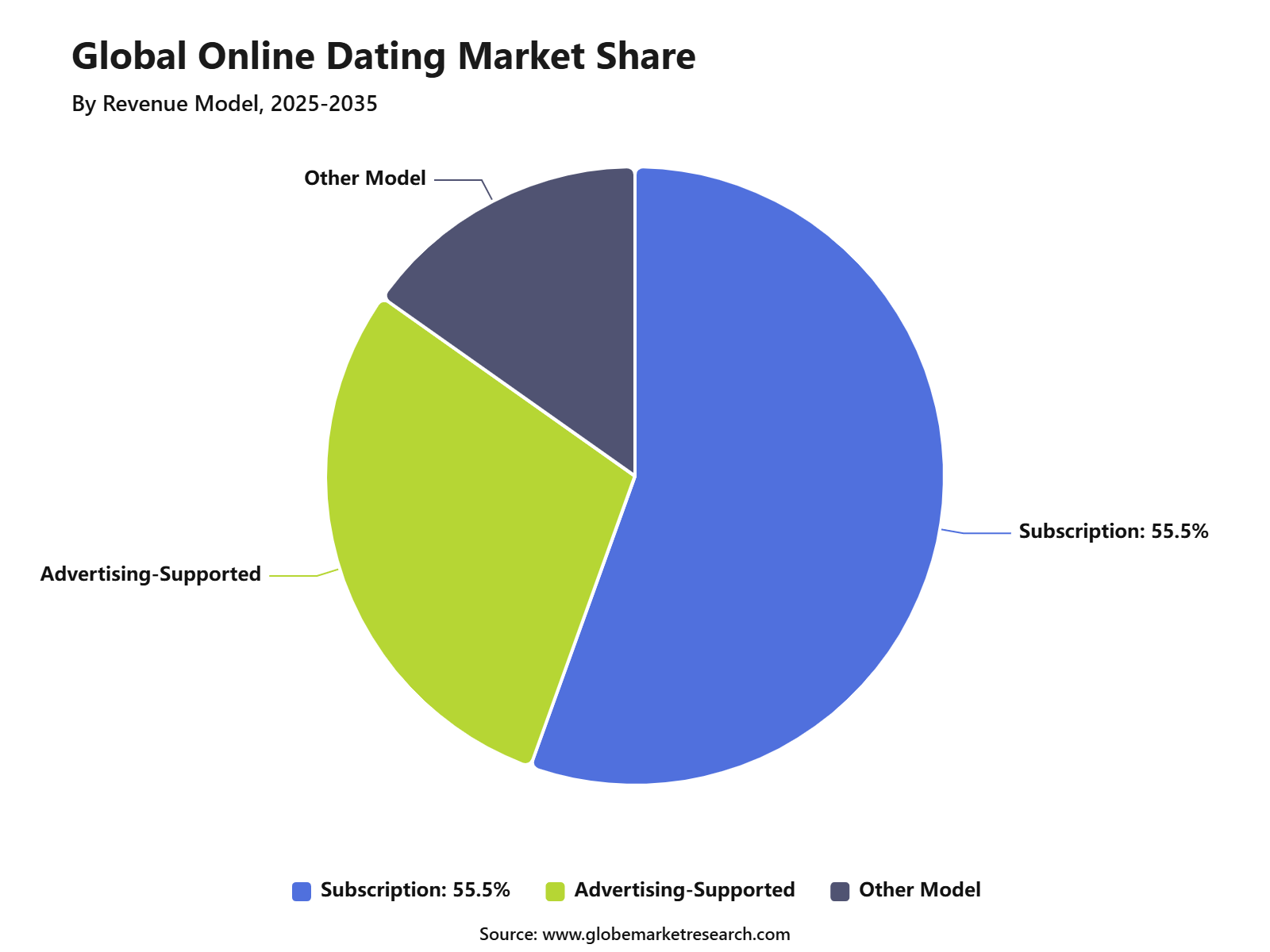
Subscription led the revenue model segment with 55.5% share. Growth was driven by recurring paid plans, flexible membership tiers, and users’ willingness to pay for better dating experiences.
Applications accounted for 86.3% share by platform. The segment benefited from mobile-first access, instant messaging, location-based matching, push alerts, and convenient user experience.
Millennials held 35.9% share by age group. Adoption was supported by high smartphone usage, comfort with online relationships, and strong preference for app-based dating.
Asia Pacific led the online dating market with 35.6% share. Growth was supported by higher smartphone penetration, wider internet access, urban youth participation, and rising acceptance of digital matchmaking.
Dating Fatigue and App Behavior
Dating app fatigue has become one of the clearest online dating trends in 2026. A Forbes Health survey found that 78% of dating app users felt emotionally, mentally, or physically exhausted by dating apps at least sometimes. The feeling was highest among millennials at 80%, followed by Gen Z at 79%, Gen X at 78%, and baby boomers at 70%.
The main causes of fatigue are not only app usage time, but also repeated disappointment. Users pointed to the inability to find a good connection, disappointment with people, rejection, repetitive conversations, swiping, and time spent on apps as major reasons for burnout. Ghosting was reported by 41% of respondents, while 38% said they had been catfished.
App behavior also differs by gender. Women are more likely to feel overwhelmed by the number of messages they receive, while men are more likely to feel insecure because of too few messages. Among current or recent online dating users, 54% of women said they felt overwhelmed by messages, compared with 25% of men. In contrast, 64% of men felt insecure because of a lack of messages, compared with 40% of women.
User Demographics & Adoption
Online dating adoption is strongly age-driven. About 53% of U.S. adults under 30 have used a dating site or app, compared with 37% of adults aged 30 to 49, 20% of adults aged 50 to 64, and 13% of adults aged 65 and older. This shows that dating apps are most deeply embedded in younger dating culture, but they are also used by older adults looking for companionship, remarriage, or later-life relationships.
Sexual orientation is another important adoption factor. LGB adults are more likely than straight adults to use online dating platforms, at 51% vs. 28%. Partner outcomes also differ, as about 24% of partnered LGB adults say they met their current partner through online dating.
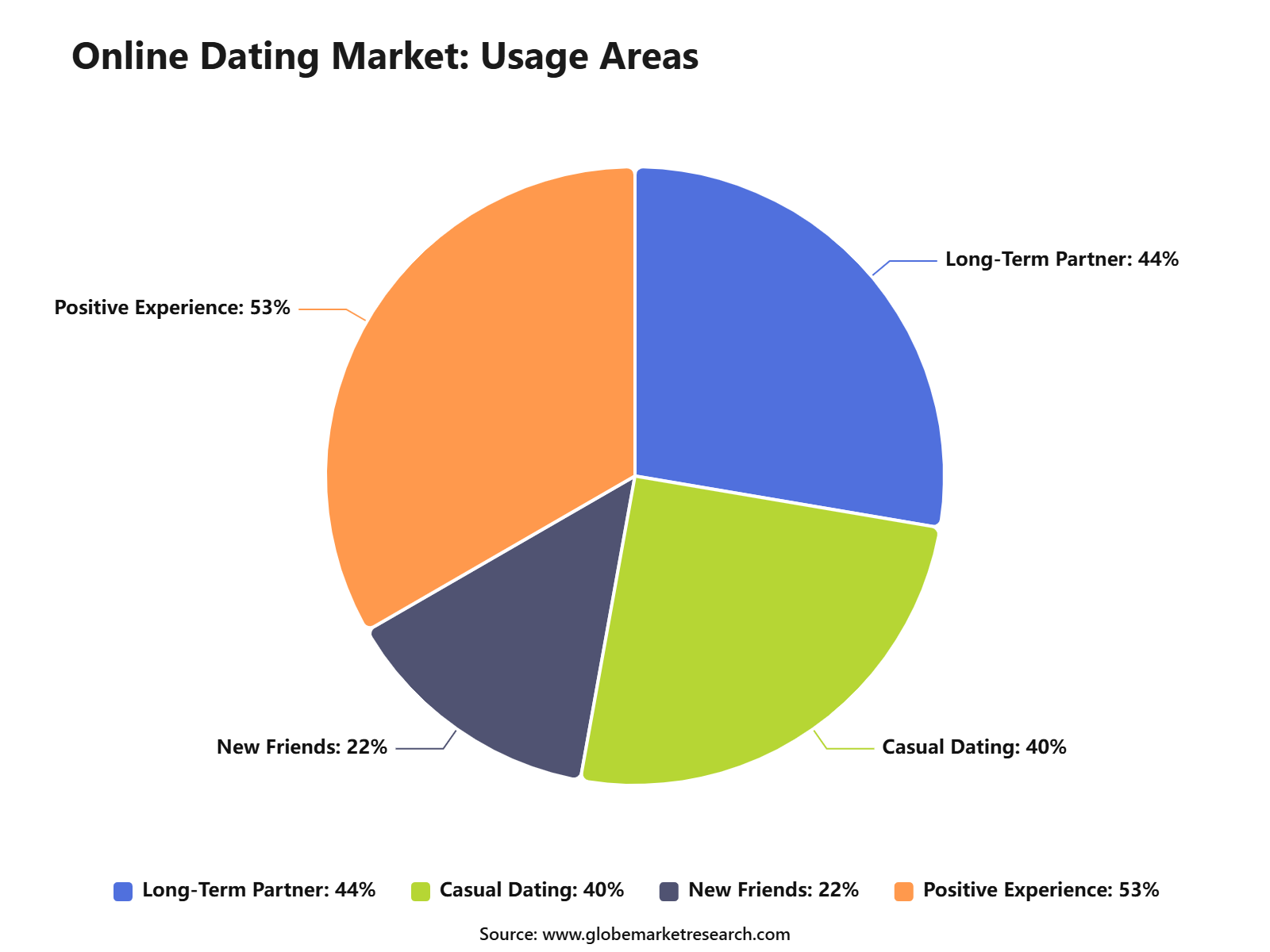
There are only modest overall differences between men and women in whether they use dating apps, but there are clear differences in experience. Men report more positive online dating experiences than women, at 57% vs. 48%, while women report more safety concerns, unwanted messages, and emotional strain from repeated interactions.
Success Rates & Intentions
Online dating is now a major route to relationships, but success depends on how it is measured. About 10% of partnered adults say they met their current spouse or partner through a dating site or app. Among partnered adults under 30, the figure rises to 20%, which shows that online dating has become more important for younger relationship formation.
User intentions are also shifting toward more serious outcomes. Among recent dating platform users, 44% said a major reason for using apps was to find a long-term partner, while 40% used them for casual dating. Smaller shares used dating apps mainly for casual sex or making new friends. Paid usage is common, but not universal. Around 35% of online dating users have paid for a dating site, app, or extra feature. Men are more likely than women to pay, at 41% vs. 29%, and users aged 30 and above are more likely to pay than users under 30.
Safety & Harassment
Safety remains a major concern in online dating. Among all online dating users, 38% have received unwanted sexually explicit messages or images, 30% have faced continued contact after saying they were not interested, 24% have been called an offensive name, and 6% have been physically threatened.
Women under 50 face the highest level of unwanted behavior. In this group, 56% have received unwanted sexually explicit content, 43% have experienced continued unwanted contact, 37% have been called an offensive name, and 11% have received threats of physical harm. These statistics show why trust, verification, reporting tools, and moderation are central to the future of dating platforms.
Scams are also a serious issue. About 52% of online dating users say they have come across someone they believed was trying to scam them. In 2025, nearly 60% of people who reported losing money to a romance scam said the scam started on social media, showing that romance fraud is no longer limited to dating apps alone.
Technological Trends
AI is becoming one of the strongest technology shifts in online dating. Dating platforms are using AI to improve profile prompts, recommend matches, summarize conversations, detect fake behavior, flag underage users, and support safer user verification. In 2026, Grindr began testing AI-powered features that summarize conversations and identify likely matches based on profile data, conversation history, and user behavior.
AI is also entering the user side of dating. Singles are using AI to write stronger bios, improve opening messages, screen compatibility, and reduce the effort involved in repetitive conversations. A 2025 singles study found that AI use in dating rose 333% in one year, while 44% of singles said they would like AI to help filter matches and 40% wanted help creating a better dating profile.
The risk side is also growing. The FBI reported that AI-related complaints caused nearly $893 million in losses in 2025 across cyber-enabled fraud categories, with scammers using fake social profiles, voice clones, false documents, and believable videos. For dating platforms, this increases the need for identity checks, fraud detection, and user education.
Industry Adoption & Usage
The dating app sector is moving from simple swiping to more intentional user experiences. Platforms are now investing in AI tools, identity checks, safety prompts, better recommendations, premium filters, and features designed to improve real-world outcomes. Match Group reported 13.5 million payers in Q1 2026, while Tinder showed improving engagement signals, including stronger conversation coverage and new user registration growth in March 2026.
Bumble reported 3.17 million total paying users in Q1 2026, including 2.08 million Bumble App paying users and 1.08 million Badoo App and other paying users. This shows that paid app usage remains meaningful, even as the sector faces slower user growth and stronger pressure to improve product value.
Grindr reported 15 million monthly active users worldwide, supported by strong use among LGBTQ+ communities and location-based interaction. Its 2026 AI feature testing shows how dating apps are moving toward more personalized, subscription-based, and safety-aware experiences.
AI Involvement Stats
AI dating area | Latest statistic | What it means |
|---|---|---|
AI use among singles | AI use in dating increased 333% in one year | Singles are using AI to reduce effort and improve dating outcomes |
Gen Z AI use | Nearly half of Gen Z singles have used AI in dating | Younger users are the fastest adopters of AI dating tools |
Match filtering | 44% of singles want AI help to filter matches | Users want better match quality and less app fatigue |
Profile creation | 40% of singles want AI help creating profiles | AI is becoming a profile optimization tool |
ChatGPT use among young singles | 74% of surveyed U.S. singles aged 18 to 39 said they use ChatGPT | AI familiarity is high among the core dating app age group |
AI for dating support | Roughly 64% said AI helps with profiles, conversations, or openers | AI is being used as a support layer, not just a novelty |
AI companion concern | 47% viewed AI negatively in romantic relationships | Many users accept AI tools but reject AI as a partner substitute |
AI companion rejection | 40% would refuse to date someone using an AI companion app | Human authenticity remains important in dating decisions |
Top Dating Apps Table
Rank | Dating app | Key user base or positioning | Notable statistic |
1 | Tinder | Broad mainstream dating, strongest among younger users | 46% of online dating users have used Tinder |
2 | Match | Older users and serious relationship seekers | 31% of online dating users have used Match |
3 | Bumble | Women-first dating and relationship-led matching | 28% of online dating users have used Bumble |
4 | OkCupid | Compatibility-led dating and detailed profiles | Around 20% of online dating users have used it |
5 | eharmony | Long-term relationship matching | Around 20% of online dating users have used it |
6 | Hinge | Relationship-focused app with prompt-based profiles | Around 20% of online dating users have used it |
7 | Plenty of Fish | Broad dating pool and free-access dating | 38% used it in a recent dating app user survey |
8 | Grindr | LGBTQ+ dating and social networking | 15 million monthly active users worldwide |
9 | HER | LGBTQ+ women and queer community dating | 3% of overall online dating users have used it |
10 | Coffee Meets Bagel | Curated matches and slower dating model | 9% used it in a recent dating app user survey |
Dating Statistics by Age and Gender
Group | Key statistic | Interpretation |
Adults under 30 | 53% have used a dating site or app | Young adults remain the strongest adoption group |
Adults 30 to 49 | 37% have used a dating site or app | Usage remains high among working-age adults |
Adults 50 to 64 | 20% have used a dating site or app | Adoption is lower but meaningful among older singles |
Adults 65+ | 13% have used a dating site or app | Older users are more cautious and more likely to prefer established platforms |
LGB adults | 51% have used a dating site or app | LGBTQ+ users show higher digital dating adoption |
Straight adults | 28% have used a dating site or app | Adoption is lower than among LGB adults |
Men users | 57% report positive online dating experiences | Men are more likely than women to describe the experience positively |
Women users | 48% report positive online dating experiences | Women report more mixed experiences due to safety and message overload |
Men users | 41% have paid for dating platforms or features | Men are more likely to spend on dating app features |
Women users | 29% have paid for dating platforms or features | Women are less likely to pay but report more message volume |
Women under 50 | 56% received unwanted sexually explicit content | Safety and moderation are especially important for women users |
Men under 50 | 63% believe they encountered a scammer | Scam awareness is high among male users under 50 |
Conclusion
Online dating statistics for 2026 show a mature but changing digital dating environment. Adoption remains highest among younger adults and LGBTQ+ users, while paid features, AI tools, and safety systems are becoming more important to platform strategy. Dating apps are still useful for meeting partners, but user fatigue, scam exposure, harassment, and trust concerns are pushing platforms to improve quality rather than only increase matches.
AI will shape the next phase of online dating, mainly through better profiles, smarter filters, conversation support, fraud detection, and identity checks. However, user trust will depend on transparency, privacy controls, and whether platforms can make digital dating feel safer, more human, and less exhausting.