
How big is AI in Interior Design Market?
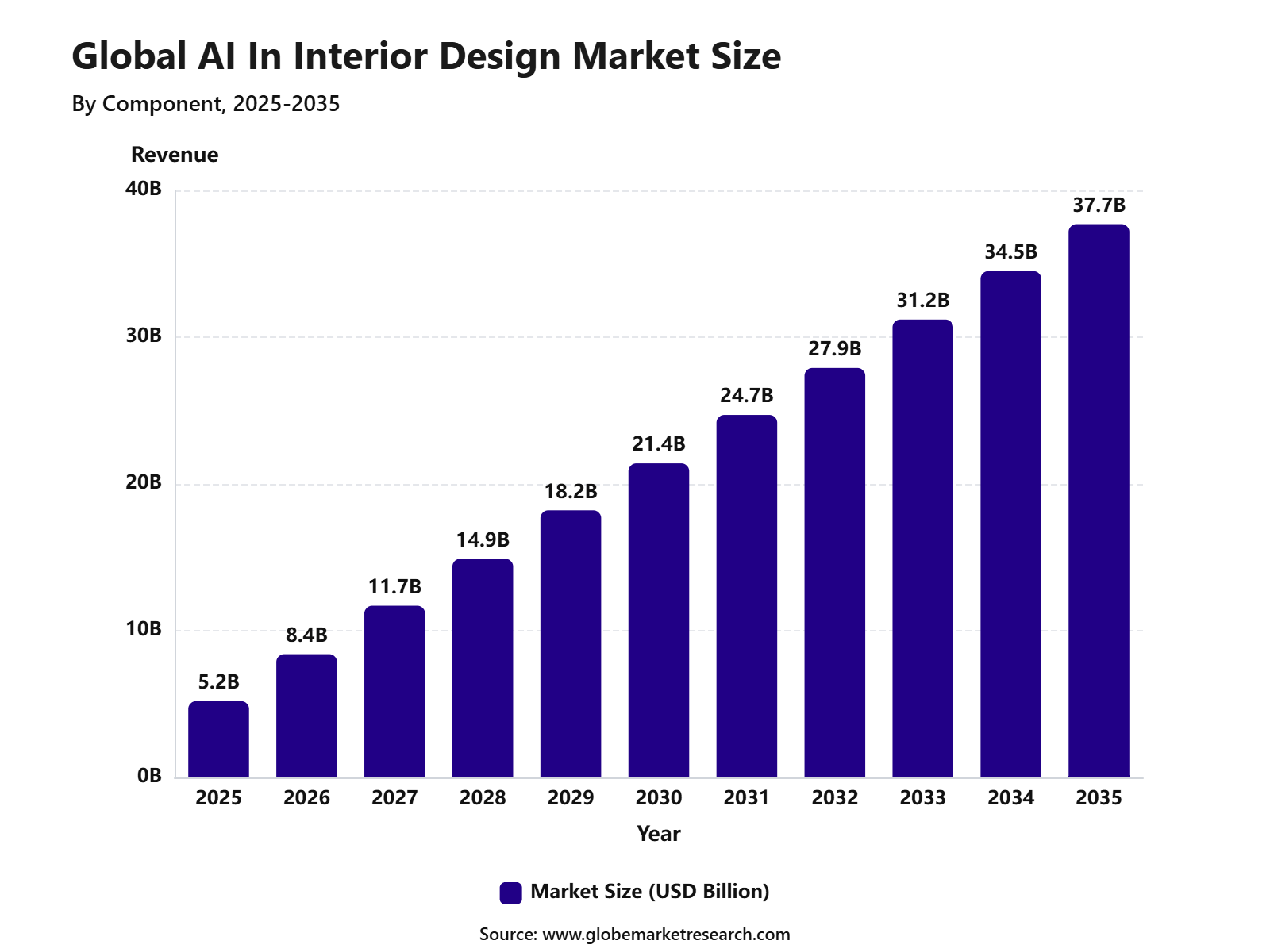
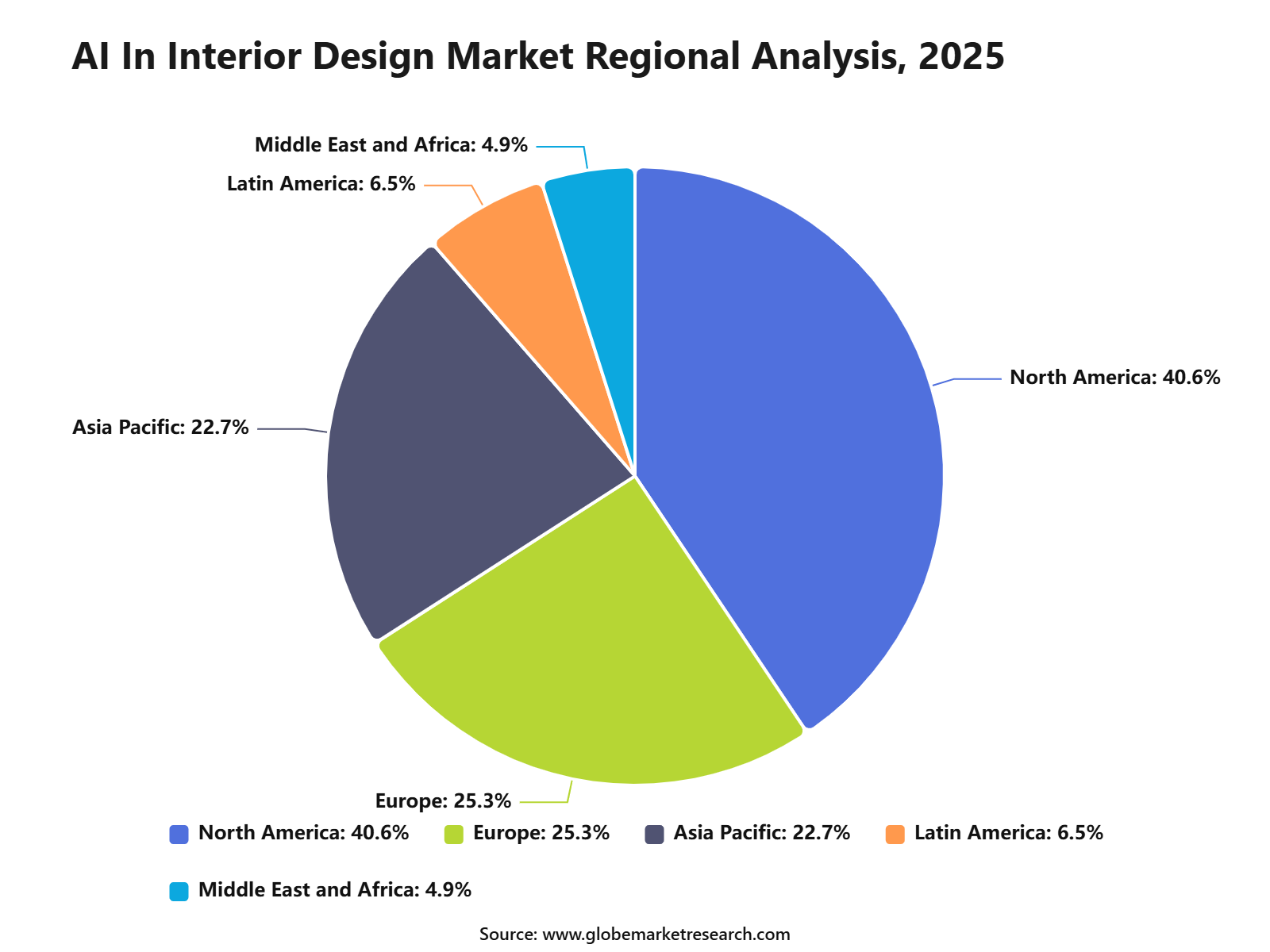
According to Globe Market Research, the global AI in Interior Design Market was valued at USD 5.2 billion in 2025 and is projected to reach approximately USD 37.7 billion by 2035, growing at a CAGR of 21.9% from 2025 to 2035. Applying the reported growth rate indicates an estimated market value of approximately USD 6.3 billion in 2026. North America led the market with a 40.6% share in 2025.
AI in interior design includes digital platforms that support room visualization, layout planning, furniture placement, colour selection, mood-board creation, material matching, virtual staging and client presentations. These tools are increasingly being used by interior designers, homeowners, architects, property developers and furniture retailers. The wider renovation economy provides a substantial commercial base for AI-assisted planning. U.S. homeowner improvement spending is expected to reach USD 518 billion by the end of 2026, while 50% of homeowners plan to undertake renovation projects during the year.
Get PDF Sample Copy for more Professional and Technical insights at: https://www.globemarketresearch.com/request-sample?reportId=1247
AI in Interior Design Market Adoption Rate
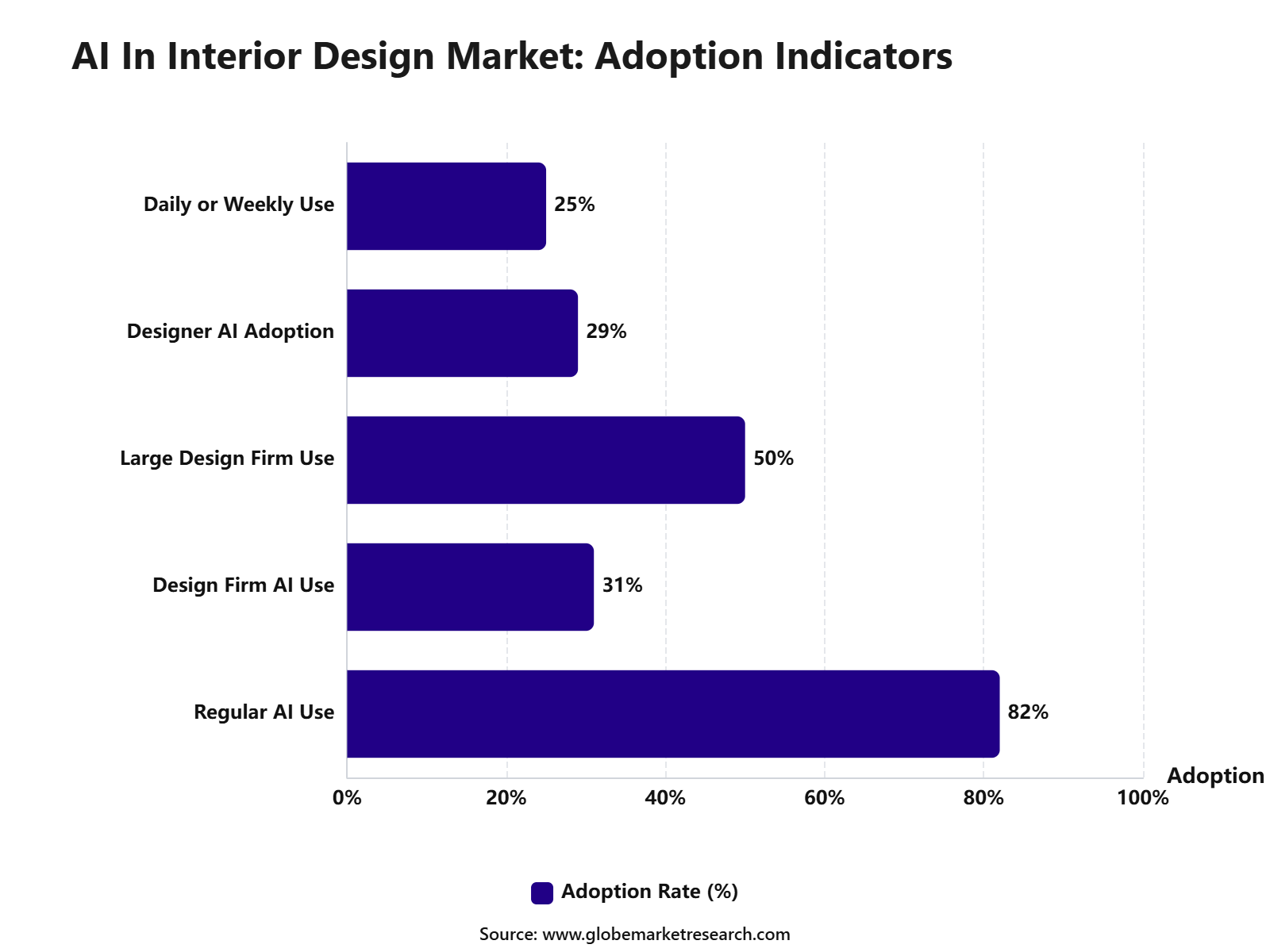
According to Mattoboard and Houzz, 82% of surveyed global interior design professionals used AI regularly, and 85% used ChatGPT to support design work. Houzz found that 31% of U.S. design businesses used AI for everyday business tasks, rising to 50% among firms with at least ten employees. The surveys used different samples and definitions, so the figures should not be interpreted as a single global penetration rate.
Metric | Adoption Rate |
|---|---|
Regular AI Use | 82% |
ChatGPT Use | 85% |
Design-Firm AI Use | 31% |
Large-Firm AI Use | 50% |
Daily or Weekly Use | 25% |
AI in Interior Design Market Usage Statistics
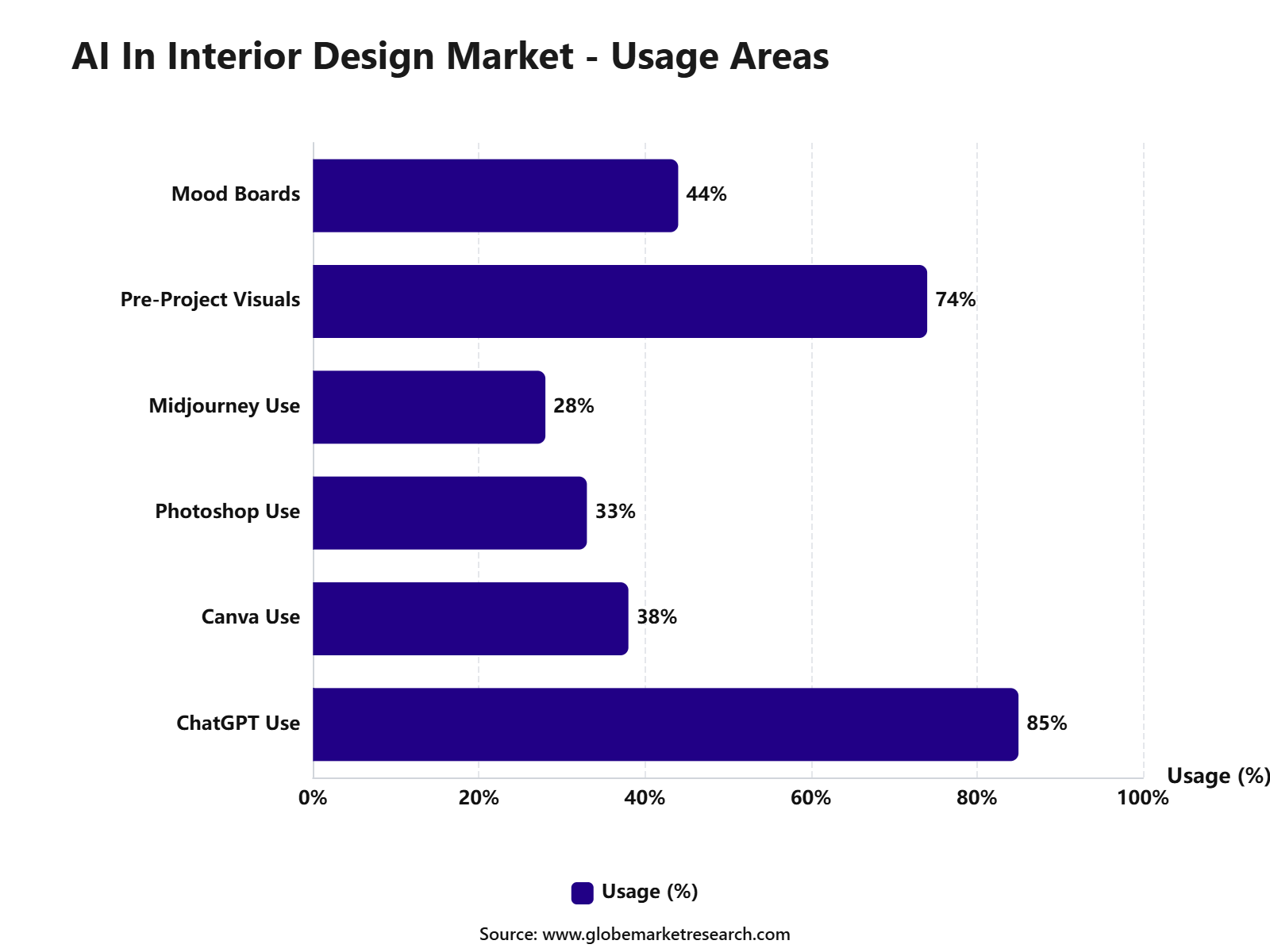
According to Houzz, pre-project visualization was the leading AI application among designers using AI for planning and design, reaching 74%. AI was also used for mood boards by 44%, floor plans by 41%, product or material recommendations by 33%, and photo analysis or tagging by 22%. These applications are reducing early-stage design time and supporting faster client presentations, layout development, and product selection.
Metric | Workflow Usage |
|---|---|
Pre-Project Visuals | 74% |
Mood Boards | 44% |
Floor Plans | 41% |
Material Recommendations | 33% |
Photo Analysis | 22% |
Key Market Drivers
Increasing AI adoption by design firms: Around 31% of U.S. design firms reported using AI, with adoption reaching 50% among firms employing more than ten people. Larger firms are adopting AI more quickly because they manage higher project volumes and have greater technology resources.
Demand for faster visualization: AI can convert photographs, sketches or written prompts into room concepts and visual alternatives. This allows clients to review layouts, furniture arrangements and finishes before physical work begins.
Strong renovation activity: Half of U.S. homeowners plan to undertake projects during 2026, while 41% expect to complete decorating activity. The median planned renovation expenditure was USD 15,000.
Growth of online furniture retail: AI-powered visualization allows customers to assess how furniture, lighting and decorative products may look inside their own rooms, reducing purchasing uncertainty and supporting online conversion.
Need for workflow productivity: Among design firms using AI, 70% applied it to administrative tasks and 59% used it for sales and marketing. This shows that adoption is extending beyond image generation into daily business operations.
Market Segmentation
Component Insights: Solutions led the market with a 62.1% share. AI room planners, generative visualization platforms, mood-board tools and furniture-recommendation systems are being adopted by professional and consumer users.
Deployment Insights: Cloud deployment accounted for 70.5% of the market. Cloud platforms support remote access, automatic updates, shared projects and collaboration between designers, clients and suppliers.
User Type Insights: Interior designers held a 42.3% share. AI is used to accelerate concept creation, compare alternatives, prepare client presentations and reduce repetitive design work.
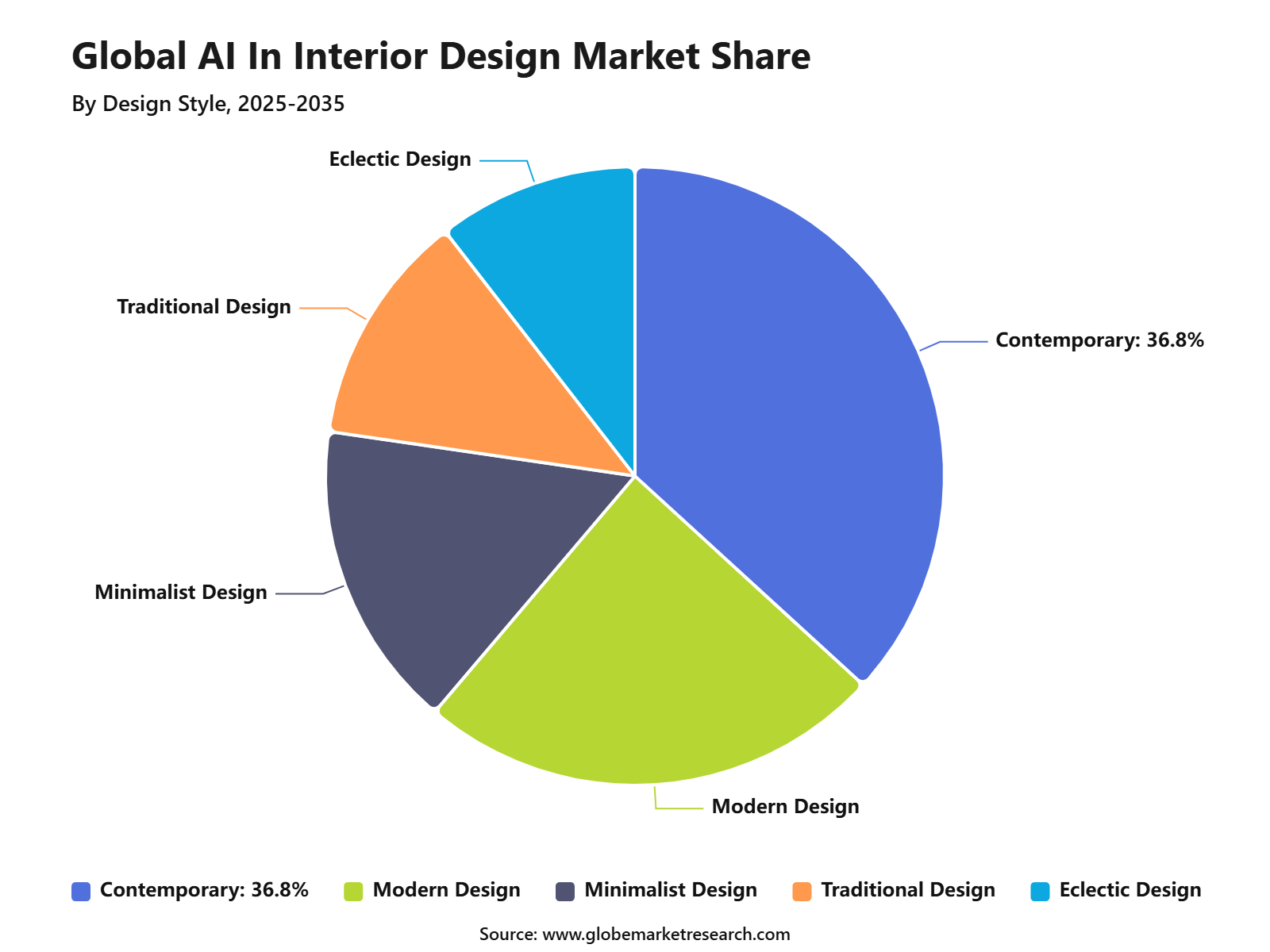
Design Style Insights: Contemporary design represented 36.8% of demand. Clean layouts, adaptable furniture arrangements and broad residential and commercial use make contemporary interiors suitable for AI-supported visualization.
Technology Integration Insights: 3D visualization tools captured a 37.2% share. These platforms provide clearer representations of dimensions, materials, lighting and furniture placement than conventional two-dimensional sketches.
Application Insights: Residential design accounted for 41.1% of the market, supported by home renovation, virtual styling, furniture planning and increasing consumer access to online design services.
Pricing Strategy Insights: Subscription-based pricing held a 42.3% share. This model reduces upfront costs and provides continuous access to cloud storage, rendering capacity, templates and new AI features.
Technology and Adoption Trends
Generative room visualization: Users can upload an existing room image and produce alternative concepts based on selected colours, styles and room functions.
AI-powered 3D floor plans: Design platforms are using artificial intelligence to convert two-dimensional drawings into editable three-dimensional environments, reducing manual modelling work.
Material-aware visualization: AI systems are progressing from general image generation toward the use of real finishes, furniture catalogues and supplier-linked material data.
Collaborative cloud workflows: Shared mood boards, project folders and virtual material libraries allow teams and clients to review design options within one connected environment. MattoBoard introduced a collaborative PRO Teams workspace in April 2026.
Human and AI co-design: Research published in February 2026 found that AI-supported client data can improve design communication, but professional interpretation remains important for trust and practical decision-making.
Regional Breakdown and Supply Chain
North America: The region led with a 40.6% share in 2025, supported by strong home improvement spending, established design-software usage and growing adoption of virtual design services.
Europe: Demand is being supported by architecture firms, furniture brands, renovation activity and interest in sustainable material selection. Data protection and AI governance requirements influence platform development.
Asia Pacific: Urbanization, apartment development, furniture e-commerce and technology-led renovation platforms are supporting adoption across China, India, Japan, South Korea and Southeast Asia.
Latin America, Middle East and Africa: Market development is being driven by real estate construction, hospitality projects and growing access to cloud-based design tools. Affordability and localized product catalogues remain important.
Supply chain structure: The market connects AI model providers, cloud infrastructure companies, design software developers, furniture retailers, material suppliers, real estate platforms, architects and interior design studios.
Key Opportunities
AI-powered residential room planners: Consumer-friendly platforms can help homeowners test layouts and styles before purchasing furniture or hiring professionals.
Virtual staging for real estate: Property sellers and developers can digitally furnish empty rooms and produce multiple design styles without physically staging each property.
Furniture visualization and commerce: Retailers can connect AI design tools with product catalogues, enabling users to visualize and purchase suitable items directly from generated rooms.
Professional workflow software: Design firms require integrated tools for client communication, specifications, proposals, procurement and project documentation.
Material and supplier discovery: Platforms that connect visual concepts with real materials, prices, stock availability and technical specifications can provide greater commercial value than image-only tools.
Challenges and Restraints
Inaccurate room outputs: AI-generated designs may contain incorrect dimensions, unsuitable furniture sizes, unrealistic lighting or materials that cannot be sourced.
Dependence on professional judgment: Interior design involves ergonomics, building systems, safety, installation and client lifestyle requirements that cannot be evaluated through visual generation alone.
Data privacy concerns: Users may upload photographs and floor plans of private homes or commercial properties, requiring secure storage and transparent data-use policies.
Integration with established software: AI platforms must work effectively with CAD, building information modelling, rendering and project-management systems to support professional adoption.
Subscription and computing costs: High-quality rendering, large design libraries and frequent AI generation can increase operating expenses for software providers and users.
Prominent Global Market Leaders
The AI in Interior Design Market has medium concentration. Established CAD, architecture, and design-software providers benefit from recognised brands, large customer bases, extensive product ecosystems, and integration with professional workflows. Smaller AI-native companies can compete in room generation, virtual staging, material sourcing, furniture recommendations, consumer applications, and specialized visualization.
Lower cloud infrastructure barriers allow new platforms to enter individual use cases without building a complete professional software ecosystem. Long-term market positions will be determined by output reliability, professional control, technical integration, real-product data, customer trust, and the ability to support projects from initial concept through sourcing and execution.
Competition covers AI visualization, CAD, floor planning, generative design, virtual staging, 3D rendering, furniture selection, material sourcing, and project collaboration.
Key companies include:
Autodesk Inc.
Coohom, Inc.
Foyr
Infurnia Technologies Pvt. Ltd.
Interior AI
Planner 5D
REimagine Home
RoomGPT
RoomSketcher
Vectorworks, Inc.
Other Key Players
Top Use Cases
Room visualization: Existing room photographs can be transformed into several alternative styles before renovation begins.
Automated space planning: AI can recommend furniture arrangements based on room size, circulation and functional requirements.
Mood-board and concept creation: Designers can generate colour palettes, design themes and presentation materials during early client discussions.
Virtual real estate staging: Empty or unfinished properties can be digitally furnished for property listings and marketing campaigns.
Furniture and material recommendations: AI can match products, finishes and decorative items with the dimensions, budget and preferred style of a project.
Latest Case Study
Houzz Pro Integrates AI With Residential Project Visualization
Business Challenge
Interior designers and renovation professionals frequently manage floor plans, material selections, client comments and installation instructions across separate systems. This can create communication gaps between designers, homeowners and subcontractors.
AI-Based Solution
In May 2026, Houzz Pro introduced elevations, plan annotations and AI-powered custom finishes within its 3D Floor Plan platform. The custom-finish tool converts clipped finish images into three-dimensional materials that can be applied to walls, floors, countertops and other surfaces.
The platform also added mood-board comments, centralized feedback and detailed annotations. These capabilities allow project participants to review materials, dimensions and installation requirements within a shared visual environment.
Operational Impact
The system gives designers the ability to use specified finishes instead of generic placeholders. Clients can review a more accurate representation of the proposed interior, while subcontractors receive clearer visual and technical guidance.
Houzz reported that its wider platform is used by more than three million construction and design professionals and over 70 million homeowners and home-design users globally.
Strategic Learning
The case shows that the commercial value of AI is increased when visualization is connected with project communication and execution. Platforms that combine realistic materials, client approvals and contractor instructions can become central operating systems for interior design projects.
Recent Developments
July 2026: MattoBoard released a major update to Design Stream, strengthening its AI concept-development and connected interior design workflow capabilities.
June 2026: Houzz Pro introduced AI-powered mobile tools for project documentation and communication as part of its continuing expansion of design and construction software.
May 2026: Houzz Pro launched AI-powered custom finishes, elevations and annotations within its 3D Floor Plan system.
May 2026: Drafted raised USD 16 million in seed financing for an AI platform that creates editable floor plans and 3D home layouts. The company reported 250,000 visitors and more than 300,000 generated floor plans within five months of launch.
April 2026: MattoBoard introduced PRO Teams, enabling interior design studios to collaborate through shared boards, virtual material libraries and connected project folders.
Conclusion
The AI in Interior Design Market is expanding as professional designers, homeowners and property companies adopt faster ways to visualize and plan interior spaces. Cloud platforms, three-dimensional visualization and subscription pricing currently represent important areas of market demand.
Future growth will depend on the ability of AI platforms to produce practical, accurate and commercially usable designs. Companies that connect visualization with real products, project collaboration and professional design controls will be better positioned to capture opportunities through 2035.
FAQs on the AI in Interior Design Market
1. What is the AI in Interior Design Market?
The AI in Interior Design Market includes artificial intelligence solutions that assist designers, architects and homeowners in space planning, furniture selection, room visualization, material recommendations, cost estimation and project management. These platforms use generative AI, computer vision and machine learning to create personalized layouts, realistic 3D renderings and automated design suggestions.
2. What is driving the growth of the AI in Interior Design Market?
Growth is driven by increasing demand for personalized home design, cloud-based visualization tools, generative AI adoption and digital transformation across architecture and interior design firms. A 2025 survey by 1stDibs found that 29% of interior designers were using AI, nearly three times the adoption level reported a year earlier.
3. Which applications are included in the AI in Interior Design Market?
Major applications include room layout generation, furniture placement, virtual staging, material selection, lighting optimization, 3D visualization, design recommendations, cost estimation and project collaboration. AI helps designers create multiple design concepts quickly while reducing manual drafting and improving client visualization before project execution.
4. How is generative AI transforming interior design?
Generative AI enables users to convert text prompts or uploaded room images into realistic interior concepts within minutes. Designers use AI to generate mood boards, explore multiple design styles and accelerate concept development while maintaining human oversight for technical accuracy and project execution. Research also shows AI-assisted workflows can improve designer productivity while supporting collaborative design decisions.
5. What are the major challenges in the AI in Interior Design Market?
Major challenges include unrealistic room layouts, incorrect dimensions, limited understanding of building codes, copyright concerns, design originality and dependence on high-quality training data. Professional designers also note that AI-generated concepts still require human expertise to ensure functionality, structural feasibility and compliance with construction standards.
6. What is the future outlook for the AI in Interior Design Market?
The market is expected to expand through AI-powered visualization, augmented reality, digital twins, personalized design recommendations and sustainable material selection. Future growth will be supported by stronger integration with BIM software, smart-home technologies and e-commerce platforms, allowing designers and consumers to move more efficiently from concept to purchase.