How big is Online Dating Market?
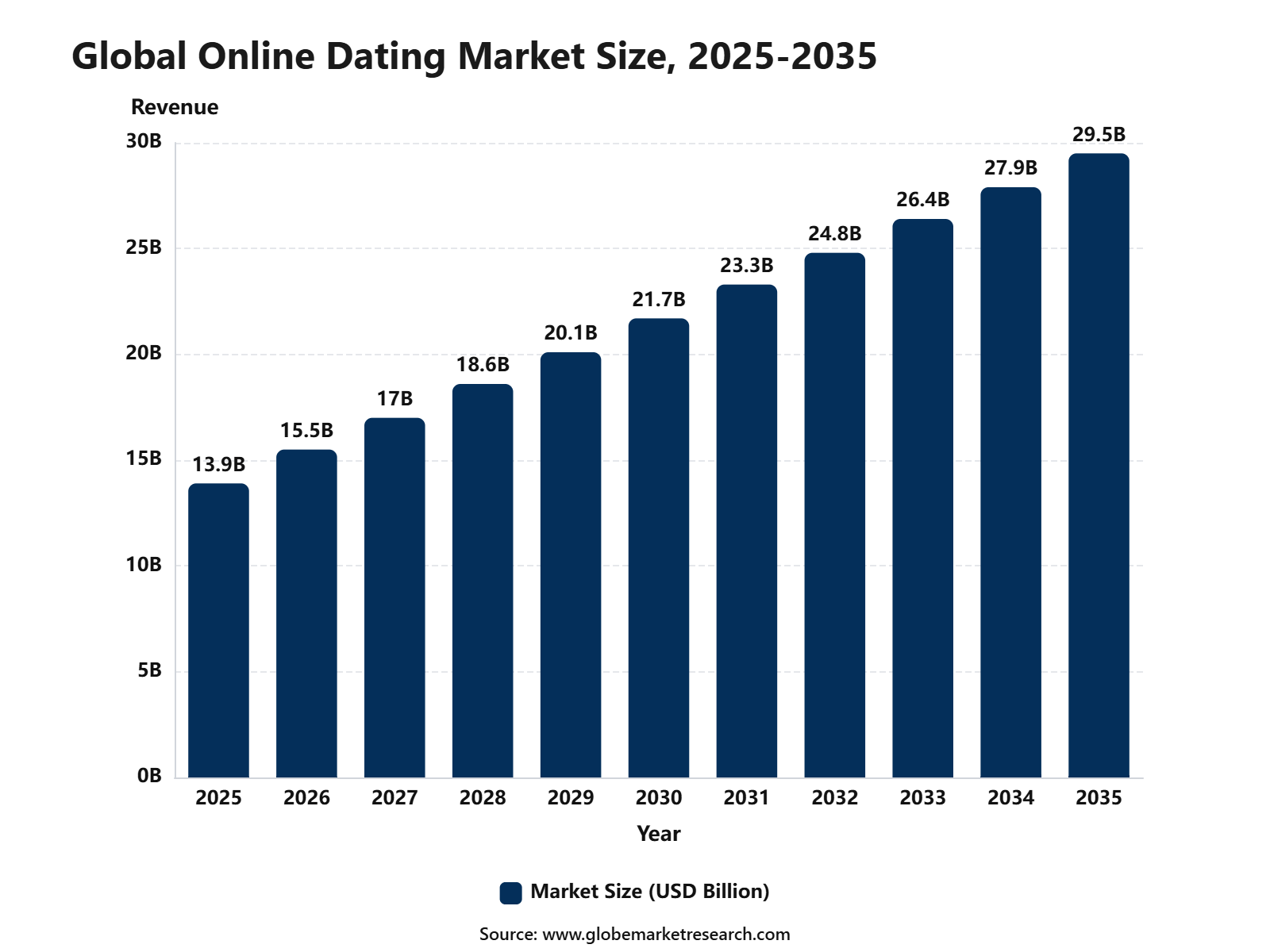
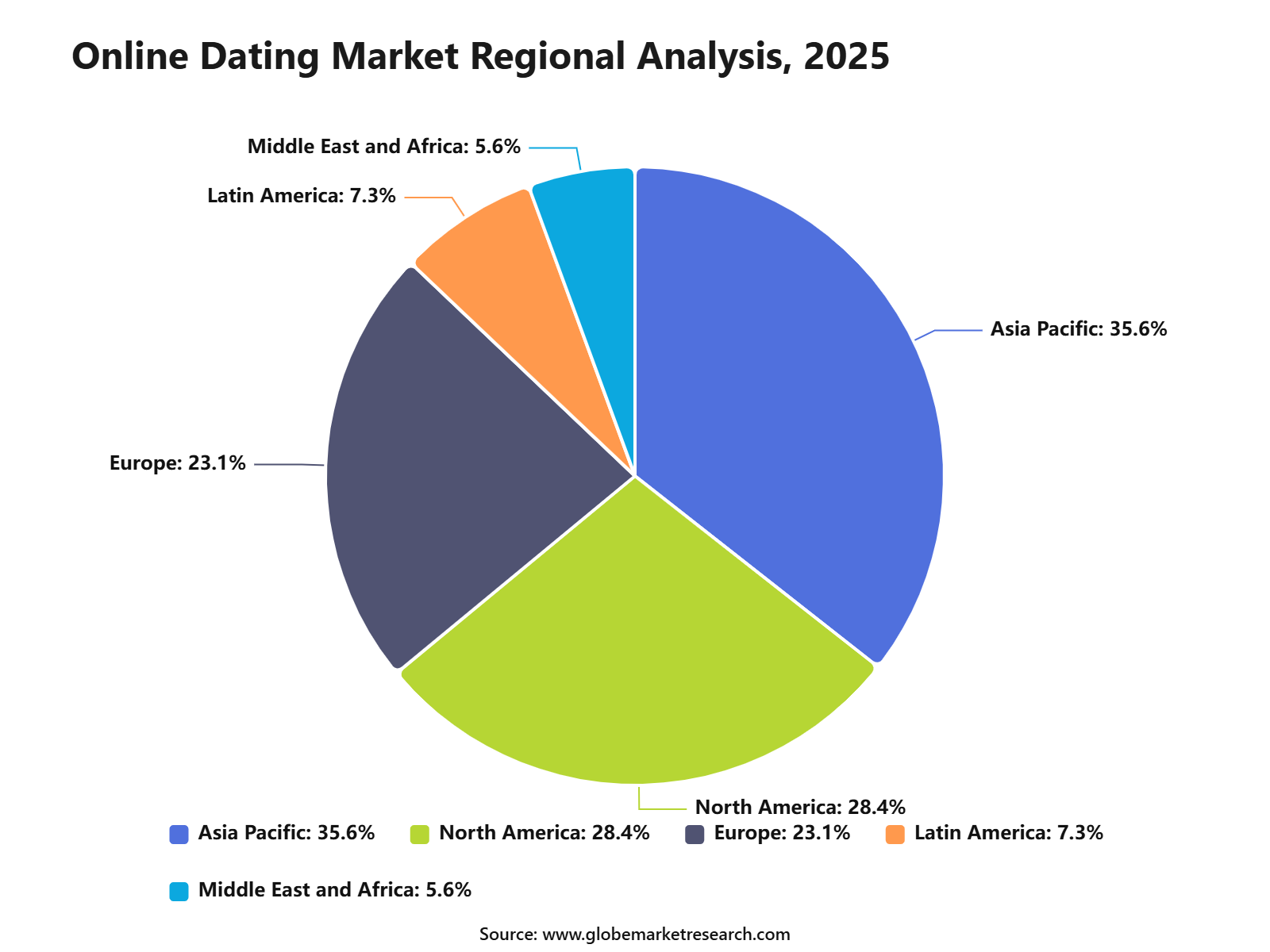
According to Globe Market Research, the Global Online Dating Market was worth USD 13.9 billion in 2025 and is expected to reach USD 29.5 billion by 2035, growing at a CAGR of 7.7% from 2025 to 2035. Asia Pacific led the regional market with a 35.6% share in 2025. Online dating includes mobile applications and web platforms that help users discover, communicate with, and meet potential romantic partners.
The platforms commonly provide location-based discovery, profile matching, messaging, video interaction, identity verification, paid subscriptions, and algorithm-based recommendations. The market is shifting from high-volume swiping toward more intentional matchmaking. Platforms are investing in AI-supported recommendations, profile verification, interest-based matching, offline events, video dating, and safety controls to improve trust, conversation quality, and real-world dating outcomes.
Interesting? Apply for a PDF sample report: https://www.globemarketresearch.com/request-sample?reportId=1250
Why the Online Dating Market Is Growing
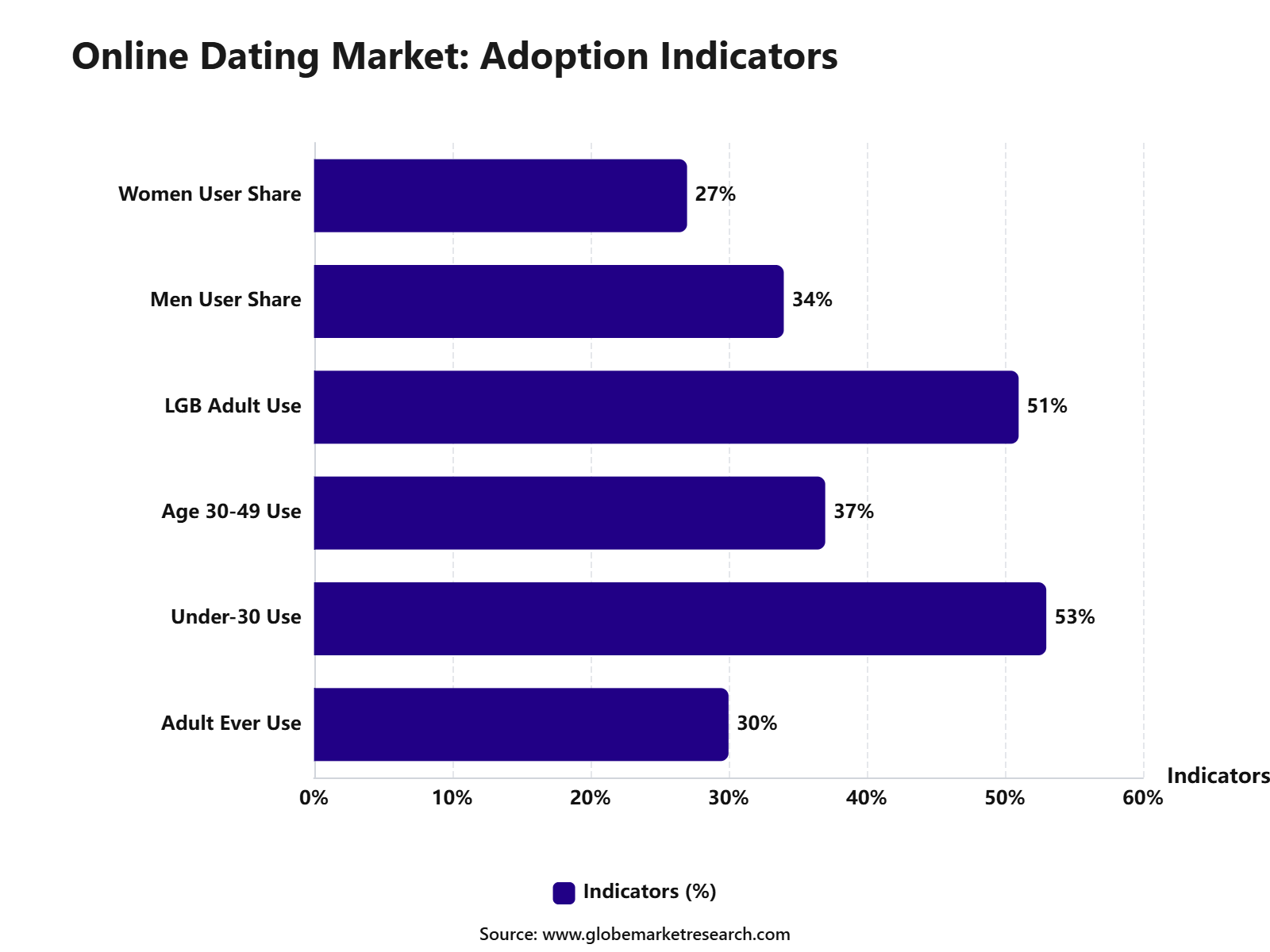
Online dating has become an established method of meeting potential partners, especially among younger adults. A nationally representative 2025 SSRS survey found that 39% of US adults had used a dating site or application, while 7% were current users. Usage reached 65% among adults aged 18 to 29, with 16% of this group actively using online dating services. Mobile application demand also remains strong. Dating applications ranked among the most frequently downloaded lifestyle platforms in 2025. The top 500 dating apps recorded a 4.1% increase in combined downloads, while Tinder generated 63.7 million downloads and represented 9.1% of category downloads.
Convenience continues to support adoption. Users can access a larger pool of potential partners, filter by interests and relationship intentions, communicate before meeting, and use safety tools from their smartphones. These functions are particularly valuable for people with limited time, smaller offline social networks, or specific relationship preferences. Acceptance of digital relationships is also expanding across age groups. Although young adults remain the largest adoption group, platforms for older users, religious communities, professional groups, LGBTQ+ users, and culturally specific audiences are creating additional customer segments.
Type Insights
Paying online dating led the type segment with a 70.5% share in 2025. Paid services generally offer advanced search filters, unlimited interactions, higher profile visibility, privacy controls, read receipts, priority recommendations, and reduced advertising. Paid users are often more commercially valuable because they demonstrate stronger intent and generate recurring revenue.
Premium access can also reduce inactive accounts and low-quality engagement when paid features are connected with verification, better discovery, and improved communication. However, platforms must demonstrate clear value before users subscribe. Excessive restrictions on free accounts, weak match quality, and unclear pricing can increase cancellations. Successful paid services will need to show that subscriptions improve discovery, safety, convenience, or relationship outcomes.
Revenue Model Insights
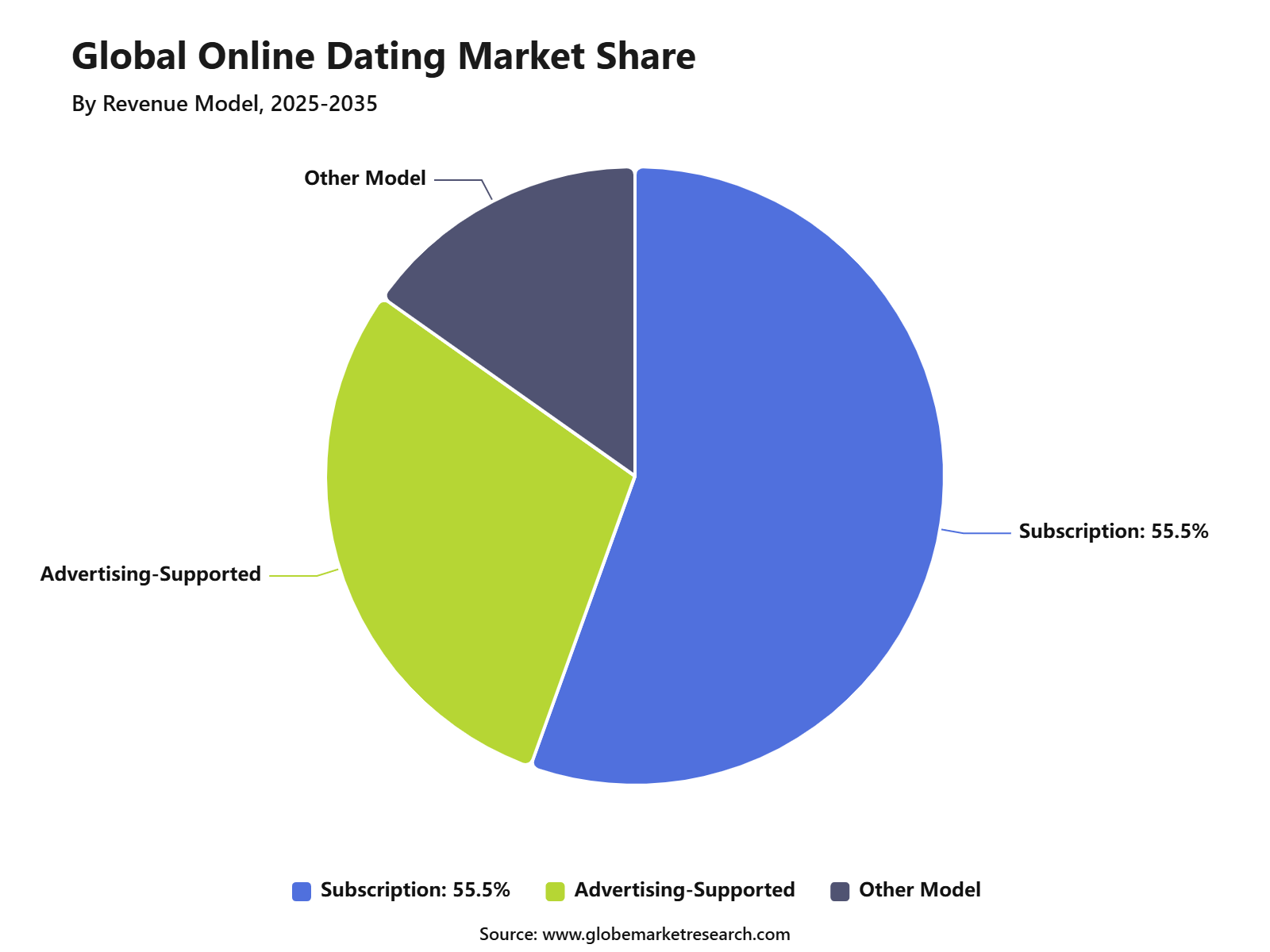
Subscription services accounted for 55.5% of market revenue. Monthly, quarterly, and annual plans give users continued access to premium functions while providing platforms with predictable recurring income. Subscription revenue supports product development, moderation, infrastructure, customer support, security, and marketing. It can also be combined with individual purchases such as profile boosts, priority likes, virtual gifts, read receipts, and temporary visibility enhancements.
Match Group reported USD 864 million in revenue during the first quarter of 2026. Revenue per payer increased 10% year over year to USD 20.90, although total payers declined 5% to 13.5 million. This indicates that higher revenue per paying customer is becoming increasingly important as platforms face slower user growth. Bumble reported a similar monetization pattern. Its average revenue per paying user increased 8.9% to USD 22.04 in the first quarter of 2026, while paying users declined 21.1% to approximately 3.2 million.
Platform Insights
Applications dominated the platform segment with an 86.3% share. Smartphone applications support continuous access, real-time notifications, location-based discovery, direct messaging, video functions, and in-app payments. Mobile applications also provide stronger engagement opportunities than traditional web portals.
Users can receive immediate match alerts, respond to messages, update profiles, access safety features, and purchase upgrades without returning to a desktop website. Application stores provide global distribution, but they also create financial and operational challenges. Dating companies must manage app-store fees, privacy rules, age restrictions, content moderation standards, user-acquisition costs, and competition from hundreds of alternative platforms.
Age Group Insights
Millennials led the age-group segment with a 35.9% share. The group is familiar with mobile communication, digital payments, social networking, and subscription services, supporting continued use of paid dating applications. Younger adults nevertheless represent the strongest adoption pool. The 2025 SSRS survey found that 65% of adults aged 18 to 29 had used online dating, compared with 49% of adults aged 30 to 49.
Adults under 30 also represented 40% of current US dating-platform users. Older users present a smaller but commercially important segment. Users aged 50 and above may prefer detailed profiles, relationship-focused services, stronger customer assistance, privacy protection, and fewer swipe-based interactions.
Regional Insights
Asia Pacific led the Online Dating Market with a 35.6% share. The region is supported by a large young population, expanding smartphone ownership, digital payment adoption, urbanization, and growing acceptance of app-based relationships.
Growth opportunities differ considerably across the region. Platforms operating in India, Japan, South Korea, Southeast Asia, and Australia must adapt to local languages, relationship expectations, cultural norms, payment methods, identity requirements, and safety concerns.
North America remains a major revenue market because of strong subscription adoption, high smartphone usage, established dating brands, and greater willingness to pay for premium digital services. Europe is being shaped by privacy regulation, age-assurance requirements, competition, and stronger scrutiny of online platform safety.
UK data demonstrate the scale and competitiveness of mature markets. In May 2025, Tinder and Hinge each reached approximately 1.5 million UK adults, while Bumble reached around 1.1 million and Grindr reached approximately 900,000. Tinder’s audience reach declined from 5.2% of online adults in 2023 to 3.1% in 2025, indicating growing competition and user fatigue.
Adoption and User Behaviour Insights
Online dating usage is concentrated among adults under 50. Among current US users in 2025, 40% were aged 18 to 29 and 44% were aged 30 to 49. Men represented a higher proportion of current users than women.
Matching preferences extend beyond physical appearance. Sharing similar family values was considered very important by 57% of people who had used online dating. Similar political beliefs were important to 33%, religious or spiritual beliefs to 31%, and shared hobbies and interests to 30%.
Multi-platform usage is common. Ofcom found that 57% of Bumble users and 56% of Hinge users also visited Tinder. Around 53% of Bumble visitors also used Hinge, showing that users frequently compare experiences across several services.
This behaviour increases customer-acquisition pressure. Platforms must continuously demonstrate better match quality, a healthier user community, improved safety, or more specialized relationship outcomes to become a user’s preferred service.
Top Dating Applications
Tinder remained the most downloaded dating application globally in 2025 with 63.7 million downloads. Bumble followed with 29.2 million, Hinge with 21.3 million, Badoo with 19.5 million, and Boo with 17.7 million.
Hinge recorded particularly strong download growth, supported by its positioning around intentional relationships and detailed profiles. Tinder retained the largest scale but is adjusting its product strategy to address declining engagement, swipe fatigue, and demand for more personalized discovery.
The top ten dating applications generated only 31.6% of category download share among the top 500 applications. This shows that the market contains strong global leaders but remains open to regional, niche, faith-based, LGBTQ+, senior, professional, and relationship-focused platforms.
AI and Matchmaking Insights
AI is being used to understand user interests, profile information, communication behaviour, relationship intentions, and previous matching decisions. This information can support more relevant recommendations and reduce the time users spend reviewing unsuitable profiles.
In March 2026, Tinder expanded elements of Chemistry, its AI-powered personalization system, from Australia and New Zealand into the United States and Canada. Chemistry is intended to improve recommendations by developing a deeper understanding of user interests and preferences.
AI is also being integrated into profile writing, photo selection, conversation assistance, fraud detection, content moderation, and date planning. These tools may improve user experience, but platforms must prevent automated conversations from becoming deceptive or replacing genuine human interaction.
Grindr is developing AI-supported premium monetization through EDGE, which applies its gAI system across discovery, messaging, and reconnection. The company described EDGE as a higher-value subscription designed to reduce the effort required to find relevant connections.
Safety and Verification Insights
Trust and safety have become central purchasing and retention factors. Users are increasingly concerned about fake profiles, impersonation, harassment, financial fraud, underage access, image misuse, and AI-generated identities.
Verification systems can create measurable improvements. Match Group reported that Hinge’s Face Check system reduced interactions with bad actors by approximately 20% to 30% across major markets without significantly affecting revenue.
Age verification is also becoming a regulatory requirement. Ofcom reported in May 2026 that Tinder, Grindr, Bumble, and Hinge were using age checks in the UK to prevent inappropriate contact between adults and under-18 users.
The FTC continued to warn consumers in 2025 against sending money or gifts to online romantic interests they had not met in person. Platforms must therefore combine user education with fraud detection, suspicious-message monitoring, reporting tools, account verification, and rapid enforcement.
Key Market Drivers
Mobile-first dating behavior: Applications held an 86.3% market share, supported by location-based matching, push notifications, instant messaging, profile discovery and integrated payments.
Demand for premium features: Paying services represented 70.5% of the market. Users are purchasing advanced filters, profile boosts, unlimited interactions, privacy controls and verification features when these services provide clear value.
AI-based matching: Dating platforms are using AI to improve profile recommendations, conversation quality and compatibility assessment. Match Group reported that Tinder’s conversation coverage increased by 6% year over year in March 2026 following product and recommendation improvements.
Greater focus on safety: Identity verification, automated moderation and fraud detection are becoming important purchasing and retention factors. Hinge’s Face Check feature reduced interactions with harmful or deceptive accounts by approximately 20% to 30% in major markets.
Growth of localized and niche platforms: Regional-language services and applications developed for specific relationship intentions, communities and demographic groups are increasing user relevance. Match Group’s USD 100 million investment in Sniffies reflects rising commercial interest in specialized dating platforms.
Top Use Cases
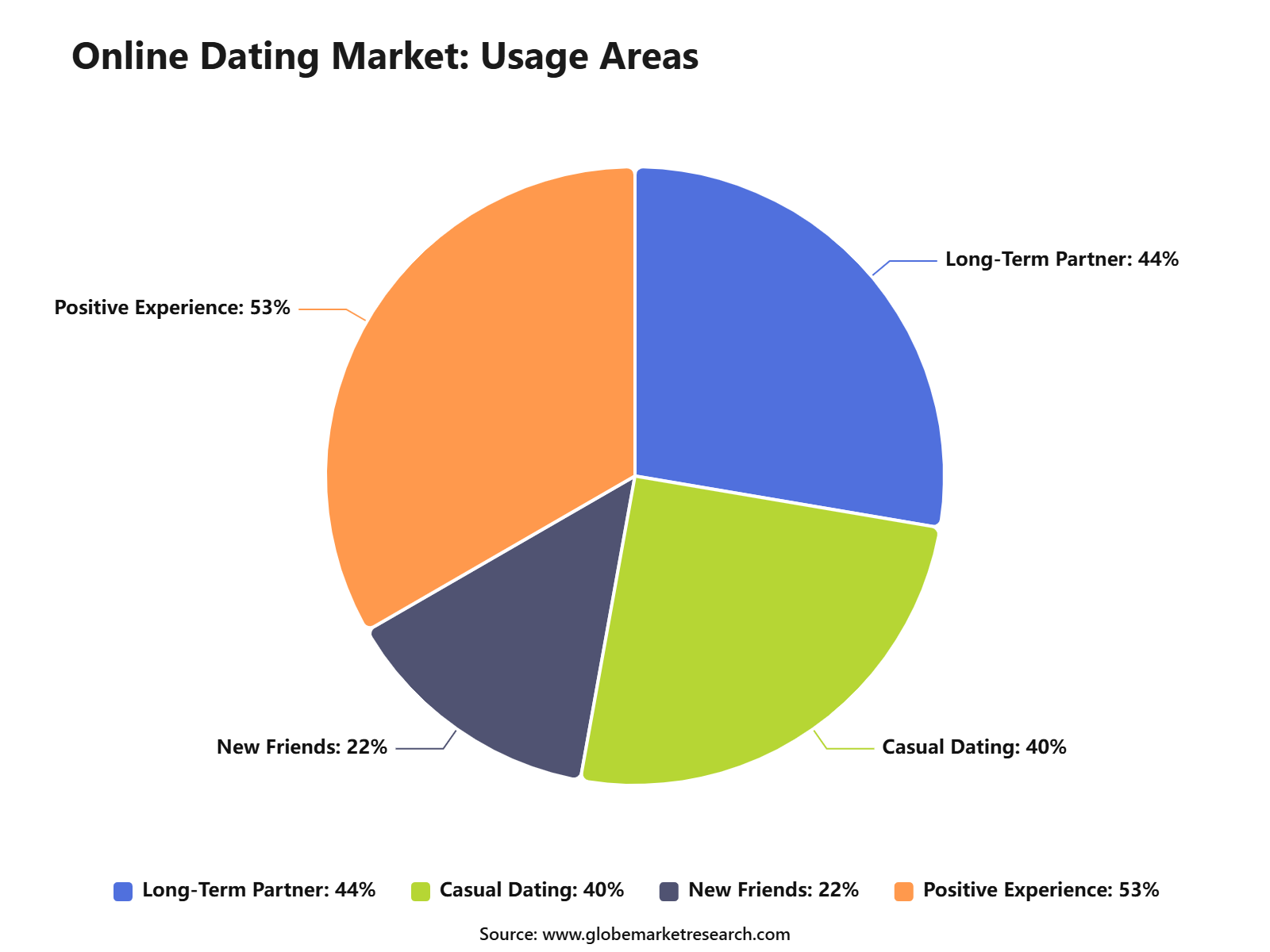
Long-Term Relationship Discovery: Users can search for potential partners based on values, interests, education, location, lifestyle, religion, family intentions, and relationship goals. Detailed compatibility data can improve the relevance of recommendations.
Casual Dating and Social Connection: Applications provide location-based discovery and low-barrier communication for users seeking casual meetings or short-term relationships. Clear intention labels can reduce misunderstanding between users.
Niche and Community Dating: Specialized platforms serve religious communities, LGBTQ+ users, professionals, older adults, cultural groups, single parents, and people with particular lifestyle interests. These platforms can build stronger loyalty through community relevance.
AI-Assisted Matchmaking: AI-based systems can analyse stated preferences and user behaviour to recommend a smaller number of potentially compatible matches. This model is being positioned as an alternative to endless swiping.
Video and Virtual Dating: Video conversations help users assess compatibility before an in-person meeting. They also provide an additional verification layer and are useful when users live in different locations.
Offline Dating Events: Applications are expanding into organized social events, speed dating, group activities, and local experiences. These services can help platforms connect online discovery with real-world outcomes.
Profile and Conversation Support: AI tools can help users write profile descriptions, select suitable photographs, identify shared interests, and prepare initial messages. Clear disclosure will be required where content is automatically generated.
Technology and Adoption Trends
AI-curated recommendations: Machine-learning systems analyze profiles, interests, communication patterns and user preferences to present more relevant potential matches. Tinder introduced improved recommendations and interest-based discovery modes as part of its 2026 product strategy.
Biometric identity verification: Facial verification is being used to reduce bots, fake profiles and impersonation. Tinder reported that Face Check produced a reduction of more than 50% in interactions with harmful accounts in markets where it was deployed.
Agentic dating assistance: AI tools can help users prepare profiles, select photographs, suggest opening messages, screen matches and plan dates. Platforms must ensure that assistance remains transparent and does not replace genuine human interaction.
Intent-based discovery: Dating services are reducing dependence on continuous swiping by adding relationship goals, interest categories, curated matches and lower-pressure social formats. Tinder’s 2026 product updates included Astrology Mode, Music Mode and continued investment in conversation-focused discovery.
Real-time location-based platforms: Sniffies uses an interactive map to connect users according to proximity and current intent. The platform had an estimated three million monthly active users and supported more than 20 million messages per day when Match Group announced its investment in April 2026.
Key Opportunities
AI compatibility matching: Platforms can use relationship goals, communication styles, interests and behavioral signals to deliver more relevant recommendations.
Verified dating communities: Identity checks, facial verification and profile-quality controls can attract users seeking safer and more serious interactions. Hinge’s Face Check produced a measurable reduction in exposure to deceptive accounts.
Niche dating applications: Platforms designed for specific communities, age groups, religions, professions or relationship intentions can provide stronger product relevance and user loyalty.
Regional-language platforms: Local-language interfaces, culturally suitable profile fields and regional payment options can increase adoption across Asia Pacific, Latin America and the Middle East.
Offline events and date planning: Dating services can expand into curated events, restaurant bookings, activity recommendations and verified public meeting locations.
Challenges and Restraints
Romance scams and fake accounts: The FBI reported that victims across its San Francisco division lost more than USD 40 million to romance scams during 2025, demonstrating the financial and reputational importance of fraud prevention.
Declining paying-user numbers: Bumble’s total paying users declined by 21.1% year over year to 3.2 million in the first quarter of 2026, indicating pressure on engagement and subscriber retention.
Subscription fatigue: Users may cancel services when profile quality, match relevance or communication outcomes do not justify recurring fees. Platforms must offer clearly differentiated premium benefits.
Data privacy concerns: Dating applications process sensitive information covering identity, location, photographs, sexual orientation and relationship preferences. A breach or improper data use can create significant regulatory and reputational risks.
AI-generated deception: Generative AI can be used to create fake photographs, automated messages and fraudulent identities. Platforms require stronger detection systems, human review and transparent AI policies.
Segment Covered in the Report
By Type
Paying Online Dating
Non-Paying Online Dating
By Revenue Model
Subscription
Advertising-Supported
Other Model
By Platform
Web Portals
Applications
By Age Group
Adult
Baby Boomer
Generation X
Generation Z
Millennials
By Region
North America
Europe
Asia Pacific
Latin America
Middle East and Africa
Recent Developments
May 2026: Match Group reported that Hinge completed the rollout of Face Check across important markets, reducing interactions with bad actors by approximately 20% to 30%. Match Group also invested USD 100 million in Sniffies and received a minority position and future acquisition option.
May 2026: Bumble confirmed that it was rebuilding its main application on an AI-enabled platform. The redesigned service is intended to offer more personalized connections and help users progress more quickly toward in-person dates.
March 2026: Tinder introduced its Tinder Sparks product strategy, including expanded AI-powered Chemistry recommendations, new interest-based matching formats, enhanced profile experiences, offline events, and stronger trust and safety functions.
February 2026: Grindr began testing EDGE, its first fully AI-supported premium subscription. The service applies AI to discovery, conversations, recommendations, and reconnection.
February 2026: Ditto raised USD 9.2 million in seed funding led by Peak XV Partners. The company is developing a text-based AI matchmaker for university students that provides curated matches and organizes offline dates.
2025: UK dating services, including Bumble, Match Group applications, Grindr, and Feeld, introduced age-assurance measures in response to the Online Safety Act.
Market Concentration: Medium
The Online Dating Market has medium concentration. Match Group owns several major brands, including Tinder, Hinge, Match, OkCupid, Plenty of Fish, and other specialized services. Bumble and Grindr also maintain large user communities and recognizable global brands. However, the top ten dating applications accounted for less than one-third of downloads among the 500 leading applications in 2025.
This indicates that a substantial portion of demand remains distributed among regional and niche platforms. New entrants can compete through AI matchmaking, stronger verification, specific communities, offline experiences, or culturally relevant services. This medium-concentration assessment is based on the presence of several large groups alongside a broad and active long-tail application market.
Competitive Landscape
Competition is based on active-user density, matching quality, trust, safety, subscription value, brand reputation, community relevance, and product innovation.
Key companies include:
Match Group, Inc.
Bumble Inc.
The Meet Group
Cupid Media Pty Ltd.
Happn SAS
TrulyMadly Matchmakers Pvt. Ltd.
Grindr Inc.
eHarmony
Coffee Meets Bagel
Matrimony.com Limited
Muzz
Spark Networks SE
Feeld Ltd.
Tantan
Badoo
Other Key Players
Large companies benefit from extensive user communities, global distribution, application portfolios, marketing capacity, and established subscription systems. Smaller competitors can differentiate through targeted audiences, local knowledge, specialized matching, stronger privacy, or more selective communities.
Conclusion
The Online Dating Market is shifting from simple profile swiping toward safer, personalized, and outcome-focused relationship discovery. Paid services held 70.5% of the type segment, subscriptions accounted for 55.5% of revenue, mobile applications represented 86.3% of platform usage, and millennials held a 35.9% age-group share. Asia Pacific led regionally with 35.6%. Market growth will be supported by smartphone access, digital acceptance, AI recommendations, identity verification, niche communities, video interaction, premium subscriptions, and offline dating experiences.
However, payer declines at several established platforms show that growth cannot be sustained through pricing alone. Platforms must improve match quality, trust, communication, and real-world outcomes. Companies that combine effective personalization with transparent AI, strong safety controls, reasonable pricing, and a clear target community will be better positioned to achieve sustainable user and revenue growth.