
Market Size and Growth
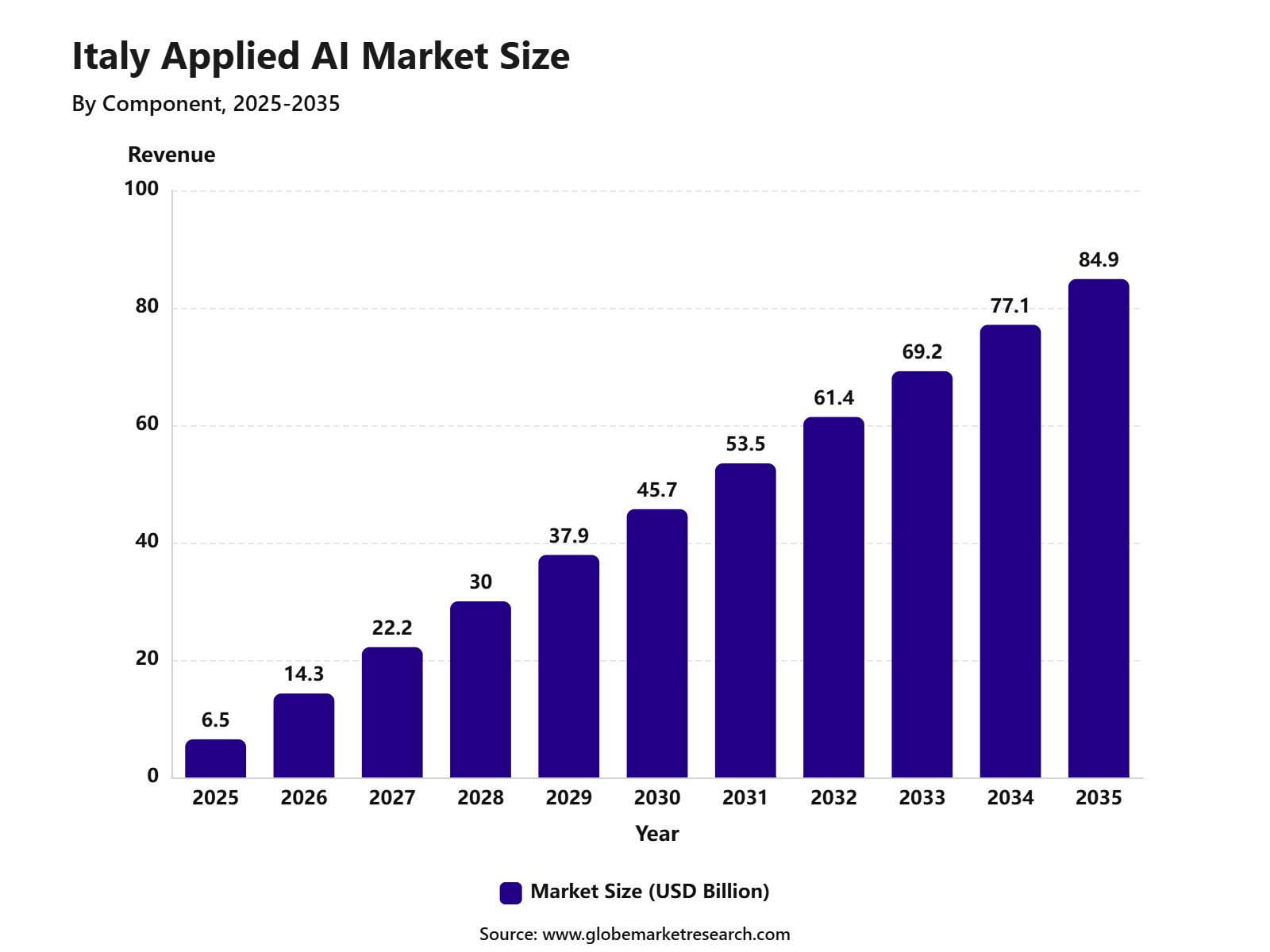
According to Globe Market Research, the Italy Applied AI Market was valued at USD 6.5 billion in 2025 and is projected to reach approximately USD 84.9 billion by 2035, growing at a CAGR of 29.3% from 2025 to 2035. Applying the reported growth rate indicates an estimated market value of approximately USD 8.4 billion in 2026.
Applied AI refers to artificial intelligence systems used to solve defined operational and commercial problems. Major applications include predictive maintenance, medical diagnostics, fraud detection, customer service automation, document processing, industrial robotics, energy management, cybersecurity and supply-chain planning.
Why is Italy Applied AI Market Growing?
The strongest growth signal is the rapid increase in enterprise adoption. AI usage among Italian companies more than doubled within one year, while 10.6% of businesses used at least two AI technologies in 2025. This indicates that companies are gradually moving from individual AI tools toward combined applications across data, documents, communication, and operational workflows.
Cloud infrastructure is also making AI more accessible. In 2025, 68.1% of Italian enterprises purchased intermediate or advanced cloud-computing services. The share conducting data analysis internally or through external providers reached 42.7%, creating a stronger technical foundation for machine learning, generative AI, forecasting, and automated decision systems.
Demand is particularly strong in digitally advanced industries. AI adoption reached 51.3% among information-service businesses, 35.7% in professional, scientific, and technical activities, and 33.2% in the energy sector. These industries have large volumes of structured and unstructured data that can be converted into operational recommendations, automated processes, and predictive insights.
The policy environment is becoming more supportive. Italy’s 2026 Digital Decade roadmap contains 67 measures supported by a total budget of EUR 62.3 billion. The investment program covers digital infrastructure, business transformation, public services, technology skills, cloud adoption, and advanced computing capacity.
Italy Applied AI Market Adoption Rate
According to Istat, 16.4% of Italian enterprises with at least ten employees used AI technologies in 2025, up from 8.2% in 2024. Adoption reached 53.1% among large enterprises and 15.7% among SMEs. AI use was especially strong in information services at 51.3% and film, television, video, and sound production at 49.5%.
Metric | Adoption Rate |
|---|---|
Business AI Use | 16.4% |
Large-Firm AI Use | 53.1% |
SME AI Use | 15.7% |
Information Services | 51.3% |
Film and Media | 49.5% |
Italy Applied AI Market Usage Statistics
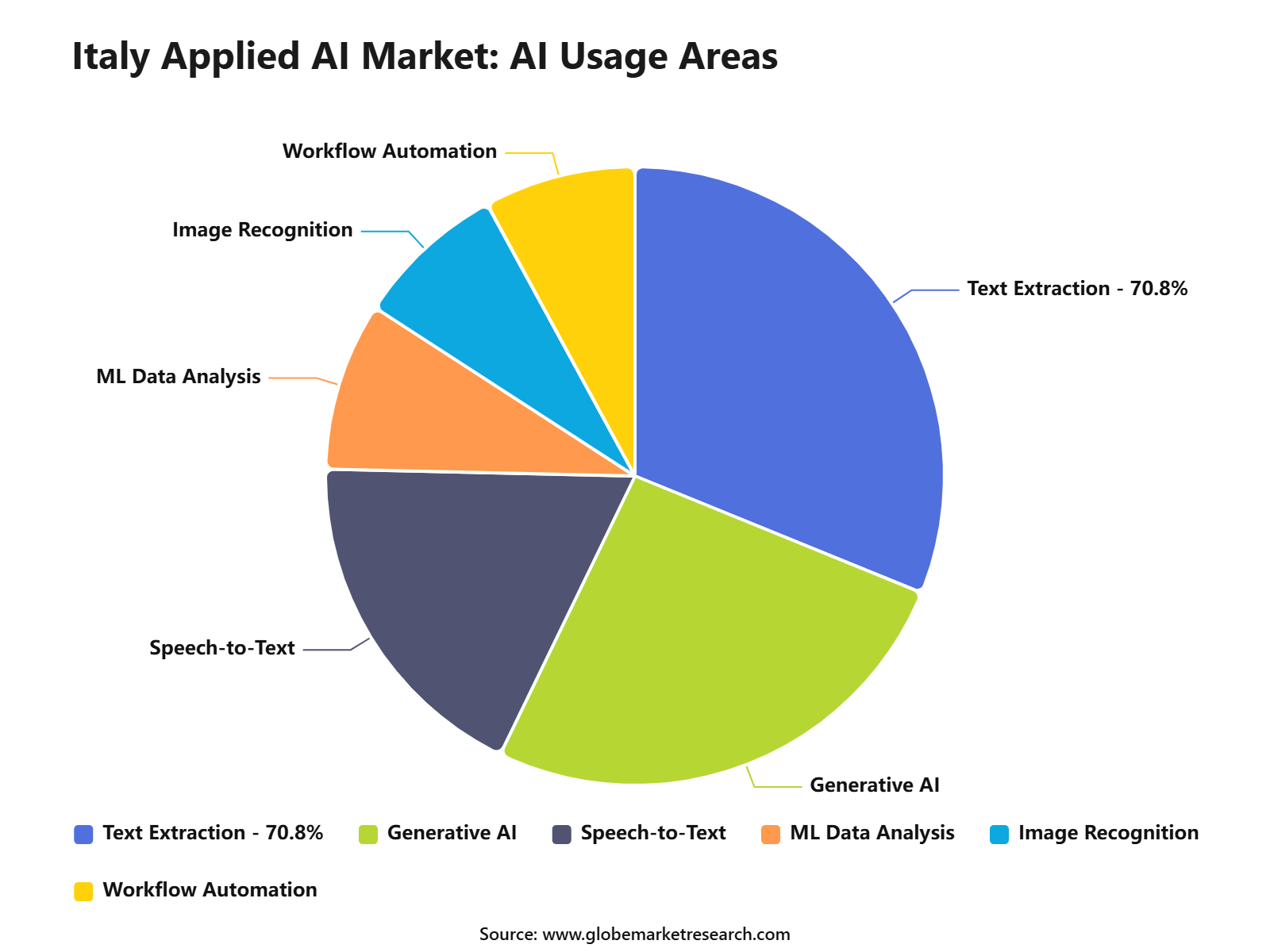
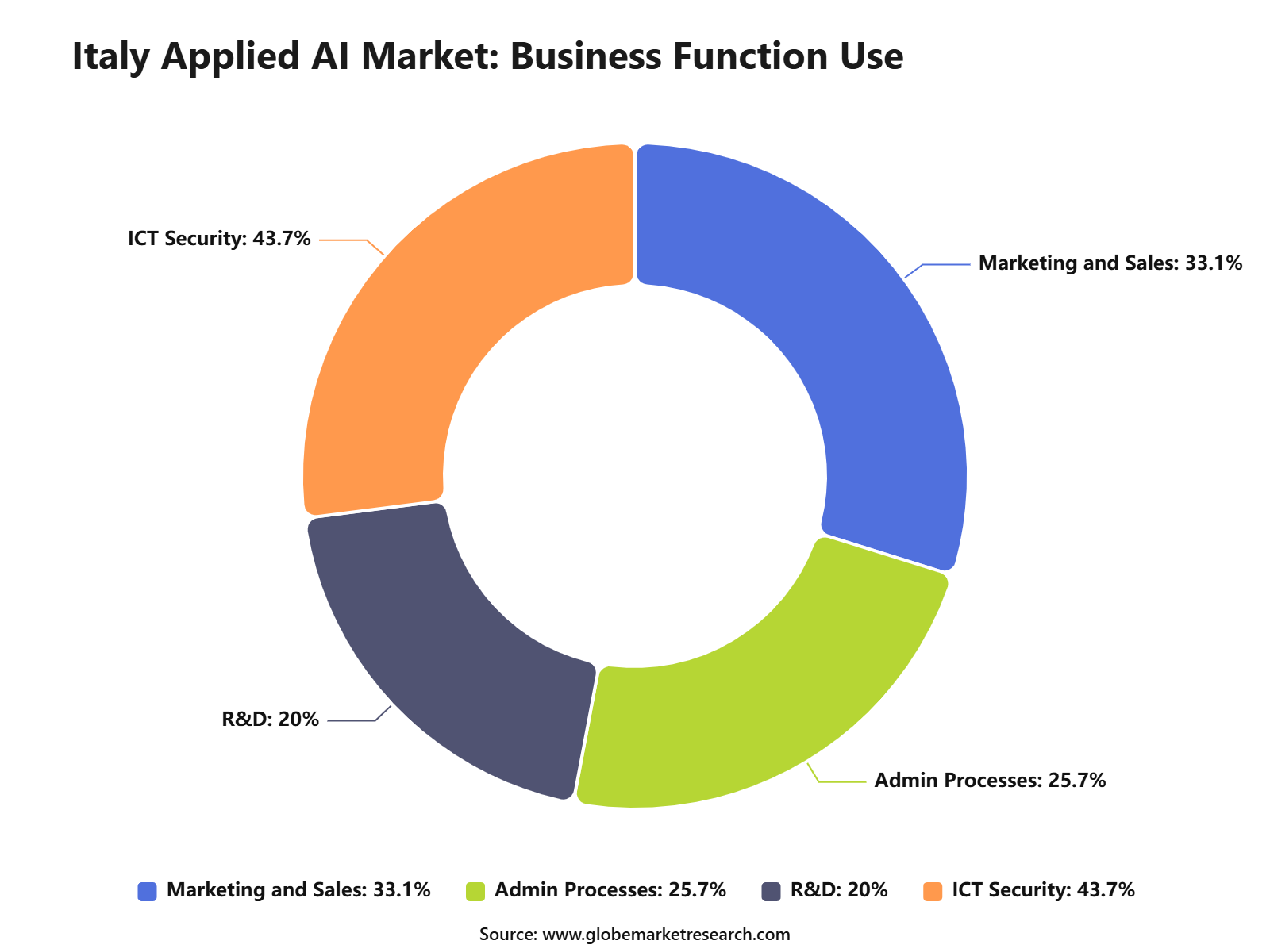
According to Istat, 70.8% of Italian enterprises using AI applied it to extract knowledge from text documents. Generative content tools were used by 59.1%, while voice-recognition technology reached 41.3%. Marketing and sales represented the leading business application at 33.1%, followed by administrative process management at 25.7%.
Metric | Application Usage |
|---|---|
Text Intelligence | 70.8% |
Generative Content | 59.1% |
Voice Recognition | 41.3% |
Marketing and Sales | 33.1% |
Admin Processes | 25.7% |
Key Market Drivers
Rapid enterprise AI adoption: The share of Italian enterprises using AI doubled to 16.4% in 2025. This increase is creating demand for implementation, integration, governance, training and managed AI services.
Strong manufacturing activity: Italy’s industrial base is creating demand for predictive maintenance, computer vision, quality inspection, production planning, robotics and energy optimization.
Growth of generative AI: Generative AI was used by 59.1% of Italian enterprises that had adopted AI, while text extraction was used by 70.8%. These results indicate strong demand for document processing, knowledge management and conversational applications.
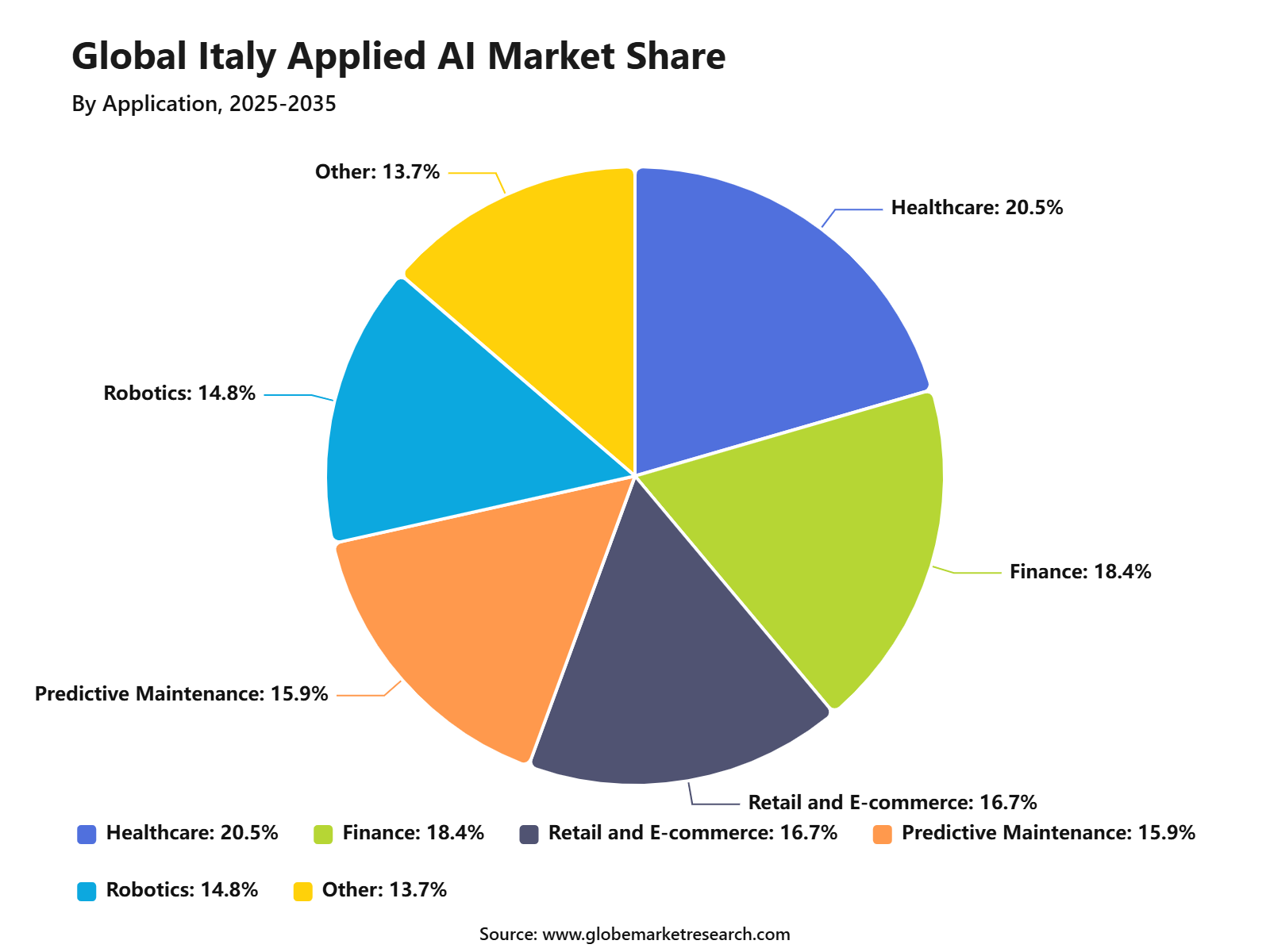
Healthcare modernization: AI is increasingly being evaluated for medical imaging, clinical documentation, patient triage and decision support. Healthcare held the largest reported application share at 20.5%.
Government and EU support: Italy’s Digital Decade roadmap and national AI strategy are supporting cloud migration, public-sector modernization, digital skills and secure AI deployment.
Market Segmentation
Component Insights: Software led the market with a 70.6% share. Demand is being generated by analytics platforms, generative AI tools, computer vision software, automation systems and industry-specific applications.
Application Insights: Healthcare accounted for a 20.5% share, supported by AI adoption in diagnostics, medical imaging, workflow management and patient monitoring.
Organization Size Insights: Large enterprises recorded substantially higher technology adoption, with 53.1% using AI in 2025 compared with 15.7% of SMEs. Larger companies benefit from greater data availability, established IT teams and stronger compliance capacity.
Technology Use Insights: Text extraction represented 70.8% of AI use among adopting businesses, followed by generative AI at 59.1%, speech-to-text at 41.3%, machine learning for data analysis at 20.0%, and image recognition at 18.0%.
Business Function Insights: Marketing and sales represented 33.1% of enterprise AI use, followed by administrative processes at 25.7% and research or innovation at 20.0%.
Technology and Adoption Trends
Generative AI copilots: Italian enterprises are implementing AI assistants for customer service, document drafting, internal knowledge search, sales support and software development.
Agentic AI systems: AI platforms are progressing from basic content generation toward systems that can complete multi-step workflows. Italgas is scaling AI agents across network management, procurement, engineering, scheduling and customer service.
Sovereign AI infrastructure: Italian organizations are increasing investment in models and computing infrastructure designed to process sensitive national and enterprise data within European governance requirements.
AI factories and accelerated computing: NVIDIA reported that Italy’s AI infrastructure ecosystem was expanding through CINECA, Fastweb and Domyn. Domyn’s planned AI factory was designed around 5,760 NVIDIA Grace Blackwell GPUs.
Industry-specific models: General-purpose language models are increasingly being adapted for regulated applications in finance, healthcare, energy, manufacturing and public administration.
Segment Covered in the Report
By Component
Software
Services
By Application
Healthcare
Finance
Retail and E-commerce
Predictive Maintenance
Industrial Robotics
Natural Language Processing
Energy and Utilities
Agriculture
Cybersecurity
Education
Entertainment and Media
Real Estate
Transportation and Logistics
Environmental Monitoring
Human Resources
Others
By Organization Size
Small and Medium Enterprise
Large Enterprise
Key Opportunities
SME-focused AI solutions: Around 15.7% of Italian SMEs used AI in 2025, leaving a large addressable market for affordable software, managed services and guided implementation.
Industrial predictive maintenance: Manufacturers can use sensor information and machine-learning models to identify equipment failures before they interrupt production.
Healthcare AI: Opportunities are emerging in medical imaging, clinical documentation, appointment management, patient monitoring and hospital resource planning.
Public-sector automation: Government agencies can use AI for document classification, citizen services, fraud detection, administrative processing and policy analysis.
Sovereign and regulated AI: Financial institutions, healthcare organizations, utilities and public bodies require models that provide data control, auditability and secure domestic or European deployment.
Challenges and Restraints
Limited specialist availability: Demand for machine-learning engineers, data scientists, cybersecurity professionals and AI governance specialists can exceed available supply.
SME implementation costs: Smaller businesses may face difficulty funding data preparation, systems integration, employee training and ongoing AI management.
Fragmented enterprise data: Information is frequently held across older software, spreadsheets and separate departmental systems, reducing model accuracy and implementation speed.
Regulatory compliance: High-risk applications require documentation, human oversight, cybersecurity controls and monitoring under national and European rules.
Uneven digital readiness: The European Commission has identified continuing challenges in AI adoption, startup growth and digital capabilities, particularly among smaller organizations.
Risk Factors and Market Barriers
The largest barrier is the shortage of suitable skills. Among Italian companies that considered AI but did not adopt it, 58.6% identified inadequate expertise as an obstacle. This creates demand for external implementation teams, managed services, employee training, and simplified industry-specific platforms.
Regulatory uncertainty was identified by 47.3% of these enterprises. Italy’s Law No. 132 of 2025 established a national framework for AI development and use, including principles for transparency, human oversight, healthcare, employment, public administration, cybersecurity, and intellectual property.
Insufficient or low-quality data affected 45.2% of businesses considering AI. Privacy and data-protection concerns affected 43.2%, while high costs were reported by 43.0%. These barriers can delay projects even when suitable AI software is already available.
Cybersecurity represents another concern. AI platforms may process customer records, financial information, industrial data, healthcare information, intellectual property, and employee documents. Vendors will need strong access controls, data separation, encryption, audit trails, model monitoring, and incident-response processes.
Prominent Global Market Leaders
The Italy Applied AI Market has medium concentration. Large global cloud, software, semiconductor, and enterprise-platform providers have advantages in computing capacity, established customer relationships, product development, and technical ecosystems.
However, the market remains open to Italian and European specialists focused on natural language processing, sovereign AI, healthcare, manufacturing, financial services, public administration, computer vision, and regulated industries.
Competition is expected to remain active because customers require a combination of technology, industry knowledge, Italian-language capabilities, implementation support, governance, and local compliance expertise. This is an analytical assessment based on the mix of global providers and expanding Italian specialists.
Top 12 Key Players
Google
Microsoft Corporation
IBM Corporation
Amazon Web Services
NVIDIA Corporation
Salesforce, Inc.
OpenAI
Baidu, Inc.
SAP SE
Domyn
Other Key Players
Strategic Implications
AI suppliers entering Italy should focus on clearly defined operational outcomes. Solutions that reduce maintenance costs, automate documents, improve customer response times or strengthen fraud detection are likely to gain adoption faster than general AI platforms without measurable business benefits.
Local-language capabilities and sector knowledge will be important. Italian enterprises require systems that understand national terminology, legal documents, industrial processes and customer communication patterns. Cloud-based delivery can reduce initial investment, particularly for SMEs.
However, regulated buyers may require private cloud, on-premise or sovereign infrastructure to protect sensitive data and meet governance requirements.Implementation partners should include training, data preparation and compliance support within their commercial offering. Software alone may not deliver results where customers lack internal AI specialists or structured data.
Top Use Cases
Predictive maintenance: Manufacturing and utility companies can predict equipment failures, plan repairs and reduce production interruptions.
Document intelligence: AI can extract, classify and summarize information from contracts, invoices, technical files and regulatory documents.
Customer service automation: Language models can answer routine questions, route complex cases and assist contact-centre employees.
Medical imaging and clinical support: AI can help healthcare professionals review images, organize clinical information and prioritize patient workflows.
Fraud and cybersecurity monitoring: Banks, insurers and public bodies can use AI to detect unusual transactions, suspicious behaviour and potential network threats.
Latest Case Study
Italgas Scales Applied and Agentic AI Across Infrastructure Operations
Business Challenge
Italgas manages extensive energy infrastructure that requires continuous network monitoring, maintenance, procurement, engineering and customer support. The integration of 2i Rete Gas assets also created a need for standardized digital systems and operational efficiencies.
Applied AI Solution
In June 2026, Italgas announced a EUR 13.0 billion investment plan for 2026–2032, including EUR 8.3 billion for the development, digitization and repurposing of Italian gas infrastructure. Artificial intelligence was identified as a central part of the group’s operating model.
The company is scaling agentic AI across:
Network management and configuration
Infrastructure monitoring
Project engineering
Procurement
Work scheduling
Customer service
Italgas also uses proprietary applications and AI systems through Geoside to improve digital energy management and reduce energy consumption.
Measurable Targets
The company increased its AI-enabled productivity target from EUR 70 million to EUR 100 million. Italgas also expects approximately EUR 120 million in incremental revenue by 2032 from the digitalization of former 2i Rete Gas assets.
Strategic Learning
The case demonstrates that applied AI can move beyond limited pilots when it is connected directly to operating processes. Large Italian enterprises are likely to prioritize AI programs that produce measurable cost savings, additional revenue and improved service quality.
Recent Developments
June 2026: Italgas presented its EUR 13.0 billion strategic plan through 2032 and increased its AI-enabled productivity target to EUR 100 million.
April 2026: Milan-based Domyn acquired Oròbix, strengthening its capabilities in computer vision, multimodal AI agents and industrial applications.
October 2025: Stellantis and Mistral AI expanded their partnership with an Innovation Lab and Transformation Academy to scale AI across sales, aftersales, engineering and production activities.
September 2025: Italy adopted Law No. 132/2025, establishing national AI requirements related to human oversight, transparency, privacy, healthcare, employment and cybersecurity.
June 2025: NVIDIA announced expanded collaboration with Italy’s AI ecosystem, including CINECA AI factory deployment, Fastweb’s AI infrastructure and Domyn’s large-scale computing platform.
Conclusion
The Italy Applied AI Market is moving from early experimentation toward practical deployment across manufacturing, healthcare, finance, utilities and public services. Software holds the largest component share, while text processing, generative AI and administrative automation are among the most widely used enterprise applications.
Market growth through 2035 will depend on whether organizations can integrate AI with existing processes, structured data and clear governance. Companies that provide secure, Italian-language and sector-specific solutions with measurable returns will be well positioned to capture demand.
Top 6 FAQs on the Italy Applied AI Market
1. What is the Italy Applied AI Market?
The Italy Applied AI Market covers artificial intelligence solutions used in practical business and public-sector operations. Major applications include process automation, customer service, fraud detection, predictive maintenance, healthcare analytics, document processing, marketing, manufacturing quality control and financial risk assessment.
2. What is driving market growth?
Growth is driven by rapid enterprise adoption, digital transformation and stronger demand for productivity tools. The share of Italian enterprises using AI increased from 8.2% in 2024 to 16.4% in 2025, showing that businesses are moving from small experiments toward operational applications.
3. Which industries are adopting applied AI?
Information technology, telecommunications, manufacturing, banking, insurance, healthcare, retail and public administration are important adopters. AI use is expanding in Italian financial markets, particularly for generative AI, compliance, customer operations, risk analysis and internal productivity.
4. Which AI applications are most widely used?
Common applications include text extraction, generative content, speech recognition, forecasting, customer support and business-process automation. In 2025, text-data analysis was used by 70.8% of Italian AI-adopting enterprises, while 59.1% used generative AI for language or visual content.
5. How is the Italian government supporting AI?
Italy’s Artificial Intelligence Strategy 2024–2026 supports AI research, enterprise adoption, public administration and workforce skills. The programme aims to strengthen domestic capabilities while promoting secure, responsible and human-centred implementation across the economy.
6. What challenges affect the market?
Major challenges include limited AI expertise, regulatory uncertainty, data-protection concerns, implementation costs and uneven adoption among smaller companies. In 2025, 58.6% of non-adopting Italian firms cited skills shortages, while 47.3% identified unclear regulation as a barrier.