
Market Size and Growth
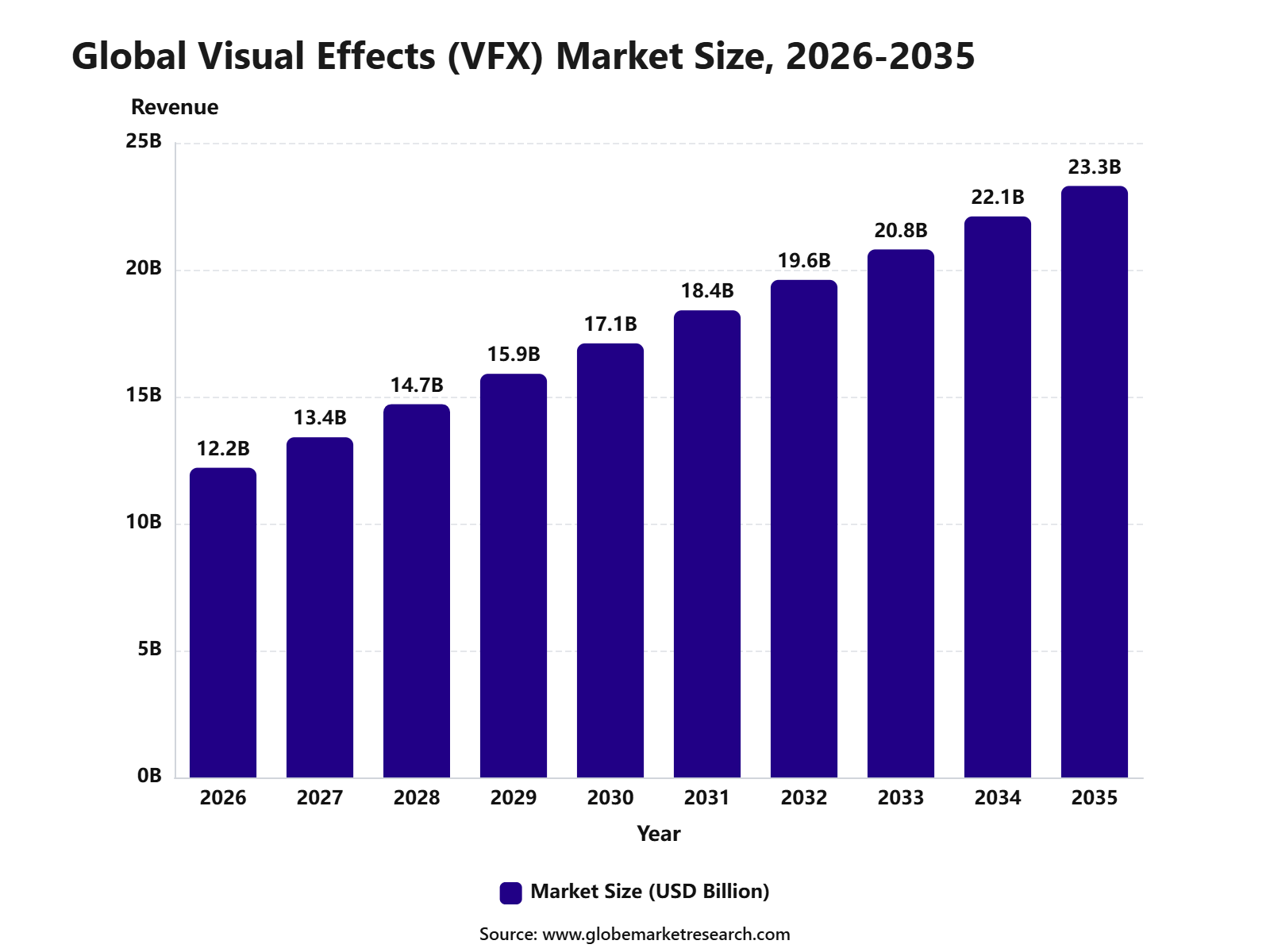
According to a recent report by Globe Market Research, the global Visual Effects (VFX) Market was valued at USD 12.2 billion in 2026 and is projected to reach approximately USD 23.3 billion by 2035, growing at a CAGR of 7.3% from 2026 to 2035. Increasing spending on films, streaming programs, gaming, advertising and digital media is strengthening demand for animation, compositing, simulation, modelling and virtual production services.
Visual effects are used to create or modify imagery that would be expensive, unsafe or impossible to capture through traditional filming. VFX workflows commonly include computer-generated imagery, motion capture, digital environments, animation, matte painting, simulation effects and scene compositing.
Key Parameter | Report Details |
|---|---|
Market Revenue, 2026 | USD 12.2 Billion |
Projected Revenue, 2035 | USD 23.3 Billion |
CAGR, 2026-2035 | 7.3% |
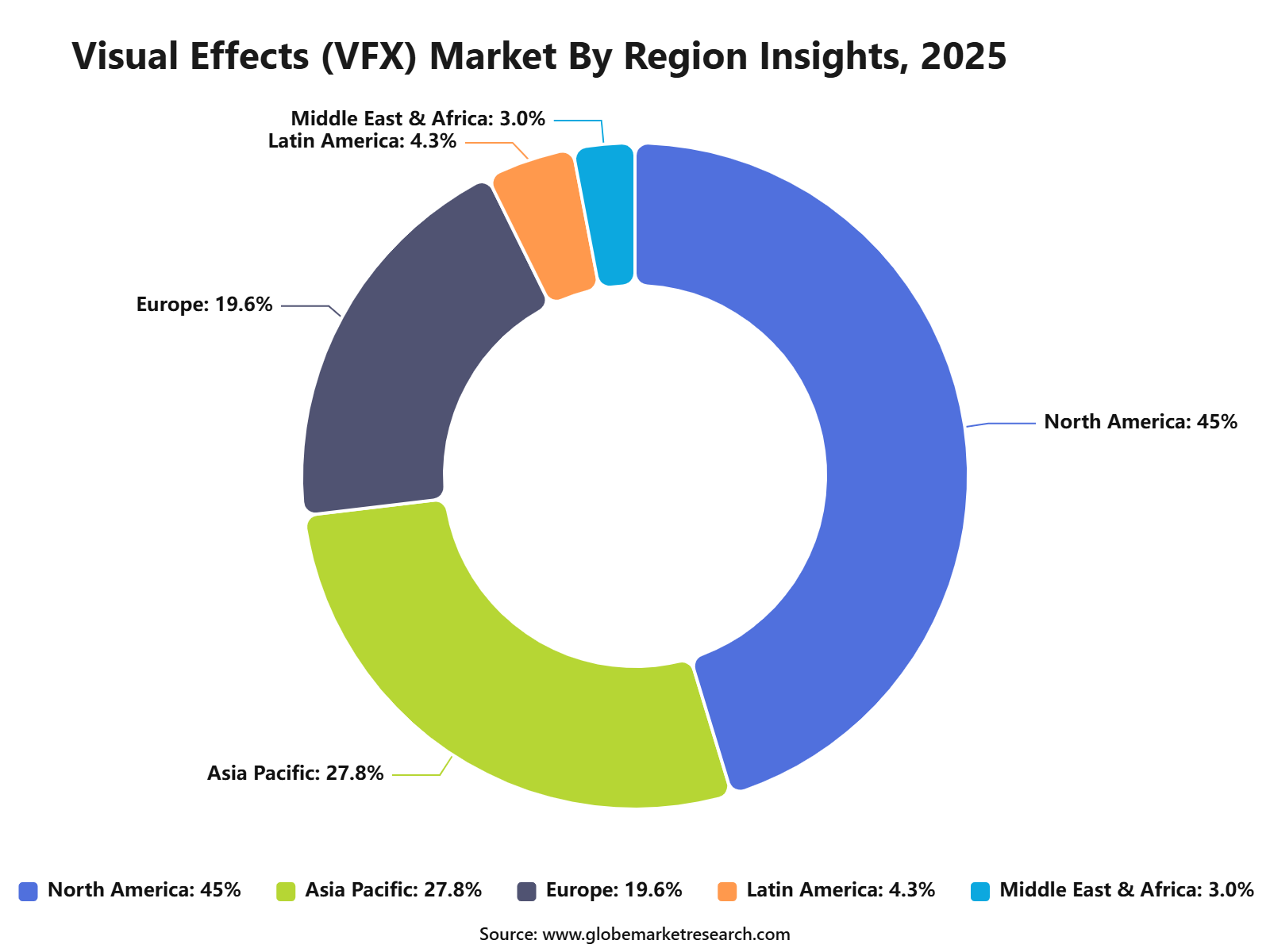
Largest Region | North America, 45.3% Share by 2035 |
North America Revenue, 2035 | USD 10.5 Billion |
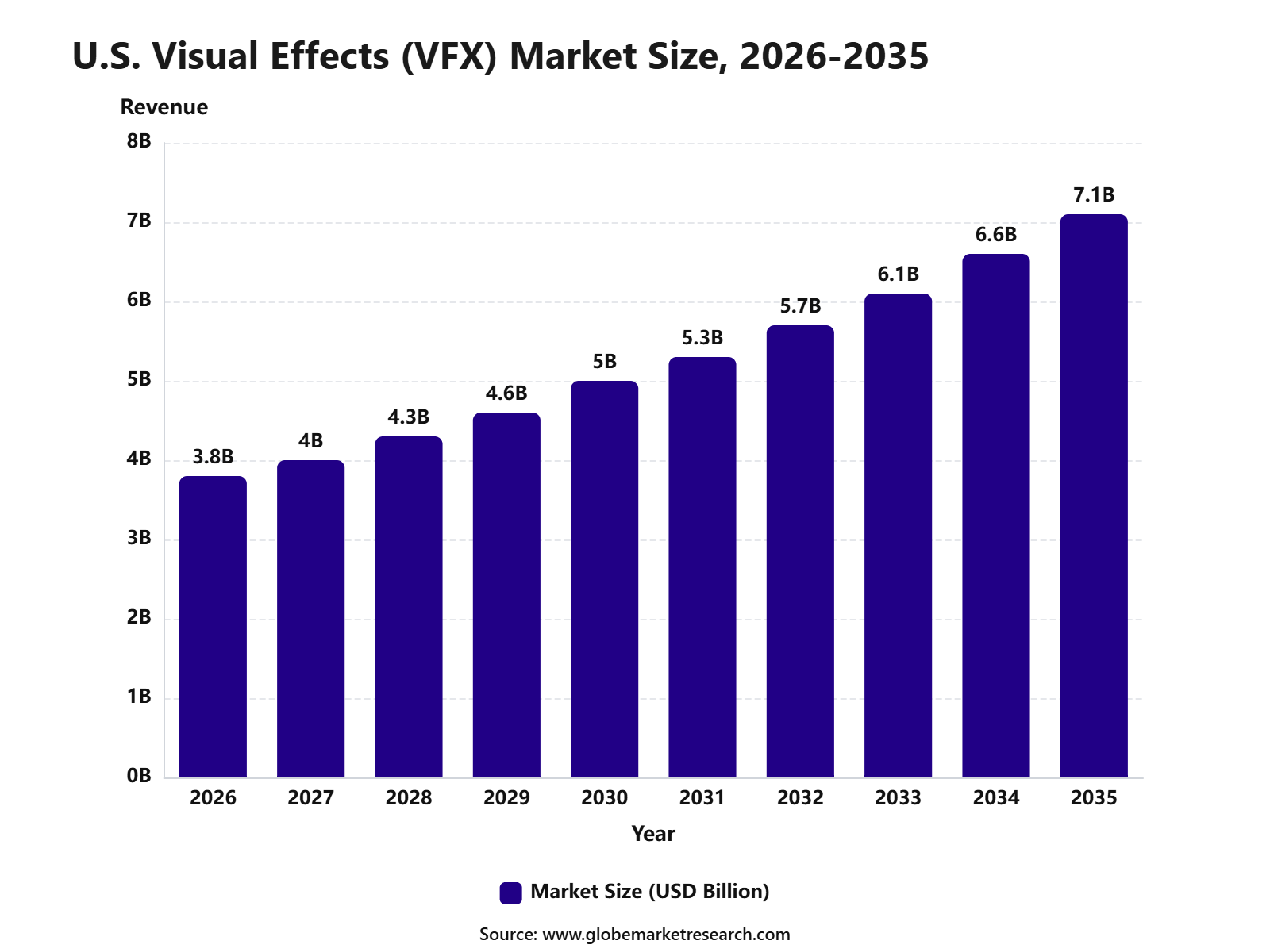
U.S. Market Revenue, 2026 | USD 3.8 Billion |
U.S. Projected Revenue, 2035 | USD 7.1 Billion |
U.S. CAGR, 2026-2035 | 7.2% |
Market Concentration | Medium |
Forecast Period | 2026-2035 |
Demand is being supported by increasing investment in high-quality video content. U.S. digital video advertising expenditure is projected to exceed USD 80 billion in 2026, increasing by 11% from the previous year. Digital video is expected to account for more than 60% of total U.S. television and video advertising spending, creating demand for motion graphics, CGI, product visualization and short-form effects.
Why the Visual Effects Market Is Growing
The market is growing because VFX has become a core part of modern content production. The report identifies rising streaming content production as a +2.1% growth impact, high-budget films and series as +1.8%, gaming and cinematic content as +1.5%, advertising and brand content as +1.2%, and virtual production adoption as +1.0%.
Digital video advertising is also increasing demand for short-form VFX, motion graphics, product visualization, virtual sets, and brand storytelling. IAB projected that U.S. digital video ad spending would surpass USD 80 billion in 2026, growing 11% year over year and accounting for more than 60% of total TV and video ad spending.
AI is strengthening production speed. Adobe’s 2026 survey found that creative professionals used AI in more than 40% of their projects, while 94% said AI helped them produce content faster. This supports AI-assisted rotoscoping, object removal, motion tracking, cleanup, upscaling, and first-pass effects work.
Impact of Agentic AI on the VFX Market
Agentic AI is shifting VFX production from individual AI-assisted tasks toward connected and autonomous workflows.
AI agents can organise footage, track objects, create masks, support rotoscoping, generate backgrounds, manage asset versions and schedule rendering jobs across cloud platforms.
Artists can provide creative instructions while AI agents complete repetitive production tasks and submit outputs for human review and approval.
Adobe reported more than 29 billion Firefly generations by late 2025, showing strong adoption of generative AI tools across creative workflows.
Around 70% of media and entertainment leaders believe AI will improve creativity, strengthen production workflows and become important to the industry.
Demand is increasing for AI-enabled compositing, animation, rendering, virtual production and production-management software.
Agentic AI can shorten production timelines, increase content output and support faster visual revisions across films, television, advertising, gaming and streaming content.
Studios can use AI agents to manage multiple delivery formats, large digital asset libraries and complex production schedules.
Major concerns include copyright ownership, training data use, workforce disruption, visual consistency and unauthorised synthetic content.
Around 55% of media and entertainment leaders believe AI could disrupt or destabilise the industry, highlighting the need for strong human supervision.
VFX platforms will increasingly require content credentials, audit trails, permission controls and clear records showing whether assets were created, modified or approved by humans or AI agents.
Market Segmentation
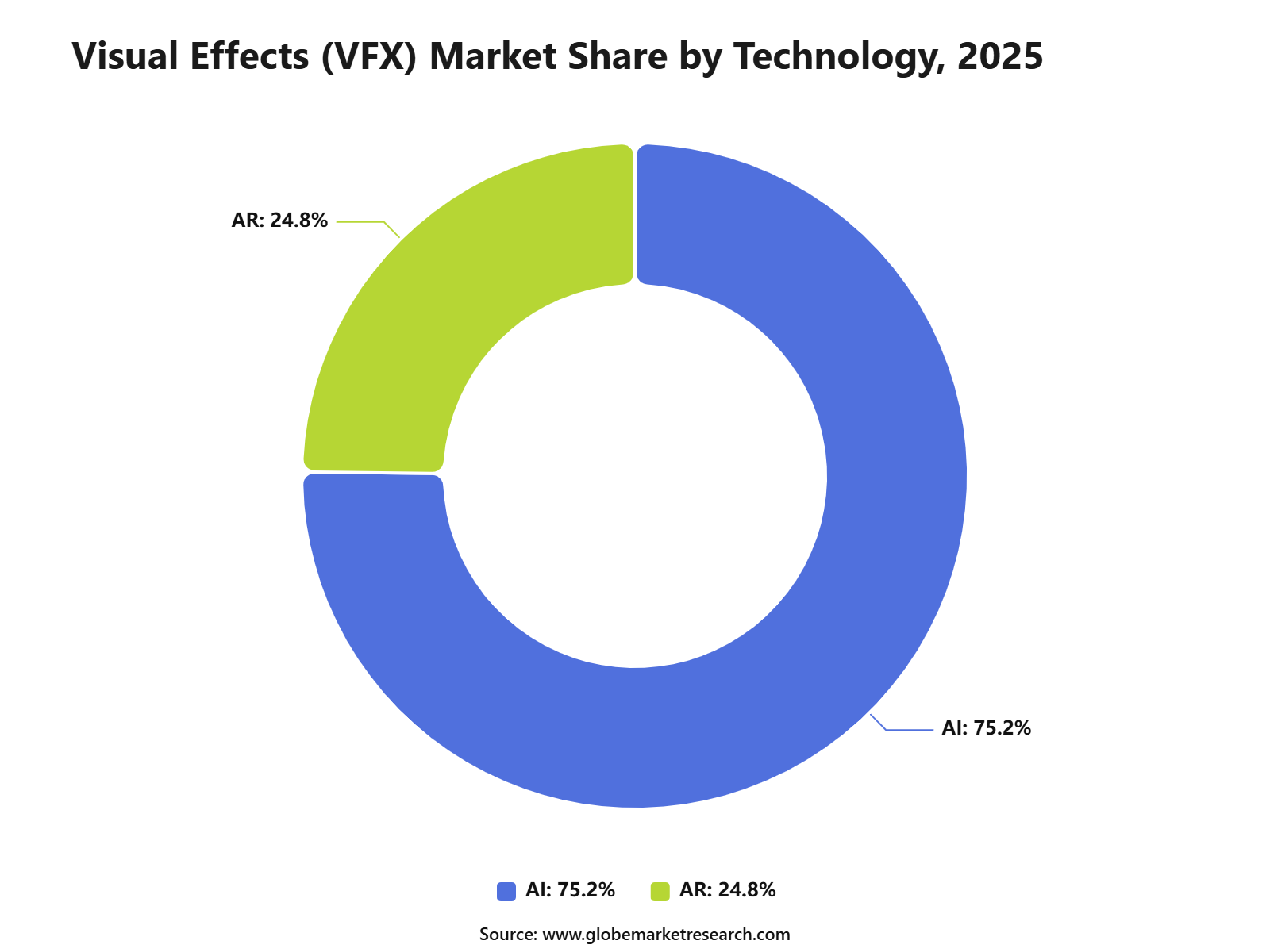
Technology Insights: Artificial intelligence led the technology segment with a 76.1% share. AI is increasingly being used for automated editing, rendering, facial animation, scene enhancement, asset creation and production management.
Application Insights: Movies held the largest application share at 39.5%. Feature films require VFX for complex action scenes, digital environments, characters and visual elements that cannot be created efficiently through physical production.
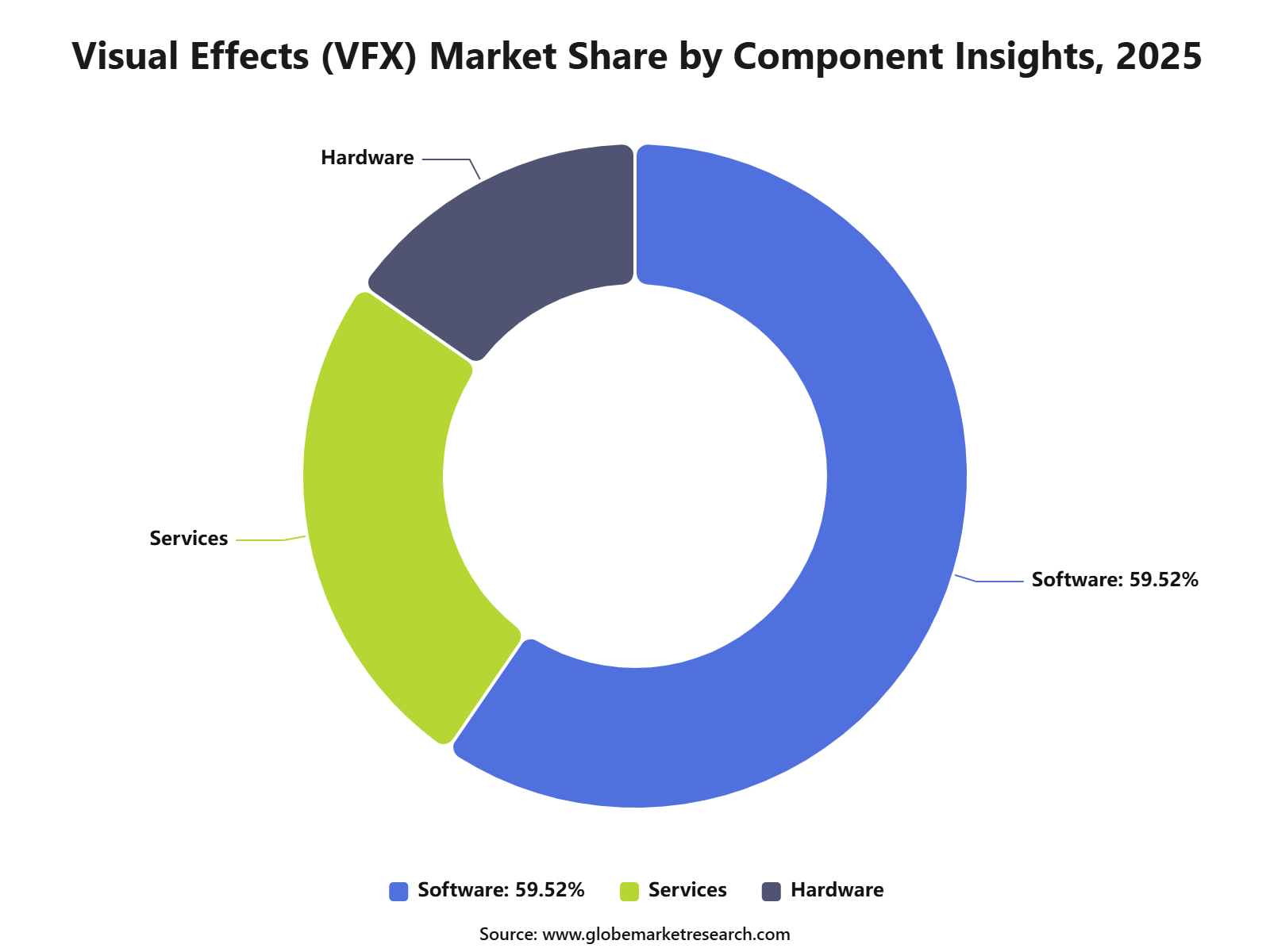
Component Insights: Software accounted for 60.8% of market revenue. VFX production depends on software for animation, modelling, rendering, compositing, simulation, motion capture, colour management and project tracking.
Product Insights: Animation represented the leading product category with a 36.7% share. It is widely used across films, television, gaming, advertising, streaming platforms and digital media.
Regional Insights: North America is projected to hold a 45.3% share by 2035. The region benefits from established studios, experienced artists, strong post-production infrastructure and substantial investment in films, television, gaming and advertising.
Key Market Drivers
Rising film and premium television production: Higher production activity creates demand for compositing, digital environments, animation, simulations, motion capture, and post-production services. UK film and high-end television production spending reached a record £6.8 billion in 2025, increasing by 22% from the initially reported 2024 level.
Expansion of streaming content production: Streaming platforms require high volumes of films, series, promotional videos, and localized content. In October 2025, Netflix combined its visual effects and virtual production operations under Eyeline, integrating traditional VFX capabilities with virtual production, AI-enabled tools, and advanced production research.
Growing use of AI-assisted creative tools: Artificial intelligence is being used for rotoscoping, masking, object removal, motion tracking, scene extension, animation, image generation, and video editing. Adobe introduced its Firefly Video Model in February 2025 to support text-to-video and image-to-video creation within professional production workflows.
Demand for faster post-production: Film, television, advertising, and online-content teams are expected to produce more visual material within shorter delivery periods. DaVinci Resolve 20, introduced in April 2025, added more than 100 features, including AI-assisted scripting, subtitle animation, multicamera selection, audio processing, compositing, depth mapping, and optical-flow tools.
Adoption of real-time rendering: Real-time engines allow directors and VFX teams to view digital lighting, environments, characters, and effects during filming. These systems support live compositing, virtual sets, broadcast graphics, and in-camera visual effects, reducing the separation between production and post-production.
Increasing use of cloud rendering: VFX production requires substantial computing capacity for complex simulations, high-resolution images, animation, and final rendering. Cloud platforms allow studios to add computing resources when workloads increase without maintaining large permanent render farms. In 2025, managed cloud rendering support was expanded for After Effects, Nuke 16, V-Ray, and Unreal Engine projects.
Wider demand outside feature films: Visual effects are increasingly used in television, video games, advertising, social media, music videos, live events, architecture, product visualization, and immersive experiences. This broader application base is creating opportunities for specialist studios, independent creators, and cloud-based VFX service providers.
Regional Breakdown and Supply Chain
North America: The region is expected to account for 45.3% of the market by 2035. Hollywood studios, streaming platforms, gaming companies and advanced post-production facilities support strong demand across the United States and Canada.
Europe: The UK remains a major production location, recording GBP 6.8 billion in film and high-end television expenditure during 2025. High-end television represented GBP 4.03 billion of this spending, increasing by 17% from the initially reported 2024 level.
Asia Pacific: India, China, Japan, South Korea and Australia provide expanding production, animation, gaming and post-production ecosystems. The region offers skilled creative talent, competitive production costs and strong demand for localized entertainment content.
Latin America, Middle East and Africa: Regional opportunities are being supported by advertising production, streaming localization, animated content and international film projects. Development depends on studio investment, technical training and access to high-performance computing infrastructure.
Supply chain structure: The VFX value chain includes production studios, software providers, cloud platforms, graphics-processor suppliers, render farms, motion-capture companies, post-production houses and independent artists. Data security, intellectual property protection and reliable computing capacity remain important procurement factors.
Emerging VFX Trends
Generative AI in post-production: Generative AI is being introduced to develop concept frames, extend backgrounds, produce temporary visual assets, repair footage, and accelerate early-stage creative testing. Adoption is expected to remain focused on artist-controlled workflows because consistency, copyright, image quality, and production approval remain important requirements.
AI-powered motion capture: Markerless motion capture allows human movement to be extracted from video without traditional capture suits or complex studio equipment. Autodesk’s 2026 media and entertainment tools include markerless AI motion capture and expanded crowd-creation capabilities for animation and VFX production.
Automated character animation: AI-assisted animation systems can generate movement from keyframes, motion paths, or reference footage. MotionMaker, introduced for Maya in 2025, allows artists to create an initial movement sequence that can then be refined rather than manually animating every frame.
In-camera visual effects: LED volumes, camera tracking, virtual backgrounds, and real-time rendering are being combined to produce final or near-final backgrounds during live filming. The technology can provide realistic reflections and lighting while reducing location travel, green-screen work, and some post-production corrections.
Cloud-native VFX pipelines: Studios are shifting asset storage, review, rendering, and production tracking into connected cloud environments. Cloud infrastructure allows artists in different locations to work on the same project and provides temporary computing capacity for demanding sequences.
Real-time collaborative production: Multiple artists can simultaneously build, light, review, and modify virtual environments. Real-time multi-user tools help directors, cinematographers, designers, and VFX supervisors make creative decisions earlier in the production process.
AI-generated crowds and digital characters: Crowd creation is becoming faster through procedural animation, AI motion systems, and reusable digital characters. These capabilities are useful for battle sequences, stadium scenes, historical reconstructions, disaster simulations, and large virtual environments.
Integrated production and post-production platforms: Editing, color grading, animation, compositing, audio, tracking, and visual effects are increasingly being managed within connected software environments. This integration reduces file transfers, duplicated work, version-management problems, and delays between creative departments.
Greater attention to content authenticity: Studios and clients are seeking clearer information about whether images or video were generated or modified with AI. Content credentials, production records, source tracking, and human approval processes are becoming important for copyright protection and audience trust.
Accessible professional-grade VFX: AI and cloud software are reducing some technical and hardware barriers for smaller studios and individual creators. Video-based tools can now assist with motion capture, character insertion, scene reconstruction, and animation without requiring a large physical production facility.
5 Best Visual Effects Technologies in 2026
Real-Time Rendering Engines: These systems generate digital environments, lighting, reflections, characters, and effects during production. They are widely used for virtual sets, previsualization, broadcast graphics, animation, gaming, and in-camera VFX.
AI-Assisted VFX and Animation Tools: AI tools support masking, rotoscoping, motion tracking, character animation, object removal, background generation, crowd creation, and footage enhancement. Their main value is the reduction of repetitive manual work while artists retain creative control.
Cloud Rendering and Production Platforms: Cloud infrastructure provides scalable computing, storage, asset management, production tracking, and remote collaboration. It is particularly useful for studios handling changing workloads or complex sequences that require substantial rendering capacity.
Virtual Production and LED Volume Systems: Virtual production combines LED displays, real-time engines, camera tracking, color management, and digital environments. It allows filmmakers to view and capture digital settings directly on set while maintaining interaction between physical lighting, actors, and virtual backgrounds.
Advanced Compositing and Finishing Platforms: Compositing systems combine live footage, computer-generated imagery, matte paintings, simulations, and digital corrections into final shots. Modern platforms also include AI tracking, depth mapping, color grading, optical flow, noise reduction, and high-dynamic-range finishing capabilities.
Key Opportunities
AI-assisted VFX services: Studios can provide faster rotoscoping, scene cleanup, motion tracking and first-pass compositing while maintaining professional human supervision.
Virtual production and LED stages: Real-time digital environments can reduce location costs, improve on-set visualization and allow directors to review effects during filming.
Gaming cinematics: Game developers require trailers, cutscenes, character animation, simulated effects and real-time environments that meet both visual and technical performance requirements.
Advertising and branded content: U.S. digital video advertising spending is projected to exceed USD 80 billion in 2026, creating demand for product visualization, motion design, short-form CGI and localized campaign assets.
Cloud rendering and remote production: Cloud infrastructure can allow studios to increase rendering capacity without maintaining large internal data centres. It also supports distributed production teams and international project delivery.
Challenges and Restraints
High production costs: Complex visual effects require specialized artists, rendering capacity, software licenses, supervisors and quality-control teams. Smaller productions may reduce VFX scope when budgets are limited.
Skilled artist shortages: Demand for experienced compositors, animators, simulation specialists and technical directors can exceed local supply, increasing labour expenses and project-delivery risks.
Tight production timelines: Film, streaming and advertising projects frequently require multiple revisions within limited delivery periods. Delays in filming or editorial approval can place additional pressure on post-production teams.
Data security and intellectual property risks: VFX suppliers manage unreleased footage, scripts, character assets and proprietary studio information. Secure systems and strict access controls are necessary for international collaboration.
Copyright and AI governance: Companies must determine whether AI tools use approved training data and whether generated assets can be used commercially. Contracts should clearly define asset ownership, model usage and client-data protection.
Key Market Segments
By Technology
Artificial Intelligence (AI)
Augmented Reality (AR)
By Application
Movies
Television
Gaming
Advertisements
By Component
Software
Services
Hardware
By Product
Animation
Simulation FX
Compositing
Modelling
Matte Painting
By Region
North America
Europe
Asia Pacific
Latin America
Middle East and Africa
Prominent Global Market Leaders
Market Concentration: Medium
The Visual Effects Market has medium concentration. Large VFX studios, production software providers, and entertainment groups have strong client relationships, rendering capacity, experienced teams, and advanced pipelines.
At the same time, independent VFX studios, animation companies, freelance artists, and regional post-production suppliers continue to compete through specialized skills, flexible pricing, and expertise in compositing, motion graphics, virtual production, simulation, and advertising content.
The Visual Effects Market is competitive, with VFX studios, animation companies, production software providers, AI video platforms, virtual production companies, gaming content creators, and post-production houses competing across creative quality, speed, cost, security, and delivery reliability.
Key companies include:
The Foundry Visionmongers Limited
Technicolor SA
Digital Domain
Framestore
Pixomondo
Adobe Inc.
Animal Logic
Cinesite
Weta FX
Industrial Light & Magic
DNEG
Other Key Players
Strategic Implications
VFX companies should enter projects during pre-production rather than waiting until post-production. Early participation in concept development, previsualization and shot planning can reduce revisions and improve project-cost visibility.
Technology investment should focus on interoperability. Software, AI systems, cloud infrastructure and asset-management platforms must exchange data without reducing creative control. Support for open standards such as USD can improve collaboration across complex production pipelines.
Studios should develop reusable libraries of environments, characters, simulations and effects. Reusable assets can reduce delivery time and create recurring value across sequels, episodic programs, advertisements and game updates.
AI adoption should be positioned as a productivity tool rather than a complete replacement for artists. Customers will continue to require human supervision, visual consistency, copyright protection and final quality control, particularly for premium film and television projects.
Recent Developments
February 2026: Foundry released Nuke 17.0 with native Gaussian Splat support, an expanded machine-learning system and a new USD-based three-dimensional workflow for compositing artists.
March 2026: Netflix acquired InterPositive, a filmmaking technology company founded by Ben Affleck. The company develops AI-powered tools designed to support filmmakers and expand creative production choices.
March 2026: Runway launched an investment fund with an initial commitment of up to USD 10 million for companies developing AI, media and world-simulation technologies.
April 2026: Autodesk introduced AI Rigging and Neural Layer in Flow Studio, allowing users to turn three-dimensional models into animation-ready characters and produce cinematic visual output with reduced technical complexity.
July 2026: Foundry expanded Griptape Enterprise to support secure and controllable AI orchestration across professional VFX workflows. The development followed Foundry’s February 2026 acquisition of Griptape.
Conclusion
The Visual Effects Market is expected to maintain steady growth as film studios, streaming services, gaming companies and advertisers increase their use of advanced digital content. AI, virtual production, cloud rendering and real-time workflows are reducing production barriers while expanding the range of visual experiences that can be created.
Software currently represents the largest component, while movies remain the leading application. North America is expected to retain a major market position because of its developed production ecosystem and strong content investment. Companies that combine technical innovation, skilled creative teams, secure workflows and reliable project delivery will be best positioned to benefit from market growth through 2035.
Contact Us
Global Business Development Team
Email: [email protected]