
Revenue, 2025
USD 2.3 Bn
Forecast, 2035
USD 96.5 Bn
CAGR, 2025-2035
45.3%
Report Coverage
US
Market Size and Forecast
AI agents are software systems that can interpret objectives, plan activities, access business applications and complete tasks with limited human involvement. These systems combine large language models, machine learning, natural language processing, memory and application programming interfaces to perform multistep activities. Compared with conventional chatbots, AI agents can coordinate workflows, retrieve information, update records and respond to changing conditions. Human oversight remains important for sensitive decisions involving financial transactions, personal data, security and regulatory compliance.
Based on findings published by Globe Market Research, The U.S. AI Agents Market was valued at USD 2.3 billion in 2025 and is projected to reach approximately USD 96.5 billion by 2035, growing at a CAGR of 45.3% from 2025 to 2035. Market growth is being supported by the rapid integration of autonomous AI systems across customer service, software development, sales, marketing, financial services and cybersecurity. Increasing enterprise investment in generative AI infrastructure is also improving access to advanced models, cloud computing and agent-development platforms. Demand is further strengthened by the need to automate complex workflows and improve employee productivity.
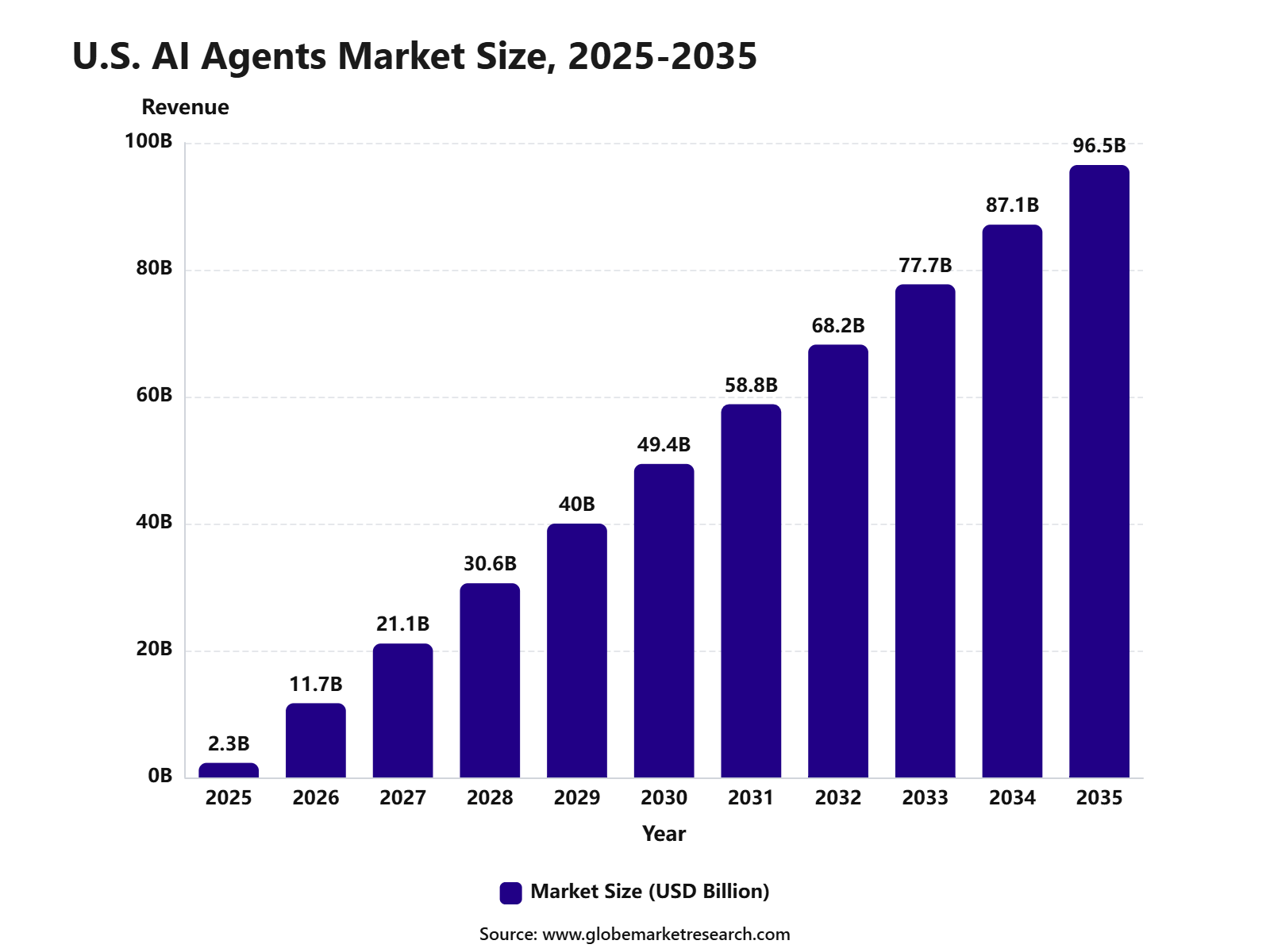 iThe graph shows projected market growth until 2035 based on CAGR analysis. Actual outcomes may vary depending on changing demand, competition, and economic factors.To gain greater insights - request a sample report PDF
Demand is also being influenced by rising adoption and AI spending among U.S. companies. A May 2025 survey of 300 senior executives found that 79% reported AI-agent adoption within their companies, while 88% planned to increase AI-related budgets during the following 12 months because of agentic AI. Among companies using agents, 66% reported measurable productivity improvements. In June 2026, technology executives surveyed by IBM expected the number of deployed AI agents to increase by 38% by 2027, supporting continued demand for agent platforms, integration services, security controls and governance solutions.
Key Market Insights
Machine learning led the technology segment with 35.4% share, supported by its strong role in task automation, predictive analytics, decision-making, workflow optimization, and adaptive AI agent performance.
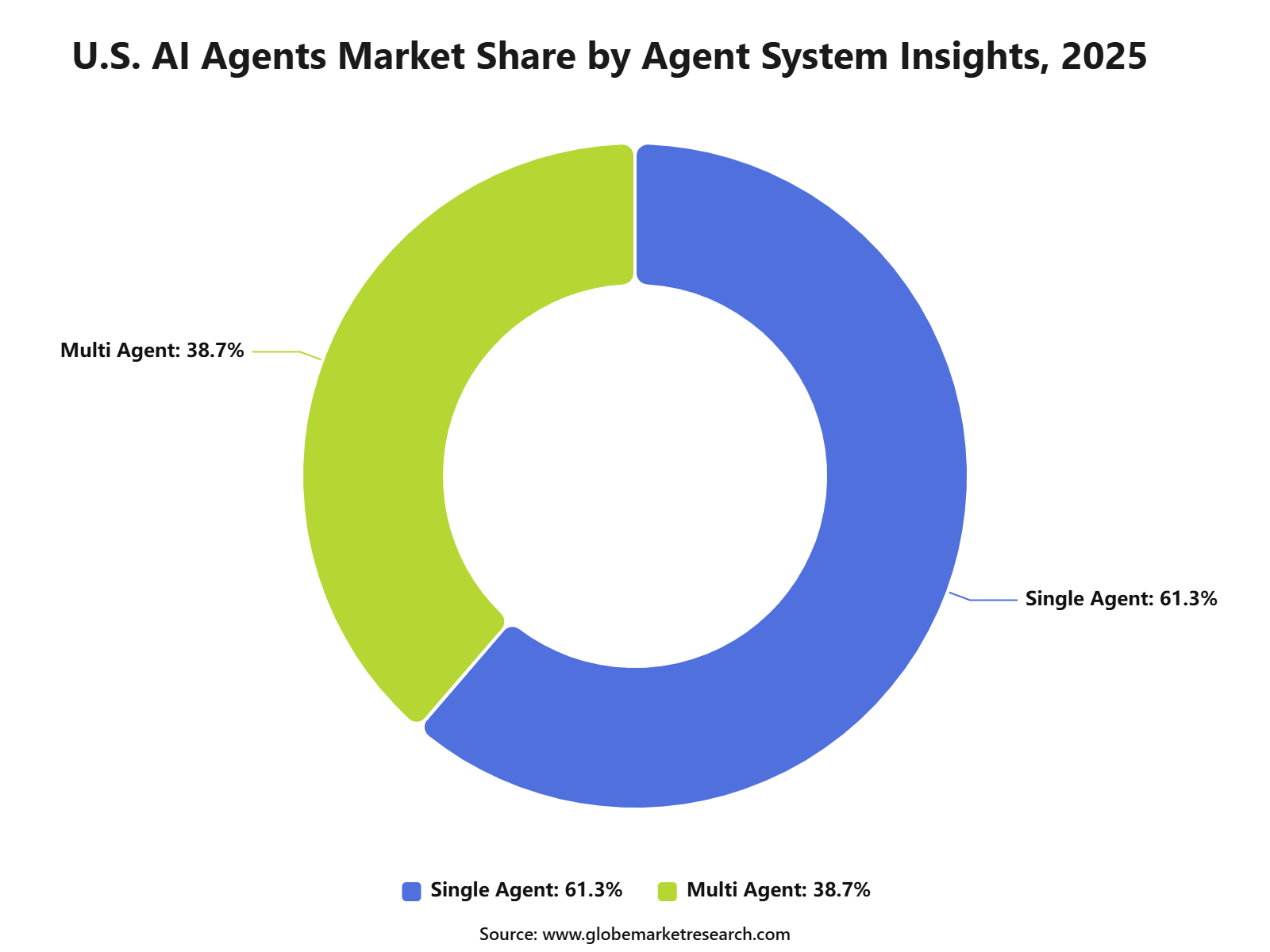
Single agent systems accounted for 61.3% share, driven by easier deployment, focused task execution, lower integration complexity, and strong use in specific business functions.
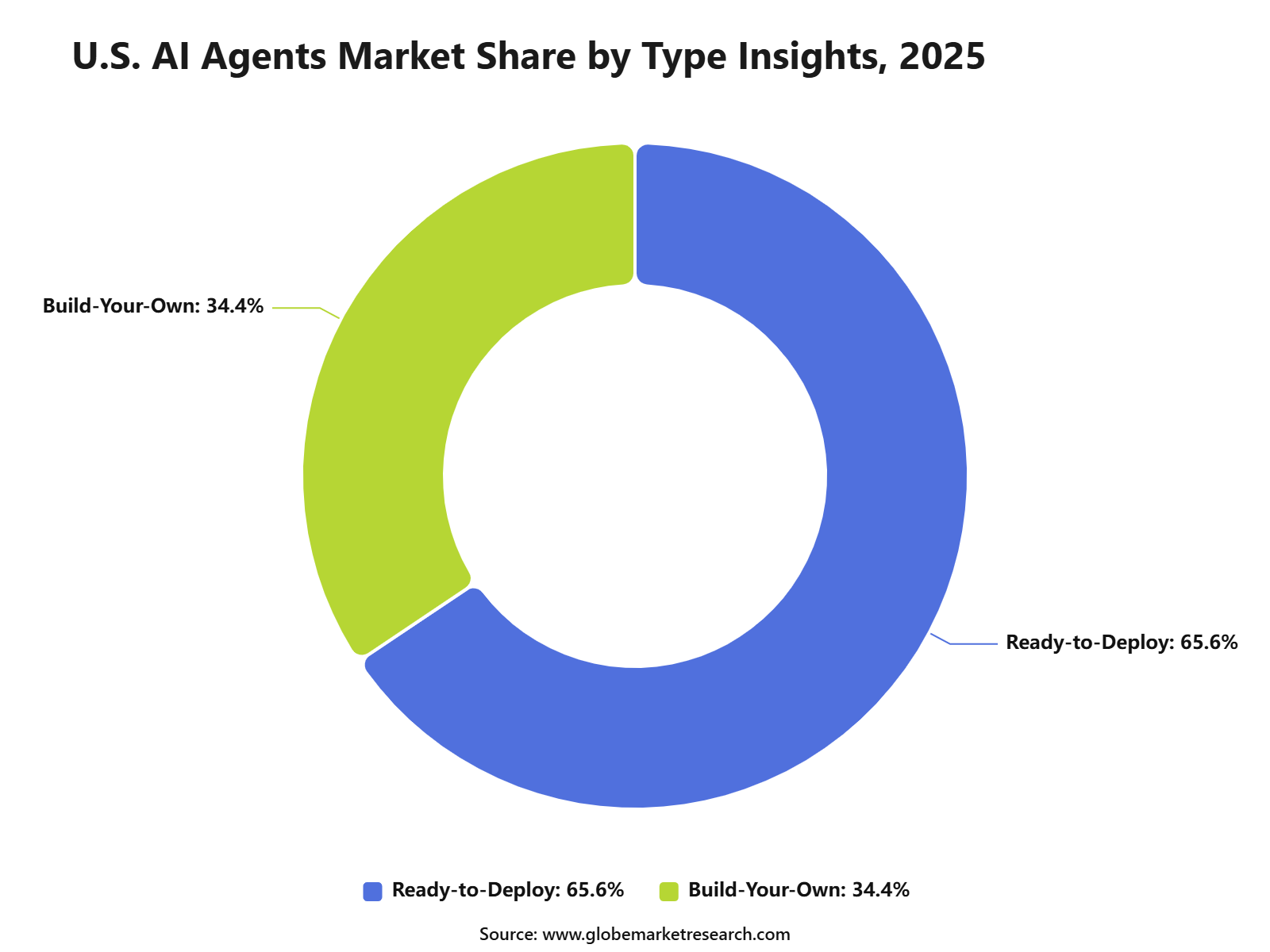
Ready-to-deploy agents held 65.6% share by type, supported by faster implementation, pre-built capabilities, lower development effort, and rising enterprise demand for plug-and-play AI solutions.
Customer service and virtual assistants captured 33.8% share by application, driven by growing use of AI agents for chat support, call handling, query resolution, lead assistance, and customer engagement.
Enterprise end use represented 50.7% share, supported by rising adoption of AI agents across operations, sales, IT support, human resources, finance, and customer service workflows.
Adoption and Usage Area Statistics
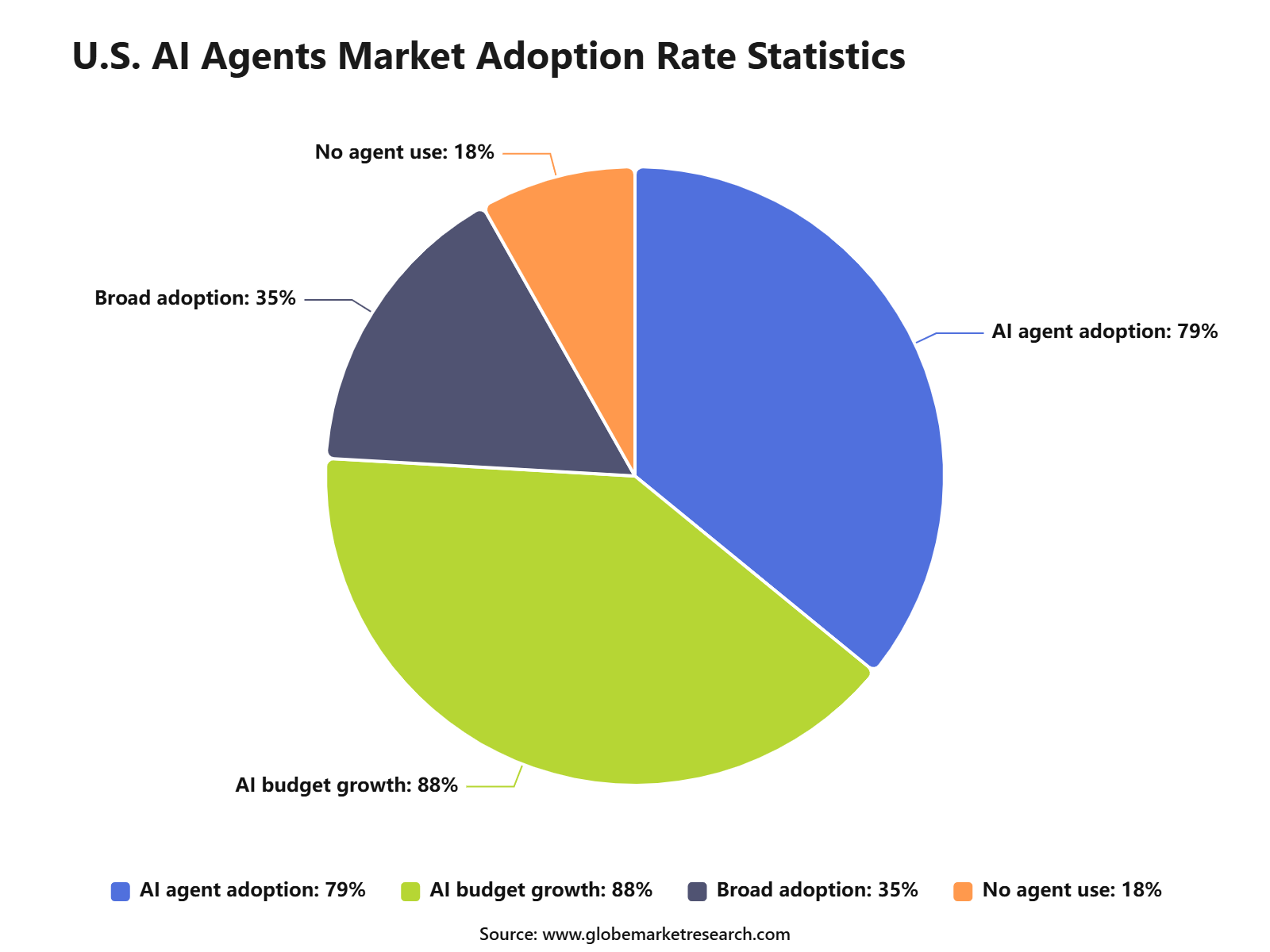 iThe graph shows projected market growth until 2035 based on CAGR analysis. Actual outcomes may vary depending on changing demand, competition, and economic factors.To gain greater insights - request a sample report PDF
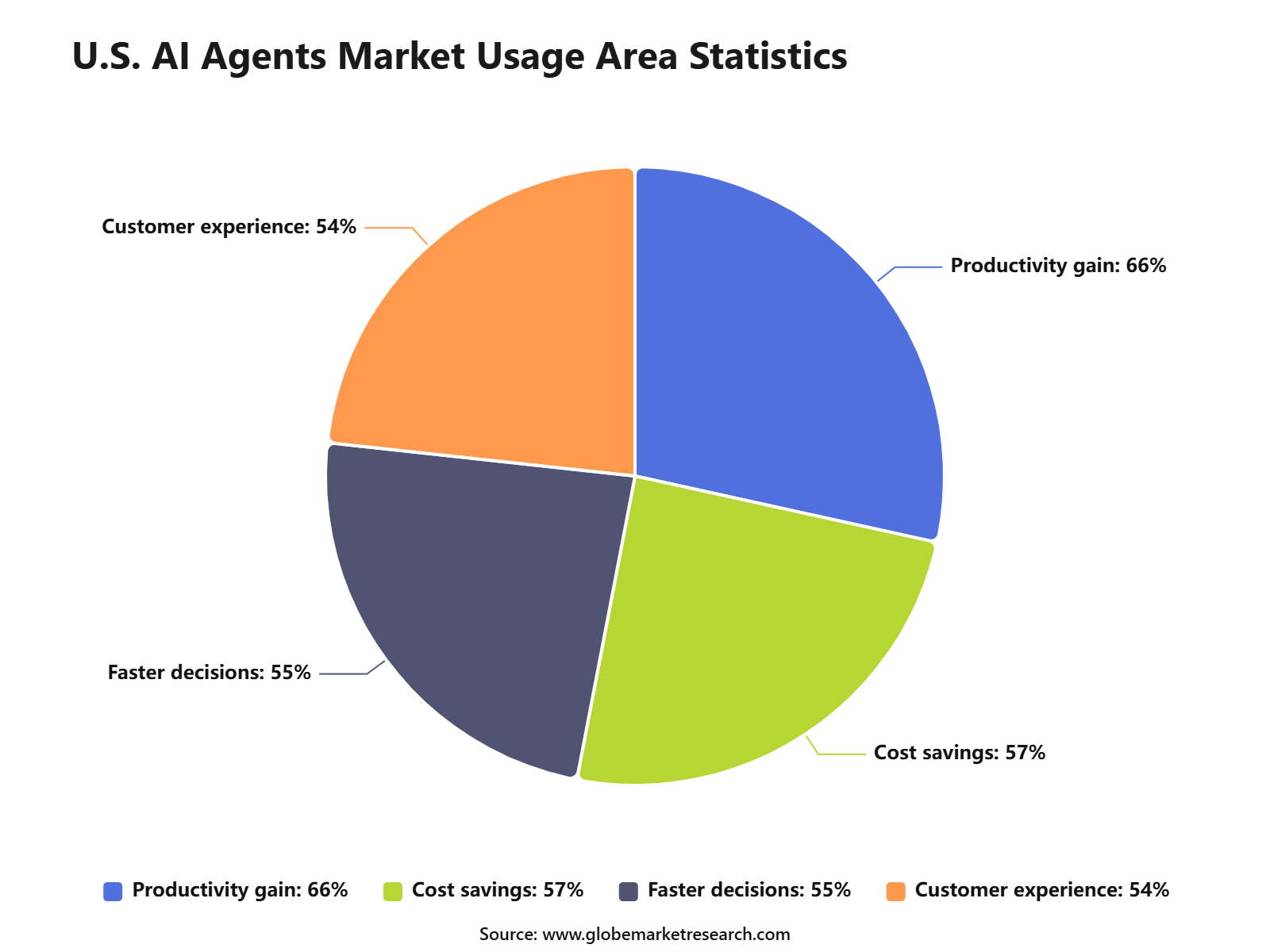 iThe graph shows projected market growth until 2035 based on CAGR analysis. Actual outcomes may vary depending on changing demand, competition, and economic factors.To gain greater insights - request a sample report PDF
Technology Insights
Machine learning accounted for the leading technology share of 35.4%. It enables AI agents to identify patterns, classify information, predict outcomes and improve responses using operational data. These capabilities are widely applied in recommendation engines, fraud detection, customer support, workflow routing and business forecasting.
Demand is being strengthened by the rising use of advanced AI reasoning in workplace applications. During 2025, enterprise AI message volume increased eightfold, while API reasoning-token consumption per organization rose by 320 times. This indicates that businesses are moving from simple AI queries toward deeper analysis and multi-step task execution.
Agent System Insights
Single agent systems held the largest share of 61.3%. These systems are designed to complete a defined task or manage a specific workflow, such as answering customer questions, preparing documents, analysing records or scheduling activities. Their limited scope makes implementation, monitoring and governance easier than coordinating several agents.
Current enterprise adoption remains focused on controlled and clearly defined use cases. In 2025, only 24% of surveyed executives reported that AI agents were taking independent action within their organizations, although 67% expected this capability by 2027. This gap shows that many businesses are still beginning with single-agent deployments before moving toward more autonomous systems.
 iThe graph shows projected market growth until 2035 based on CAGR analysis. Actual outcomes may vary depending on changing demand, competition, and economic factors.To gain greater insights - request a sample report PDF
Type Insights
Ready-to-deploy agents represented the leading type share of 65.6%. These agents provide preconfigured features for sales, service, human resources, finance and internal knowledge management. They allow organizations to begin using agent-based automation without building every model, interface and workflow from the beginning.
The preference for packaged solutions is supported by pressure to introduce AI quickly. A 2025 study found that 61% of surveyed chief executives were actively adopting AI agents and preparing to implement them at scale. By February 2026, more than 80% of business leaders expected agents to become moderately or extensively integrated into their AI strategies within 12 to 18 months.
 iThe graph shows projected market growth until 2035 based on CAGR analysis. Actual outcomes may vary depending on changing demand, competition, and economic factors.To gain greater insights - request a sample report PDF
Application Insights
Customer service and virtual assistants accounted for the largest application share of 33.8%. AI agents can answer common questions, retrieve account information, guide customers through transactions and transfer complex cases to human representatives. Their round-the-clock availability also helps businesses manage high enquiry volumes without expanding support teams at the same rate.
In 2025, AI was estimated to resolve 30% of customer service cases, with the share expected to reach 50% by 2027. Service teams using AI agents also anticipated average reductions of 20% in service costs and case-resolution times, supporting continued investment in automated assistance.
End Use Insights
Enterprise users held the dominant end-use share of 50.7%. Large organizations have the data, computing infrastructure and financial capacity required to integrate AI agents across several departments. Common enterprise uses include employee assistance, customer operations, software development, compliance reviews, sales support and document processing.
Recent U.S. government data show that AI use increases considerably with company size. From December 2025 to May 2026, 37% of firms with at least 250 employees reported using AI in business operations, compared with an overall business adoption range of 17% to 20%. This difference supports the stronger position of enterprise users in the U.S. AI agents market.
Key Market Segments
By Technology
Machine Learning
Natural Language Processing (NLP)
Deep Learning
Computer Vision
Others
By Agent System
Single Agent Systems
Multi Agent Systems
By Type
Ready-to-Deploy Agents
Build-Your-Own Agents
By Application
Customer Service and Virtual Assistants
Others
By End Use
Consumer
Enterprise
Industrial
Drivers Impact Analysis
The US AI Agents Market is driven by rising enterprise automation, generative AI adoption, customer service transformation, workflow orchestration, and demand for autonomous decision-support tools. AI agents help businesses complete tasks, answer queries, manage workflows, analyze data, and reduce manual workload across departments. The U.S. market benefits from strong cloud infrastructure, large enterprise software spending, advanced AI model development, and a mature startup ecosystem. Demand is strongest across technology, financial services, healthcare, retail, legal, cybersecurity, and customer support operations.
Impact Factor | Estimated CAGR Impact | Regional Relevance | Market Impact |
|---|---|---|---|
Enterprise workflow automation | +13.5% | United States | Drives core AI agent adoption. |
Growth in generative AI platforms | +12.4% | U.S. technology ecosystem | Improves agent capability. |
Customer service automation demand | +10.8% | Contact centers and digital channels | Expands commercial use. |
Rising cloud and API-based deployment | +9.5% | U.S. enterprise software users | Supports scalable rollout. |
Need for productivity improvement | +8.2% | Large enterprises and SMEs | Reduces manual work. |
Restraints Impact Analysis
The market faces restraints from data privacy concerns, uncertain ROI, integration difficulty, AI hallucination risk, and trust issues around autonomous decision-making. Enterprises need strong governance before allowing AI agents to act on sensitive systems or customer data. Another restraint is the complexity of connecting agents with legacy applications, databases, security tools, and workflow systems. Without clean data, strong access controls, and proper monitoring, AI agents may fail to deliver reliable business outcomes.
Impact Factor | Estimated CAGR Impact | Regional Relevance | Market Impact |
|---|---|---|---|
Data privacy and security concerns | -7.2% | U.S. regulated industries | Slows sensitive deployments. |
AI hallucination and accuracy risk | -6.4% | Enterprise and customer-facing use | Affects trust. |
Legacy system integration complexity | -5.6% | Large enterprises | Increases rollout time. |
Unclear ROI for early deployments | -4.8% | SMEs and mid-market firms | Delays buying decisions. |
Governance and compliance burden | -4.0% | BFSI, healthcare, legal, government | Raises adoption requirements. |
Opportunities Impact Analysis
Opportunities are strong in customer service agents, sales agents, coding agents, cybersecurity agents, HR agents, finance agents, legal workflow agents, and healthcare administrative agents. These areas benefit from repetitive tasks, high labor cost, and strong need for faster response. Higher-value opportunities are emerging in multi-agent systems, autonomous enterprise copilots, AI operations assistants, agentic workflow platforms, and vertical-specific AI agents. Vendors that combine reliability, security, integration, and measurable productivity gains can capture strong long-term demand.
Impact Factor | Estimated CAGR Impact | Regional Relevance | Market Impact |
|---|---|---|---|
Customer support AI agents | +13.2% | U.S. contact centers and SaaS users | Builds early revenue scale. |
Coding and software development agents | +11.6% | Technology companies | Improves developer productivity. |
Cybersecurity AI agents | +10.1% | Security operations teams | Supports faster threat response. |
Sales and marketing agents | +8.9% | Enterprise and mid-market firms | Improves lead handling. |
Vertical-specific AI agents | +7.5% | BFSI, healthcare, legal, retail | Adds premium use cases. |
Challenges Impact Analysis
The main challenge is moving AI agents from pilot projects to dependable production systems. Businesses need agents that can follow instructions, use enterprise tools safely, explain actions, and operate within approved permissions. Another challenge is managing risk when agents take actions across business systems. Companies need human oversight, audit trails, access controls, escalation rules, and testing frameworks to avoid errors, data exposure, or unwanted automation outcomes.
Impact Factor | Estimated CAGR Impact | Regional Relevance | Market Impact |
|---|---|---|---|
Production reliability requirements | -6.8% | U.S. enterprise users | Slows full deployment. |
Human oversight and control needs | -5.9% | Regulated and high-risk workflows | Adds governance layers. |
Tool-use and workflow failure risk | -5.0% | Enterprise software environments | Affects user confidence. |
Model bias and explainability issues | -4.2% | Healthcare, finance, HR, legal | Raises compliance concerns. |
Shortage of AI implementation talent | -3.6% | U.S. enterprise market | Slows adoption speed. |
Go-to-Market and Sales Economics
The go-to-market approach for the US AI Agents Market should focus on task-specific deployments with clear business outcomes. Customer support, sales operations, software development, IT service management and document processing provide practical entry points. Microsoft’s 2026 Work Trend Index found that 49% of AI-assisted workplace conversations supported analysis, problem-solving, evaluation and other cognitive tasks, indicating strong demand for agents that support complex knowledge work.
Sales economics should be built around measurable reductions in handling time, manual work and operational delays. In June 2026, average hourly earnings for U.S. private-sector employees reached USD 37.64, while wages increased 3.5% over the year. Rising labor expenses strengthen the financial case for agents that can complete repetitive administrative tasks while allowing employees to concentrate on decisions, customer relationships and exception management.
The strongest commercial model will combine platform subscriptions, implementation fees, usage-based charges, system integration and managed services. Consumption pricing allows customers to start with limited workflows and increase usage after performance has been demonstrated. Salesforce prices Agentforce actions at USD 0.10 each, with packages of 100,000 Flex Credits offered for USD 500, establishing a clear benchmark for outcome-linked agent pricing.
Financial Impact
The financial impact of AI agents will be determined by time saved, task completion rates, accuracy, escalation frequency and cost per successful outcome. DeVry University reported saving more than 500 employee hours annually after introducing AI agents into academic advising and student support. Similar productivity improvements can support investment when agents are applied to high-volume workflows with predictable steps and reliable business data.
Cybersecurity failures could create substantial financial losses for suppliers and enterprise users. IBM reported that the average cost of a U.S. data breach reached a record USD 10.22 million in 2025. AI agents can access applications, customer information and internal systems, making identity controls, permission limits, activity logs, human approvals and continuous security testing essential parts of deployment budgets.
Integration and governance will remain major cost factors as agent fleets expand. In 2026, only 54% of surveyed organizations had established centralized governance with formal oversight for agentic capabilities. NIST also launched its AI Agent Standards Initiative to support secure, interoperable and trusted agent systems, increasing the importance of identity management, authorization controls, auditability and standard communication protocols.
Common U.S. AI Agent Usage Areas
Metric | Practical Use |
|---|---|
Customer support | AI chat agents, ticket routing, case summaries, and FAQ automation |
Sales support | Lead qualification, follow-up emails, CRM updates, and meeting scheduling |
Marketing | Campaign content, audience insights, personalization, and performance reporting |
IT service desk | Password support, troubleshooting, ticket triage, and knowledge retrieval |
Cybersecurity | Alert triage, anomaly detection, investigation support, and response guidance |
Software development | Code generation, testing, documentation, and workflow automation |
Finance operations | Invoice checks, reconciliations, reporting, and forecasting support |
HR workflows | Candidate screening, employee queries, onboarding, and policy support |
Recent Developments
In February 2026, ServiceNow launched Autonomous Workforce and added Moveworks to the ServiceNow AI Platform to support AI agents across employee service, enterprise search, workflow automation, and business task execution.
In April 2026, OpenAI introduced workspace agents in ChatGPT, allowing teams to create shared agents that automate repeatable workflows, run in the cloud, and operate within organizational permissions and controls.
In April 2026, Google Cloud launched Gemini Enterprise Agent Platform, a platform designed to help developers build, scale, govern, and optimize AI agents for enterprise applications and workflows.
In May 2026, Microsoft updated Copilot Studio with new computer-using agents, workflow experiences, and real-time voice capabilities for enterprise automation.
In June 2026, Visa partnered with OpenAI to support the next generation of AI commerce, enabling secure agent-led payment use cases through Visa’s global payment network.
In July 2026, OpenAI launched ChatGPT Work, an AI agent for professional users that combines ChatGPT with Codex to help create documents, websites, presentations, and other work outputs.
Acquisitions
In February 2026, Salesforce signed a definitive agreement to acquire Cimulate, an AI-powered product discovery and agentic commerce company, to strengthen Agentforce Commerce and improve conversational shopping experiences.
In March 2026, OpenAI announced plans to acquire Promptfoo, an AI security platform, to strengthen agentic security testing and evaluation inside OpenAI Frontier.
In March 2026, OpenAI announced plans to acquire Astral to bring open-source developer tools into the Codex ecosystem.
In April 2026, Salesforce completed its acquisition of Qualified, an agentic AI marketing company that helps businesses deploy AI workers for inbound buyer engagement and pipeline generation.
In June 2026, Salesforce signed a definitive agreement to acquire Fin for about USD 3.6 billion, adding an AI customer agent that resolves complex customer queries across live chat, email, WhatsApp, SMS, phone, and Slack.
Funding and Investments
In January 2026, Decagon raised USD 250.1 million led by Coatue Management and Index Ventures, tripling its valuation to USD 4.5 billion and supporting expansion of AI customer agents.
In February 2026, Anthropic raised USD 30.1 billion in Series G funding at a USD 380.1 billion post-money valuation, with Claude Code run-rate revenue reported above USD 2.5 billion.
In March 2026, Harvey raised USD 200.1 million at an USD 11.1 billion valuation to scale AI agents across law firms and enterprise legal teams.
In May 2026, Cognition raised more than USD 1.1 billion at a USD 25.1 billion pre-money valuation for Devin, its autonomous AI software engineering agent.
In May 2026, Anthropic raised USD 65.1 billion in Series H funding to expand safety research, interpretability work, compute capacity, products, and partnerships.
In May 2026, Sierra raised USD 950.1 million from new and existing investors led by Tiger Global and GV, reaching a valuation above USD 15 billion for AI customer experience agents.
Market Concentration
The US AI Agents Market has a medium level of concentration. Large technology and enterprise software providers hold strong positions because they control cloud infrastructure, foundation models, data platforms and established customer relationships. However, the market is not fully concentrated, as many specialist developers offer industry-focused agents for customer service, finance, healthcare, legal operations, cybersecurity and human resources.
Competition is increasing as enterprises seek agents that can connect with existing software, follow internal policies and complete specific business tasks. Ready-to-deploy products benefit from faster implementation, while smaller providers compete through customization, domain knowledge and flexible pricing. Open-source models and low-code development tools are also reducing entry barriers and allowing new participants to enter the market.
Market concentration may increase gradually as larger providers acquire specialist developers or integrate agent capabilities into broader software suites. At the same time, demand for tailored workflows, data security and regulatory compliance is expected to preserve opportunities for smaller companies. As a result, the market is likely to remain moderately concentrated, with large platforms controlling core infrastructure and specialist firms serving focused applications.
Competitive Landscape
The market is characterized by intense competition among established players and emerging companies. Strategic partnerships, mergers and acquisitions, and product innovation are key strategies employed by market participants.
Key Market Players
Cognigy
Google LLC
IBM Corporation
Amelia US LLC
LivePerson
Microsoft
NVIDIA Corporation
Nuance Communications
Salesforce, Inc.
Meta Platforms
Meta Platforms
Research Methodology
This market study is prepared using a combination of primary and secondary research. Primary research includes discussions with manufacturers, suppliers, distributors, consultants, industry experts, and end users. Secondary research covers company reports, government databases, trade associations, technical publications, regulatory sources, and trusted industry documents. The collected information is used to assess market demand, pricing trends, technology adoption, competitive activity, and regional performance.
AI language models are not used as primary data sources, and publicly available AI-generated content is not treated as market evidence. Computational tools may be used to support data processing, translation, data classification, and pattern identification. However, every published assessment is supported by verified sources, human review, and primary market discussions.
Market estimates are developed through top-down and bottom-up approaches and validated using data triangulation. Revenue, production, shipment, pricing, and application-level data are compared across multiple sources. Forecasts consider economic conditions, regulatory changes, investment activity, innovation, supply chain developments, and industry risks. All findings are reviewed through source verification and internal quality checks before publication.
Part I
Source Management & Input Data Standards
Who provides data, how sources are qualified, and what types of evidence are admissible.
Part II
Research Scope & Market Coverage
How we define the markets we assess and the parameters that govern each product.
Part III
Data Collection, Verification & Submission
The mechanics of gathering, cross-checking, and hierarchically ranking evidence.
Part IV
Assessment Determination & Quality Controls
How raw data becomes a published assessment — normalisation, expert judgement, and outlier exclusion.
Part V
Publication, Corrections & Revision
Our publication schedule, corrections policy, and methodology review cycle.
Part VI
Independence, Ethics & Complaints
Conflict-of-interest policies, editorial independence, and how clients raise concerns.
Google · Preferred Sources
Don't miss the latest market research insights and industry updates on Google.
Add Globe Market Research as a preferred source in the Google app to see our reports, analysis, and market stories in your news suggestions.
Frequently Asked Questions
Related Reports
More in Information and Technology
Edtech SaaS Tools Market Size to hit USD 217.6 billion by 2035
EdTech SaaS Tools Market Size, Share, Trends and Growth Analysis Report By Software (Classroom Management Systems, Document Management Systems, Learning and Gamification Platforms, Learning Management Systems, Student Collaboration Systems, Assessment and Analytics Tools, Content Authoring Tools, Other Software), By Sector (Preschool, K-12, Higher Education, Other Education Sectors), By Deployment (Cloud-Based, Hybrid), By End Use (Businesses, Educational Institutions, Individual Learners and Consumers), By Regional Insights, Technology Trends, Competitive Landscape, Strategic Opportunities and Growth Forecast, 2026–2035
Marketing Technology Market Size to Reach USD 3,810.8 billion by 2035
Marketing Technology Market Size, Share, Trends and Growth Analysis Report By Marketing Type (Digital Marketing, Offline Marketing), By Product (Social Media Tools, Content Marketing Tools, Rich Media Tools, Marketing Automation Tools, Data and Analytics Tools, Sales Enablement Tools), By Deployment (Cloud-Based, On-Premises, Other Deployment Models), By Enterprise Type (Large Enterprises, Small and Medium-Sized Enterprises), By Application (IT and Telecommunication, Retail and E-commerce, Healthcare, Media and Entertainment, Sports and Events, BFSI, Real Estate, Other Applications), By Regional Insights, Technology Trends, Competitive Landscape, Strategic Opportunities and Growth Forecast, 2026-2035
AI Watermarking Market Size to hit USD 10.9 billion by 2035
AI Watermarking Market Size, Share, Trends and Growth Analysis Report By Type (Invisible Watermarking, Visible Watermarking), By Technology (Non-Reversible Watermarking, Reversible Watermarking), By Deployment (Cloud, On-Premises), By Application (Copyright Protection, Authentication and Security, Branding and Marketing, Other Applications), By Content Type (Video, Image, Model Watermarking, Audio, Text), By End Use (Media and Entertainment, BFSI, Healthcare, Government and Defense, Retail and E-commerce, Other End-Use Industries), By Regional Insights, Technology Trends, Regulatory Landscape, Competitive Analysis, Strategic Opportunities and Growth Forecast, 2026-2035
Environmental, Social and Governance (ESG) Consulting Market to hit USD 49.4 billion by 2035
Environmental, Social and Governance (ESG) Consulting Market Size, Share, Trends and Growth Analysis Report By Service Type (Testing, Auditing and Verification, Technical Support, Sustainability Marketing, Strategy and Planning, Other Services), By Enterprise Size (Small and Medium-Sized Enterprises, Large Enterprises), By End User (Corporates, Investors, Government Bodies, Non-Profit Organizations, Other End Users), By Industry Vertical (BFSI, Energy and Utilities, Manufacturing, Healthcare, Retail and Consumer Goods, IT and Telecom, Transportation and Logistics, Other Industries), By Regional Insights, Regulatory Trends, Competitive Landscape, Strategic Opportunities and Growth Forecast, 2026-2035