

Revenue, 2025
$ 78.9 Bn
Forecast, 2035
$ 152.3 Bn
CAGR, 2025-2035
6.8%
Report Coverage
Global
Market Size and Forecast
The Global Adhesives and Sealants Market was worth USD 78.9 billion in 2025 and is expected to reach USD 152.3 billion by 2035, growing at a CAGR of 6.8% from 2025 to 2035. Asia Pacific held the largest regional share of 37.5% in 2025, supported by strong packaging production, rapid construction activity, expanding automotive manufacturing, and rising demand from electronics, furniture, footwear, and consumer goods industries.
The Adhesives and Sealants Market includes bonding and sealing materials used to join, protect, fill, and strengthen surfaces across industrial and consumer applications. These products are widely used in packaging, construction, automotive, aerospace, woodworking, electronics, healthcare, textiles, and general assembly. The market is closely linked with material compatibility, durability, flexible bonding, moisture resistance, and performance under different operating conditions.
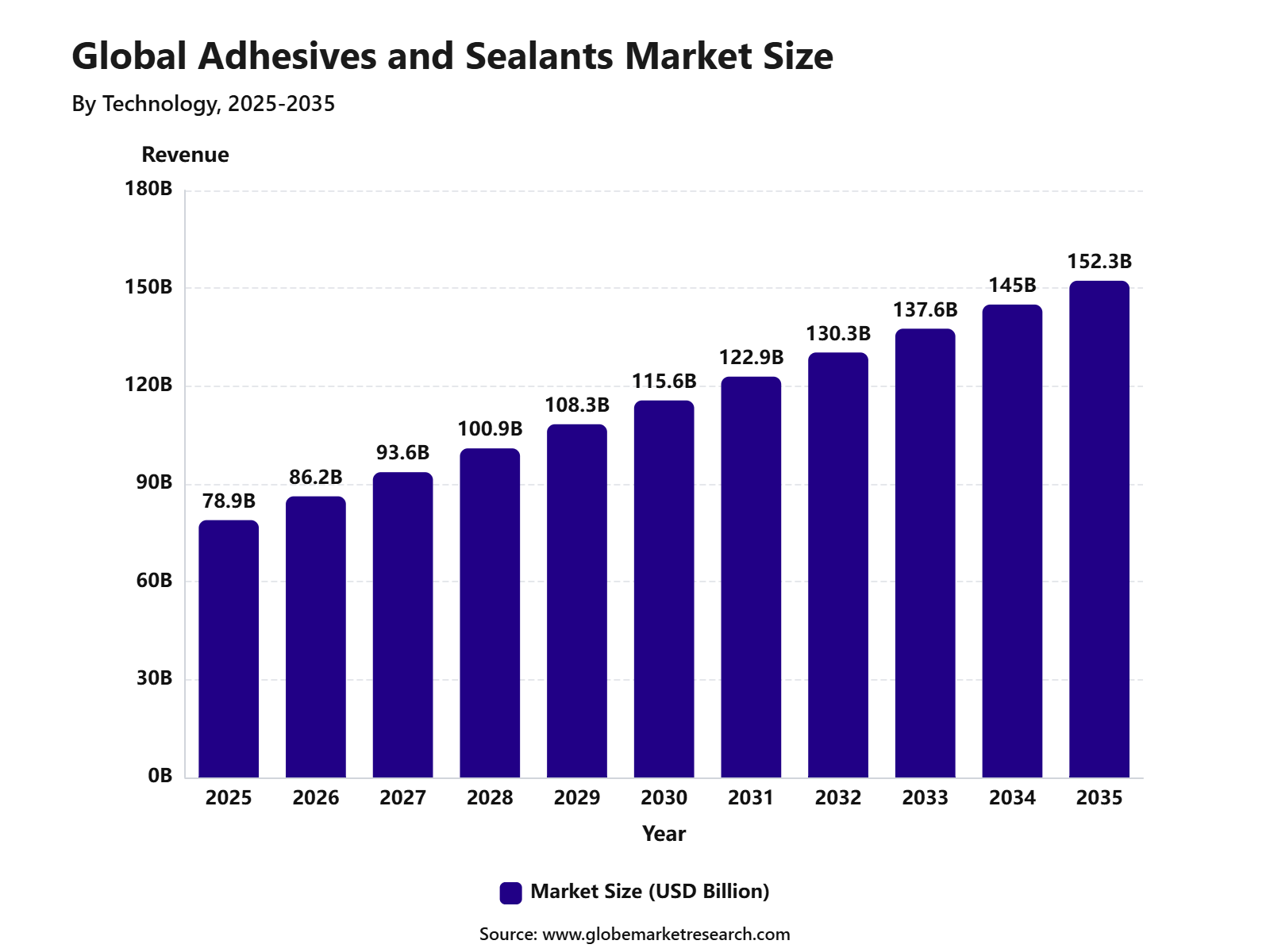 iThe graph shows projected market growth until 2035 based on CAGR analysis. Actual outcomes may vary depending on changing demand, competition, and economic factors.To gain greater insights - request a sample report PDF
The market outlook remains positive as industries continue to replace mechanical fasteners with lightweight, flexible, and high-strength bonding solutions. Growth can be attributed to rising demand for sustainable packaging, energy-efficient buildings, electric vehicles, and advanced manufacturing processes. The expansion of water-based, hot-melt, silicone, and low-VOC adhesive technologies is expected to support long-term market demand.
Report Highlights | Details |
|---|---|
Market Revenue (2025) | USD 78.9 Billion |
Forecast Revenue (2035) | USD 152.3 Billion |
CAGR (2025-2035) | 6.8% |
Base Year for Estimation | 2025 |
Historic Data | 2020-2024 |
Forecast Period | 2025-2035 |
Key Market Insights
Water based technology led the market with 25.8% share, supported by rising demand for low-VOC bonding solutions, safer application, and better environmental compliance.
Acrylic adhesives accounted for 36.9% share, driven by strong bonding strength, fast curing, durability, and wide use across packaging, construction, automotive, and consumer applications.
Silicone sealants held 33.2% share, supported by their flexibility, weather resistance, waterproofing ability, and strong use in construction, glazing, automotive, and industrial sealing.
Paper and packaging captured 29.4% share by adhesives application, driven by growing demand for cartons, labels, flexible packaging, corrugated boxes, and e-commerce packaging.
Construction led the sealants application segment with 44.8% share, supported by strong use in joints, facades, flooring, windows, doors, roofing, and infrastructure projects.
Asia Pacific led the adhesives and sealants market with 37.5% share, supported by expanding construction activity, strong packaging demand, rising manufacturing output, and high consumption across China, India, Japan, and Southeast Asia.
Top Funding and Investment Highlights
Investment in the adhesives and sealants market is being led by water-based tapes, medical adhesives, flooring adhesives, construction sealants, industrial bonding systems, specialty hot-melt technologies, and regional manufacturing capacity. Capital is shifting toward products with low-VOC performance, stronger regulatory fit, recyclable packaging compatibility, and higher use in healthcare, construction, automotive, electronics, hygiene, and industrial assembly.
H.B. Fuller announced a recommended cash offer to acquire Advanced Medical Solutions Group for an enterprise value of GBP 715 million. The acquisition is focused on tissue bonding adhesives, medical tapes and dressings, and formulated biosurgicals. The company stated that the deal would expand its total addressable market by USD 15 billion to USD 95 billion and add around USD 300 million in annual revenue. This investment highlights the rising value of medical-grade adhesive technologies, where regulatory barriers and specialized formulations support stronger margins.
Henkel signed an agreement in January 2026 to acquire Switzerland-based ATP Adhesive Systems from Arsenal Capital Partners. ATP is known for high-performance water-based specialty tapes used in automotive, electronics, medical, building and construction, and graphics applications. The company employs around 700 people and generated expected fiscal 2025 sales of about EUR 270 million. More than 90% of ATP’s portfolio uses water-based technologies, which supports Henkel’s low-VOC and sustainable bonding strategy.
Avery Dennison completed the acquisition of Meridian Adhesives Group’s U.S. based flooring adhesives business for USD 390 million in October 2025. The acquired business includes Taylor Adhesives, Polycom, and Frontier Products, and focuses on specialty adhesives and coatings for the U.S. flooring industry. This deal strengthens Avery Dennison’s position in high-value adhesive solutions linked to resilient flooring, construction renovation, and professional installation demand.
By Technology
Water based technology accounted for 25.8% share of the Adhesives and Sealants Market. Its strong position can be attributed to lower solvent content, safer handling, and wider use in packaging, woodworking, construction, labels, tapes, and consumer product applications. These systems are preferred where low odor, easier cleanup, and reduced environmental impact are required.
Water based adhesives offer good bonding strength for paper, board, textiles, films, and porous surfaces, making them suitable for high-volume industrial use. Demand is also supported by stricter emission control standards and rising preference for sustainable bonding solutions. As packaging, construction, and furniture production continue to expand, water based technology is expected to remain an important formulation category.
By Adhesives Product
Acrylic adhesives held 36.9% share of the Adhesives and Sealants Market. This dominance is supported by their strong bonding performance, weather resistance, fast curing ability, and compatibility with metals, plastics, glass, paper, wood, and coated surfaces. The segment is widely used in packaging, automotive, electronics, construction, medical products, tapes, labels, and assembly applications.
Acrylic adhesives are valued because they can maintain strength under moisture, heat, UV exposure, and changing operating conditions. Their demand is expected to remain firm as manufacturers seek durable and versatile bonding materials. Acrylic adhesives also support lightweight assembly and surface protection needs, especially in transport, electronics, and industrial production.
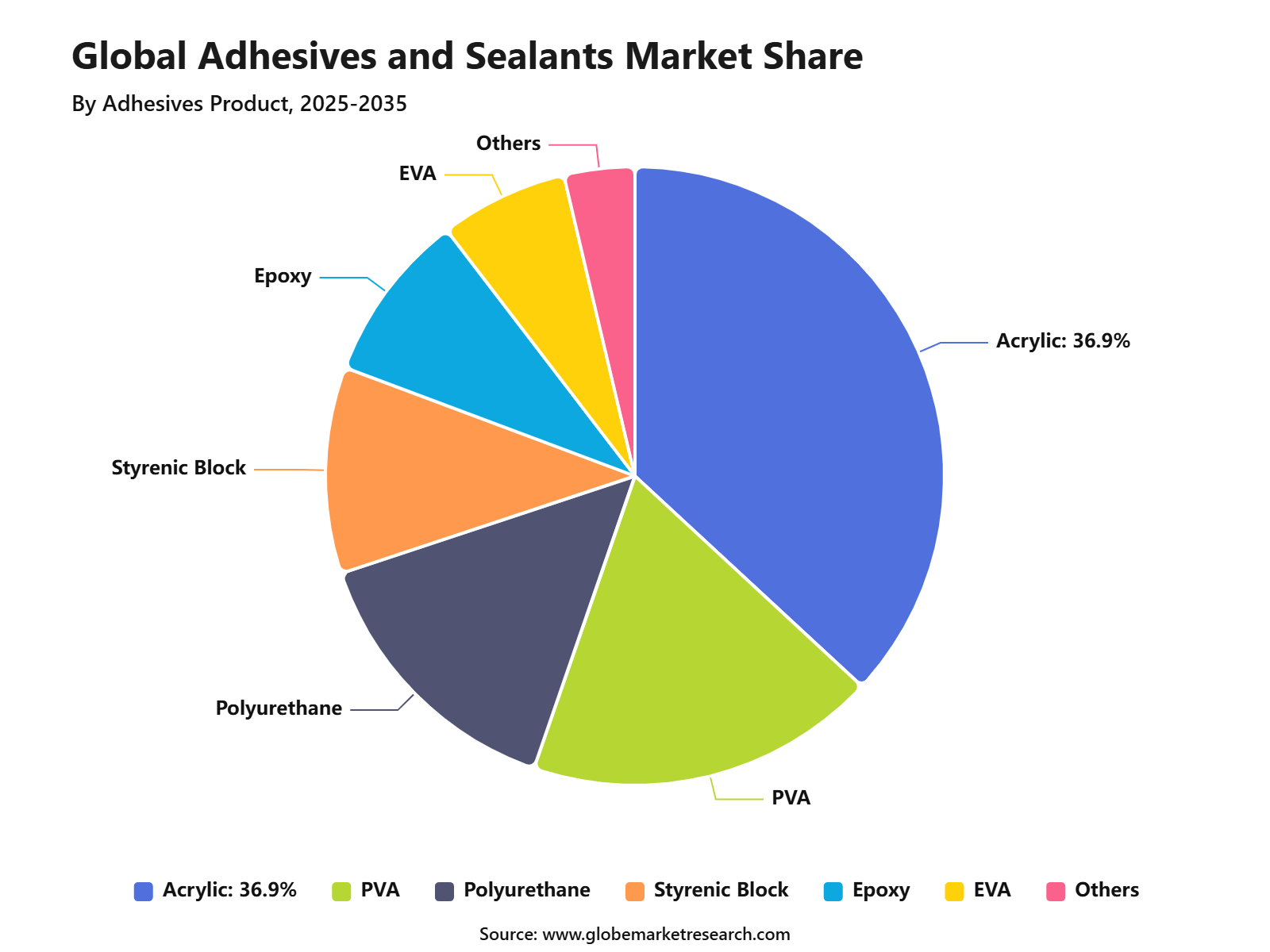 iThe graph shows projected market growth until 2035 based on CAGR analysis. Actual outcomes may vary depending on changing demand, competition, and economic factors.To gain greater insights - request a sample report PDF
By Sealants Product
Silicone sealants accounted for 33.2% share of the Adhesives and Sealants Market. Their leadership is driven by excellent flexibility, water resistance, UV stability, thermal resistance, and long service life across construction, automotive, electronics, and industrial uses. These sealants are widely applied in glazing, façade joints, bathrooms, kitchens, expansion joints, electrical insulation, and automotive components.
Silicone sealants perform well in areas exposed to moisture, temperature changes, sunlight, and structural movement. The segment benefits from strong construction and renovation activity, where reliable sealing is required for energy efficiency, leakage control, and durability. Their ability to maintain elasticity over time makes silicone sealants a preferred product type in demanding applications.
By Adhesives Application
Paper and packaging applications captured 29.4% share of the Adhesives and Sealants Market. This leading share is supported by strong demand from cartons, corrugated boxes, labels, flexible packaging, paper bags, envelopes, and consumer goods packaging. Adhesives are essential in packaging because they provide secure bonding, fast processing, clean application, and compatibility with automated production lines.
Water based, hot melt, and acrylic adhesives are widely used to support high-speed packaging operations. Growth in packaged food, e-commerce shipments, personal care products, and retail-ready packaging continues to support this segment. As brands focus on recyclable and lightweight packaging formats, adhesive performance is becoming more important in package design and production efficiency.
By Sealants Application
Construction applications held 44.8% share of the Adhesives and Sealants Market. This dominance is driven by high use in flooring, roofing, glazing, façade systems, insulation, wall joints, bathrooms, kitchens, concrete repair, and structural sealing. Sealants are used to prevent air leakage, water entry, dust movement, and joint failure in buildings and infrastructure.
Silicone, polyurethane, acrylic, and hybrid sealants are commonly selected based on flexibility, adhesion, weather resistance, and movement capability. The segment is expected to remain strong as urban development, repair work, and energy-efficient building practices increase. Construction sealants help improve building durability, indoor comfort, and long-term maintenance performance, making them a critical material in modern projects.
By Region
Asia Pacific accounted for 37.5% share of the Adhesives and Sealants Market, making it the leading regional market. Growth is supported by strong activity in packaging, construction, automotive, electronics, furniture, footwear, and industrial manufacturing. China, India, Japan, South Korea, and Southeast Asian countries are key demand centers due to large production bases and expanding consumer markets.
Rising infrastructure spending, e-commerce growth, and export-oriented manufacturing continue to support regional consumption. Asia Pacific is expected to maintain its leading position as industrial capacity and urban construction continue to grow. Demand for cost-effective, durable, and application-specific bonding and sealing solutions will remain strong across major end-use industries.
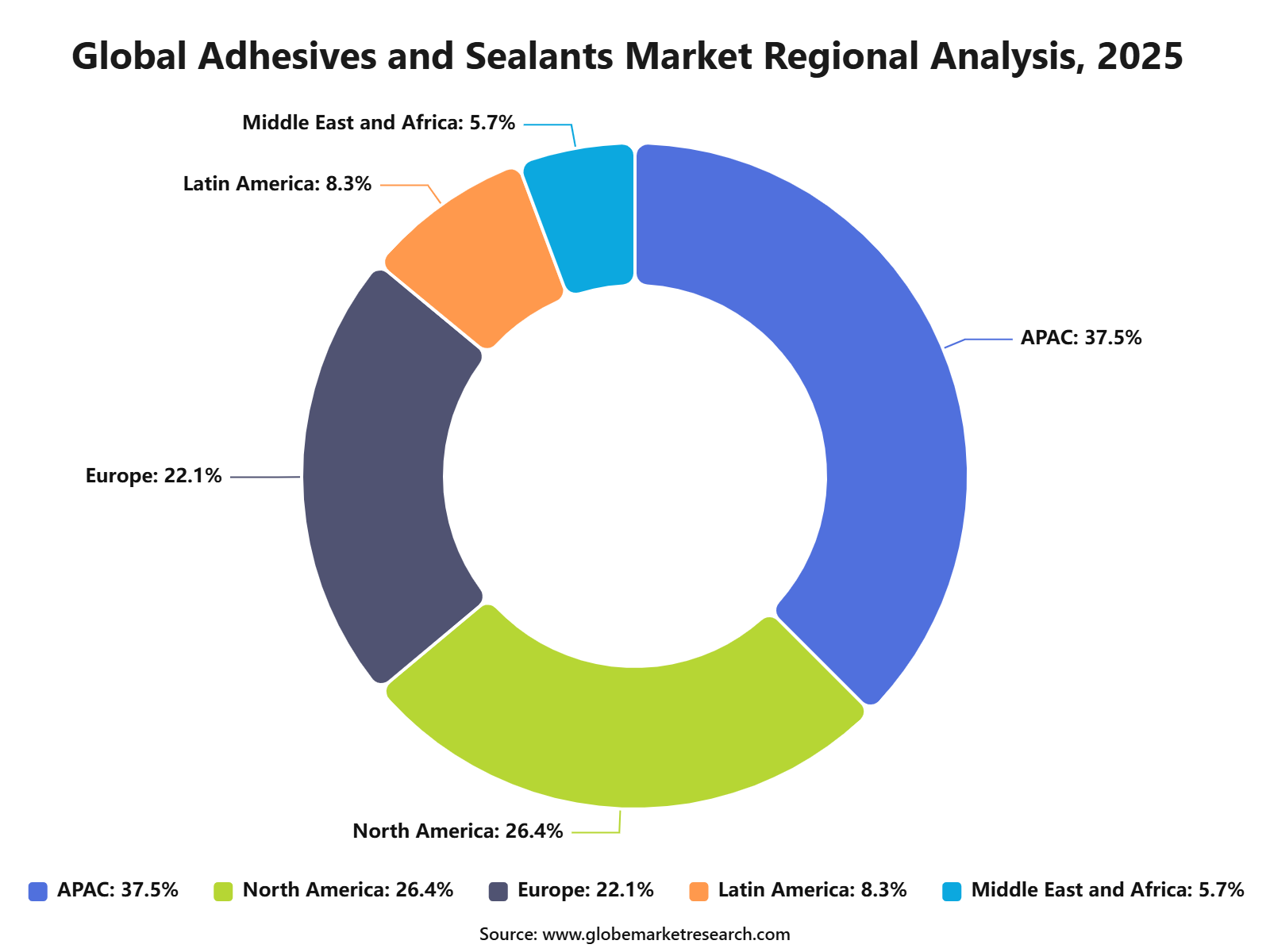 iThe graph shows projected market growth until 2035 based on CAGR analysis. Actual outcomes may vary depending on changing demand, competition, and economic factors.To gain greater insights - request a sample report PDF
Go-To-Market and Sales Economics
The go-to-market approach for the Adhesives and Sealants Market should focus on application performance, regulatory fit and supply reliability. Buyers in packaging, construction, automotive, electronics, hygiene and consumer goods need bonding solutions that improve durability, line speed, safety and material efficiency. Henkel’s Adhesive Technologies business generated €2,627 million in Q1 2026 sales, with 1.7% organic growth, supported mainly by strong demand in mobility and electronics applications.
Sales economics are being shaped by pricing discipline and technical account management. H.B. Fuller reported USD 950 million in Q2 2026 net revenue, up 5.8% year over year, while pricing added 3.0% to revenue and helped offset softer volume. This shows that adhesive suppliers with strong customer relationships, sourcing flexibility and product qualification support can protect revenue even in uneven industrial demand.
The strongest sales model is consultative selling, where suppliers help customers reduce downtime, improve substrate compatibility and meet end-use compliance needs. In adhesives and sealants, switching suppliers is not always easy because products are often validated into packaging lines, building systems, vehicle parts or electronics assemblies. This creates stronger retention for companies that provide testing, formulation support, local inventory and consistent batch quality.
Revenue Potential Analysis
Revenue Landscape Across
Revenue potential is spread across packaging adhesives, construction sealants, pressure-sensitive adhesives, tapes, labels, automotive bonding, electronics assembly, hygiene products, woodworking, flooring, roofing and industrial maintenance. Packaging remains one of the most active revenue channels. AF&PA reported that U.S. packaging papers and specialty packaging shipments increased 12% in May 2026 compared with May 2025, with shipments up 6% for the first five months of 2026.
Construction is another major revenue pool for sealants, waterproofing products, flooring adhesives, façade systems, roofing membranes and repair materials. U.S. construction spending reached a seasonally adjusted annual rate of USD 2,172.4 billion in April 2026, while private residential construction stood at USD 909.9 billion. This supports demand for adhesives and sealants used in housing, public infrastructure, commercial buildings and renovation activity.
Automotive and mobility applications are also supporting higher-value demand. Global vehicle production increased to 96.4 million units in 2025, while vehicle sales reached 99.8 million units. Adhesives and sealants are increasingly used in lightweighting, battery packs, interior trims, glass bonding, noise reduction, thermal management and structural joining, especially as automakers reduce mechanical fasteners and improve vehicle efficiency.
Financial Impact
The financial impact of adhesives and sealants is mainly linked to margin protection, raw material control and value-added formulations. H.B. Fuller’s Q2 2026 adjusted gross margin reached 34.2%, up 200 basis points year over year, while adjusted EBITDA rose 9% to USD 181 million. This shows that pricing execution, restructuring savings and product mix can improve profitability even when some end-use volumes remain soft.
Raw material volatility remains a key cost factor for producers and converters. Acrylic acid, used in several acrylic adhesive systems, was priced in June 2026 at USD 1.58/kg in North America, USD 1.45/kg in Europe and USD 1.19/kg in Northeast Asia. Feedstock-linked contracts, regional sourcing and faster price pass-through are therefore important for protecting supplier margins.
Profitability is expected to be stronger for companies that sell engineered systems rather than commodity bonding products. Sika reported CHF 11,201.3 million in 2025 sales and improved its material margin to 54.9%, supported by innovation and input-cost management. Adhesives and sealants suppliers with differentiated products, approved specifications and technical service capabilities are likely to capture better margins than suppliers competing mainly on price.
Drivers Impact Analysis
The Adhesives and Sealants Market is driven by rising demand from packaging, construction, automotive, electronics, footwear, woodworking, healthcare, and consumer goods. These materials are widely used for bonding, sealing, laminating, assembly, insulation, protection, and lightweight product design.
Asia Pacific supports strong demand because of large manufacturing output, infrastructure development, packaging growth, and automotive production. China, India, Japan, South Korea, and Southeast Asia remain key contributors due to high consumption across construction chemicals, industrial assembly, and consumer product manufacturing.
Impact Factor | Estimated CAGR Impact | Regional Relevance | Market Impact |
|---|---|---|---|
Rising packaging industry demand | +1.7% | Asia Pacific, North America, Europe | Drives core consumption. |
Growth in construction applications | +1.4% | China, India, Southeast Asia, Middle East | Supports sealing demand. |
Automotive lightweighting trend | +1.2% | Asia Pacific, Europe, North America | Increases bonding use. |
Expansion of electronics assembly | +1.0% | China, Japan, South Korea, Taiwan | Builds precision demand. |
Demand from woodworking and furniture | +0.8% | Asia Pacific, Europe, North America | Adds steady volume. |
Restraints Impact Analysis
The market faces restraints from raw material price volatility, especially petrochemical-based resins, solvents, rubber, acrylics, silicones, and polyurethane inputs. These cost changes can pressure margins for manufacturers and raise prices for downstream customers. Environmental regulations also affect solvent-based adhesives and sealants. Producers must reduce VOC emissions, improve worker safety, and develop cleaner formulations, which can increase R&D spending and reformulation costs.
Impact Factor | Estimated CAGR Impact | Regional Relevance | Market Impact |
|---|---|---|---|
Raw material price volatility | -0.9% | Global producers | Pressures margins. |
VOC and emission regulations | -0.8% | Europe, North America, Japan | Raises compliance burden. |
Competition from mechanical fastening | -0.6% | Construction and industrial markets | Limits substitution. |
Performance limits in harsh conditions | -0.5% | Marine, automotive, infrastructure | Restricts application fit. |
Disposal and recyclability concerns | -0.4% | Packaging and consumer goods sectors | Adds sustainability pressure. |
Opportunities Impact Analysis
Opportunities are growing in water-based adhesives, hot-melt adhesives, silicone sealants, construction sealants, flexible packaging, EV battery assembly, and medical adhesives. These applications need stronger bonding, faster curing, safer chemistry, and better durability. Sustainable adhesive technologies also create strong future value. Companies that offer low-VOC, bio-based, recyclable-compatible, and high-performance formulations can gain stronger demand from packaging, automotive, construction, and electronics customers.
Impact Factor | Estimated CAGR Impact | Regional Relevance | Market Impact |
|---|---|---|---|
Water-based adhesive expansion | +1.6% | Asia Pacific, Europe, North America | Supports cleaner growth. |
EV and battery assembly demand | +1.3% | China, Europe, U.S., South Korea | Builds future usage. |
Sustainable packaging adhesives | +1.2% | Global packaging hubs | Adds green value. |
Construction sealant innovation | +1.0% | Asia Pacific, Middle East, North America | Expands building demand. |
Medical and hygiene adhesive growth | +0.8% | North America, Europe, Asia Pacific | Supports premium use. |
Challenges Impact Analysis
The main challenge is balancing bonding strength, curing speed, flexibility, cost, and environmental compliance. End users want adhesives and sealants that perform across different substrates while meeting safety and sustainability expectations. Another challenge is product customization. Packaging films, metals, glass, wood, concrete, textiles, plastics, and electronics all require different adhesive chemistry, which increases technical service needs and formulation complexity.
Impact Factor | Estimated CAGR Impact | Regional Relevance | Market Impact |
|---|---|---|---|
Balancing cost and performance | -0.8% | Global customers | Affects buying decisions. |
Meeting substrate-specific needs | -0.7% | Packaging, construction, electronics | Raises customization. |
Improving recyclability compatibility | -0.6% | Europe, North America, Asia Pacific | Requires reformulation. |
Maintaining durability under stress | -0.5% | Automotive, construction, marine | Protects product reliability. |
Reducing curing and application time | -0.4% | Manufacturing and assembly lines | Affects productivity. |
Segment overed in the Report
By Technology
Solvent Based
Hot Melt
Reactive
Others
By Adhesives Product
Acrylic
PVA
Polyurethane
Styrenic Block
Epoxy
EVA
Others
By Sealants Product
Silicone
Polyurethane
Acrylic
Polyvinyl Acetate
Others
By Adhesives Application
Paper and Packaging
Consumer and DIY
Building and Construction
Furniture and Woodworking
Footwear and Leather
Automotive and Transportation
Medical
Others
By Sealants Application
Construction
Packaging
Automotive and Transportation
Consumer
Others
By Region
North America
Europe
Asia Pacific
Latin America
Middle East and Africa
Market Trend Analysis
The market trend is moving toward water-based, hot-melt, silicone, polyurethane, acrylic, and epoxy adhesive systems. Water-based and hot-melt products are gaining importance because they support faster processing, lower emissions, and wider packaging use. Sealants are also becoming more important in construction, transportation, and industrial applications. Demand is rising for products that resist moisture, heat, vibration, UV exposure, chemicals, and structural movement.
Impact Factor | Estimated CAGR Impact | Regional Relevance | Market Impact |
|---|---|---|---|
Water-based adhesives gain preference | +1.5% | Asia Pacific, Europe, North America | Leads cleaner shift. |
Hot-melt adhesive use expands | +1.3% | Packaging, hygiene, labels | Supports fast bonding. |
Silicone sealants remain important | +1.1% | Construction, automotive, electronics | Adds durable sealing. |
Construction sealants gain demand | +1.0% | Asia Pacific, Middle East, North America | Supports building growth. |
Flexible packaging adhesives rise | +0.8% | Global consumer markets | Builds recurring demand. |
Investor Type Impact Matrix
Investors should focus on adhesive and sealant companies with strong formulation capability, diversified end-use exposure, reliable raw material access, and technical service strength. Packaging, construction, automotive, and electronics provide both volume and value opportunities. Strategic investors can also target sustainable adhesives, water-based technologies, hot-melt systems, specialty sealants, and EV bonding materials. Companies that combine performance, compliance, and application support are better positioned for long-term growth.
Investor Type | Estimated CAGR Impact | Regional Relevance | Market Impact |
|---|---|---|---|
Adhesive and Sealant Manufacturers | +1.5% | Global | Expands product capacity. |
Packaging Material Companies | +1.2% | Asia Pacific, Europe, North America | Drives adhesive demand. |
Construction Chemical Companies | +1.0% | Asia Pacific, Middle East, North America | Supports sealant use. |
Automotive and Electronics Suppliers | +0.9% | China, Europe, U.S., Japan | Builds technical demand. |
Sustainability and Strategic Investors | +0.7% | Europe, North America, Asia Pacific | Funds cleaner systems. |
Recent Developments
In January 2026, Henkel agreed to acquire ATP Adhesive Systems, a Swiss specialist in high-performance water-based specialty tapes. ATP serves automotive, electronics, medical, building and construction, and graphics applications, with around 700 employees and expected 2025 sales of about EUR 270 million.
In February 2026, BASF announced that it would expand dispersions production capacity at its Mangalore site in India through a new production line. Polymer dispersions are used in adhesives, sealants, construction chemicals, paper applications, and coatings. This expansion supports local supply in India, where construction, packaging, and paper value chains continue to require reliable water-based formulation inputs.
Research Methodology
Methodology Area | Coverage Details |
|---|---|
Primary Research | Interviews with manufacturers, suppliers, distributors, consultants, procurement teams, and industry experts. |
Secondary Research | Company filings, annual reports, regulatory databases, government publications, trade associations, and verified industry sources. |
Data Validation | Cross-verification through source triangulation, historical trend review, demand-side checks, and supply-side assessment. |
Market Estimation | Bottom-up and top-down analysis based on product demand, regional consumption, company presence, and application-level usage. |
Forecasting Approach | Forecasts based on regulatory shifts, infrastructure investment, technology adoption, pricing trends, industrial expansion, and end-use demand. |
Quality Review | Analyst review, peer validation, outlier checks, internal consistency review, and final publication approval. |
AI Policy | AI is not used as a primary data source. All published insights are reviewed against human-verified evidence. |
Competitive Landscape
The market is characterized by intense competition among established players and emerging companies. Strategic partnerships, mergers and acquisitions, and product innovation are key strategies employed by market participants.
Key Market Players
3M Company
Ashland Inc.
Avery Dennison Corporation
H.B. Fuller
Henkel AG
Sika AG
Pidilite Industries
Huntsman
Wacker Chemie AG
RPM International Inc.
Dow
Kuraray Co., Ltd.
Other Key Players
Meet the Team
This report was prepared by our expert analysts with deep industry knowledge and research experience.
Pratiksha is market research analyst with strong experience in industry research, market forecasting, and competitive analysis. She specializes in identifying market trends, evaluating growth opportunities, and preparing data-driven insights across global industries. Her work supports businesses in understanding market dynamics, customer demand, regional opportunities, and strategic investment areas.
Sayali brings more than 5 years of experience to Globe Market Research, supporting the accuracy, clarity, and relevance of research content across multiple industries. She reviews market data, segment analysis, competitive insights, and industry trends to ensure each report meets strong quality standards and provides practical value to business decision-makers. Her expertise spans healthcare, information technology, consumer goods, and diverse cross-industry domains. With a strong focus on data reliability, structured analysis, and clear presentation, Sayali helps ensure that each research output delivers well-reviewed insights for clients, investors, consultants, and industry stakeholders.
Frequently Asked Questions
Related Reports
More in Chemical and Material
Carbon Capture Chemicals Market Size to Reach USD 78.0 Billion by 2035
Carbon Capture Chemicals Market By Chemical Type (Amines, Carbonates, Ammonia-based Solvents, Ionic Liquids, Solid Sorbent Chemicals, Others), By Absorption Type (Chemical Absorption, Physical Absorption), By End-Use Industry (Oil and Gas, Power Generation, Chemical and Petrochemical, Cement, Iron and Steel, Others), By Application (Post-combustion Capture, Pre-combustion Capture, Industrial Gas Separation, Direct Air Capture, Others), By Regional Insights, Business plan and Project Report, Investment Opportunities, Profitability, Industry Trends, Leading Companies and Growth Forecasts by 2025-2035
Bio-based Chemicals Market Size to Hit USD 296.7 Bn by 2035
Bio-based Chemicals Market By Product Category (Platform Chemicals, Polymers for Plastics, Paints, Coatings, Inks and Dyes, Surfactants, Cosmetics and Personal Care Products, Adhesives, Man-made Fibers, Others), By Application (Industrial, Agricultural, Pharmaceutical, Others), By Source (Plant-based, Animal-based, Microbial-based, Waste-based), By End Use (Chemical Manufacturing, Agriculture, Food and Beverage, Personal Care, Pharmaceuticals, Automotive), By Regional Insights, Business plan and Project Report, Investment Opportunities, Profitability, Industry Trends, Leading Companies and Growth Forecasts by 2025-2035
Hydrogen Processing Chemicals Market Size to Hit USD 14.6 Billion by 2035
Hydrogen Processing Chemicals Market By Chemical Type (Catalysts, Adsorbents, Solvents, Corrosion Inhibitors, Scavengers, Others), By Function (Reforming Chemicals, Purification Chemicals, Hydroprocessing Chemicals, Gas Treatment Chemicals, Corrosion Control Chemicals, Others), By Process (Steam Methane Reforming, Hydrocracking, Hydrotreating, Pressure Swing Adsorption, Water-Gas Shift Reaction, Others), By End Use (Refineries, Ammonia Production, Methanol Production, Petrochemicals, Clean Hydrogen Plants, Others), By Regional Insights, Business plan and Project Report, Investment Opportunities, Profitability, Industry Trends, Leading Companies and Growth Forecasts by 2025-2035
Electrolyte Chemicals Market to Cross USD 49.4 Billion by 2035
Electrolyte Chemicals Market By Battery Type (Lithium-ion Electrolytes, Lead-acid Electrolytes, Flow Battery Electrolytes, Others), By Electrolyte Form (Liquid Electrolytes, Gel, Solid-State Electrolytes), By Application (Electric Vehicles, Energy Storage Systems, Consumer Electronics, Industrial and Motive Batteries, Others), By Product Type (Lithium-Based Electrolytes, Sulfide-Based Electrolytes, Polymer-Based Electrolytes, Oxide-Based Electrolytes, Others), By Regional Insights, Business plan and Project Report, Investment Opportunities, Profitability, Industry Trends, Leading Companies and Growth Forecasts by 2025-2035