
Revenue, 2026
USD 6.1 Bn
Forecast, 2035
USD 1,222.1 Bn
CAGR, 2026-2035
80.2%
Report Coverage
Global
Market Size and Forecast
Agentic CPUs are processors designed to support the orchestration, memory management, tool execution, data retrieval and real-time decision-making required by autonomous AI agents. Unlike traditional generative AI applications that mainly send prompts to GPU-based models, agentic systems repeatedly plan, call external tools, process results and adjust their actions. This creates additional demand for high-core-count CPUs, fast single-thread performance, large memory bandwidth, low-latency connectivity and efficient coordination with GPUs and other AI accelerators.
The global Agentic CPU Market was valued at USD 6.1 billion in 2026 and is projected to reach approximately USD 1,222.1 billion by 2035, growing at a CAGR of 80.2% from 2026 to 2035. North America accounted for around 47.8% of the market, representing approximately USD 2.9 billion in 2026. Regional leadership is being supported by hyperscale data-center investment, advanced semiconductor development, expanding cloud AI infrastructure and early deployment of autonomous agents across software development, customer service, cybersecurity, research and enterprise operations.
Key Parameter | Report Details |
|---|---|
Market Revenue, 2026 | USD 6.1 Billion |
Projected Revenue, 2035 | USD 1,222.1 Billion |
CAGR, 2026-2035 | 80.2% |
Largest Region | North America, 47.8% Share |
Market Concentration | Medium |
Base Year | 2025 |
Forecast Period | 2026-2035 |
A 2025 technical study found that CPU-based tool processing represented up to 90.6% of total latency in selected agentic workloads, while CPUs consumed up to 44% of total dynamic energy at large batch sizes. Arm introduced its AGI CPU in March 2026 for rack-scale agentic AI infrastructure, with the company reporting more than twice the performance per rack compared with recent x86-based systems. NVIDIA has also positioned its Vera CPU for agent orchestration and high-throughput reasoning, while AMD projects that the total addressable CPU market could approximately quadruple by 2030 as agentic AI increases demand for CPU-intensive processing.
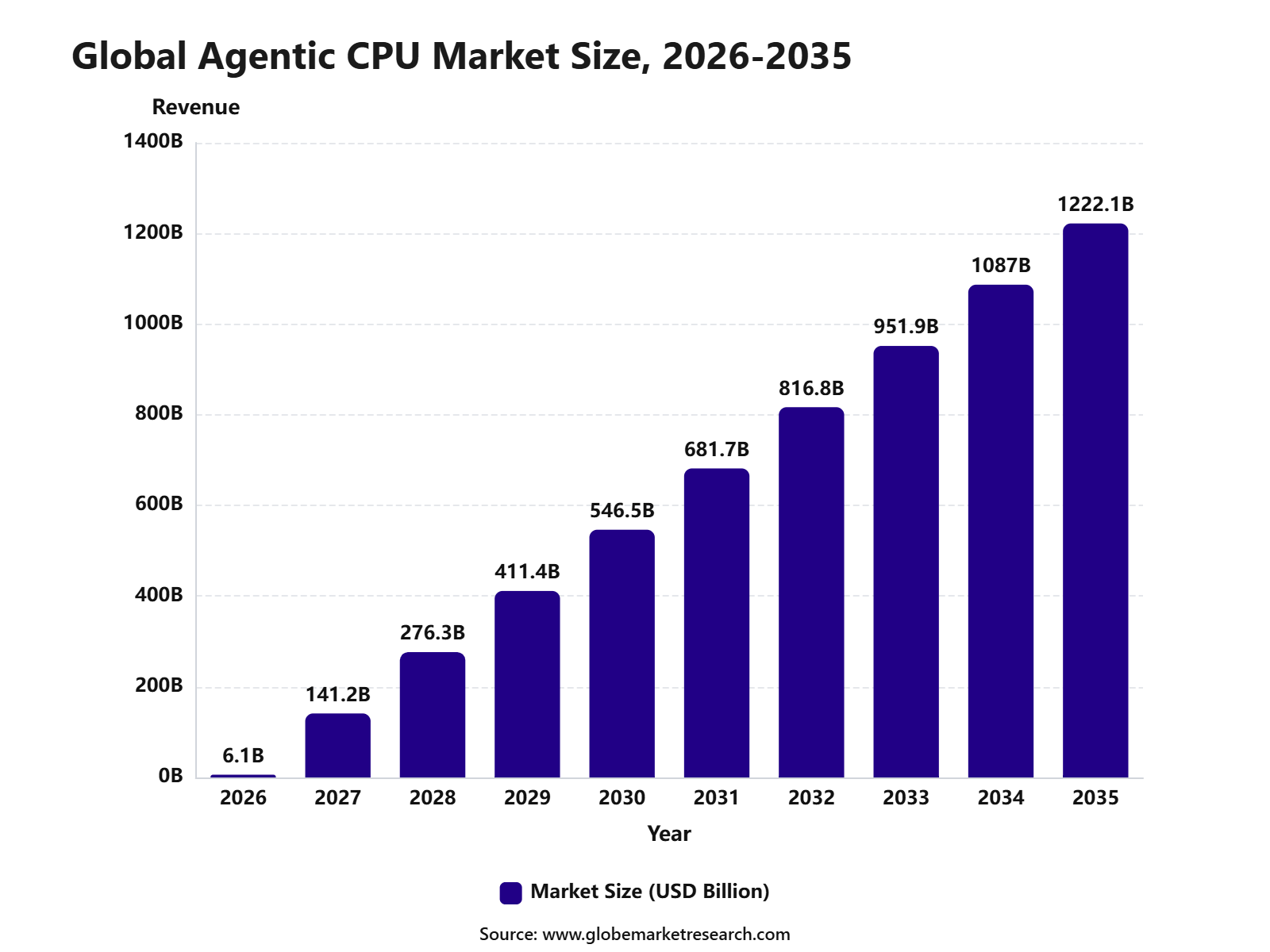 iThe graph shows projected market growth until 2035 based on CAGR analysis. Actual outcomes may vary depending on changing demand, competition, and economic factors.To gain greater insights - request a sample report PDF
Key Market Insights
x86 processors led the CPU architecture segment with 70.1% share, supported by strong compatibility with enterprise workloads, cloud infrastructure, AI software stacks, and existing data center systems.
Cloud data centers accounted for 53.2% share by deployment environment, driven by rising demand for scalable compute capacity, AI workload processing, and agent-based automation services.
AI copilots and digital agents held 28.3% share by application, supported by growing use of intelligent assistants for coding, workflow automation, customer support, analytics, and enterprise productivity.
Hyperscale cloud providers captured 40.2% share by end user, driven by large-scale AI infrastructure investments, high server deployment volumes, and rising demand for agentic computing platforms.
North America led the agentic CPU market with 47.8% share, supported by advanced cloud ecosystems, strong AI chip development, major hyperscale operators, and high enterprise adoption of AI agents.
CPU Architecture Insights
In 2025, x86 processors accounted for 70.1% of the Agentic CPU Market by CPU architecture. Their leading position is supported by the large installed base of x86 servers across cloud platforms, enterprise data centers and high-performance computing systems. Existing compatibility with operating systems, development tools and business applications also allows organizations to introduce agentic AI workloads without rebuilding their complete computing environment.
Current processor demand indicates that general-purpose CPUs continue to play an important role alongside AI accelerators. According to AMD, its data center segment revenue increased by 57% year over year in the first quarter of 2026, supported by strong demand for EPYC processors and AI computing products. EPYC processors use the x86 architecture and are designed for cloud, enterprise and large data center workloads.
x86 processors are particularly suitable for workload orchestration, agent scheduling, memory management, database access and communication between AI models and enterprise applications. Their broad software compatibility reduces migration difficulties for businesses introducing autonomous agents. Competition will increasingly be influenced by core density, memory bandwidth, energy efficiency and the ability to work closely with GPUs and other AI accelerators.
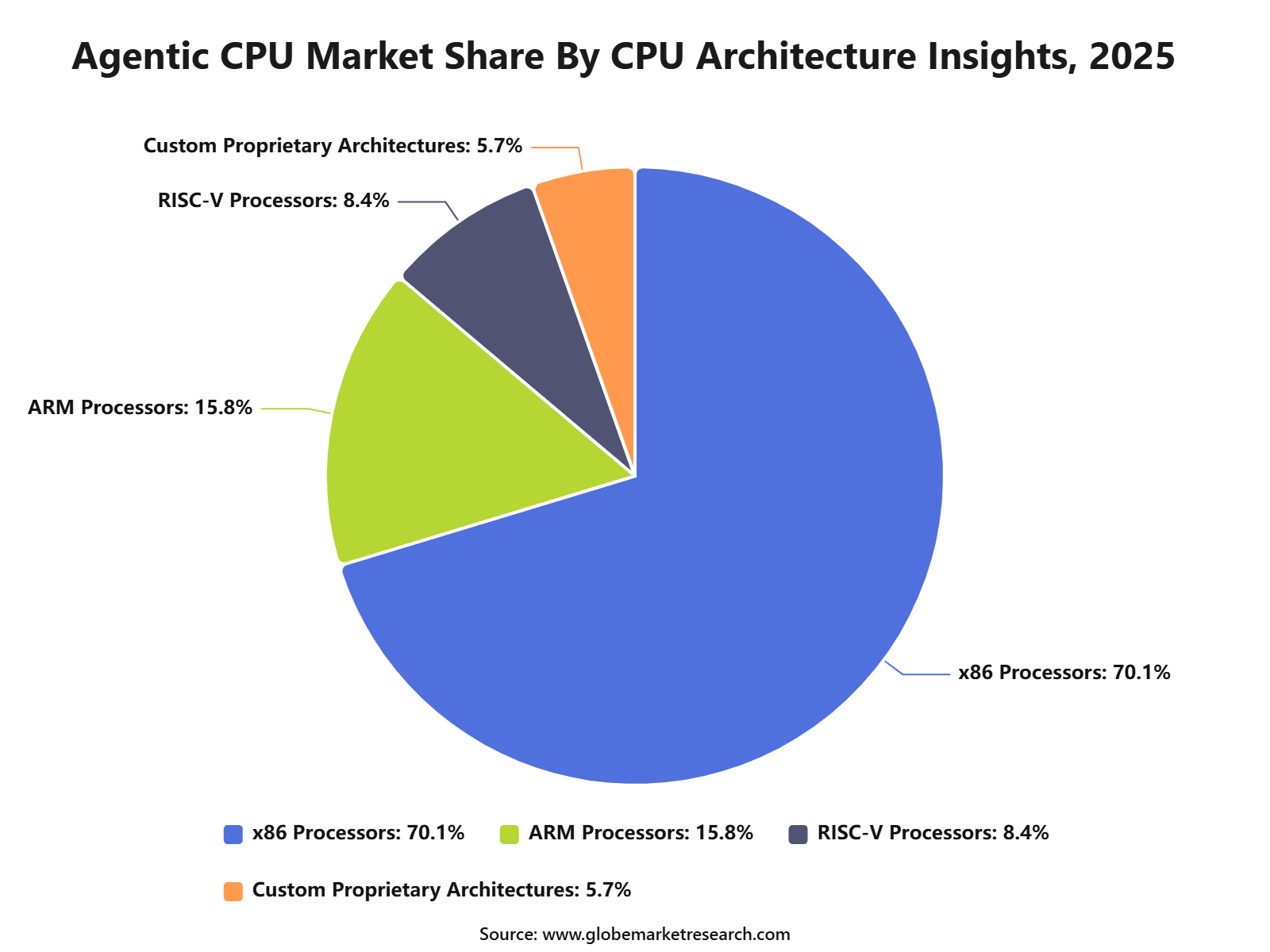 iThe graph shows projected market growth until 2035 based on CAGR analysis. Actual outcomes may vary depending on changing demand, competition, and economic factors.To gain greater insights - request a sample report PDF
Deployment Environment Insights
In 2025, Cloud data centers represented 53.2% of the market by deployment environment. Cloud infrastructure allows agentic AI applications to access computing capacity, storage and networking resources as demand changes. It also supports centralized model deployment, continuous software updates and connections between multiple agents operating across different business functions.
According to the International Energy Agency, global electricity demand from data centers increased by 17% in 2025. Electricity consumption from AI-focused data centers increased by approximately 50% during the same year, showing that AI workloads are expanding much faster than general digital infrastructure.
Cloud deployment is well suited to agentic applications because these systems may need to process large numbers of requests, use several models and access real-time business data. Cloud environments also make it easier to monitor agent activity and apply security policies from a central location. However, providers must address power availability, data privacy, service reliability and the cost of continuous inference.
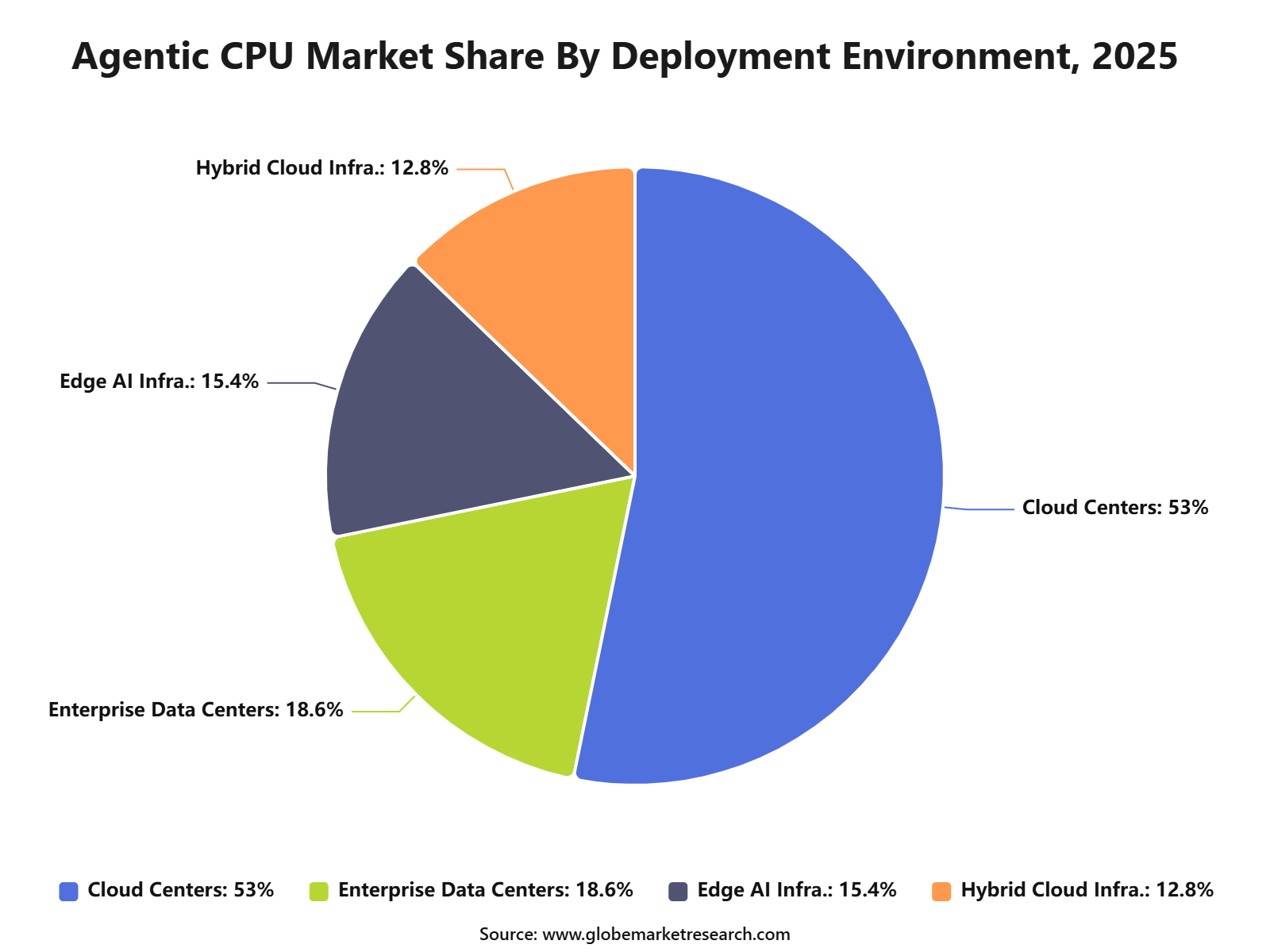 iThe graph shows projected market growth until 2035 based on CAGR analysis. Actual outcomes may vary depending on changing demand, competition, and economic factors.To gain greater insights - request a sample report PDF
Application Insights
In 2025, AI copilots and digital agents accounted for 28.3% of the Agentic CPU Market by application. These systems assist users with document preparation, software development, research, customer service, workflow management and operational decision-making. CPU resources are required to coordinate model requests, retrieve information, manage application logic and maintain interactions between users and agents.
According to Microsoft’s 2025 annual report, more than 230,000 organizations were using Copilot Studio to extend workplace copilots or build their own agents. The 2025 Work Trend Index also found that 67% of business leaders were familiar with AI agents, compared with 40% of employees. These figures show that agent-based applications are moving from early testing into wider organizational use.
Application | Market Share |
|---|---|
AI Copilots and Digital Agents | 28.3% |
Multi-Agent Systems | 16.4% |
AI Agent Orchestration | 14.7% |
Retrieval-Augmented Generation | 12.8% |
Autonomous Software Development | 9.6% |
Robotics and Physical AI | 8.2% |
Research and Scientific Computing | 6.1% |
Other Agentic Workflows | 3.9% |
AI copilots create demand for processors that can support low-latency responses and handle many user sessions at the same time. Unlike traditional software, digital agents may repeatedly call models, databases and external tools before completing a task. Processor suppliers must therefore improve workload coordination, security isolation and performance across mixed AI and conventional computing operations.
End User Insights
In 2025, Hyperscale cloud providers held 40.2% of the market by end user. These providers operate large computing environments that support AI training, inference, storage and enterprise cloud services. Their scale allows new processor architectures and workload-management technologies to be deployed across thousands of servers.
According to Alphabet’s 2025 financial results, the majority of its capital expenditure was directed toward technical infrastructure. Approximately 60% of this infrastructure investment was allocated to servers, while around 40% was allocated to data centers and networking equipment. This investment pattern reflects the high level of computing and connectivity required by large cloud and AI platforms.
End User | Market Share |
|---|---|
Hyperscale Cloud Providers | 40.2% |
Enterprises | 22.4% |
AI Model Developers | 15.6% |
Government and Defense Organizations | 8.9% |
Research Institutions | 7.1% |
Telecommunications Providers | 5.8% |
Hyperscale providers require CPUs that deliver consistent performance while controlling electricity use and operating costs. They also need processors that can coordinate GPUs, storage systems, networking equipment and AI accelerators within large clusters. Purchasing decisions are likely to be influenced by performance per watt, software compatibility, supply availability and the ability to support customized cloud services.
Regional Insights
North America accounted for 47.8% of the Agentic CPU Market. The region benefits from a large concentration of cloud platforms, AI developers, semiconductor companies, enterprise software users and advanced data center infrastructure. Strong investment in AI computing has also increased demand for processors capable of supporting autonomous and multi-agent applications.
According to a June 2026 facility-level study, 403 hyperscale data centers were operating in the United States between May 2024 and April 2025. Under the study’s central scenario, these facilities accounted for approximately 1.8% of total U.S. electricity consumption, highlighting the scale of computing infrastructure already supporting cloud and AI workloads.
North American demand is being supported by the rapid construction of AI-focused data centers and the replacement of older server infrastructure. However, electricity availability, grid connections, cooling requirements and local approval processes are becoming important constraints. Processor vendors that improve energy efficiency and reduce the computing resources required for agent execution will be better positioned in the region.
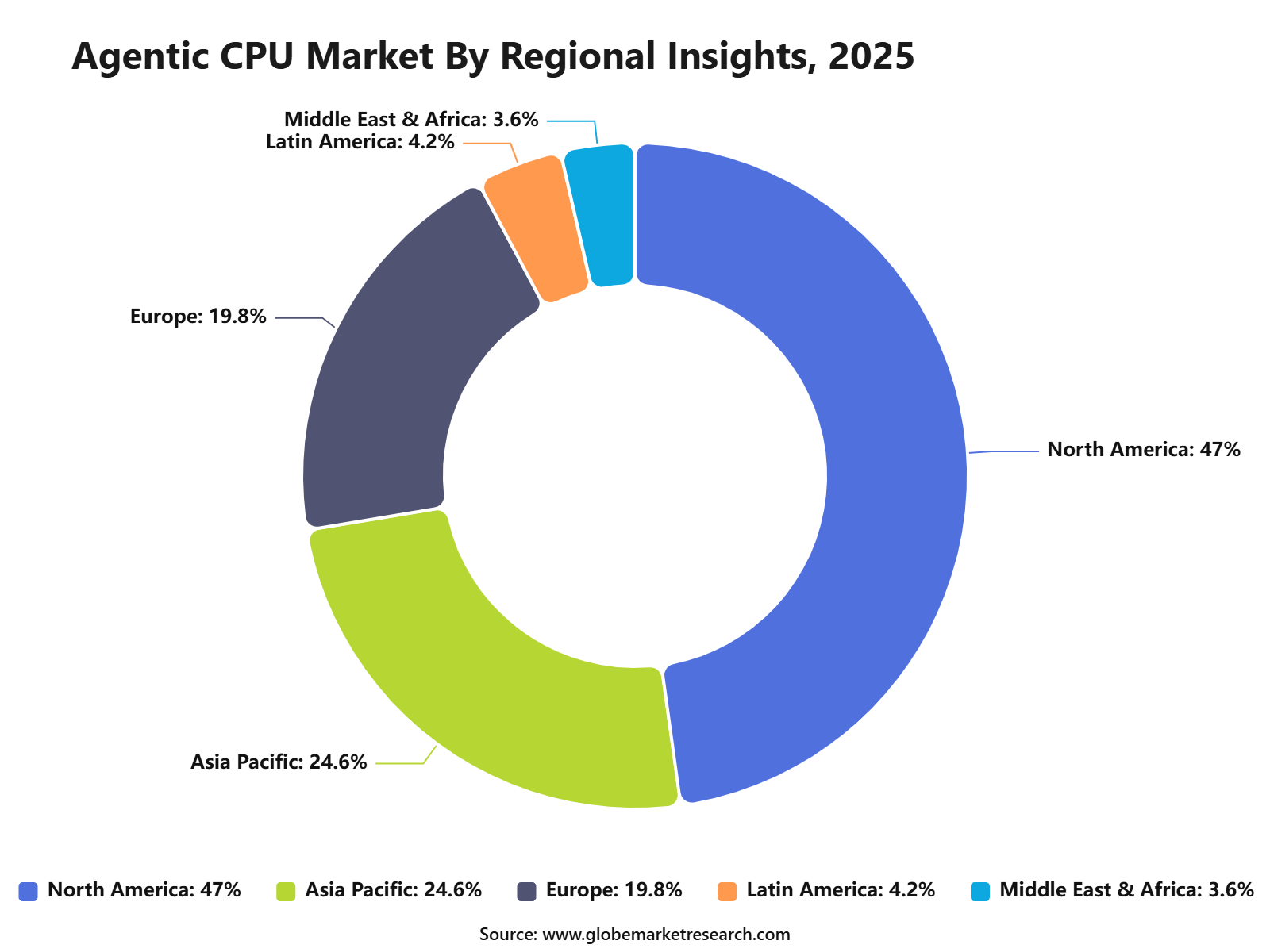 iThe graph shows projected market growth until 2035 based on CAGR analysis. Actual outcomes may vary depending on changing demand, competition, and economic factors.To gain greater insights - request a sample report PDF
Regional Impact Analysis
North America leads the Agentic CPU Market with 47.8% share in 2026, valued at around USD 2.9 billion, supported by AI chip innovation, hyperscale cloud investment, enterprise AI deployment, and strong venture funding. The U.S. remains the key market because of its semiconductor design base, AI software ecosystem, and large data center footprint.
Asia Pacific remains important because of semiconductor manufacturing strength, electronics supply chains, and rising AI infrastructure investment. Europe supports growth through secure AI systems, industrial automation, automotive AI, and sovereign compute initiatives.
Impact Factor | Estimated CAGR Impact | Regional Relevance | Market Impact |
|---|---|---|---|
North America market leadership | +25.5% | North America, 47.8% share in 2026 | Leads global value demand. |
U.S. AI chip and cloud ecosystem | +22.6% | U.S. | Drives major revenue contribution. |
Canada AI research and enterprise adoption | +15.8% | Canada | Supports regional innovation. |
Asia Pacific semiconductor manufacturing | +18.4% | Taiwan, South Korea, Japan, China | Supports production scale. |
Europe secure and industrial AI demand | +13.9% | Germany, France, UK, Netherlands | Adds regulated and industrial growth. |
Case Study: NVIDIA Vera CPU and Its Agentic AI Infrastructure
NVIDIA developed the Vera CPU to address the processing work that occurs between AI model calls. Agentic systems repeatedly retrieve information, execute code, call external tools, manage context and verify results. These activities can create CPU-side delays that reduce GPU utilization and increase response time. NVIDIA reported in July 2026 that Perplexity was among the AI companies adopting Vera for agent-based workloads.
Vera uses 88 custom Olympus cores and provides up to 1.2 TB per second of memory bandwidth. NVIDIA’s technical testing showed that the processor delivered 40% lower peak latency under heavily loaded conditions compared with the evaluated x86 platform. The architecture is designed to maintain consistent per-core performance while several agent sandboxes, retrieval processes and data services are operating simultaneously.
The case demonstrates that agentic AI infrastructure requires balanced investment across CPUs, GPUs, networking, memory and storage. NVIDIA reported that Vera completed selected tasks 1.8 times faster than the x86 comparison platform, potentially allowing GPUs to spend more time generating tokens instead of waiting for CPU-side operations. For customers, the financial value will depend on actual agent completion time, energy consumption, GPU utilization and cost per successfully completed workflow rather than processor performance alone.
Top Investments in Agentic CPU Industry Globally
Global investment in agentic CPU infrastructure is being driven by the need to operate AI agents that can plan tasks, retrieve information, execute software tools and coordinate with AI accelerators. The sector does not yet have a separate investment reporting category, so the leading indicators are capital commitments for AI data centres, server processors, advanced semiconductor manufacturing, memory, networking and cloud computing capacity.
Hyperscale operators are allocating larger budgets to servers and computing infrastructure as agentic workloads require continuous CPU processing alongside GPUs and other accelerators. Amazon expects approximately USD 200 billion in 2026 capital expenditure, Alphabet plans USD 175 billion to USD 185 billion, and Meta has raised its 2026 range to USD 125 billion to USD 145 billion. These investments are expected to support demand for high-core-count CPUs, custom processors, memory systems and rack-level infrastructure.
Semiconductor manufacturing is also receiving substantial investment because advanced agentic processors require leading-edge fabrication and packaging capacity. TSMC’s planned U.S. investment has reached USD 165 billion, while the Stargate initiative intends to deploy USD 500 billion across AI infrastructure over four years. However, financial returns will depend on processor utilization, energy availability, agent adoption and the ability to convert infrastructure capacity into recurring cloud and enterprise revenue.
Company or Initiative | Investment | Period | Primary Focus |
|---|---|---|---|
OpenAI, SoftBank, Oracle and MGX, Stargate | USD 500 billion | Four years from 2025 | AI data centres, computing systems and infrastructure for advanced and agentic AI workloads. |
Amazon | ~USD 200 billion | 2026 | AWS infrastructure, AI servers, custom processors, networking and data-centre capacity. |
Alphabet | USD 175 billion to USD 185 billion | 2026 | AI computing capacity, servers, data centres, networking, GPUs and TPUs. |
TSMC | USD 165 billion total U.S. commitment | Announced expansion in 2025 | Advanced semiconductor fabs, packaging facilities and an R&D centre for AI chips. |
Meta | USD 125 billion to USD 145 billion | 2026 | AI data centres, servers and infrastructure supporting Meta Superintelligence Labs. |
Microsoft | ~USD 80 billion | Fiscal 2025 | AI-enabled data centres used to train models and deploy AI and cloud applications. |
Market Dynamics
Drivers Impact Analysis
The Agentic CPU Market is driven by rising demand for processors optimized for autonomous AI agents, on-device reasoning, low-latency inference, AI workflow execution, and intelligent task orchestration. As enterprises move from basic automation to agentic systems, CPUs with stronger AI workload handling, memory efficiency, and secure execution become more important.
North America leads the market due to strong AI infrastructure, hyperscale cloud investments, semiconductor innovation, enterprise AI adoption, and high demand for agentic computing platforms. The U.S. remains the key contributor because of major AI chip designers, cloud providers, software companies, and advanced data center deployments.
Impact Factor | Estimated CAGR Impact | Regional Relevance | Market Impact |
|---|---|---|---|
Rising adoption of autonomous AI agents | +24.5% | North America, Europe, Asia Pacific | Drives demand for agentic compute hardware. |
Growth in enterprise AI workflow automation | +21.8% | U.S., Canada, Europe, Japan | Supports CPU demand for AI task execution. |
Expansion of AI data centers | +19.6% | North America and Asia Pacific | Increases processor deployment scale. |
Need for low-latency AI inference | +16.9% | Cloud, edge, enterprise AI | Supports real-time agentic workloads. |
Growth in AI-native system architecture | +14.7% | Advanced semiconductor markets | Builds long-term platform demand. |
Restraints Impact Analysis
The market faces restraints from high chip development cost, fabrication complexity, supply chain dependency, and uncertainty around standard architectures for agentic workloads. Agentic CPUs require strong hardware-software integration, which raises design, validation, and commercialization challenges.
Another restraint is competition from GPUs, NPUs, TPUs, ASICs, and other AI accelerators. Many enterprises may continue using existing accelerator-heavy infrastructure unless agentic CPUs prove clear advantages in cost, latency, energy efficiency, and workload flexibility.
Impact Factor | Estimated CAGR Impact | Regional Relevance | Market Impact |
|---|---|---|---|
High semiconductor development cost | -14.8% | Global chip design markets | Raises entry barriers. |
Competition from GPUs and AI accelerators | -13.5% | Data center and edge AI markets | Limits CPU-only adoption. |
Fabrication and supply chain constraints | -11.9% | U.S., Taiwan, South Korea, China | Affects production scale. |
Architecture standardization uncertainty | -10.2% | Emerging agentic computing ecosystem | Slows enterprise purchasing decisions. |
High validation and software integration needs | -8.7% | Enterprise and cloud deployments | Extends commercialization cycles. |
Opportunities Impact Analysis
Opportunities are strong in AI-native CPUs, hybrid CPU-AI accelerator platforms, edge agentic processors, secure enterprise AI chips, data center CPUs, and processors designed for multi-agent orchestration. These areas benefit from demand for faster, safer, and more efficient agentic AI execution.
Higher-value opportunities are emerging in cloud AI infrastructure, robotics, autonomous systems, enterprise copilots, edge devices, smart factories, automotive AI, and AI-powered cybersecurity systems. Companies that combine chip performance with developer ecosystems and software tools can capture stronger market value.
Impact Factor | Estimated CAGR Impact | Regional Relevance | Market Impact |
|---|---|---|---|
AI-native CPU architecture development | +23.8% | North America, Asia Pacific, Europe | Builds core market opportunity. |
Hybrid CPU and AI accelerator platforms | +21.1% | Cloud and data center markets | Supports high-performance workloads. |
Edge agentic processors | +18.4% | Industrial, automotive, robotics | Expands deployment beyond data centers. |
Secure enterprise AI hardware | +15.6% | BFSI, healthcare, government | Adds compliance-led demand. |
Developer ecosystem and software tooling | +13.2% | Global AI infrastructure markets | Improves adoption and integration. |
Challenges Impact Analysis
The main challenge is proving performance advantage over existing AI compute infrastructure. Agentic CPUs must show measurable benefits in agent orchestration, context handling, latency, power efficiency, and total cost of ownership. Another challenge is ecosystem readiness. Hardware providers need operating systems, compilers, AI frameworks, orchestration layers, developer tools, and enterprise integration support to make agentic CPUs practical at scale.
Impact Factor | Estimated CAGR Impact | Regional Relevance | Market Impact |
|---|---|---|---|
Proving performance over existing accelerators | -13.9% | Global AI hardware markets | Affects procurement confidence. |
Building software ecosystem support | -12.4% | Cloud, enterprise, edge AI | Slows developer adoption. |
Managing power and thermal limits | -10.7% | Data centers and edge devices | Influences deployment cost. |
Long semiconductor design cycles | -9.5% | Chip manufacturers | Delays product upgrades. |
Enterprise integration complexity | -8.1% | Large AI users | Raises adoption barriers. |
Market Trend Analysis
The market trend is moving toward AI-native CPUs, agent-optimized instruction sets, memory-centric processing, secure execution environments, hybrid compute architectures, and edge-ready AI processors. These trends reflect the shift from simple AI model usage toward autonomous, multi-step, tool-using AI systems.
North America remains the largest value region because of strong AI infrastructure spending, cloud-scale compute demand, and deep semiconductor ecosystem. Asia Pacific supports manufacturing and future demand growth, while Europe adds opportunities through secure AI, industrial automation, and data-sovereign AI infrastructure.
Impact Factor | Estimated CAGR Impact | Regional Relevance | Market Impact |
|---|---|---|---|
Agent-optimized CPU designs rise | +22.7% | North America, Asia Pacific | Supports specialized compute growth. |
Hybrid AI compute architectures expand | +20.5% | Cloud and enterprise AI markets | Improves workload flexibility. |
Edge AI and on-device agents grow | +17.8% | Automotive, robotics, IoT, manufacturing | Builds distributed compute demand. |
Secure AI processing gains importance | +15.1% | Regulated industries | Supports enterprise adoption. |
Memory and bandwidth optimization increases | +12.9% | Data centers and AI servers | Improves agentic workload performance. |
Key Market Segments
CPU Architecture
ARM-Based Processors
RISC-V Processors
x86 Processors
Custom Proprietary Architectures
Deployment Environment
Enterprise Data Centers
Edge AI Infrastructure
Cloud Data Centers
Hybrid Cloud Infrastructure
Application
AI Agent Orchestration
Multi-Agent Systems
Retrieval-Augmented Generation
AI Copilots and Digital Agents
Autonomous Software Development
Robotics and Physical AI
Research and Scientific Computing
Other Agentic Workflows
End User
Hyperscale Cloud Providers
AI Model Developers
Enterprises
Government and Defense Organizations
Research Institutions
Telecommunications Providers
By Region
North America
Europe
Asia Pacific
Latin America
Middle East and Africa
Investment Opportunity Analysis
Investment opportunities are strongest in AI-native CPU design, chiplet processors, agentic AI server hardware, secure AI chips, edge AI processors, semiconductor IP, and software toolchains. These areas benefit from rapid growth in autonomous AI systems and large-scale enterprise AI infrastructure.
North America offers strong value opportunities because of its large regional share, AI cloud ecosystem, chip design leadership, and enterprise AI demand. Asia Pacific provides manufacturing and scale opportunities, while Europe supports secure AI hardware, industrial AI, and sovereign compute demand.
Impact Factor | Estimated CAGR Impact | Regional Relevance | Market Impact |
|---|---|---|---|
AI-native CPU developers | +23.5% | North America, Asia Pacific, Europe | Builds core market value. |
Chiplet and advanced packaging firms | +20.2% | U.S., Taiwan, South Korea, Japan | Supports processor scalability. |
Agentic AI server hardware providers | +17.6% | Data center and cloud markets | Adds infrastructure revenue. |
Secure AI hardware companies | +15.0% | BFSI, healthcare, government | Builds trust-led demand. |
AI compiler and software toolchain firms | +12.8% | Global developer ecosystems | Improves hardware adoption. |
Investor Type Impact Matrix
Investors should focus on companies with strong chip design capability, software ecosystem support, secure compute features, scalable manufacturing access, and clear enterprise use cases. Performance, energy efficiency, integration, and total cost of ownership will be key success factors.
Strategic investors can also target AI-native CPU startups, semiconductor IP providers, advanced packaging firms, AI server manufacturers, edge AI processor companies, and compiler software providers. Companies that combine hardware innovation with strong software adoption are better positioned for long-term growth.
Investor Type | Estimated CAGR Impact | Regional Relevance | Market Impact |
|---|---|---|---|
AI-Native CPU Developers | +21.5% | North America, Asia Pacific, Europe | Builds core processor market value. |
Semiconductor IP Providers | +18.2% | Global chip design ecosystem | Supports scalable architecture licensing. |
AI Server and Data Center Hardware Firms | +15.7% | Cloud and enterprise AI markets | Expands deployment infrastructure. |
Edge AI Processor Companies | +13.4% | Automotive, robotics, industrial AI | Adds distributed compute opportunity. |
Strategic Semiconductor Investors | +11.2% | Global AI hardware markets | Funds design, packaging, and commercialization. |
Go-to-Market and Sales Economics
According to Globe Market Research, the go-to-market approach for the Agentic CPU Market should focus on hyperscale data centres, cloud service providers, enterprise AI platforms and telecommunications infrastructure. These processors are used to manage agent planning, application execution, data movement, memory access and coordination with AI accelerators. Arm reported that its AGI CPU can deliver more than twice the performance per rack compared with conventional x86 platforms, supporting demand for purpose-built CPU architectures in agentic infrastructure.
Sales strategies should begin with workload assessment, server benchmarking and limited rack-level deployment. Buyers will require evidence covering throughput, latency, power use, software compatibility and accelerator utilization before committing to large installations. Intel’s Xeon 6+ platform supports up to 288 efficient cores, addressing the high concurrency required when multiple agents, databases and enterprise applications operate simultaneously.
Revenue Landscape Across
Revenue opportunities extend across agent orchestration, retrieval systems, tool execution, code processing, database operations, cybersecurity and accelerator management. Enterprise agent systems generate heavier CPU activity than standard chatbot requests because every user objective can trigger several reasoning and application steps. Intel reported that high-autonomy enterprise agents can generate between 25 and more than 100 model-inference calls during a single interaction.
Hyperscale infrastructure represents an important revenue channel for processors, server systems, memory and networking suppliers. Customers are expected to purchase CPUs as part of complete AI infrastructure rather than as isolated components. Microsoft recorded USD 31.9 billion in capital expenditure during its third quarter of fiscal 2026, with approximately two-thirds allocated to short-lived assets that mainly included CPUs and GPUs.
Edge devices and AI computers provide additional revenue through processors that combine general-purpose CPU performance with dedicated AI acceleration. These systems can support private, low-latency agents without sending every task to a cloud data centre. Qualcomm-supported mini-computers using the Snapdragon X2 Elite platform can provide 80 TOPS of on-device AI performance, supporting local agents for retail, office productivity and enterprise data processing.
Financial Impact
The financial impact of agentic CPUs will be determined by processor utilization, energy efficiency, server density, cooling requirements and software migration expenses. Electricity costs will become increasingly important as always-active agents run continuous planning, retrieval and application workflows. The International Energy Agency reported that electricity consumption from AI-focused data centres increased by 50% in 2025.
Processor performance can improve financial returns by increasing the amount of agent activity supported within an existing data-centre power limit. NVIDIA reported that its Vera CPU can complete agentic workloads 50% faster than traditional rack-scale processors. Higher throughput can reduce the number of servers required for a defined workload, although actual savings will depend on software design, memory capacity and accelerator integration.
Large infrastructure investments may place pressure on margins before sufficient agent-based revenue is generated. CPU suppliers and cloud operators will therefore need to connect hardware purchases with utilization, service pricing and customer demand. Microsoft’s cloud gross margin was 66% in its third fiscal quarter of 2026, with continued AI infrastructure investment identified as a factor affecting margin performance.
Recent Developments
Market News
In January 2026, AMD presented an early version of its Helios rack-scale AI platform, combining next-generation AMD EPYC processors, codenamed Venice, with AMD Instinct MI455X accelerators. The platform was designed to support advanced AI training, inference, and agentic workloads through an integrated CPU, GPU, networking, and software architecture.
In February 2026, AMD and Tata Consultancy Services announced plans to jointly develop rack-scale AI infrastructure based on the AMD Helios platform for India. The platform is expected to use AMD EPYC Venice CPUs to support orchestration, data processing, system management, and accelerator coordination within national-scale AI infrastructure.
In March 2026, NVIDIA launched the Vera CPU, describing it as a processor purpose-built for agentic AI and reinforcement-learning workloads. NVIDIA stated that Vera delivers 50% higher performance and twice the efficiency of traditional rack-scale CPUs for data processing, AI training support, and agentic inference operations.
In March 2026, Arm introduced the Arm AGI CPU, its first Arm-designed production processor for AI data centers. The processor supports up to 136 Arm Neoverse V3 cores, operates at a 300-watt thermal design power, and provides 6 GB per second of memory bandwidth per core at latency below 100 nanoseconds.
Acquisitions
In June 2026, Qualcomm agreed to acquire Modular to strengthen its software foundation for generative and agentic AI. The combination is intended to create a hardware-independent compute layer that can operate across CPU, GPU, NPU, and custom application-specific integrated circuit architectures.
Funding
In April 2026, SiFive raised USD 400 million in Series G funding at a company valuation of USD 3.65 billion. The investment is being used to accelerate high-performance RISC-V CPU and AI processor intellectual property for data centers, custom silicon, and AI infrastructure.
In May 2026, AMD announced more than USD 10 billion in planned investment across Taiwan’s technology ecosystem. The investment covers advanced packaging, manufacturing partnerships, and infrastructure required for Venice EPYC CPUs, Instinct accelerators, and the Helios rack-scale AI platform.
Competitive Landscape
The market is characterized by intense competition among established players and emerging companies. Strategic partnerships, mergers and acquisitions, and product innovation are key strategies employed by market participants.
Key Market Players
NVIDIA Corporation
Qualcomm Incorporated
Arm Holdings plc
Apple Inc.
Google LLC
Microsoft Corporation
Oracle Corporation
Ampere Computing
International Business Machines Corporation
Alibaba Group
Intel Corporation
Other Key Players
Research Methodology
This market study is prepared using a combination of primary and secondary research. Primary research includes discussions with manufacturers, suppliers, distributors, consultants, industry experts, and end users. Secondary research covers company reports, government databases, trade associations, technical publications, regulatory sources, and trusted industry documents. The collected information is used to assess market demand, pricing trends, technology adoption, competitive activity, and regional performance.
AI language models are not used as primary data sources, and publicly available AI-generated content is not treated as market evidence. Computational tools may be used to support data processing, translation, data classification, and pattern identification. However, every published assessment is supported by verified sources, human review, and primary market discussions.
Market estimates are developed through top-down and bottom-up approaches and validated using data triangulation. Revenue, production, shipment, pricing, and application-level data are compared across multiple sources. Forecasts consider economic conditions, regulatory changes, investment activity, innovation, supply chain developments, and industry risks. All findings are reviewed through source verification and internal quality checks before publication.
Part I
Source Management & Input Data Standards
Who provides data, how sources are qualified, and what types of evidence are admissible.
Part II
Research Scope & Market Coverage
How we define the markets we assess and the parameters that govern each product.
Part III
Data Collection, Verification & Submission
The mechanics of gathering, cross-checking, and hierarchically ranking evidence.
Part IV
Assessment Determination & Quality Controls
How raw data becomes a published assessment — normalisation, expert judgement, and outlier exclusion.
Part V
Publication, Corrections & Revision
Our publication schedule, corrections policy, and methodology review cycle.
Part VI
Independence, Ethics & Complaints
Conflict-of-interest policies, editorial independence, and how clients raise concerns.
Google · Preferred Sources
Don't miss the latest market research insights and industry updates on Google.
Add Globe Market Research as a preferred source in the Google app to see our reports, analysis, and market stories in your news suggestions.
Meet the Team
This report was prepared by our expert analysts with deep industry knowledge and research experience.
Prashant S. is a Research Analyst at Globe Market Research with more than four years of experience in market research and industry analysis. He specializes in the Aerospace and Defence, Automotive and Transportation, Semiconductor and Electronics, Information and Technology sectors, with expertise in market sizing, trend analysis, competitive assessment, and industry forecasting. He applies primary and secondary research, data validation, company analysis, and market estimation methods to deliver reliable insights for strategic planning and business decision-making.
Sayali brings more than 7 years of experience to Globe Market Research, supporting the accuracy, clarity, and relevance of research content across multiple industries. She reviews market data, segment analysis, competitive insights, and industry trends to ensure each report meets strong quality standards and provides practical value to business decision-makers. Her expertise spans healthcare, information technology, consumer goods, and diverse cross-industry domains. With a strong focus on data reliability, structured analysis, and clear presentation, Sayali helps ensure that each research output delivers well-reviewed insights for clients, investors, consultants, and industry stakeholders.
Frequently Asked Questions
Related Reports
More in Information and Technology
Edtech SaaS Tools Market Size to hit USD 217.6 billion by 2035
EdTech SaaS Tools Market Size, Share, Trends and Growth Analysis Report By Software (Classroom Management Systems, Document Management Systems, Learning and Gamification Platforms, Learning Management Systems, Student Collaboration Systems, Assessment and Analytics Tools, Content Authoring Tools, Other Software), By Sector (Preschool, K-12, Higher Education, Other Education Sectors), By Deployment (Cloud-Based, Hybrid), By End Use (Businesses, Educational Institutions, Individual Learners and Consumers), By Regional Insights, Technology Trends, Competitive Landscape, Strategic Opportunities and Growth Forecast, 2026–2035
Marketing Technology Market Size to Reach USD 3,810.8 billion by 2035
Marketing Technology Market Size, Share, Trends and Growth Analysis Report By Marketing Type (Digital Marketing, Offline Marketing), By Product (Social Media Tools, Content Marketing Tools, Rich Media Tools, Marketing Automation Tools, Data and Analytics Tools, Sales Enablement Tools), By Deployment (Cloud-Based, On-Premises, Other Deployment Models), By Enterprise Type (Large Enterprises, Small and Medium-Sized Enterprises), By Application (IT and Telecommunication, Retail and E-commerce, Healthcare, Media and Entertainment, Sports and Events, BFSI, Real Estate, Other Applications), By Regional Insights, Technology Trends, Competitive Landscape, Strategic Opportunities and Growth Forecast, 2026-2035
AI Watermarking Market Size to hit USD 10.9 billion by 2035
AI Watermarking Market Size, Share, Trends and Growth Analysis Report By Type (Invisible Watermarking, Visible Watermarking), By Technology (Non-Reversible Watermarking, Reversible Watermarking), By Deployment (Cloud, On-Premises), By Application (Copyright Protection, Authentication and Security, Branding and Marketing, Other Applications), By Content Type (Video, Image, Model Watermarking, Audio, Text), By End Use (Media and Entertainment, BFSI, Healthcare, Government and Defense, Retail and E-commerce, Other End-Use Industries), By Regional Insights, Technology Trends, Regulatory Landscape, Competitive Analysis, Strategic Opportunities and Growth Forecast, 2026-2035
Environmental, Social and Governance (ESG) Consulting Market to hit USD 49.4 billion by 2035
Environmental, Social and Governance (ESG) Consulting Market Size, Share, Trends and Growth Analysis Report By Service Type (Testing, Auditing and Verification, Technical Support, Sustainability Marketing, Strategy and Planning, Other Services), By Enterprise Size (Small and Medium-Sized Enterprises, Large Enterprises), By End User (Corporates, Investors, Government Bodies, Non-Profit Organizations, Other End Users), By Industry Vertical (BFSI, Energy and Utilities, Manufacturing, Healthcare, Retail and Consumer Goods, IT and Telecom, Transportation and Logistics, Other Industries), By Regional Insights, Regulatory Trends, Competitive Landscape, Strategic Opportunities and Growth Forecast, 2026-2035