

Revenue, 2026
USD 36.8 Bn
Forecast, 2035
USD 115.0 Bn
CAGR, 2026-2035
13.5%
Report Coverage
Global
Market Size and Forecast
The Global Plant-Based Dairy Alternatives Market was worth USD 36.8 billion in 2026 and is expected to reach USD 115.0 billion by 2035, growing at a CAGR of 13.5% from 2026 to 2035. Asia Pacific held the largest regional share of 47.3% in 2026, valued at around USD 17.4 billion, supported by rising demand for lactose-free products, growing vegan and flexitarian diets, and strong adoption of plant-based milk across urban consumers.
The Plant-Based Dairy Alternatives Market includes non-dairy milk, yogurt, cheese, ice cream, butter, creamers, and other dairy-free products made from soy, almond, oat, coconut, rice, cashew, pea, hemp, and blended plant sources. These products are used as substitutes for traditional dairy in daily diets, beverages, cooking, baking, desserts, and foodservice menus.
Market growth is being supported by rising awareness of digestive health, lactose intolerance, animal welfare, and sustainable food choices. Consumers are increasingly choosing plant-based dairy alternatives that offer better taste, clean-label ingredients, added protein, calcium fortification, low sugar, and improved texture. Brands are also investing in oat-based, soy-based, and blended formulations to meet demand across different price points and nutrition needs.
Key Parameter | Report Details |
|---|---|
Market Revenue, 2026 | USD 36.8 Billion |
Projected Revenue, 2035 | USD 115.0 Billion |
CAGR (2026-2035) | 13.5% |
Largest Region | Asia Pacific (47.3%, USD 17.4 Bn) |
Market Concentration | Medium |
Base Year | 2025 |
Forecast Period | 2026-2035 |
Asia Pacific is expected to remain a leading region due to its large population, strong plant-based food culture, and rising demand for convenient nutrition products. Countries such as China, India, Japan, South Korea, Australia, and Southeast Asian markets are seeing growing product availability across supermarkets, online retail, cafés, and quick-service restaurants. Long-term growth will depend on taste improvement, affordable pricing, ingredient innovation, and wider acceptance of dairy-free products in mainstream diets.
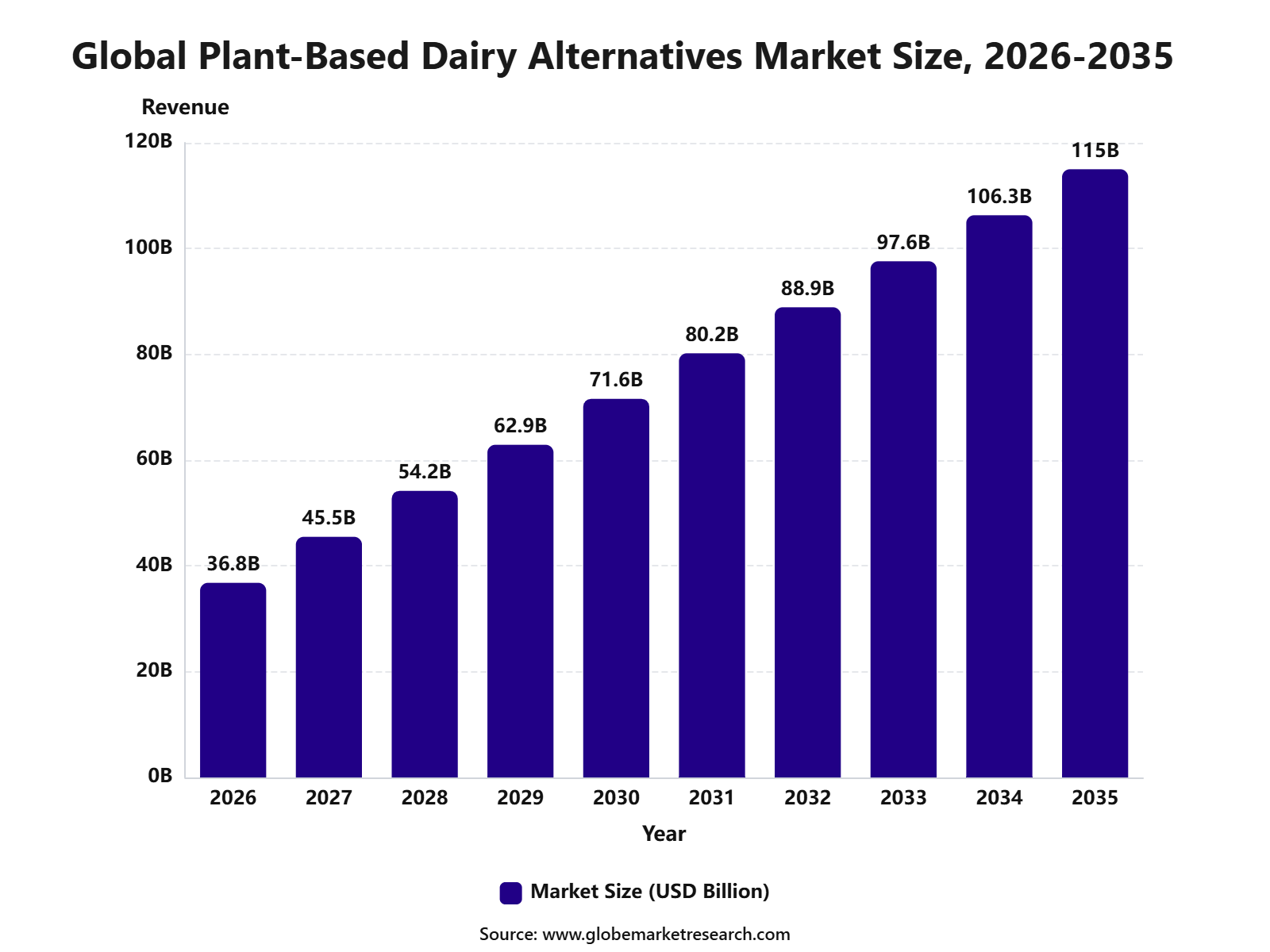 iThe graph shows projected market growth until 2035 based on CAGR analysis. Actual outcomes may vary depending on changing demand, competition, and economic factors.To gain greater insights - request a sample report PDF
Key Market Insights
Plant-based milk led the product type segment with 72.1% share, supported by strong consumer demand for dairy-free, lactose-free, vegan, and everyday beverage alternatives.
Soy accounted for 53.6% share by source, driven by its high protein content, broad availability, cost efficiency, and established use in milk, yogurt, cheese, and other dairy alternative products.
Supermarkets and hypermarkets held 35.9% share by distribution channel, supported by wide shelf availability, organized plant-based sections, promotional pricing, and strong household grocery purchases.
Asia Pacific led the plant-based dairy alternatives market with 47.3% share, valued at USD 17.4 billion, supported by rising lactose intolerance awareness, growing vegan product adoption, expanding retail access, and strong demand across China, India, Japan, and Southeast Asia.
Top Funding and Investment
Top Investments
Fenton Food and Beverage announced an investment of up to USD 56.2 million to establish a plant-based milk ingredient facility in Fenton, Michigan. The project is expected to create at least 96 jobs and will use a new process that extracts milk directly from nuts using water. Michigan approved a USD 960,000 performance-based grant and tax exemptions valued at up to USD 168,000 for the facility.
Phytokana Ingredients and Maia Farms launched a CAD 32.0 million project to manufacture fava protein concentrate, starch flour, fava flour, and fermented mushroom proteins. The consortium is contributing CAD 25.7 million, while Protein Industries Canada is providing CAD 6.3 million. The ingredients are being designed for plant-based milk, dairy alternatives, and other protein products. Phytokana is also developing a facility capable of processing 30,000 metric tonnes annually.
Oatly committed USD 16 million to expand its Landskrona oat-drink manufacturing facility. The project will increase annual production capacity by more than 33%, from 150 million litres to 200 million litres, without expanding the plant’s existing physical footprint. Construction started in March 2026 and is expected to be completed by March 2027.
Taaleri Bioindustry invested EUR 10 million in Finnish Food Factory, a contract manufacturer of oat-based drinks, cooking products, snacks, and other plant-based dairy alternatives. The investment will be used to increase production capabilities and support international expansion. Finnish Food Factory’s revenue increased from EUR 1.2 million in 2020 to EUR 13.5 million in 2024.
Danone invested in sourcing, processing, and manufacturing systems at its Alpro facility in Kettering to produce oat drinks made from 100% British oats. The facility is expected to manufacture approximately 58 million litres annually, representing one-quarter of its plant-based beverage production. The oats are sourced mainly from farms located within 80 miles of the processing mill.
Top Funding Transactions
The European Investment Bank provided EUR 35 million in venture debt financing to Formo. The funding will support research, technology development, and industrial scale-up of micro-fermentation and precision-fermentation processes for animal-free cheese and dairy alternatives. The financing increased Formo’s total capital raised to more than EUR 135 million.
Ripple Foods raised USD 17 million from Material Impact, Rich Products Ventures, S2G Ventures, Prelude Ventures, Fall Line Capital, and other investors. The capital will support retail expansion, foodservice growth, and the launch of organic plant-based milk products. Ripple’s pea-protein beverages provide up to 20 grams of plant protein per serving across selected products.
Bettani Farms, formerly Climax Foods, secured an initial USD 6.5 million Series A led by S2G Investments. Additional participation was provided by At One Ventures, Gratitude Railroad, Manta Ray Ventures, and Toba Capital. The funding will support commercialization of Caseed, its plant-derived protein platform for mozzarella, feta, cream cheese, Brie, and other dairy-free cheese products.
Top Acquisitions
Refresco, North America, May 2026: Acquisition of SunOpta
Refresco completed the acquisition of SunOpta, making the company a wholly owned subsidiary. Refresco acquired SunOpta’s plant-based and nutritional beverage operations, aseptic manufacturing capabilities, product-development platform, workforce, and customer relationships across retail, club, foodservice, and out-of-home channels.
The transaction also added SunOpta’s tea, broth, and better-for-you snack operations. SunOpta shareholders received USD 6.50 per share in cash under the acquisition agreement.
Misha’s Inc., United States, January 2025: Acquisition of Vertage
Misha’s Inc. acquired Vertage, a dairy-free cheese producer using plant proteins, traditional cheesemaking methods, and patent-pending fermentation processes. The acquisition added Vertage’s shredded and sliced cheese products, formulation technology, product-development expertise, and management capabilities to Misha’s portfolio.
Misha’s also gained access to production facilities, technology, transportation, and logistics infrastructure through Vertage’s relationship with Fresh Del Monte. At the time of the acquisition, Misha’s products were available through more than 1,100 U.S. retail locations.
By Product Type
Plant-based milk accounted for 72.1% share of the Plant-Based Dairy Alternatives Market. This leading position is supported by strong consumer demand for dairy-free, lactose-free, vegan, and lower-cholesterol beverage options across daily diets.
The segment is widely consumed through soy milk, almond milk, oat milk, coconut milk, rice milk, and blended plant-based milk products. These products are used in tea, coffee, cereals, smoothies, bakery preparation, cooking, and ready-to-drink formats, which supports high repeat consumption.
Demand is expected to remain strong as brands improve taste, texture, fortification, and clean-label positioning. Growth will be supported by rising lactose intolerance awareness, plant-based eating habits, and wider use of plant-based milk in retail and foodservice channels.
By Source
Soy accounted for 53.6% share of the Plant-Based Dairy Alternatives Market. This dominance is driven by its strong protein content, established supply chain, cost efficiency, and long-standing use in dairy alternative products.
Soy-based products are widely used in plant-based milk, yogurt, cheese alternatives, creamers, desserts, and nutritional beverages. Soy is preferred because it provides a closer protein profile to dairy compared with many other plant sources, making it suitable for consumers seeking functional nutrition.
The segment is expected to maintain a strong position as manufacturers continue to develop fortified, flavored, unsweetened, and high-protein soy-based products. Demand will remain supported by affordability, product availability, and broad consumer acceptance across Asia Pacific and other major markets.
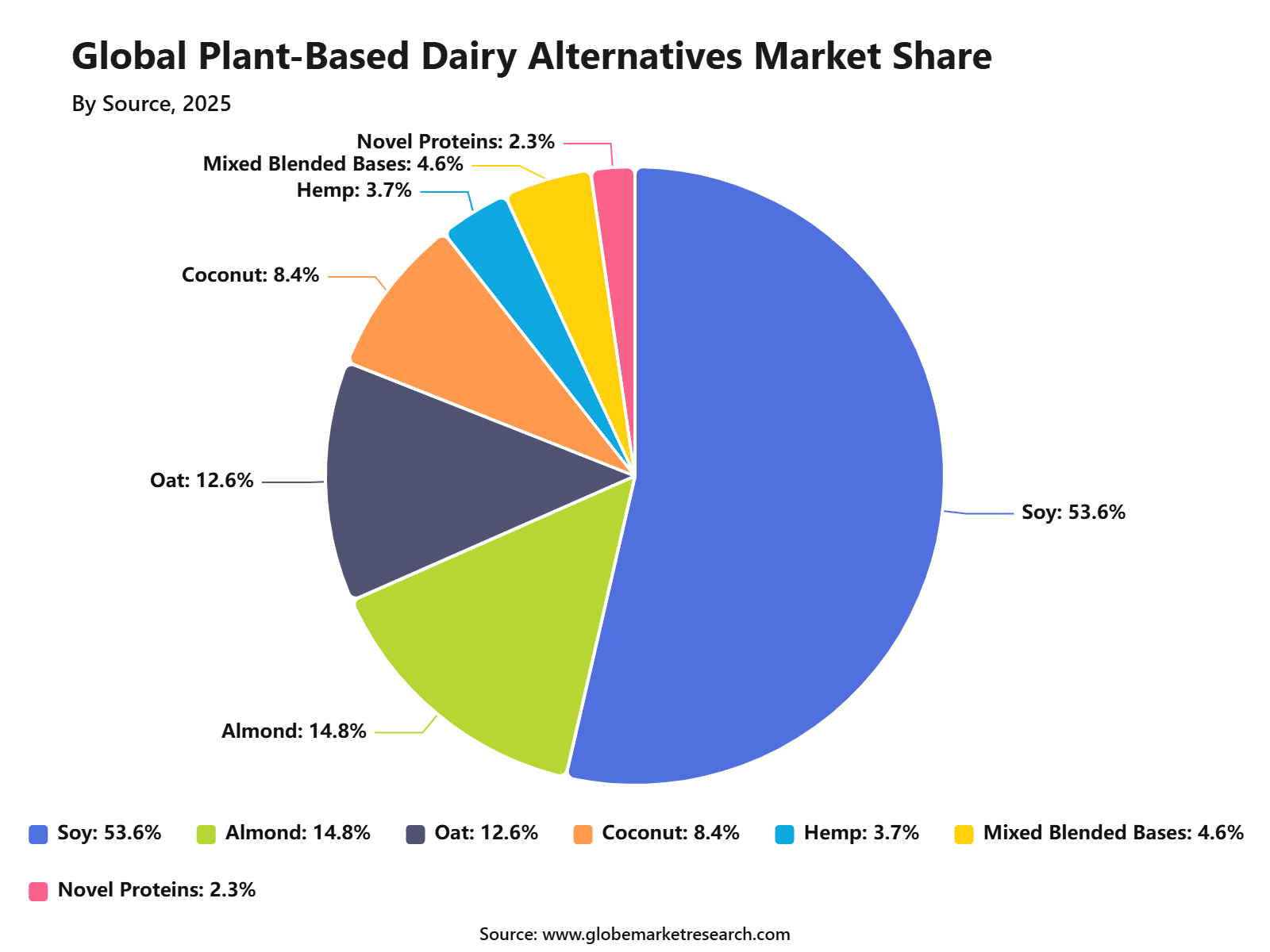 iThe graph shows projected market growth until 2035 based on CAGR analysis. Actual outcomes may vary depending on changing demand, competition, and economic factors.To gain greater insights - request a sample report PDF
By Distribution Channel
Supermarkets and hypermarkets held 35.9% share of the Plant-Based Dairy Alternatives Market. This leading channel is supported by wide product availability, chilled storage capacity, organized shelf placement, and strong consumer access to multiple brands and formats.
Consumers prefer these stores because they can compare plant-based milk, yogurt, cheese, butter, creamers, and frozen desserts in one place. Promotional offers, private-label launches, and dedicated health food sections also help increase trial and repeat purchases.
The segment is expected to remain important as plant-based dairy alternatives move from niche shelves into mainstream grocery categories. Demand will be supported by better retail visibility, larger pack formats, premium product ranges, and growing household adoption of dairy-free products.
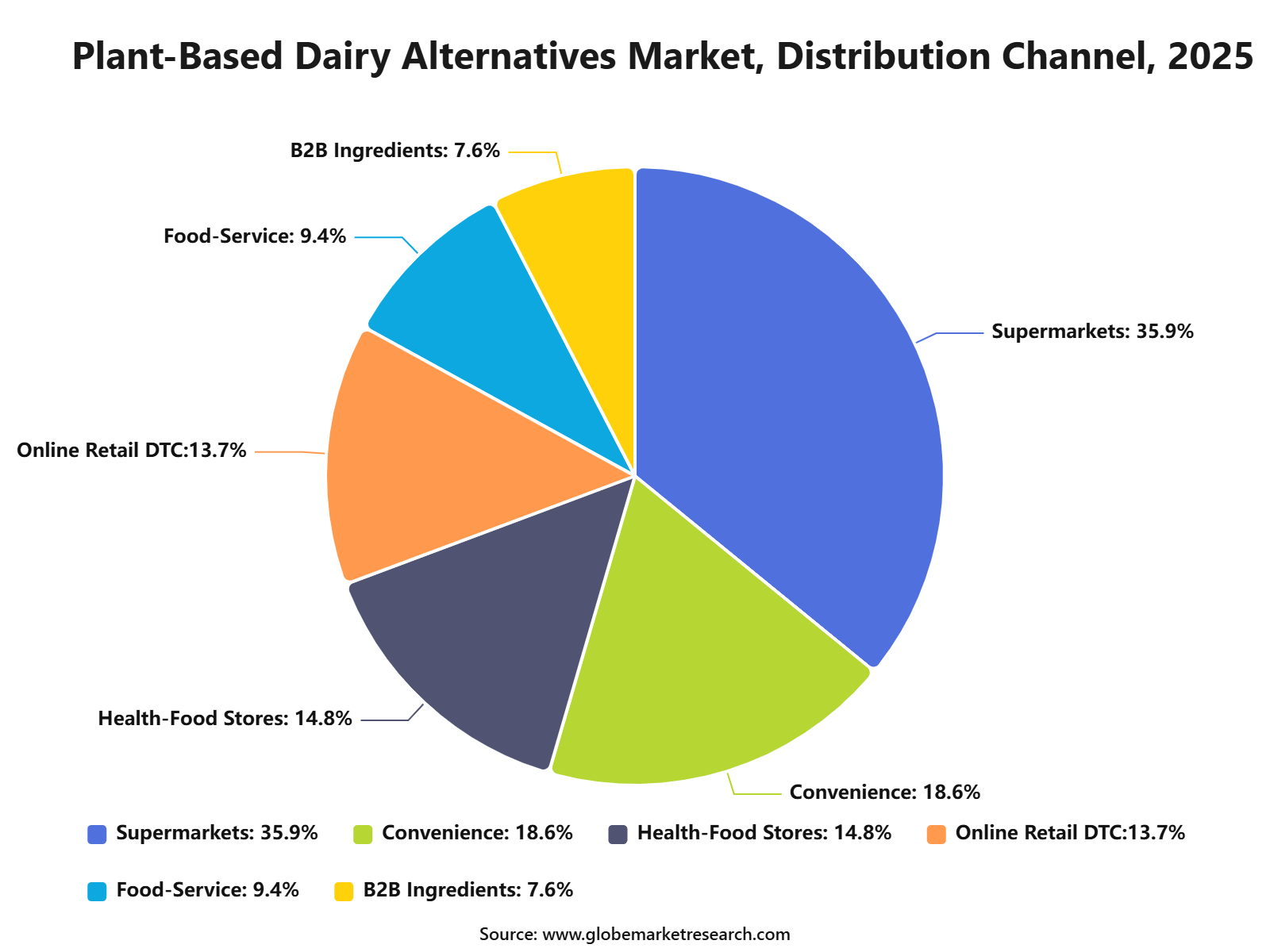 iThe graph shows projected market growth until 2035 based on CAGR analysis. Actual outcomes may vary depending on changing demand, competition, and economic factors.To gain greater insights - request a sample report PDF
By Region
Asia Pacific accounted for 47.3% share of the Plant-Based Dairy Alternatives Market, reaching USD 17.4 billion. The region’s leadership is supported by large consumer populations, high lactose intolerance levels, traditional soy consumption, and rising demand for healthier beverage options.
China, India, Japan, South Korea, Australia, Thailand, Indonesia, and Vietnam are key contributors to regional demand. Asia Pacific benefits from strong soy-based food culture, expanding modern retail, rising urban income, and increasing acceptance of plant-based products among younger consumers.
Asia Pacific is expected to maintain its leading position as plant-based milk consumption expands across both traditional and modern diets. Growth will remain supported by soy-based products, supermarket and hypermarket distribution, local flavor innovation, and rising demand for dairy-free nutrition.
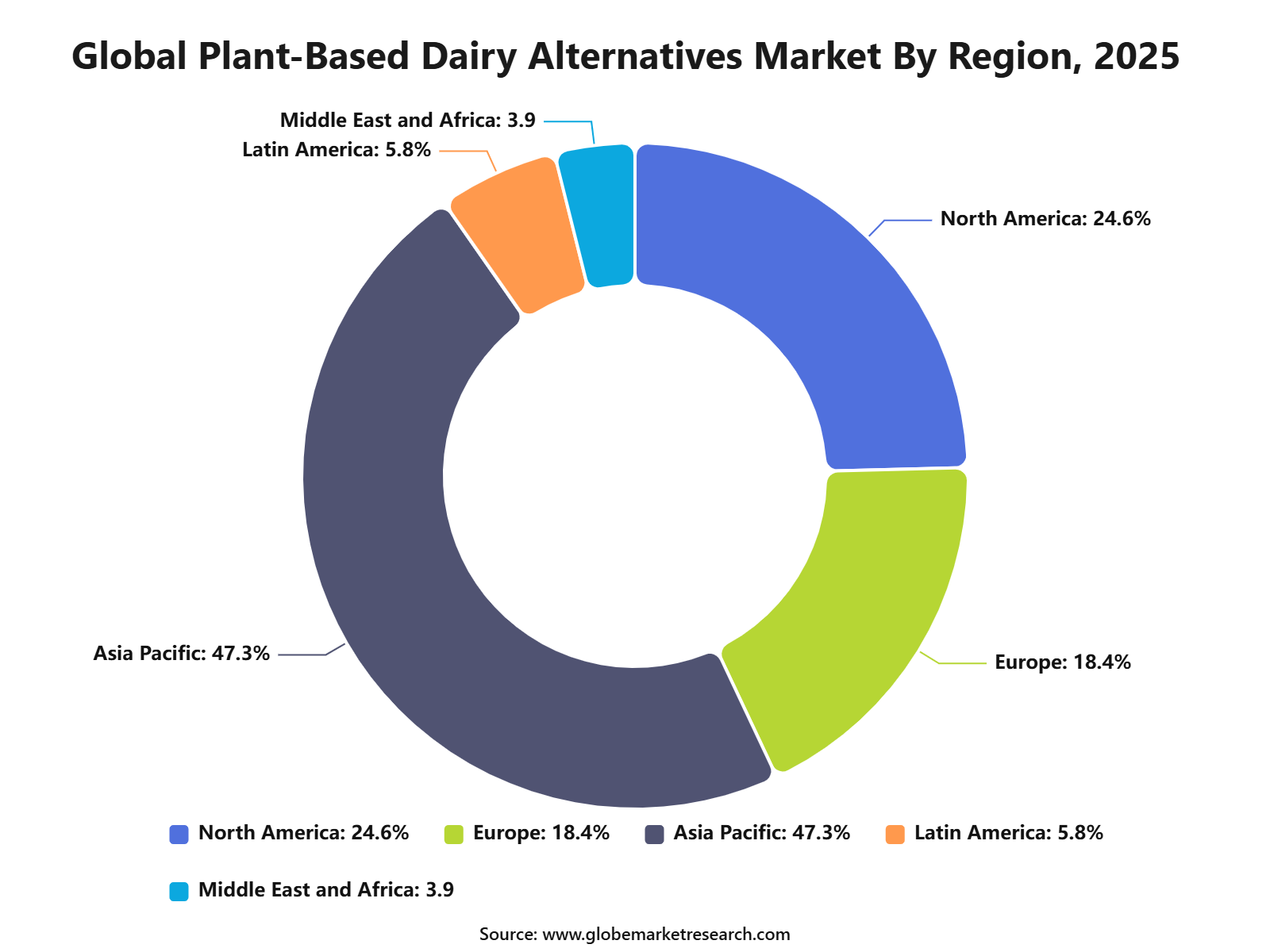 iThe graph shows projected market growth until 2035 based on CAGR analysis. Actual outcomes may vary depending on changing demand, competition, and economic factors.To gain greater insights - request a sample report PDF
Regional Impact Analysis
Asia Pacific leads the Plant-Based Dairy Alternatives Market with 47.3% share in 2026, valued at around USD 17.4 billion, supported by high lactose sensitivity, large consumer populations, soy-based food traditions, rising disposable income, and expanding retail availability. China, India, Japan, South Korea, Australia, Thailand, and Indonesia remain key regional markets.
North America remains important because of strong vegan, flexitarian, and clean-label demand, especially in plant-based milk, creamers, frozen desserts, and cheese alternatives. Europe supports premium growth through sustainability-focused consumers, strict labeling expectations, and strong demand for oat, almond, soy, and coconut-based dairy alternatives.
Impact Factor | Estimated CAGR Impact | Regional Relevance | Market Impact |
|---|---|---|---|
Asia Pacific market leadership | +4.1% | Asia Pacific, 47.3% share in 2026 | Leads global value demand. |
China plant-based milk consumption | +3.0% | China | Drives high-volume regional demand. |
India lactose-free and dairy alternative growth | +2.4% | India | Supports future expansion. |
Japan and South Korea premium product demand | +1.9% | Japan, South Korea | Adds value-led growth. |
North America and Europe clean-label demand | +1.6% | U.S., Canada, UK, Germany, France | Supports premium adoption. |
Plant Milk Nutrition Leads Growth
The most important factor in the Plant-Based Dairy Alternatives Market is nutrition-led trust in plant-based milk and creamers. In 2025, GFI reported that plant-based milk held 13% of total U.S. milk dollar sales and 30% of milk dollar sales in the natural channel, showing that plant-based dairy is strongest where shoppers actively look for health, sustainability, and specialty nutrition products. In foodservice, plant-based milk grew 16% in dollar sales in 2025, while plant-based creamer held a 28% pound share of the creamer category.
For companies, the key decision is to improve protein, calcium, vitamin D, sugar level, taste, and clear labeling, because customers compare plant-based products with dairy milk before buying. The FDA’s January 2025 plant-based alternative food guidance focuses on clearer naming and labeling so consumers understand product differences, making transparency a direct market growth factor. Brands that combine strong nutrition, clean labels, affordable pricing, and retail-foodservice availability are better positioned to win repeat buyers.
Go-To-Market and Sales Economics
Plant-based dairy brands should combine supermarket listings, foodservice partnerships, convenience outlets, and direct online sales. U.S. e-commerce sales reached USD 326.7 billion in the first quarter of 2026 and represented 16.9% of retail sales. Multipacks, subscriptions, chilled delivery, digital sampling, and retailer-specific promotions can improve household penetration and repeat purchasing.
Barista products provide a practical entry route into cafés, hotels, restaurants, and workplace catering. Oatly’s Europe and International revenue reached USD 136.8 million in the first quarter of 2026, with 12.6% volume growth mainly supported by Barista products. Training programs, machine compatibility, and dependable distributor service can strengthen customer retention.
Product development should focus on nutrition, taste, texture, and use-case performance rather than dairy-free positioning alone. Danone reported first-quarter 2026 sales of EUR 6.71 billion, with 2.7% like-for-like growth and positive volume mix across all categories. Fortified beverages, high-protein yogurt alternatives, cheese formats, and creamers can support wider household use.
Risk Factors & Market Barriers
Nutritional comparison remains a significant market barrier because plant-based beverages vary in protein, calcium, vitamin D, and potassium. FDA guidance updated in March 2026 states that only fortified soy beverages are currently included in the dairy group. Clear fortification, simple labels, and evidence-based claims are required to build consumer and institutional confidence.
Packaging compliance will create redesign, testing, and documentation costs. The EU Packaging and Packaging Waste Regulation generally applies from 12 August 2026 and covers all packaging, while packaging accounts for 40% of plastics used in the EU. Producers must improve recyclability without weakening shelf life, light protection, seal quality, or chilled distribution performance.
Raw-material concentration can expose manufacturers to weather, logistics, and price movements. USDA estimated 85.4 million acres of U.S. soybeans planted in 2026, up 5% from 2025, while the United States supplied 77% of global almond production in 2025/26. Multi-origin sourcing and flexible formulations can reduce supply disruption and margin volatility.
Revenue Potential Analysis
Revenue Landscape Across
Europe provides revenue through oat drinks, plant-based yogurt, barista products, creamers, and dairy-free desserts. Oatly’s Europe and International business sold 90.8 million litres in the first quarter of 2026, while approximately 80% of regional revenue came from retail. Premium café partnerships and large grocery accounts can support volume and brand visibility.
North America offers opportunities across grocery, club stores, cafés, schools, and workplace channels. Oatly’s regional revenue reached USD 62.2 million in the first quarter of 2026, with retail representing approximately 65% of sales and volume reaching 35 million litres. Growth depends on distribution quality, promotional discipline, and refrigerated shelf productivity.
Asia offers selective growth through cafés, modern retail, hotels, and urban foodservice networks, but performance differs by country. Oatly’s Greater China revenue reached USD 29.3 million in the first quarter of 2026, while foodservice represented 63% of regional sales. Local flavours, smaller packs, and strong distributor economics remain important for expansion.
Financial Impact
Improved supply-chain productivity can materially strengthen category margins. Oatly reported first-quarter 2026 revenue of USD 228.3 million, gross margin of 33.4%, and adjusted EBITDA of USD 5.0 million, compared with an adjusted EBITDA loss one year earlier. Better plant utilisation, product mix, procurement, and pricing can convert volume growth into sustainable earnings.
Liquidity remains important because brand building, chilled logistics, and production capacity require substantial funding. At 31 March 2026, Oatly held USD 49.4 million in cash against USD 513.1 million of debt, while first-quarter free cash flow was negative USD 11.7 million. Expansion should therefore be tied to secured distribution and measurable contribution margins.
Forward financial planning should balance growth with disciplined capital spending. Oatly maintained 2026 guidance for 3% to 5% constant-currency revenue growth, adjusted EBITDA of USD 25 million to USD 35 million, and capital expenditure of USD 20 million to USD 30 million. Investment should prioritise proven products, efficient factories, and profitable regional channels.
Drivers Impact Analysis
The Plant-Based Dairy Alternatives Market is driven by rising demand for dairy-free products, lactose-free diets, vegan lifestyles, flexitarian eating, and cleaner-label food choices. Plant-based milk, yogurt, cheese, creamers, butter, and frozen desserts are gaining demand as consumers look for products that support digestion, sustainability, and lifestyle preferences.
Asia Pacific leads the market due to high lactose intolerance levels, large consumer populations, rising urban income, strong soy-based product consumption, and growing demand for plant-based nutrition. China, India, Japan, South Korea, Australia, Thailand, and Indonesia remain key contributors because of strong retail growth and expanding foodservice adoption.
Impact Factor | Estimated CAGR Impact | Regional Relevance | Market Impact |
|---|---|---|---|
Rising lactose-free product demand | +3.8% | Asia Pacific, North America, Europe | Drives core dairy alternative consumption. |
Growth in vegan and flexitarian diets | +3.2% | Urban and health-focused markets | Supports plant-based product adoption. |
Expanding plant-based milk usage | +2.7% | China, India, Japan, Australia | Builds high-volume category growth. |
Sustainability and animal welfare awareness | +2.1% | Europe, North America, Asia Pacific | Improves brand preference. |
Wider retail and foodservice availability | +1.7% | Global grocery and café channels | Increases product access. |
Restraints Impact Analysis
The market faces restraints from higher product pricing, taste and texture challenges, allergen concerns, and competition from conventional dairy. Plant-based cheese, yogurt, and cream products still need improvement in mouthfeel, meltability, protein content, and nutritional balance.
Another restraint is ingredient and supply chain complexity. Soy, almond, oat, coconut, pea, rice, and other plant bases require different sourcing, processing, fortification, and quality control systems, which can affect cost and consistency.
Impact Factor | Estimated CAGR Impact | Regional Relevance | Market Impact |
|---|---|---|---|
Higher price than conventional dairy | -1.8% | Mass-market consumers | Slows wider household adoption. |
Taste and texture limitations | -1.6% | Cheese, yogurt, creamers | Affects repeat purchase. |
Allergen concerns from soy and nuts | -1.3% | Global consumer markets | Limits some ingredient choices. |
Fortification and nutrition gaps | -1.1% | Health-focused buyers | Requires stronger formulation. |
Raw material and logistics volatility | -0.9% | Plant-based supply chains | Affects margins and pricing. |
Opportunities Impact Analysis
Opportunities are strong in plant-based milk, oat milk, soy milk, almond milk, plant-based yogurt, dairy-free cheese, creamers, frozen desserts, and plant-based butter. These categories benefit from demand for convenient dairy substitutes across households, cafés, bakeries, and packaged food companies.
Higher-value opportunities are emerging in high-protein dairy alternatives, clean-label formulations, fortified plant-based products, barista-style milk, kids’ dairy-free products, and localized flavors. Companies that improve taste, nutrition, and affordability can capture stronger long-term demand.
Impact Factor | Estimated CAGR Impact | Regional Relevance | Market Impact |
|---|---|---|---|
Plant-based milk expansion | +3.6% | Asia Pacific, North America, Europe | Leads category growth. |
Oat and soy-based product innovation | +3.0% | China, Japan, Australia, Europe | Supports mainstream adoption. |
Plant-based yogurt and desserts | +2.5% | Retail and foodservice markets | Adds new consumption occasions. |
Dairy-free cheese improvement | +2.0% | Developed and urban markets | Builds premium opportunity. |
Fortified and high-protein products | +1.6% | Health-focused consumers | Improves nutritional positioning. |
Challenges Impact Analysis
The main challenge is matching the taste, texture, nutrition, and cooking performance of dairy products. Consumers expect plant-based alternatives to work well in tea, coffee, baking, cooking, snacking, and foodservice applications.
Another challenge is building trust around ingredients and nutrition. Some consumers prefer plant-based products, but they also check protein content, added sugar, oils, stabilizers, calcium, vitamin D, and clean-label claims.
Impact Factor | Estimated CAGR Impact | Regional Relevance | Market Impact |
|---|---|---|---|
Replicating dairy-like performance | -1.7% | Cheese, creamers, yogurt, butter | Affects product acceptance. |
Improving protein and calcium content | -1.4% | Health-conscious buyers | Influences purchase decisions. |
Managing added sugar and additives | -1.2% | Clean-label product markets | Raises reformulation pressure. |
Building affordable scale | -1.0% | Emerging consumer markets | Limits mass adoption. |
Maintaining shelf stability and freshness | -0.8% | Retail and distribution channels | Impacts product quality. |
Segment Covered in the Report
By Product Type
Plant-Based Milk (Shelf-Stable, Refrigerated)
Plant-Based Yogurt (Spoonable, Drinkable)
Plant-Based Cheese (Block & Wheel, Shredded & Grated, Sliced, Cream-Cheese & Spreads)
Plant-Based Ice Cream & Frozen Dessert (Pints & Tubs, Novelties)
Plant-Based Butter & Spreads (Stick / Block, Soft-Tub Spreads)
Creamers (Refrigerated Liquid, Shelf-Stable Liquid, Powdered)
Others
By Source
Soy
Almond
Oat
Coconut
Hemp
Mixed / Blended Bases
Novel Proteins (Faba Bean, Flaxseed, Quinoa, Other Proteins)
By Distribution Channel
Supermarkets & Hypermarkets
Convenience & Grocery Stores
Specialty & Health-Food Stores
Online Retail / DTC
Food-Service
Industrial / B2B Ingredients
By Region
North America
Europe
Asia Pacific
Latin America
Middle East and Africa
Market Trend Analysis
The market trend is moving toward oat milk, soy milk, almond milk, plant-based yogurt, barista blends, clean-label creamers, dairy-free desserts, and better plant-based cheese. Consumers are also showing stronger interest in products with lower sugar, added protein, calcium, vitamins, and simple ingredients.
Asia Pacific remains the largest value region because of strong soy-based food culture, high lactose sensitivity, large urban populations, and fast modern retail expansion. Europe and North America support premium growth through vegan diets, sustainable food choices, and foodservice-led plant-based adoption.
Impact Factor | Estimated CAGR Impact | Regional Relevance | Market Impact |
|---|---|---|---|
Oat milk and barista blends rise | +3.4% | Cafés, retail, urban consumers | Supports premium plant milk demand. |
Clean-label plant-based products grow | +2.8% | Europe, North America, Asia Pacific | Improves consumer trust. |
Dairy-free cheese innovation expands | +2.3% | Pizza, snacks, foodservice | Adds higher-value growth. |
Fortified plant-based milk increases | +1.9% | Family and health markets | Supports nutritional acceptance. |
Plant-based desserts gain popularity | +1.5% | Retail frozen and chilled channels | Builds impulse and premium demand. |
Investor Type Impact Matrix
Investors should focus on companies with strong plant-protein sourcing, product formulation capability, retail distribution, foodservice partnerships, and brand trust. Taste, texture, nutrition, pricing, and supply reliability are key success factors in this market.
Strategic investors can also target plant-based milk brands, oat and soy processors, dairy-free cheese developers, fortified product companies, ingredient suppliers, and cold chain or shelf-stable packaging providers. Companies that combine affordability with strong sensory quality are better positioned for long-term growth.
Investor Type | Estimated CAGR Impact | Regional Relevance | Market Impact |
|---|---|---|---|
Plant-Based Dairy Manufacturers | +2.8% | Global | Expands core alternative dairy supply. |
Plant Milk and Creamer Brands | +2.3% | Asia Pacific, Europe, North America | Supports high-volume demand. |
Dairy-Free Cheese and Yogurt Firms | +1.9% | Retail and foodservice markets | Adds premium product value. |
Plant Protein and Ingredient Suppliers | +1.5% | Alternative dairy supply chains | Improves formulation performance. |
Strategic Consumer Food Investors | +1.2% | Global plant-based food markets | Funds scale and channel expansion. |
Recent Developments
In May 2026, Trek One Capital acquired Good Karma Foods, adding the company’s flaxmilk and plant-based beverage portfolio while providing new ownership support for distribution growth, product development and market expansion.
In March 2026, Hain Celestial completed the sale of its North American snacks business, reducing debt and sharpening future investment priorities around core brands, including Joya and Natumi plant-based beverages globally.
In February 2026, Blue Diamond Growers launched Blue Diamond Almondmilk in four varieties, extending the cooperative’s almond expertise into refrigerated plant-based beverages and strengthening its branded value-added consumer product portfolio.
In January 2026, Califia Farms launched Simple & Organic Soymilk with three ingredients and eight grams of protein, alongside new plant-based creamers and cold-brew and matcha almondmilk beverage products nationwide.
Competitive Landscape
The market is characterized by intense competition among established players and emerging companies. Strategic partnerships, mergers and acquisitions, and product innovation are key strategies employed by market participants.
Key Market Players
Blue Diamond Growers
Califia Farms
Danone S.A.
Earth’s Own Food Company Inc.
Eden Foods,Inc.
Elmhurst 1925
Good Karma Foods
Happy Planet Foods
Hain Celestial Group
Nestlé S.A.
Oatly Group AB
Pacific Foods of Oregon, LLC
Ripple Foods
SunOpta Inc.
The Coca-Cola Company (Fairlife/Simply platforms)
The Hain Celestial Group
The Hershey Company (via SOFIT)
TurtleTree
Valio Ltd
Yili Group
Other Key Players
Research Methodology
This market study is prepared using a combination of primary and secondary research. Primary research includes discussions with manufacturers, suppliers, distributors, consultants, industry experts, and end users. Secondary research covers company reports, government databases, trade associations, technical publications, regulatory sources, and trusted industry documents. The collected information is used to assess market demand, pricing trends, technology adoption, competitive activity, and regional performance.
AI language models are not used as primary data sources, and publicly available AI-generated content is not treated as market evidence. Computational tools may be used to support data processing, translation, data classification, and pattern identification. However, every published assessment is supported by verified sources, human review, and primary market discussions.
Market estimates are developed through top-down and bottom-up approaches and validated using data triangulation. Revenue, production, shipment, pricing, and application-level data are compared across multiple sources. Forecasts consider economic conditions, regulatory changes, investment activity, innovation, supply chain developments, and industry risks. All findings are reviewed through source verification and internal quality checks before publication.
Part I
Source Management & Input Data Standards
Who provides data, how sources are qualified, and what types of evidence are admissible.
Part II
Research Scope & Market Coverage
How we define the markets we assess and the parameters that govern each product.
Part III
Data Collection, Verification & Submission
The mechanics of gathering, cross-checking, and hierarchically ranking evidence.
Part IV
Assessment Determination & Quality Controls
How raw data becomes a published assessment — normalisation, expert judgement, and outlier exclusion.
Part V
Publication, Corrections & Revision
Our publication schedule, corrections policy, and methodology review cycle.
Part VI
Independence, Ethics & Complaints
Conflict-of-interest policies, editorial independence, and how clients raise concerns.
Google · Preferred Sources
Don't miss the latest market research insights and industry updates on Google.
Add Globe Market Research as a preferred source in the Google app to see our reports, analysis, and market stories in your news suggestions.
Meet the Team
This report was prepared by our expert analysts with deep industry knowledge and research experience.
Kimaya brings more than five years of experience in market research, content review, and industry analysis to Globe Market Research. She plays an important role in maintaining the accuracy, clarity, consistency, and relevance of research content across a wide range of industries. Her responsibilities include reviewing market data, segment analysis, competitive landscapes, industry trends, company developments, and strategic insights. Each report is carefully assessed to ensure that the findings are supported by reliable data, presented in a structured format, and aligned with the information needs of business decision-makers. Kimaya has research experience across healthcare, information technology, consumer goods, and several cross-industry domains.
Pratiksha K. is a Senior Research Analyst with more than five years of experience in market research, industry analysis, competitive intelligence, and business strategy. She has contributed to detailed market reports, customized research studies, company profiling, market sizing, trend analysis, and strategic consulting projects for clients across different regions. Her industry expertise covers Chemical and Material, Consumer Goods, Food & Beverages and Energy & Power. She closely evaluates changing customer requirements, technology developments, regulatory conditions, supply chain structures, investment activity, and competitive strategies to provide clear and practical market insights.
Frequently Asked Questions
Related Reports
More in Food and Beverages
Gourmet Food Market to Hit USD 1,033.1 Billion by 2035
Gourmet Food Market Size, Share, Analysis By Product (Cheese and Dairy, Gourmet Packaged Foods, Meat and Seafood, Bakery and Confectionery, Beverages, Other Products), By Distribution Channel (Supermarkets and Hypermarkets, Specialty Stores, Online and Direct-to-Consumer, Other Channels), By End Use (Household, Foodservice, Hospitality, Gifting), By Regional Insights, Business plan and Project Report, Investment Opportunities, Profitability, Industry Trends, Leading Companies and Growth Forecasts by 2026-2035
Paraben Market to Hit USD 1.6 Billion by 2035 | CAGR of 7.8%
Paraben Market Size, Share, Analysis By Product Type (Methyl Paraben, Propyl Paraben, Butyl Paraben, Ethyl Paraben, Others), By Application (Cosmetics and Personal Care, Pharmaceuticals, Food and Beverages, Household Products, Others), By Form (Powder, Liquid), By Regional Insights, Business plan and Project Report, Investment Opportunities, Profitability, Industry Trends, Leading Companies and Growth Forecasts by 2026-2035
Refrigerated Ready Meals Market to Hit USD 355.8 Billion by 2035
Refrigerated Ready Meals Market Size, Share, Analysis By Product (Refrigerated Meals, Frozen Meals, Shelf-Stable Meals, Canned Meals), By Meal Type (Vegetarian, Non-Vegetarian, Vegan), By Distribution Channel (Supermarkets and Hypermarkets, Convenience Stores, Online Retail, Specialty Stores), By Regional Insights, Business plan and Project Report, Investment Opportunities, Profitability, Industry Trends, Leading Companies and Growth Forecasts by 2026-2035
Frozen Desserts Market to Hit USD 298.8 Billion by 2035
Frozen Desserts Market Size, Share, Analysis By Product (Ice Cream, Frozen Yogurt, Gelato, Sorbet, Frozen Cakes, Other Products), By Consumption (Retail Consumption, Foodservice Consumption), By Distribution Channel (Supermarkets and Hypermarkets, Convenience Stores, Specialty Stores, Online Retail), By Regional Insights, Business plan and Project Report, Investment Opportunities, Profitability, Industry Trends, Leading Companies and Growth Forecasts by 2026-2035