

Revenue, 2025
$ 184.2 Bn
Forecast, 2035
$ 320.7 Bn
CAGR, 2025-2035
5.7%
Report Coverage
Global
Market Size and Forecast
The Global Instant Food Market was worth USD 184.2 billion in 2025 and is expected to reach USD 320.7 billion by 2035, growing at a CAGR of 5.7% from 2025 to 2035. Asia Pacific held the largest regional share of 48.1% in 2025, supported by high population density, rising urban lifestyles, strong demand for quick meals, and wide consumption of noodles, ready meals, instant soups, and packaged convenience food across China, India, Japan, South Korea, and Southeast Asia.
The Instant Food Market includes food products that can be prepared quickly with minimal cooking time. These products include instant noodles, ready-to-eat meals, instant pasta, soups, rice meals, breakfast mixes, frozen instant meals, and packaged snacks. The market is closely linked with food processing, packaging innovation, retail distribution, online grocery platforms, and changing consumer eating habits.
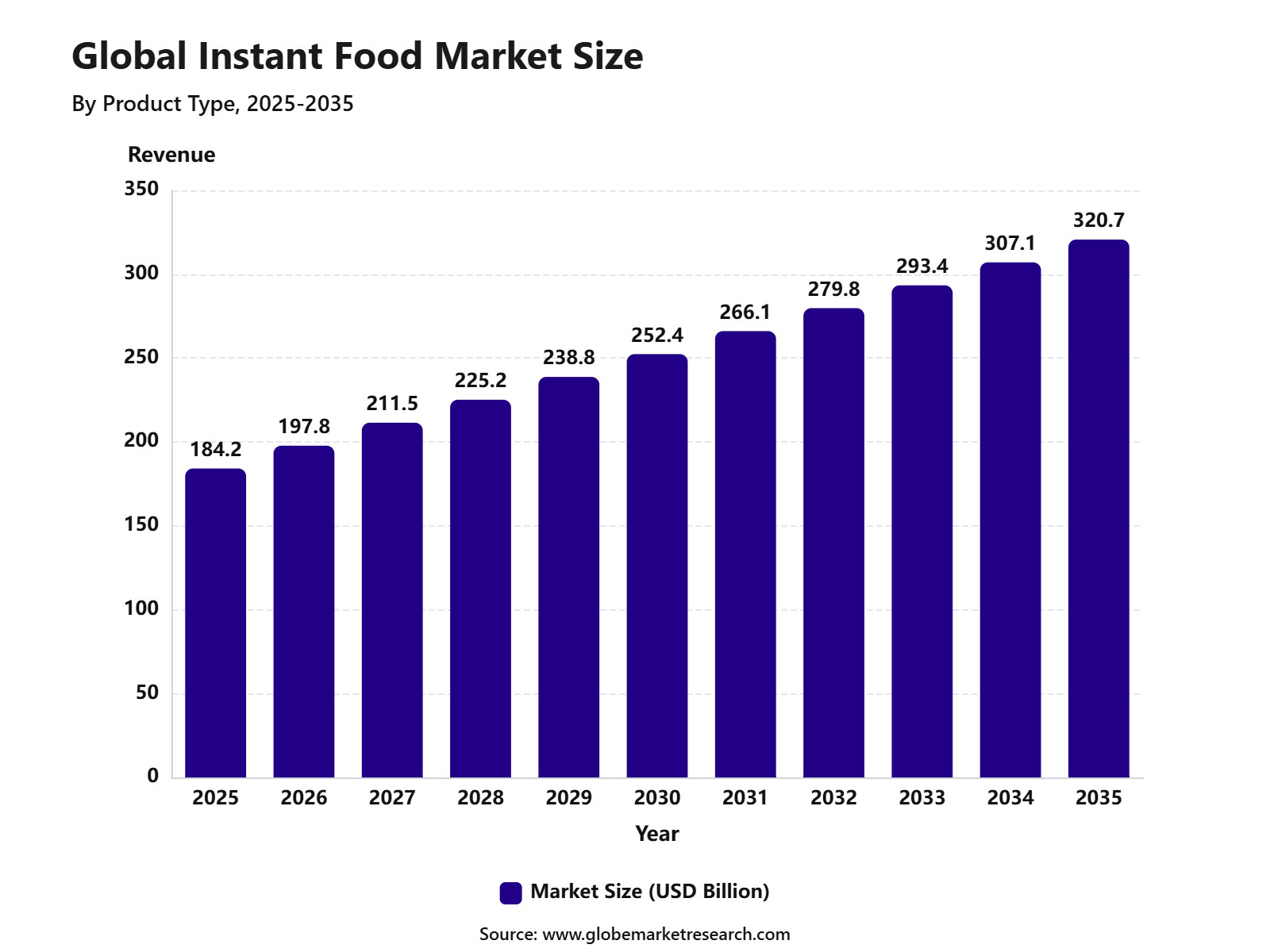 iThe graph shows projected market growth until 2035 based on CAGR analysis. Actual outcomes may vary depending on changing demand, competition, and economic factors.To gain greater insights - request a sample report PDF
The market outlook remains steady as consumers continue to prefer affordable, convenient, and easy-to-prepare food options. Growth can be attributed to busy work schedules, rising student and working populations, increasing single-person households, and stronger demand for packaged meals with longer shelf life. The expansion of healthier instant food options, premium flavors, and e-commerce grocery delivery is expected to support long-term market growth.
Key Market Insights
Instant noodles led the product type segment with 36.3% share, supported by strong demand for quick, affordable, and easy-to-prepare meal options.
Pouches accounted for 47.1% share by packaging type, driven by low cost, easy storage, lightweight handling, and wide use across instant food products.
Supermarkets and hypermarkets held 43.2% share by distribution channel, supported by broad product availability, promotional pricing, and strong consumer footfall.
Vegetarian instant food captured 58.3% share by ingredient type, driven by rising demand for plant-based, convenient, and affordable meal choices.
Working professionals represented 44.2% share by end user, supported by busy lifestyles, limited cooking time, and growing preference for ready-to-cook meals.
Asia Pacific led the instant food market with 48.1% share, supported by high consumption of instant meals, large working population, urbanization, and strong retail distribution.
Go-To-Market Strategy
The Instant Food Market should be positioned through convenience, affordability, and meal-speed benefits in 2026. Urban households, students, working professionals, travelers, and single-person homes are key buyer groups. Instant noodles, instant pasta, ready soups, instant rice, meal cups, breakfast mixes, and dehydrated meals should be placed across supermarkets, convenience stores, e-commerce, and quick-commerce channels.
Product messaging should focus on quick preparation, clear nutrition, portion control, taste variety, and value packs. Global instant noodle demand reached 123,067 million servings in 2024, with China/Hong Kong at 43,802 million servings, Indonesia at 14,680 million, and India at 8,320 million. This indicates strong mass consumption across Asia and other high-volume markets.
Channel strategy should combine shelf visibility with online discoverability. Multipacks can support household stocking, while cup formats can target office, travel, hostel, and convenience-store buyers. Brands should also add protein, fiber, vegetables, regional flavors, and lower-sodium variants, as packaged food buyers are increasingly comparing taste, price, health claims, and preparation time.
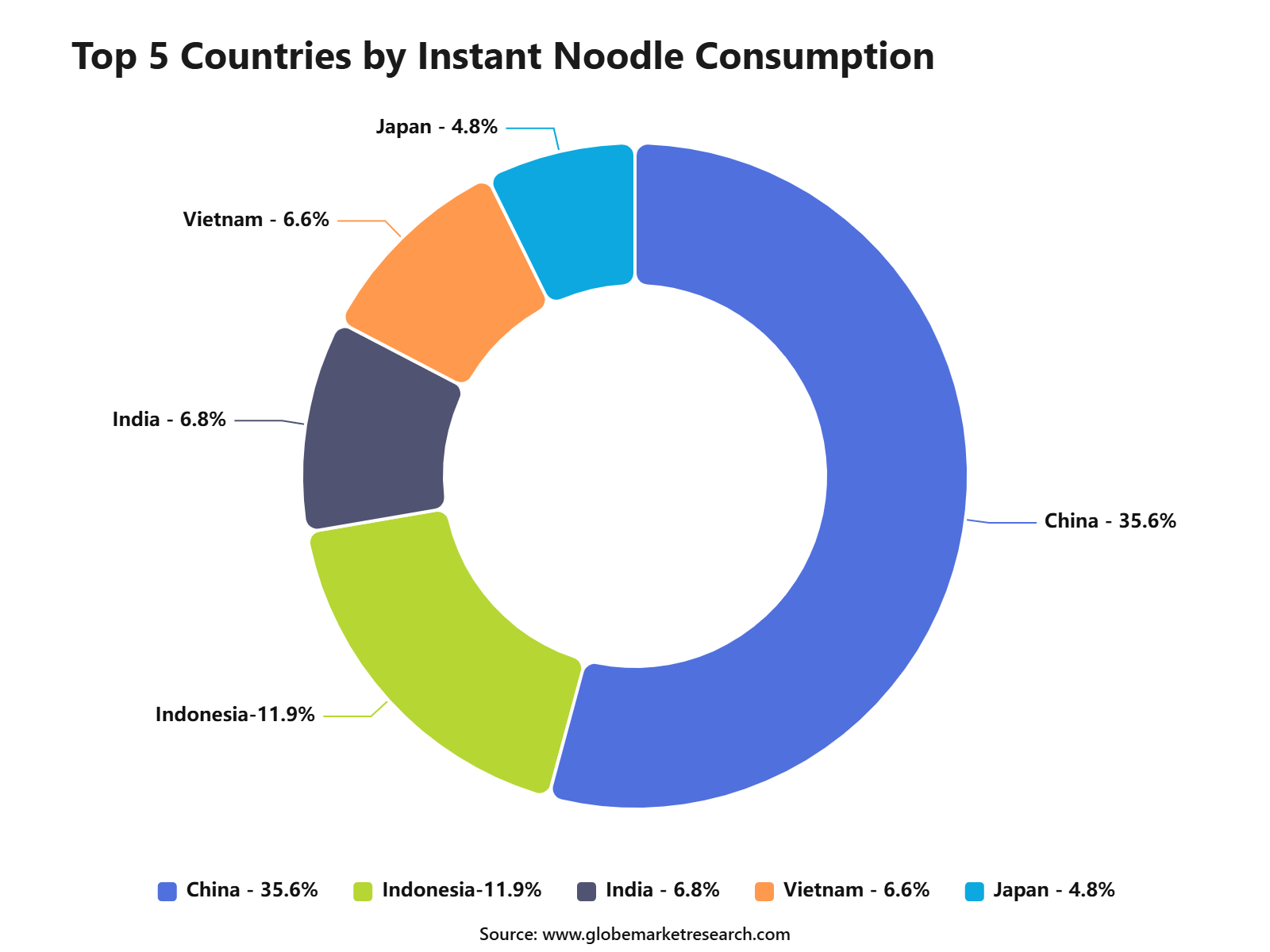 iThe graph shows projected market growth until 2035 based on CAGR analysis. Actual outcomes may vary depending on changing demand, competition, and economic factors.To gain greater insights - request a sample report PDF
Government Initiatives for the Instant Food Market
Government initiatives are supporting the Instant Food Market through food safety standards, nutrition labelling rules, sodium reduction programs, trans-fat elimination policies, sustainable packaging regulations, food loss reduction measures, and public health-focused reformulation. These initiatives do not usually target instant food as a separate category, but they directly influence instant noodles, ready-to-eat meals, instant soups, instant rice, instant pasta, frozen meals, retort pouches, cups, cans, and shelf-stable convenience foods.
Food Safety and Hygiene Standards
Food safety regulation is one of the most important government-driven factors for the instant food industry. Instant food products pass through several stages such as ingredient sourcing, cooking, drying, seasoning, packaging, storage, and distribution. Because these products are often consumed quickly with limited home preparation, strict hygiene control is required across the full production chain.
Codex Alimentarius food hygiene principles provide a global reference for good hygiene practices and HACCP-based food safety systems. The framework covers preventive controls across the food chain and is widely used by regulators and food businesses to manage contamination risks. This supports demand for better processing systems, automated quality checks, safer packaging lines, and stronger supplier compliance in instant food manufacturing.
Nutrition Labelling and Consumer Transparency
Nutrition labelling policies are becoming more important for instant food brands because consumers and regulators are paying closer attention to calories, sodium, saturated fat, added sugar, allergens, and ingredient quality. Clear labelling helps buyers compare products and supports healthier purchase decisions, especially in packaged and ready-to-eat food categories.
Codex nutrition labelling guidance is used as an international reference for nutrition information on food packages. The Codex Committee on Food Labelling sets standards and guidelines that help consumers make informed food choices. For instant food companies, this increases the need for accurate nutrient declaration, cleaner ingredient communication, allergen labelling, and transparent product positioning.
Revenue Potential Analysis
Revenue Landscape Across
Revenue opportunities are spread across instant noodles, instant soups, pasta cups, meal bowls, dehydrated meals, ready mixes, instant breakfast, and shelf-stable snacks. The category benefits from regular repeat purchases and small-ticket affordability. In May 2026, U.S. food-at-home prices rose 2.7% year over year, supporting demand for budget-friendly home meal options.
Across regions, Asia remains the strongest volume base due to frequent noodle and rice-based meal consumption. WINA data shows India consumed 8,320 million servings of instant noodles in 2024, while the United States consumed 5,151 million servings. These figures show revenue potential in both emerging and mature packaged food markets.
Across channels, supermarkets and convenience stores support impulse and pantry purchases, while e-commerce enables subscription packs, bulk bundles, and flavor discovery. Quick-commerce can improve repeat buying for single cups and family packs. Stronger revenue can be generated through premium flavors, fortified nutrition, vegetarian formats, and local taste customization.
Financial Impact
The financial impact of instant food is supported by repeat purchasing, high shelf stability, lower cold-chain dependence for dry products, and broad channel reach. Products such as noodles, soups, pasta, and rice cups can be sold through supermarkets, convenience stores, discount stores, vending channels, e-commerce, and institutional supply. This allows brands to build volume across several buying occasions instead of depending on one customer group.
Margin performance depends on wheat, rice, palm oil, packaging, spices, energy, and freight costs. FAO reported that the Cereal Price Index averaged 114.3 points in May 2026, up 2.6% from April and 4.9% from a year earlier, while world wheat prices rose 3.4% month over month. This directly affects instant noodles, pasta, and wheat-based ready meal producers because raw material inflation can reduce margins when retail prices cannot be increased quickly
Product Type Analysis
Instant noodles led the Instant Food Market with 36.3% share, supported by strong demand for affordable, quick-cooking, and easy-to-store meal options. These products are widely consumed by students, working professionals, single-person households, travelers, and price-sensitive consumers because they require minimal preparation time. The growth of this segment can be attributed to wider availability of cup noodles, packet noodles, premium ramen, regional flavors, and ready-to-cook noodle meals.
Instant noodles also benefit from long shelf life, low cost, strong brand recall, and suitability for both home consumption and on-the-go eating. Instant noodles are expected to remain the leading product type as companies continue to launch healthier, spicy, protein-added, low-sodium, and international flavor variants. Demand is likely to remain strong in Asia Pacific, where instant noodles are already part of regular food consumption across many countries.
Packaging Type Analysis
Pouches accounted for 47.1% share of the Instant Food Market, supported by their low packaging cost, light weight, portability, and easy storage. Pouch packaging is widely used for instant noodles, ready mixes, soups, sauces, instant rice, meal kits, and powdered food products. The segment is growing because pouches help brands offer affordable pack sizes and strong shelf visibility.
They are also suitable for single-serve and family-size products, which makes them useful across both budget and mass-market instant food categories. Pouches are expected to remain a leading packaging type as food companies focus on convenience and cost control. Future demand will be supported by resealable formats, better barrier films, recyclable pouches, attractive printing, and compact packaging designs for modern retail and e-commerce.
Distribution Channel Analysis
Supermarkets and hypermarkets held 43.2% share of the Instant Food Market, supported by wide product availability, high consumer footfall, visible pricing, and strong brand comparison. These stores offer instant noodles, ready meals, soups, snacks, frozen instant foods, and packaged meal solutions under one roof. The growth of this channel can be linked to organized retail expansion and consumer preference for bulk buying.
Supermarkets and hypermarkets also support promotional pricing, combo packs, private-label products, and seasonal displays, which help increase instant food purchases. This channel is expected to remain important as consumers continue to buy instant foods during routine grocery shopping. Demand will also be supported by urban households, working consumers, students, and families seeking quick meal options at accessible prices.
Ingredient Type Analysis
Vegetarian instant food led the ingredient type segment with 58.3% share, supported by strong demand from consumers seeking plant-based, affordable, and widely acceptable meal options. Vegetarian products are common in instant noodles, soups, ready mixes, rice meals, pasta, and snack-based instant foods. The growth of this segment can be attributed to cultural food habits, religious preferences, health awareness, and rising interest in plant-based meals.
Vegetarian instant foods are also easier to position across broad consumer groups because they are suitable for everyday meals and mass-market distribution. Vegetarian instant food is expected to remain a leading ingredient type as brands expand products with vegetables, pulses, grains, spices, and plant-based proteins. Demand is likely to remain strong in Asia Pacific, where vegetarian and flexitarian food habits support broad product acceptance.
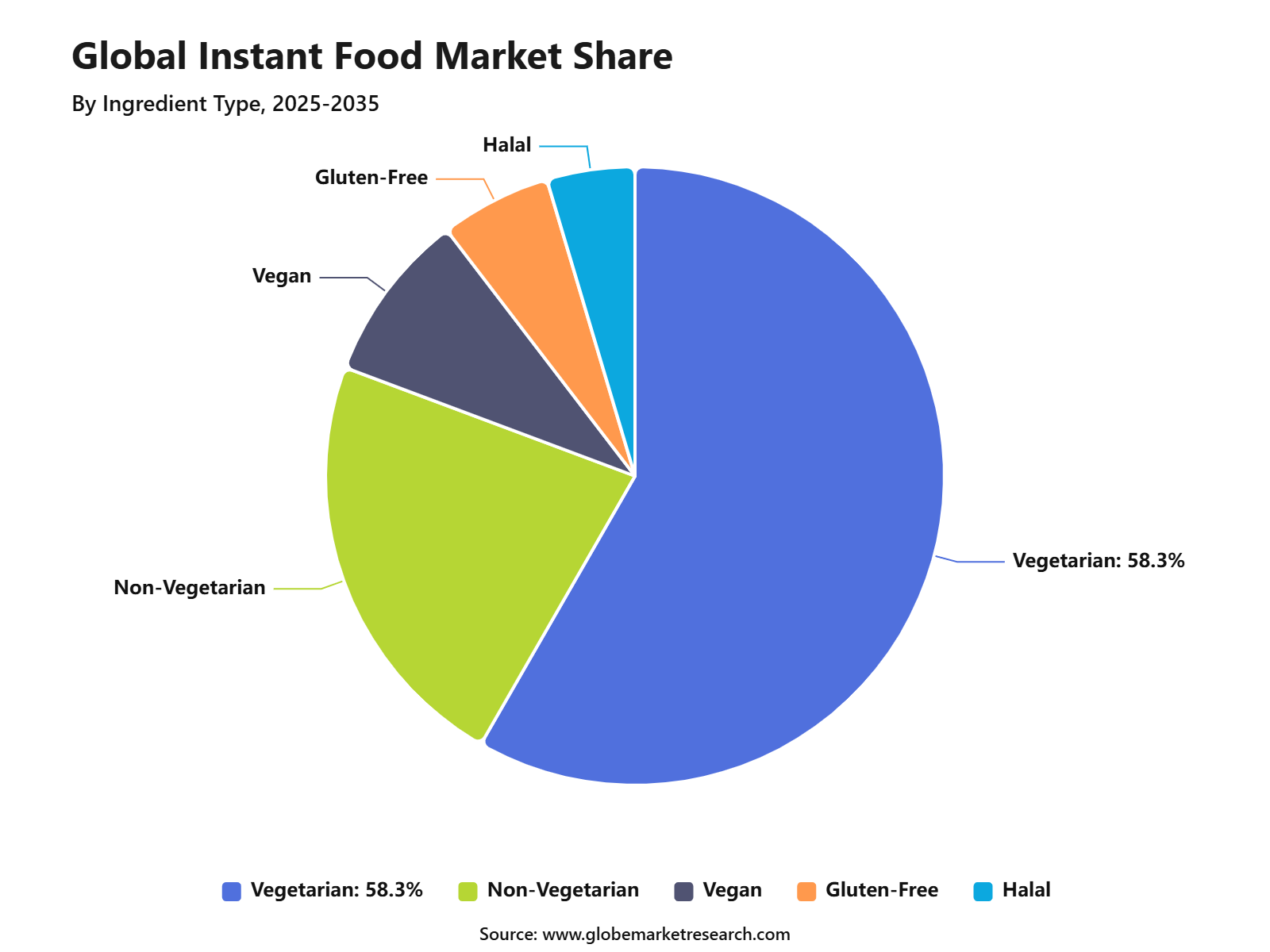 iThe graph shows projected market growth until 2035 based on CAGR analysis. Actual outcomes may vary depending on changing demand, competition, and economic factors.To gain greater insights - request a sample report PDF
End User Analysis
Working professionals accounted for 44.2% share of the Instant Food Market, supported by busy schedules, long working hours, urban lifestyles, and demand for quick meals. This consumer group prefers instant foods because they reduce cooking time and provide easy meal access at home, offices, hostels, and during travel. The growth of this segment is being driven by urbanization, higher workforce participation, and rising demand for convenient food products.
Working professionals often choose instant noodles, ready meals, instant soups, frozen snacks, and microwaveable products for fast meal preparation. Working professionals are expected to remain a key end-user group as convenience continues to influence food choices. Products with better taste, healthier ingredients, portion control, easy preparation, and affordable pricing are likely to gain stronger demand among this group.
Regional Analysis
Asia Pacific led the Instant Food Market with 48.1% share, supported by large population, strong instant noodle consumption, urbanization, modern retail growth, and rising demand for quick meal solutions. China, India, Indonesia, Viet Nam, Japan, South Korea, and Southeast Asian countries remain major contributors to regional demand. The region’s growth can be attributed to changing lifestyles, student populations, working consumers, and strong availability of affordable packaged foods.
Instant food products are widely accepted because they suit fast-paced urban routines and offer familiar local flavors at accessible prices. Asia Pacific is expected to remain the leading regional market as food manufacturers expand instant noodles, ready meals, pouches, vegetarian variants, and value-focused product lines. Opportunities are likely to remain strong in premium ramen, healthier instant meals, regional flavors, online grocery sales, and supermarket distribution.
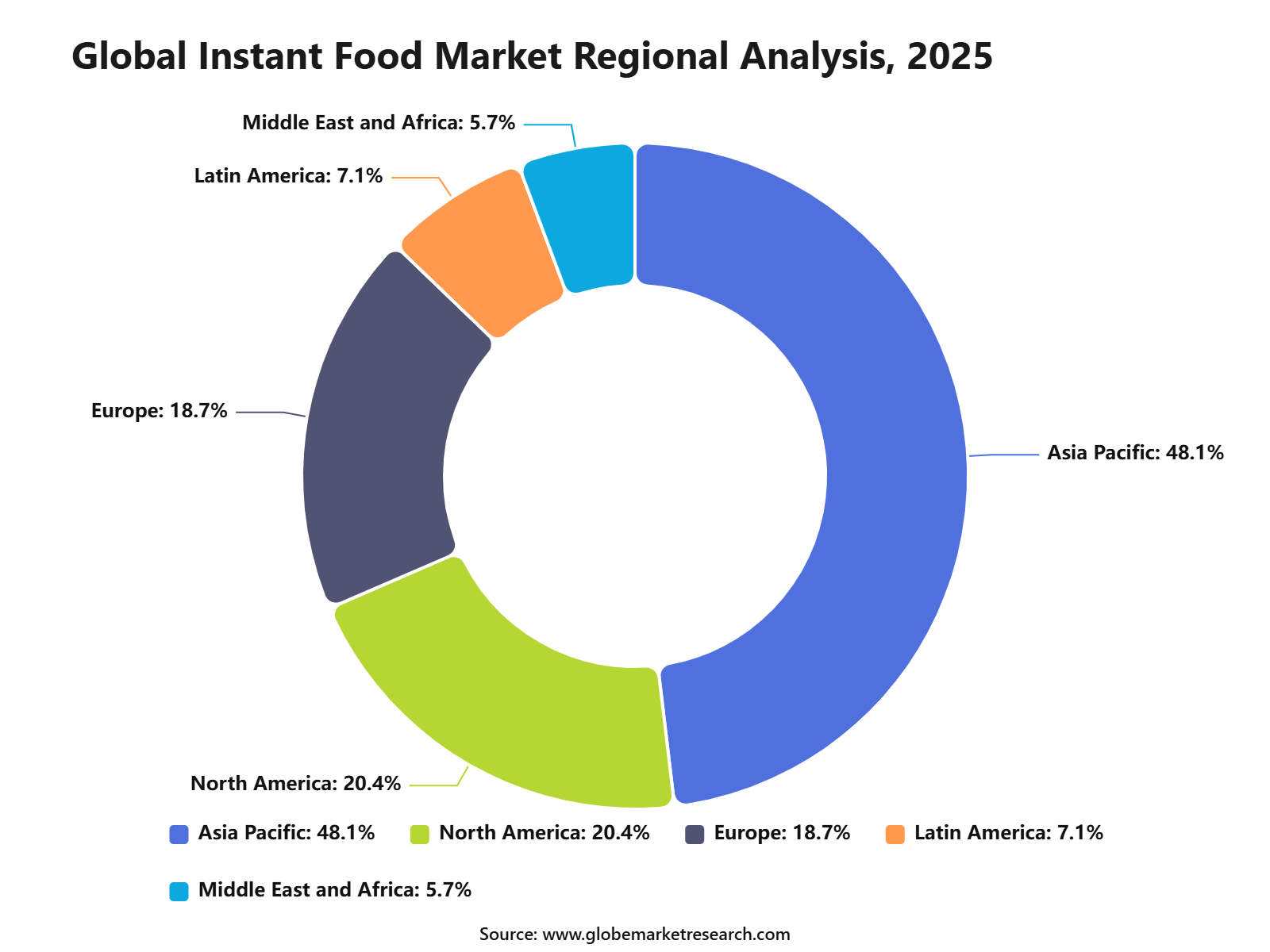 iThe graph shows projected market growth until 2035 based on CAGR analysis. Actual outcomes may vary depending on changing demand, competition, and economic factors.To gain greater insights - request a sample report PDF
Regional Impact Analysis
Impact Factor | Estimated CAGR Impact | Regional Relevance | Market Impact |
|---|---|---|---|
Asia Pacific market leadership | +2.0% | Asia Pacific, 48.1% share in 2025 | Leads consumption volume. |
China and India urban demand | +1.4% | China, India | Drives volume expansion. |
North America convenience food adoption | +0.9% | U.S. and Canada | Supports premium formats. |
Europe demand for healthier instant meals | +0.8% | UK, Germany, France, Italy | Drives reformulated products. |
Latin America affordable packaged food growth | +0.6% | Brazil, Mexico, Chile | Builds future demand. |
Risk Factors & Market Barriers
Regulatory & Compliance Risks
Regulatory risk is increasing because instant food products are closely reviewed for nutrition, labeling, additives, allergens, sodium content, packaging safety, and traceability. In the U.S., the FDA’s sodium reduction programme targets commercially processed, packaged, and prepared foods, and its draft Phase II guidance includes three-year sodium reduction targets across 163 food categories. This creates reformulation pressure for instant noodles, instant soups, sauces, seasoning mixes, and ready meals that often depend on salt for taste and shelf stability.
Food traceability is another important compliance issue. The FDA’s Food Traceability Final Rule requires additional recordkeeping for foods on the Food Traceability List to support faster identification and removal of potentially contaminated products from the market. The compliance timeline has been under extension discussion, but the direction is clear: food manufacturers and distributors will need stronger lot-level data, supplier records, and recall readiness.
Packaging compliance is also becoming stricter. The European Commission stated that the Packaging and Packaging Waste Regulation will begin to apply from mid-2026 and will replace the existing Packaging Waste Directive. This can affect pouches, cups, bowls, trays, sachets, and multilayer packaging used in instant food, especially where recyclability, labeling, recycled content, and food-contact safety requirements become more demanding.
Market Adoption Barriers
Market adoption is limited by health concerns, sodium levels, processed food perception, price competition, and strong private-label pressure. Consumers want convenience, but many also check ingredient lists, calories, artificial additives, preservatives, and nutritional value before repeat purchase. WHO stated in May 2026 that reducing sodium intake is one of the most cost-effective ways to improve health and reduce the burden of noncommunicable diseases, which increases pressure on instant food brands to improve nutritional profiles.
Input cost volatility is another major barrier. USDA’s June 2026 outlook projected U.S. prices for sugar and sweets to increase 6.9% in 2026, nonalcoholic beverages to increase 5.7%, and farm-level wheat prices to rise 21.1%. These cost movements affect seasonings, sauces, wheat-based products, sweet instant desserts, beverage-linked meal kits, and packaged snack meals.
Retail shelf competition also makes adoption difficult for new entrants. Established brands already control distribution, pricing architecture, and consumer trust in major instant food categories. New brands are more likely to succeed when they offer a clear difference, such as regional taste, better nutrition, clean labeling, plant-based ingredients, microwavable convenience, student-friendly pricing, or strong online availability.
Market Trend Analysis
Impact Factor | Estimated CAGR Impact | Regional Relevance | Market Impact |
|---|---|---|---|
Instant noodles remain leading product type | +1.4% | Asia Pacific, global retail markets | Leads volume demand. |
Pouches gain strong packaging preference | +1.1% | Asia Pacific, Latin America, Africa | Supports affordable sales. |
Supermarkets and hypermarkets lead distribution | +1.0% | Global | Drives retail visibility. |
Vegetarian instant food demand increases | +0.9% | India, Europe, urban Asia | Supports wider adoption. |
Working professionals remain key end users | +0.8% | Urban global markets | Drives repeat demand. |
Investor Type Impact Matrix
Investor Type | Estimated CAGR Impact | Regional Relevance | Market Impact |
|---|---|---|---|
Instant Food Manufacturers | +1.4% | Global | Expands product capacity. |
Food and Beverage Companies | +1.2% | Asia Pacific, North America, Europe | Builds branded portfolios. |
Retail and E-commerce Investors | +1.0% | Global | Strengthens sales channels. |
Packaging Companies | +0.8% | Asia Pacific, Europe, North America | Supports shelf-ready formats. |
Private Equity Firms | +0.7% | Emerging and urban markets | Enables brand scaling. |
Segment Covered in the Report
By Product Type
Instant Noodles
Instant Soups
Instant Rice
Instant Pasta
Instant Meat Products
Others
By Packaging Type
Pouches
Cups and Bowls
Cans and Jars
Boxes
Others
By Distribution Channel
Supermarkets and Hypermarkets
Convenience Stores
Online Stores
Specialty Stores
Others
By Ingredient Type
Vegetarian
Non-Vegetarian
Vegan
Gluten-Free
Halal
By End User
Working Professionals
Students
Travelers
Households
Military and Emergency Services
Others
By Region
North America
Europe
Asia Pacific
Latin America
Middle East and Africa
Drivers Impact Analysis
Impact Factor | Estimated CAGR Impact | Regional Relevance | Market Impact |
|---|---|---|---|
Rising demand for quick meal solutions | +1.5% | Asia Pacific, North America, Europe | Drives daily consumption. |
Growth in urban working population | +1.2% | China, India, Japan, Southeast Asia | Supports convenience demand. |
Expansion of modern retail channels | +1.0% | Asia Pacific, Europe, Latin America | Improves product access. |
Increasing demand from students and professionals | +0.9% | Urban global markets | Boosts repeat purchases. |
Affordable pricing of instant meals | +0.8% | Emerging markets | Supports mass adoption. |
Restraints Impact Analysis
Impact Factor | Estimated CAGR Impact | Regional Relevance | Market Impact |
|---|---|---|---|
Health concerns over sodium and additives | -0.8% | North America, Europe, urban Asia | Limits frequent consumption. |
Competition from fresh and ready-to-eat meals | -0.6% | Global | Pressures category growth. |
Raw material price volatility | -0.5% | Global manufacturers | Affects margins. |
Regulatory pressure on labeling and nutrition | -0.5% | Europe, U.S., Asia Pacific | Raises compliance burden. |
Perception of low nutritional value | -0.4% | Developed and urban markets | Slows premium adoption. |
Opportunities Impact Analysis
Impact Factor | Estimated CAGR Impact | Regional Relevance | Market Impact |
|---|---|---|---|
Healthier instant food formulations | +1.3% | North America, Europe, Asia Pacific | Improves consumer trust. |
Growth in vegetarian instant food | +1.1% | India, Asia Pacific, Europe | Expands consumer base. |
Premium and regional flavor innovation | +1.0% | Asia Pacific, North America, Europe | Supports product differentiation. |
Online grocery and quick-commerce growth | +0.9% | Urban global markets | Improves delivery reach. |
Expansion of single-serve packaging | +0.7% | Students, workers, travelers | Supports convenience use. |
Challenges Impact Analysis
Impact Factor | Estimated CAGR Impact | Regional Relevance | Market Impact |
|---|---|---|---|
Maintaining taste with healthier ingredients | -0.7% | Global manufacturers | Creates reformulation pressure. |
Managing packaging sustainability concerns | -0.6% | Europe, North America, developed Asia | Raises material costs. |
Strong price competition among brands | -0.5% | Asia Pacific and emerging markets | Reduces margin strength. |
Supply chain disruption risk | -0.4% | Global | Impacts product availability. |
Building trust in nutritional claims | -0.4% | Developed and urban markets | Requires clear labeling. |
Recent Developments
In May 2026, Nissin Foods Holdings reported FY3/2026 revenue of ¥788.1 billion, up 1.5% year on year. Management cited domestic price revisions, anniversary initiatives, volume share gains, and premium U.S. launches.
In May 2026, Ajinomoto reported FY ended March 2026 consolidated sales of ¥1,583.7 billion, up 3.5%. Seasonings and Foods sales rose 4.6% to ¥936.9 billion, while Frozen Foods reached ¥290.3 billion.
Report Scope
Report Highlights | Details |
|---|---|
Market Revenue (2025) | USD 184.2 Billion |
Forecast Revenue (2035) | USD 320.7 Billion |
CAGR (2025-2035) | 5.7% |
Base Year for Estimation | 2025 |
Historic Data | 2020-2024 |
Forecast Period | 2025-2035 |
Report Coverage | AI market impact analysis, market surveys, trade analysis, Industry & competitive intelligence, Revenue projections, company positioning, competitive analysis, growth drivers, and emerging market trends, Strategic Consultation & Advisory Services |
Segments Covered | By Product Type (Instant Noodles, Instant Soups, Instant Rice, Instant Pasta, Instant Meat Products, Others), By Packaging Type (Pouches, Cups and Bowls, Cans and Jars, Boxes, Others), By Distribution Channel (Supermarkets and Hypermarkets, Convenience Stores, Online Stores, Specialty Stores, Others), By Ingredient Type (Vegetarian, Non-Vegetarian, Vegan, Gluten-Free, Halal), By End User (Working Professionals, Students, Travelers, Households, Military and Emergency Services, Others) |
Regional Analysis | North America - US, Canada; Europe - Germany, France, The UK, Spain, Italy, Russia, Netherlands, Rest of Europe; Asia Pacific - China, Japan, South Korea, India, New Zealand, Singapore, Thailand, Vietnam, Rest of Latin America; Latin America - Brazil, Mexico, Rest of Latin America; Middle East & Africa - South Africa, Saudi Arabia, UAE, Rest of MEA |
Key companies profiled | Nestlé S.A., Nissin Foods Holdings Co., Ltd., Ajinomoto Co., Inc., Unilever PLC, The Kraft Heinz Company, Campbell Soup Company, ITC Limited, Toyo Suisan Kaisha, Ltd., Nongshim Co., Ltd., Indofood CBP, Tingyi Holding Corp., Uni-President Enterprises Corporation |
Customization Scope | Tailored insights for specific regions, countries, and market segments can be provided. Additional report customization is available upon request. |
Competitive Landscape
The market is characterized by intense competition among established players and emerging companies. Strategic partnerships, mergers and acquisitions, and product innovation are key strategies employed by market participants.
Key Market Players
Nestlé S.A.
Nissin Foods Holdings Co., Ltd.
Ajinomoto Co., Inc.
Unilever PLC
The Kraft Heinz Company
Campbell Soup Company
ITC Limited
Toyo Suisan Kaisha, Ltd.
Nongshim Co., Ltd.
Indofood CBP
Tingyi Holding Corp.
Uni-President Enterprises Corporation
Other Key Players
Research Methodology
This market study is prepared using a combination of primary and secondary research. Primary research includes discussions with manufacturers, suppliers, distributors, consultants, industry experts, and end users. Secondary research covers company reports, government databases, trade associations, technical publications, regulatory sources, and trusted industry documents. The collected information is used to assess market demand, pricing trends, technology adoption, competitive activity, and regional performance.
AI language models are not used as primary data sources, and publicly available AI-generated content is not treated as market evidence. Computational tools may be used to support data processing, translation, data classification, and pattern identification. However, every published assessment is supported by verified sources, human review, and primary market discussions.
Market estimates are developed through top-down and bottom-up approaches and validated using data triangulation. Revenue, production, shipment, pricing, and application-level data are compared across multiple sources. Forecasts consider economic conditions, regulatory changes, investment activity, innovation, supply chain developments, and industry risks. All findings are reviewed through source verification and internal quality checks before publication.
Part I
Source Management & Input Data Standards
Who provides data, how sources are qualified, and what types of evidence are admissible.
Part II
Research Scope & Market Coverage
How we define the markets we assess and the parameters that govern each product.
Part III
Data Collection, Verification & Submission
The mechanics of gathering, cross-checking, and hierarchically ranking evidence.
Part IV
Assessment Determination & Quality Controls
How raw data becomes a published assessment — normalisation, expert judgement, and outlier exclusion.
Part V
Publication, Corrections & Revision
Our publication schedule, corrections policy, and methodology review cycle.
Part VI
Independence, Ethics & Complaints
Conflict-of-interest policies, editorial independence, and how clients raise concerns.
Google · Preferred Sources
Don't miss the latest market research insights and industry updates on Google.
Add Globe Market Research as a preferred source in the Google app to see our reports, analysis, and market stories in your news suggestions.
Meet the Team
This report was prepared by our expert analysts with deep industry knowledge and research experience.
Pratiksha K. is a Senior Research Analyst with more than five years of experience in market research, industry analysis, competitive intelligence, and business strategy. She has contributed to detailed market reports, customized research studies, company profiling, market sizing, trend analysis, and strategic consulting projects for clients across different regions. Her industry expertise covers Chemical and Material, Consumer Goods, Food & Beverages and Energy & Power. She closely evaluates changing customer requirements, technology developments, regulatory conditions, supply chain structures, investment activity, and competitive strategies to provide clear and practical market insights.
Sayali brings more than 7 years of experience to Globe Market Research, supporting the accuracy, clarity, and relevance of research content across multiple industries. She reviews market data, segment analysis, competitive insights, and industry trends to ensure each report meets strong quality standards and provides practical value to business decision-makers. Her expertise spans healthcare, information technology, consumer goods, and diverse cross-industry domains. With a strong focus on data reliability, structured analysis, and clear presentation, Sayali helps ensure that each research output delivers well-reviewed insights for clients, investors, consultants, and industry stakeholders.
Frequently Asked Questions
Related Reports
More in Food and Beverages
Frozen Desserts Market to Hit USD 298.8 Billion by 2035
Frozen Desserts Market Size, Share, Analysis By Product (Ice Cream, Frozen Yogurt, Gelato, Sorbet, Frozen Cakes, Other Products), By Consumption (Retail Consumption, Foodservice Consumption), By Distribution Channel (Supermarkets and Hypermarkets, Convenience Stores, Specialty Stores, Online Retail), By Regional Insights, Business plan and Project Report, Investment Opportunities, Profitability, Industry Trends, Leading Companies and Growth Forecasts by 2026-2035
Frozen Meat and Seafood Market to Hit USD 181.1 Billion by 2035
Frozen Meat and Seafood Market Size, Share, Analysis By Product (Frozen Meat, Frozen Seafood), By Seafood Form (Whole, Fillets, Processed Seafood, Other Forms), By Seafood End Use (Retail and Household, Foodservice, Industrial), By Regional Insights, Business plan and Project Report, Investment Opportunities, Profitability, Industry Trends, Leading Companies and Growth Forecasts by 2026-2035
Frozen Meals Market to Hit USD 74.2 Billion by 2035
Frozen Meals Market Size, Share, Analysis By Product (Frozen, Chilled, Canned, Shelf-Stable), By Meal Type (Vegetarian, Non-Vegetarian, Vegan), By Distribution Channel (Supermarkets and Hypermarkets, Online Retail, Convenience Stores, Specialty Stores), By Regional Insights, Business plan and Project Report, Investment Opportunities, Profitability, Industry Trends, Leading Companies and Growth Forecasts by 2026-2035
Food Colorants Market to Hit USD 8.6 Billion by 2035
Food Colorants Market Size, Share, Analysis By Type (Natural, Synthetic, Nature-Identical), By Form (Powder, Liquid, Gel), By Application (Beverages, Bakery and Confectionery, Dairy, Meat Products, Snacks, Other Applications), By Regional Insights, Business plan and Project Report, Investment Opportunities, Profitability, Industry Trends, Leading Companies and Growth Forecasts by 2026-2035