

Revenue, 2025
$ 0.3 Bn
Forecast, 2035
$ 5.0 Bn
CAGR, 2025-2035
32.6%
Report Coverage
Global
Market Size and Forecast
The Global Perovskite Solar Cells Module Market was worth USD 0.3 billion in 2025 and is expected to reach USD 5.0 billion by 2035, growing at a CAGR of 32.6% from 2025 to 2035. Based on this growth rate, the market is estimated to reach around USD 0.8 billion in 2026. Asia Pacific held the largest regional share of 54.5% in 2025, valued at around USD 0.16 billion, supported by strong solar manufacturing capacity, clean energy investments, and rising research activity in next-generation photovoltaic technologies.
The Perovskite Solar Cells Module Market includes photovoltaic modules made using perovskite-structured materials that can convert sunlight into electricity with high efficiency and lightweight design potential. These modules are used in rooftop solar systems, building-integrated photovoltaics, flexible solar panels, portable power devices, tandem solar cells, and utility-scale clean energy projects. The market is closely linked with advanced materials, thin-film solar production, printed electronics, and renewable energy deployment.
Key Parameter | Report Details |
|---|---|
Market Revenue, 2025 | USD 0.3 Billion |
Projected Revenue, 2035 | USD 5.0 Billion |
CAGR (2025-2035) | 32.6% |
Largest Region | Asia Pacific (54.5%, USD 0.16 Bn) |
Market Concentration | Medium |
Base Year | 2025 |
Forecast Period | 2025-2035 |
The market outlook remains strong as perovskite technology gains attention for its high efficiency potential, low material use, and compatibility with flexible manufacturing methods. Growth can be attributed to rising demand for low-cost solar modules, increasing pilot-scale production, and growing interest in perovskite-silicon tandem cells. The expansion of Asia Pacific solar supply chains, research partnerships, and commercialization efforts is expected to support long-term market demand.
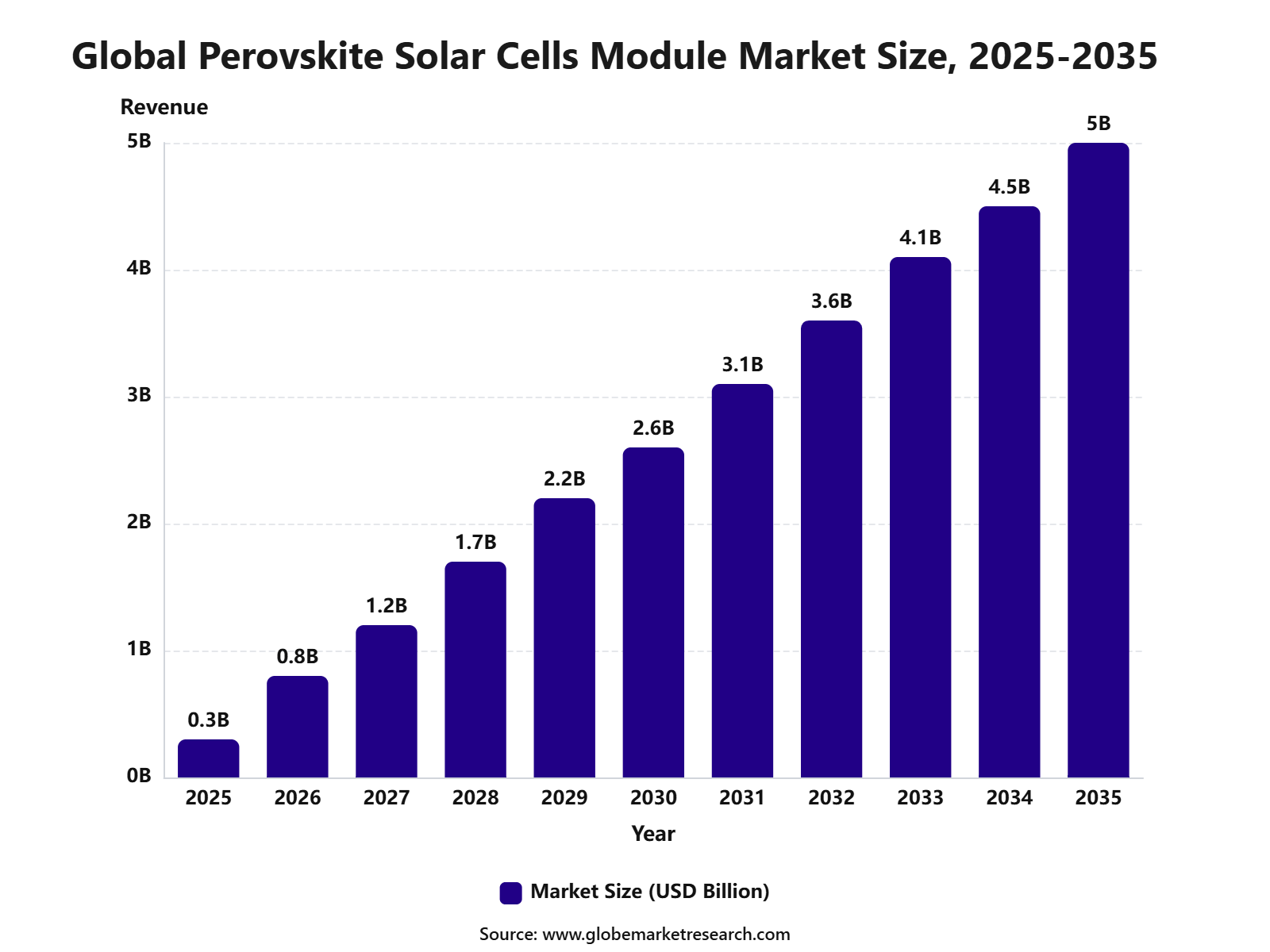 iThe graph shows projected market growth until 2035 based on CAGR analysis. Actual outcomes may vary depending on changing demand, competition, and economic factors.To gain greater insights - request a sample report PDF
Key Market Insights
Mesoporous structures led the structure segment with 53.0% share, supported by better charge transport, improved light absorption, and strong suitability for high-efficiency perovskite solar cell designs.
Flexible modules accounted for 60.1% share by product, driven by rising demand for lightweight, bendable, and easy-to-integrate solar solutions used in portable devices, building surfaces, and next-generation photovoltaic applications.
Asia Pacific led the perovskite solar cells module market with 54.5% share, valued at USD 0.16 billion, supported by strong solar manufacturing capacity, advanced materials research, and rising investment in emerging photovoltaic technologies.
Top Funding and Investment
Top 5 Investment
In June 2026, Quzhou FiberNano New Energy Technology’s perovskite and tandem PV systems project was listed with a total investment of CNY 5.46 billion, with planned capacity of 5 GW.
In June 2025, GCL Optoelectronics commissioned its GW-level perovskite industrial base in Kunshan, with a total investment of CNY 5 billion and a target production capacity of 2 GW.
In March 2026, Maxwell Technologies signed a CNY 5 billion investment cooperation agreement in Suzhou, including CNY 3.5 billion for perovskite tandem cell equipment R&D, large-scale production, and industrial application.
In January 2025, Sekisui Chemical outlined a JPY 90 billion investment for a 100 MW perovskite solar cell production facility, with the investment period running from January 2025 to March 2027.
In March 2025, Kelin Electric planned to raise up to CNY 1.46 billion through private placement, with CNY 1.26 billion allocated to a 1 GW perovskite solar module project in Hangzhou.
Top 3 Funding
In March 2025, Tandem PV secured $50 million in Series A funding and debt to build a commercial-scale perovskite solar manufacturing facility in the U.S.
In July 2025, GCL Optoelectronics Materials raised nearly CNY 200 million, or about $27.5 million, in C2 financing to support perovskite solar manufacturing and research at its gigawatt-scale facility.
In November 2025, South Korea allocated KRW 33.6 billion, or about $22.8 million, for R&D on perovskite-silicon tandem solar technology.
By Structure
Mesoporous structures accounted for 53.0% share of the Perovskite Solar Cells Module Market. This leading position is supported by their strong charge transport capability, better light absorption support, and improved device stability compared with many early-stage structural formats.
Mesoporous perovskite modules are preferred because their porous layer helps improve contact between the perovskite absorber and transport materials. This supports better electron movement, reduced recombination losses, and more stable power conversion performance.
Demand for mesoporous structures is expected to remain strong as researchers and manufacturers focus on improving module efficiency, durability, and commercial readiness. Their suitability for high-performance perovskite designs makes them an important structure in next-generation solar module development.
By Product
Flexible perovskite solar cell modules held 60.1% share of the Perovskite Solar Cells Module Market. This dominance can be attributed to their lightweight design, bendable structure, and suitability for surfaces where rigid solar modules are difficult to install.
Flexible modules are widely considered for building-integrated photovoltaics, portable electronics, vehicles, wearables, off-grid devices, and curved surfaces. Their low weight and design flexibility create opportunities beyond conventional rooftop solar systems.
The segment is expected to maintain its strong position as demand grows for thin, adaptable, and easy-to-install solar solutions. Flexible perovskite modules can support wider adoption in consumer electronics, smart infrastructure, mobility, and distributed renewable energy applications.
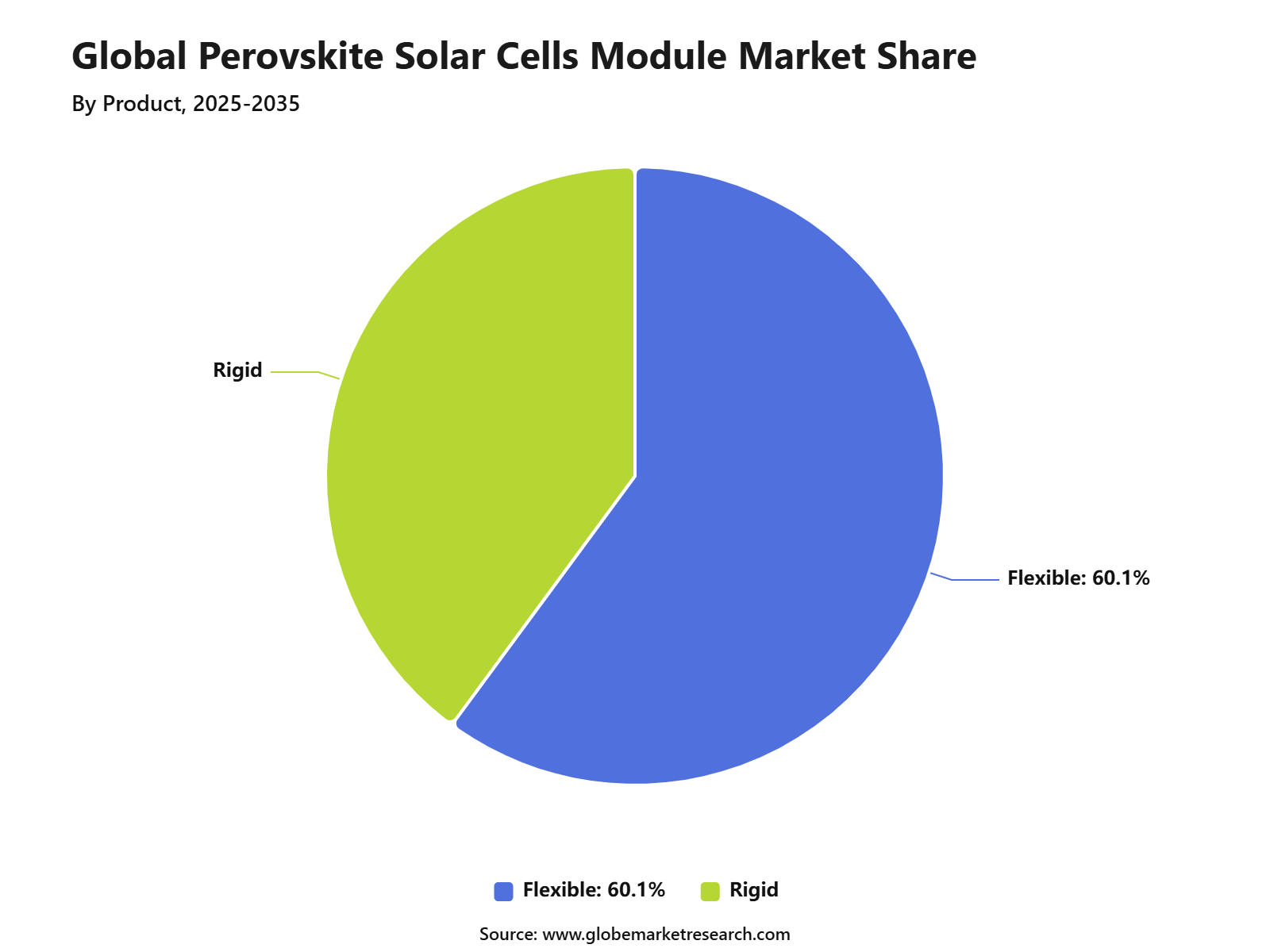 iThe graph shows projected market growth until 2035 based on CAGR analysis. Actual outcomes may vary depending on changing demand, competition, and economic factors.To gain greater insights - request a sample report PDF
By Region
Asia Pacific accounted for 54.5% share of the Perovskite Solar Cells Module Market, reaching USD 0.16 billion. The region’s leadership is supported by strong solar manufacturing capacity, advanced electronics production, and rising investment in next-generation photovoltaic technologies.
China, Japan, South Korea, India, and Southeast Asian countries are key contributors to regional demand and development. The region benefits from large renewable energy deployment, established solar supply chains, and growing research activity in perovskite module efficiency and stability.
Asia Pacific is expected to maintain its leading position as governments and manufacturers focus on low-cost solar technologies and domestic clean energy production. Rising demand for lightweight, flexible, and high-efficiency solar modules will continue to support regional market growth.
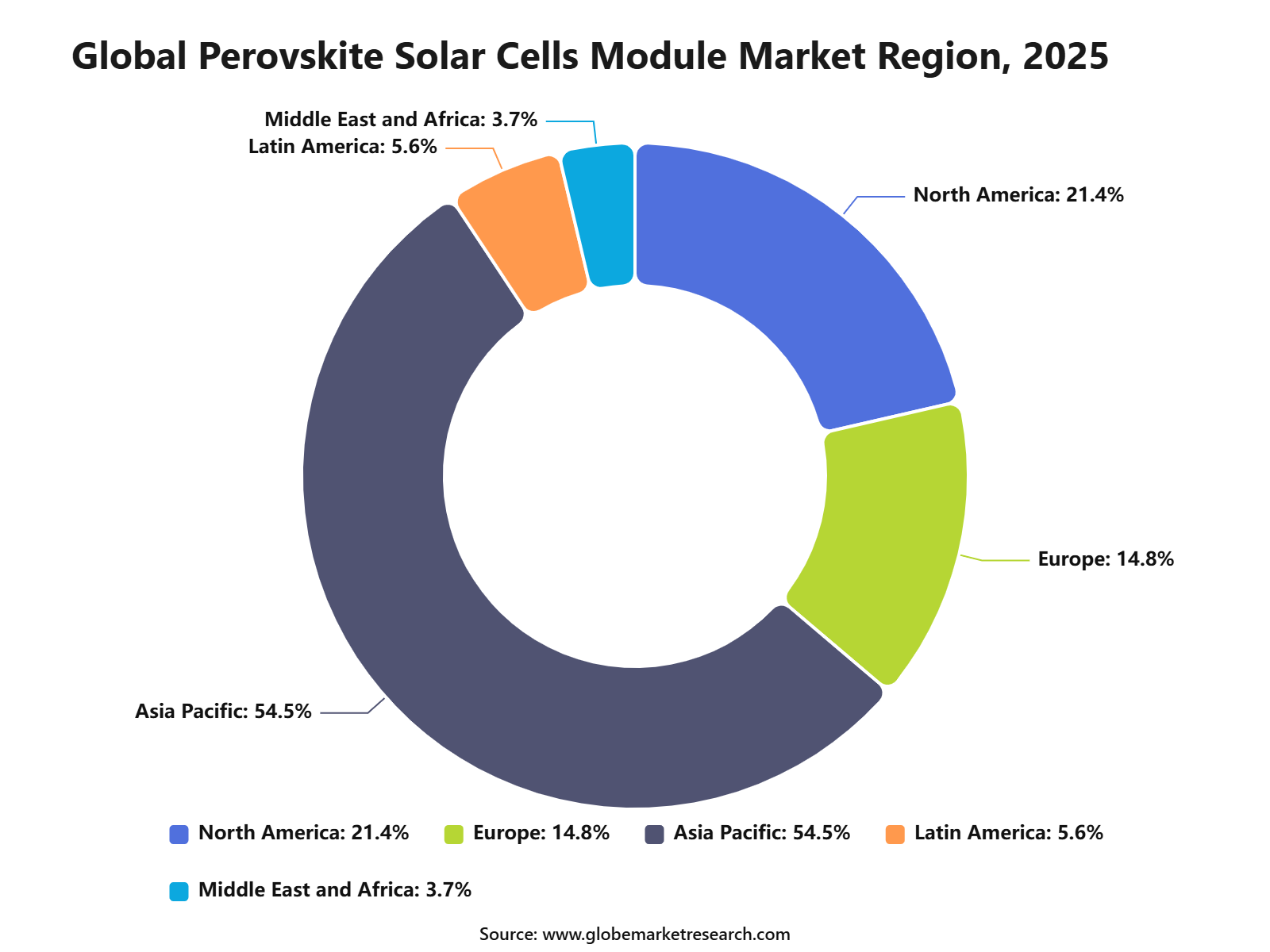 iThe graph shows projected market growth until 2035 based on CAGR analysis. Actual outcomes may vary depending on changing demand, competition, and economic factors.To gain greater insights - request a sample report PDF
Regional Impact Analysis
Asia Pacific leads the Perovskite Solar Cells Module Market with 54.5% share in 2025, supported by strong solar manufacturing, renewable energy deployment, advanced materials research, and large-scale photovoltaic supply chains. China, Japan, South Korea, and India remain major regional contributors.
Europe remains important because of clean energy policy support, building-integrated solar demand, and advanced photovoltaic research. North America supports value growth through technology startups, pilot projects, national energy research, and demand for next-generation solar solutions.
Impact Factor | Estimated CAGR Impact | Regional Relevance | Market Impact |
|---|---|---|---|
Asia Pacific market leadership | +9.0% | Asia Pacific, 54.5% share in 2025 | Leads global demand. |
China solar manufacturing strength | +6.8% | China | Drives regional scale. |
Japan and South Korea advanced PV research | +5.2% | Japan, South Korea | Supports technology adoption. |
Europe BIPV and clean energy demand | +4.4% | Germany, France, UK, Italy | Adds premium opportunity. |
North America solar innovation ecosystem | +3.8% | U.S. and Canada | Supports commercialization. |
Go-To-Market and Sales Economics
Perovskite solar cell modules are best commercialized through tandem-module licensing, rooftop installers, utility developers, building-integrated solar partners, and specialty lightweight solar channels. The market entry case is supported by record solar deployment, as global renewable capacity reached 5,149 GW in 2025, with solar accounting for 2,392 GW of capacity.
Sales economics are strongest where higher module efficiency reduces land, roof space, mounting cost, and balance-of-system spending. Oxford PV stated in 2026 that its commercially ready tandem technology delivers at least 20% more power than conventional modules, while its roadmap targets 27% module efficiency by 2027 and 30% by 2030.
The go-to-market route should focus first on premium and space-constrained solar applications before commodity utility-scale supply. U.S. solar installed 7.8 GWdc in Q1 2026, despite a 27% decline from Q1 2025, which shows that the channel remains active but selective. High-output modules can therefore win where space value is high.
Risk Factors & Market Barriers
The biggest barrier is long-term durability, as perovskite modules must prove stable performance under heat, moisture, UV exposure, mechanical stress, and field aging. The U.S. Department of Energy lists stability, efficiency at scale, manufacturability, and validation for bankability as key commercialization needs for perovskite PV technologies.
Scale-up risk remains high because lab-cell efficiency does not directly convert into full-size module performance. A 2026 review noted that perovskite-silicon tandem cells reached certified efficiency of 34.85%, but also emphasized the need for stability, scalable fabrication, encapsulation, busbars, and external component improvement for commercialization.
Bankability is another major barrier because solar buyers expect long warranties, proven degradation rates, and lender acceptance. DOE’s perovskite commercialization work includes third-party validation and bankability support, while the Perovskite Startup Prize was designed to accelerate U.S. companies moving cells and modules toward commercial readiness.
Revenue Potential Analysis
Revenue Landscape Across
Revenue opportunities are spread across rooftop solar, utility solar, building-integrated photovoltaics, façades, carports, portable power, aerospace, and high-efficiency tandem upgrades for silicon modules. Solar remains the largest renewable growth engine, as IRENA reported 511 GW of solar additions in 2025, equal to almost three-quarters of all renewable capacity additions.
Asia, the U.S., and Europe are the most important early revenue zones because they combine solar manufacturing, large project pipelines, and policy support. IEA expects renewable capacity to increase by almost 4,600 GW between 2025 and 2030, with utility-scale and distributed solar PV representing nearly 80% of the expansion.
Technology licensing is also becoming a practical revenue path. Oxford PV and Trinasolar announced a perovskite PV patent licensing agreement in 2025, while Oxford PV’s 2026 positioning highlights commercial readiness and higher power output. This supports revenue through module supply, patents, joint production, and manufacturing partnerships.
Financial Impact
Perovskite solar cell modules can improve financial returns by increasing energy yield per square meter. This matters for rooftops, industrial buildings, land-constrained projects, and high-cost installation sites. Oxford PV’s claim of at least 20% more power supports better project economics where extra output can be gained without adding land or roof area.
Manufacturing economics could improve if perovskite layers are produced through low-temperature and printable processes. DOE notes that perovskite PV can use ink-based printing of active layers and may support fewer process steps and lower capital expenditure. However, these benefits depend on stable yields, repeatable coating, and proven module lifetimes.
The strongest financial impact is expected from companies that combine efficiency gains with warranty confidence, recycling plans, and scalable manufacturing. A 2026 circularity review stated that perovskite-based tandem PV has simpler device architectures and low-temperature processing advantages, but must address lead sequestration, recycling, and material substitution before terawatt-scale deployment.
Drivers Impact Analysis
The Perovskite Solar Cells Module Market is driven by rising demand for high-efficiency solar technologies, lightweight solar modules, tandem solar cells, building-integrated photovoltaics, and next-generation renewable energy solutions. Perovskite modules are gaining attention because they can offer higher efficiency potential, flexible form factors, and lower-temperature manufacturing compared with traditional solar technologies.
Asia Pacific leads the market due to strong solar manufacturing capacity, government-backed renewable energy deployment, and active investment in advanced photovoltaic technologies. China, Japan, South Korea, India, and Southeast Asia remain key regional contributors because of large solar supply chains and growing demand for low-cost clean energy systems.
Impact Factor | Estimated CAGR Impact | Regional Relevance | Market Impact |
|---|---|---|---|
Rising demand for high-efficiency solar modules | +8.8% | Asia Pacific, Europe, North America | Drives core market growth. |
Growth in tandem solar cell development | +7.4% | China, Japan, South Korea, Europe | Supports premium efficiency gains. |
Expansion of lightweight and flexible solar uses | +6.3% | Asia Pacific, Europe, U.S. | Opens new application areas. |
Strong renewable energy investment | +5.4% | Global clean energy markets | Builds commercialization momentum. |
Lower-temperature manufacturing potential | +4.6% | Solar manufacturing hubs | Supports cost improvement. |
Restraints Impact Analysis
The market faces restraints from stability concerns, moisture sensitivity, lead-related environmental concerns, and limited long-term field performance data. Perovskite modules must prove durability under heat, humidity, ultraviolet exposure, and outdoor operating conditions before large-scale adoption.
Another restraint is the dominance of mature silicon photovoltaic modules. Silicon solar has established supply chains, bankability, warranties, and global installation experience, so perovskite module suppliers must prove clear performance and cost advantages.
Impact Factor | Estimated CAGR Impact | Regional Relevance | Market Impact |
|---|---|---|---|
Long-term stability concerns | -4.2% | Global solar developers | Slows commercial adoption. |
Moisture and heat sensitivity | -3.6% | Humid and high-temperature regions | Raises durability risk. |
Lead and environmental safety concerns | -3.0% | Europe, North America, Japan | Adds compliance pressure. |
Competition from mature silicon modules | -2.7% | Global solar markets | Limits near-term penetration. |
Limited bankability and warranty history | -2.2% | Utility and commercial solar buyers | Delays large project use. |
Opportunities Impact Analysis
Opportunities are strong in perovskite-silicon tandem modules, flexible solar films, building-integrated photovoltaics, indoor photovoltaics, portable energy products, and lightweight solar panels. These applications benefit from efficiency gains, design flexibility, and demand for solar in spaces where conventional modules are less suitable.
Higher-value opportunities are also emerging in roll-to-roll manufacturing, transparent solar windows, solar facades, vehicle-integrated solar, and advanced encapsulation materials. Companies that improve lifetime, scalability, and module reliability can capture strong long-term demand.
Impact Factor | Estimated CAGR Impact | Regional Relevance | Market Impact |
|---|---|---|---|
Perovskite-silicon tandem modules | +8.4% | Asia Pacific, Europe, North America | Builds high-efficiency opportunity. |
Flexible and lightweight solar films | +7.0% | Asia Pacific, Europe, U.S. | Expands non-traditional use cases. |
Building-integrated photovoltaics | +6.1% | Japan, South Korea, Europe, China | Supports urban solar adoption. |
Indoor and low-light photovoltaics | +5.0% | Smart devices and IoT markets | Adds specialty demand. |
Advanced encapsulation materials | +4.2% | Global module manufacturers | Improves commercialization readiness. |
Challenges Impact Analysis
The main challenge is moving from lab-scale efficiency to reliable mass-produced modules. Perovskite cells can perform well in controlled settings, but large-area modules need consistent coating, uniform film quality, low defect rates, and stable output.
Another challenge is proving cost competitiveness at commercial scale. Manufacturing may offer cost advantages, but suppliers must manage material quality, production yield, encapsulation cost, recycling needs, and certification requirements.
Impact Factor | Estimated CAGR Impact | Regional Relevance | Market Impact |
|---|---|---|---|
Scaling large-area module production | -4.0% | Solar manufacturing hubs | Increases commercialization risk. |
Maintaining uniform film quality | -3.4% | Module producers | Affects efficiency and yield. |
Meeting certification and durability standards | -2.9% | Global solar project markets | Slows project approval. |
Reducing production defect rates | -2.5% | Manufacturing facilities | Impacts cost competitiveness. |
Building investor and customer confidence | -2.1% | Utility and commercial buyers | Affects early adoption. |
Segment Covered in the Report
By Structure
Mesoporous
Planar
By Product
Flexible
Rigid
By Region
North America
Europe
Asia Pacific
Latin America
Middle East and Africa
Market Trend Analysis
The market trend is moving toward tandem solar modules, flexible perovskite films, roll-to-roll production, improved encapsulation, and building-integrated photovoltaic products. Tandem technology is gaining strong attention because it can combine perovskite with silicon to raise conversion efficiency beyond conventional module limits.
Commercialization activity is also shifting from pure research toward pilot production, reliability testing, and early deployment partnerships. Asia Pacific remains the leading regional base because of strong photovoltaic manufacturing ecosystems and clean energy deployment targets.
Impact Factor | Estimated CAGR Impact | Regional Relevance | Market Impact |
|---|---|---|---|
Tandem solar module development rises | +8.0% | China, Japan, South Korea, Europe | Leads technology trend. |
Flexible perovskite films expand | +6.6% | Asia Pacific, Europe, North America | Supports lightweight applications. |
Roll-to-roll manufacturing gains interest | +5.7% | Solar manufacturing hubs | Improves scale potential. |
Encapsulation innovation strengthens | +4.8% | Module makers and material suppliers | Improves durability. |
BIPV adoption supports new demand | +4.0% | Urban solar markets | Adds design-led growth. |
Investor Type Impact Matrix
Investors should focus on perovskite module companies with strong efficiency records, durability testing, scalable manufacturing methods, encapsulation technology, and partnerships with solar developers or module makers. Reliability, certification, and cost control are key success factors.
Strategic investors can also target tandem cell developers, thin-film equipment suppliers, encapsulation material firms, BIPV solution providers, and specialized testing companies. Companies that convert lab performance into bankable modules are better positioned for long-term growth.
Investor Type | Estimated CAGR Impact | Regional Relevance | Market Impact |
|---|---|---|---|
Perovskite Module Manufacturers | +7.2% | Global | Expands next-generation solar supply. |
Tandem Cell Technology Developers | +6.1% | Asia Pacific, Europe, North America | Supports efficiency gains. |
Thin-film Equipment Suppliers | +5.0% | Solar manufacturing hubs | Enables scalable production. |
Encapsulation and Materials Companies | +4.2% | Global module producers | Improves durability and reliability. |
Strategic Clean Energy Investors | +3.6% | Global renewable energy markets | Funds commercialization and scale-up. |
Recent Developments
July 2026: Panasonic continued developing glass-integrated perovskite photovoltaics for building walls and windows. Its earlier practical-size module reached 18.1% efficiency over 804 cm², supporting BIPV commercialization work
June 2026: Tandem PV reported a 30.4% efficient 100 cm² perovskite-silicon demonstration module. The design uses a 4-terminal perovskite glass layer over a Maxeon IBC silicon cell.
June 2026: Greatcell’s successor, Halocell Energy, secured AUD 606,680 to scale indoor perovskite PV module output from about 7,000 units to nearly 100,000 units per year
Research Methodology
Methodology Area | Coverage Details |
|---|---|
Primary Research | Interviews with manufacturers, suppliers, distributors, consultants, procurement teams, and industry experts. |
Secondary Research | Company filings, annual reports, regulatory databases, government publications, trade associations, and verified industry sources. |
Data Validation | Cross-verification through source triangulation, historical trend review, demand-side checks, and supply-side assessment. |
Market Estimation | Bottom-up and top-down analysis based on product demand, regional consumption, company presence, and application-level usage. |
Forecasting Approach | Forecasts based on regulatory shifts, infrastructure investment, technology adoption, pricing trends, industrial expansion, and end-use demand. |
Quality Review | Analyst review, peer validation, outlier checks, internal consistency review, and final publication approval. |
AI Policy | AI is not used as a primary data source. All published insights are reviewed against human-verified evidence. |
Competitive Landscape
The market is characterized by intense competition among established players and emerging companies. Strategic partnerships, mergers and acquisitions, and product innovation are key strategies employed by market participants.
Key Market Players
Oxford PV
Saule Technologies
Swift Solar
Tandem PV
Panasonic Corporation
Microquanta Semiconductor
Solaronix SA
G24 Power
Greatcell Energy
Sekisui Chemical
FUJIFILM Wako Pure Chemical
Fraunhofer ISE
Energy Materials Corporation
Dyenamo AB
Frontier Energy Solution
Other Key Players
Meet the Team
This report was prepared by our expert analysts with deep industry knowledge and research experience.
Pratiksha is market research analyst with strong experience in industry research, market forecasting, and competitive analysis. She specializes in identifying market trends, evaluating growth opportunities, and preparing data-driven insights across global industries. Her work supports businesses in understanding market dynamics, customer demand, regional opportunities, and strategic investment areas.
Sayali brings more than 5 years of experience to Globe Market Research, supporting the accuracy, clarity, and relevance of research content across multiple industries. She reviews market data, segment analysis, competitive insights, and industry trends to ensure each report meets strong quality standards and provides practical value to business decision-makers. Her expertise spans healthcare, information technology, consumer goods, and diverse cross-industry domains. With a strong focus on data reliability, structured analysis, and clear presentation, Sayali helps ensure that each research output delivers well-reviewed insights for clients, investors, consultants, and industry stakeholders.
Frequently Asked Questions
Related Reports
More in Energy and Power
Hydropower Generation Market to Hit USD 560.9 Billion by 2035
Hydropower Generation Market Size, Share, Analysis By Plant Type (Large Hydropower Plant, Small Hydropower Plant, Pumped Storage Hydropower), By Application (Utility, Industrial, Rural Electrification), By Regional Insights, Business plan and Project Report, Investment Opportunities, Profitability, Industry Trends, Leading Companies and Growth Forecasts by 2025-2035
Power Generation Market to Hit USD 2,539.5 Billion by 2035
Power Generation Market Size, Share, Analysis By Type (Conventional/Non-Renewable (Nuclear and Fossil Fuels), Non-Conventional/Renewable (Solar, Wind, Hydro, and Others)), By End-User (Residential, Commercial, Industrial, Others), By Regional Insights, Business plan and Project Report, Investment Opportunities, Profitability, Industry Trends, Leading Companies and Growth Forecasts by 2025-2035
Single Phase String Inverters Market to Hit USD 5.1 Billion by 2035
Single Phase String Inverters Market Size, Share, Analysis By Connectivity (On-Grid, Off-Grid), By Power Rating (Below 1 kW, 1 kW to 3 kW, 3 kW to 5 kW, Above 5 kW), By Application (Residential, Commercial), By Regional Insights, Business plan and Project Report, Investment Opportunities, Profitability, Industry Trends, Leading Companies and Growth Forecasts by 2025-2035
Hydrogen Fuel Cells Market to Hit USD 70.2 Billion by 2035
Hydrogen Fuel Cells Market Size, Share, Analysis By Type (Air-Cooled Type, Water-Cooled Type), By Application (Stationary, Transport, Portable), By Regional Insights, Business plan and Project Report, Investment Opportunities, Profitability, Industry Trends, Leading Companies and Growth Forecasts by 2025-2035