

Revenue, 2026
USD 50.7 Bn
Forecast, 2035
USD 94.8 Bn
CAGR, 2026-2035
7.2%
Report Coverage
Global
Market Size and Forecast
The Global Yogurt Market was worth USD 50.7 billion in 2026 and is expected to reach USD 94.8 billion by 2035, growing at a CAGR of 7.2% from 2026 to 2035. Europe held the largest regional share of 35.8% in 2026, valued at around USD 18.1 billion, supported by high dairy consumption, strong demand for probiotic foods, premium yogurt varieties, and well-established retail distribution.
The Yogurt Market includes regular yogurt, Greek yogurt, drinkable yogurt, flavored yogurt, frozen yogurt, probiotic yogurt, organic yogurt, and plant-based yogurt alternatives. These products are widely consumed as breakfast items, snacks, desserts, meal additions, and health-focused dairy products. Yogurt remains popular because it offers taste, protein, calcium, convenience, and digestive health benefits.
Key Parameter | Report Details |
|---|---|
Market Revenue, 2026 | USD 50.7 Billion |
Projected Revenue, 2035 | USD 94.8 Billion |
CAGR (2026-2035) | 7.2% |
Largest Region | Europe (35.8%, USD 18.1 Bn) |
Fastest Growing Region | Asia Pacific |
Market Concentration | Medium |
Base Year | 2025 |
Forecast Period | 2026-2035 |
Market growth is being supported by rising consumer interest in gut health, functional nutrition, and clean-label dairy products. Demand is increasing for low-sugar yogurt, high-protein yogurt, lactose-free options, natural ingredients, fruit-based flavors, and fortified formulations. Brands are also expanding single-serve packs, spoonable formats, and drinkable yogurt products to meet busy lifestyle needs.
Europe is expected to remain a leading region due to its mature dairy industry, strong yogurt culture, and high acceptance of probiotic and fermented foods. The region benefits from advanced dairy processing, premium product innovation, and strong retail availability across supermarkets, convenience stores, and online channels. Long-term market growth will depend on healthier formulations, sustainable dairy sourcing, affordable pricing, and continued innovation in functional yogurt products.
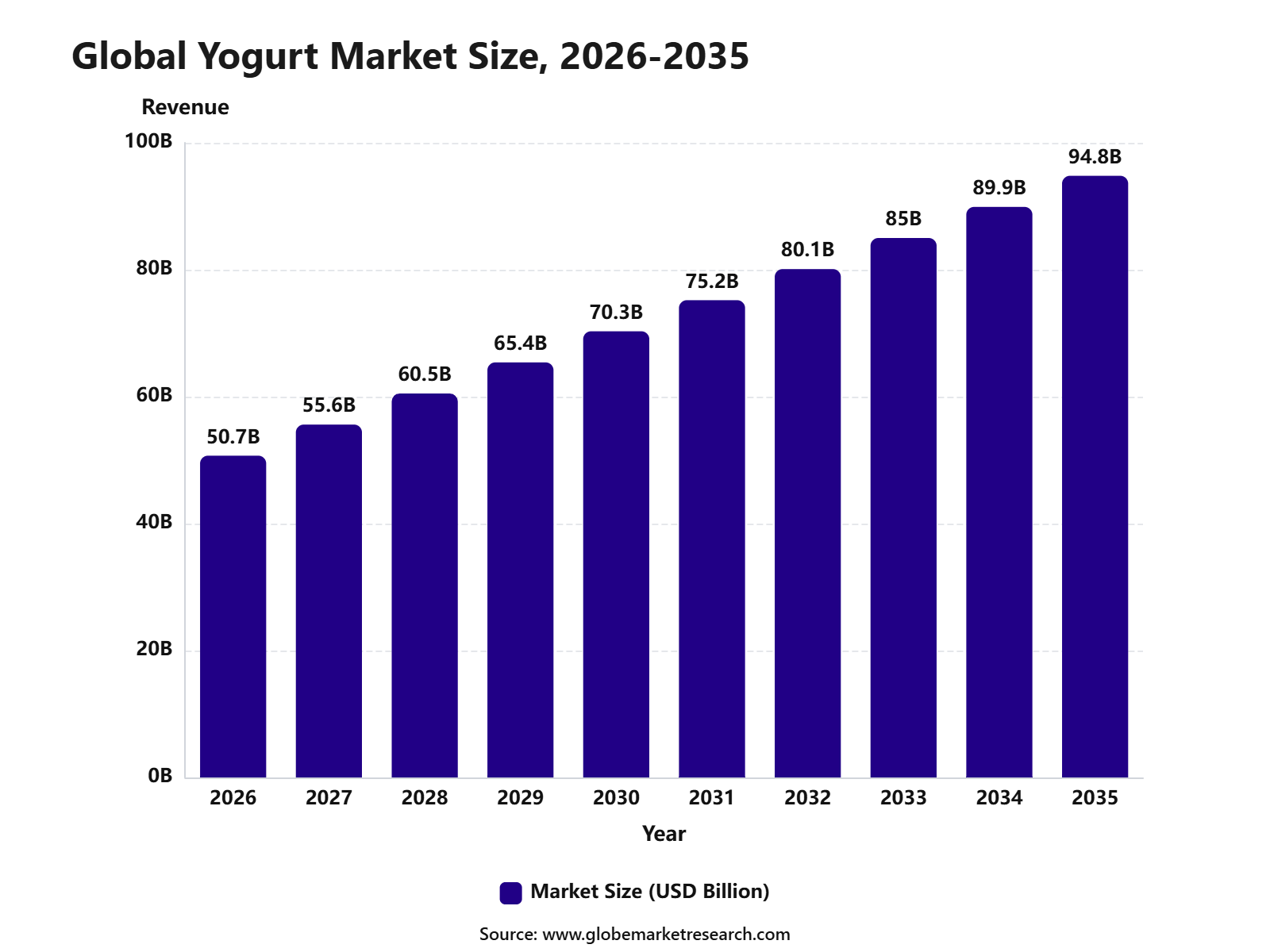 iThe graph shows projected market growth until 2035 based on CAGR analysis. Actual outcomes may vary depending on changing demand, competition, and economic factors.To gain greater insights - request a sample report PDF
Key Market Insights
Greek-style yogurt led the product type segment with 35.2% share, supported by strong demand for high-protein, creamy, and nutrient-rich yogurt options across breakfast, snack, and wellness-focused diets.
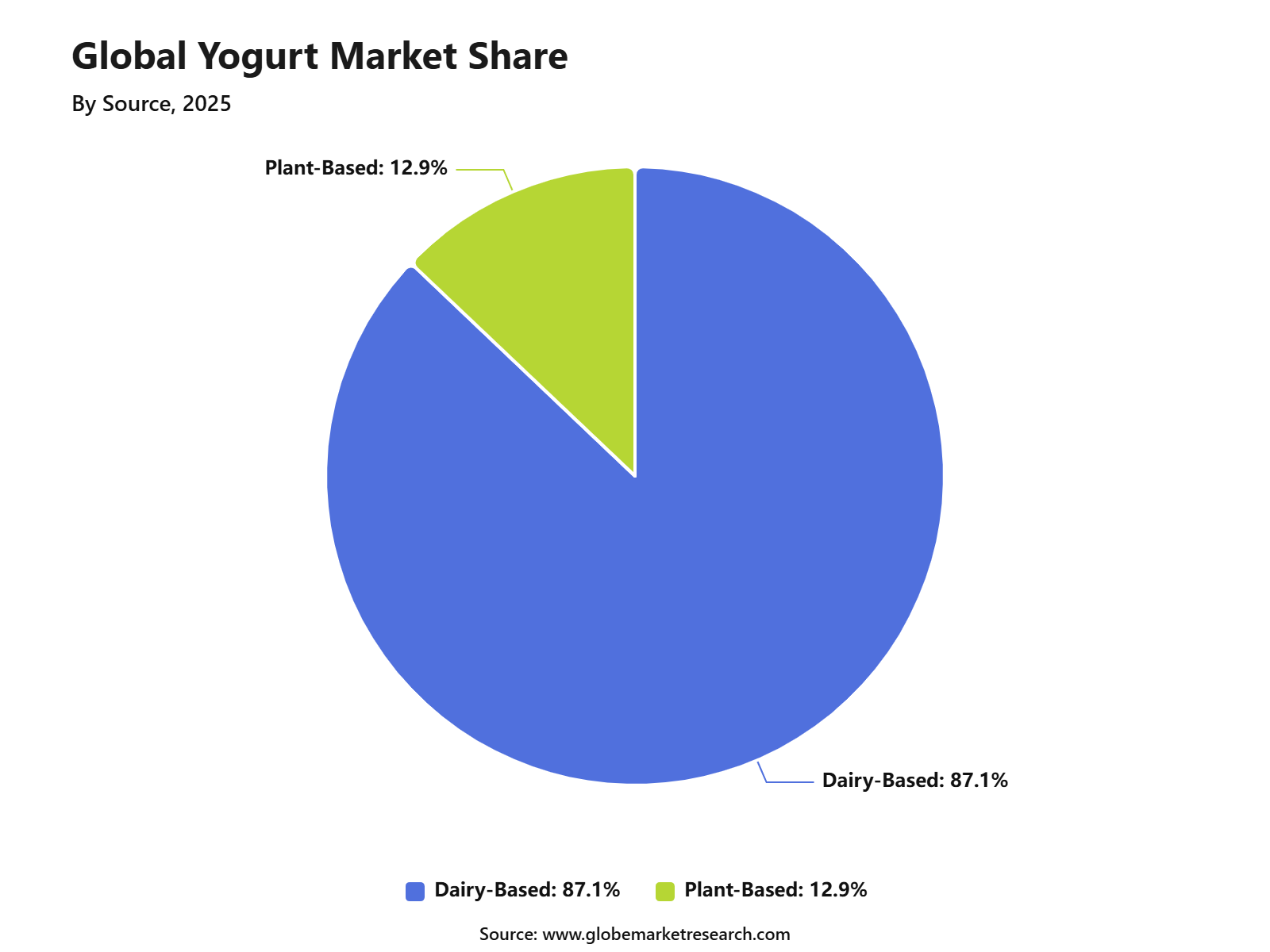
Dairy-based yogurt accounted for 87.1% share by source, driven by wide consumer acceptance, established production systems, strong nutritional value, and broad retail availability.
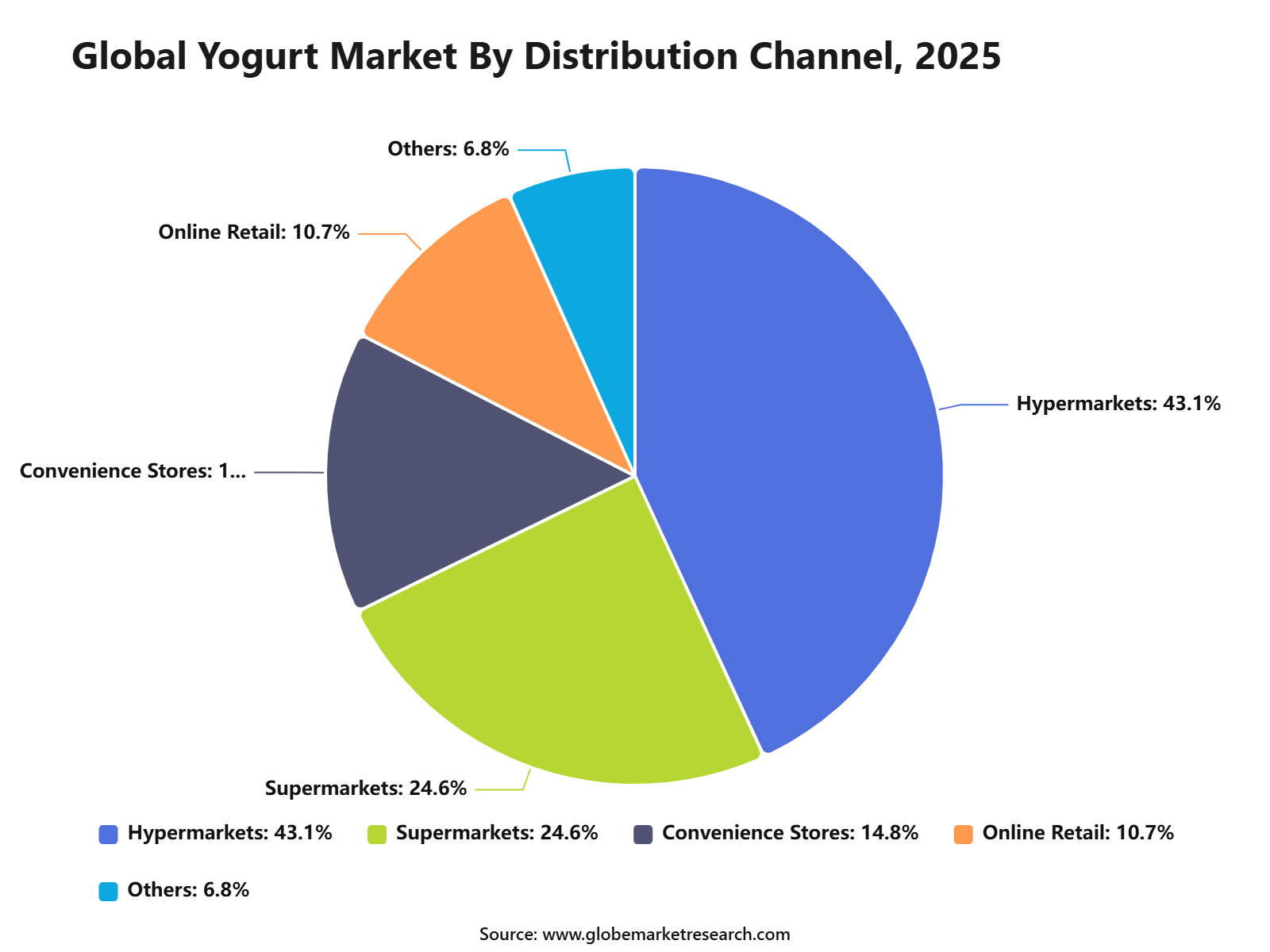
Hypermarkets held 43.1% share by distribution channel, supported by large product variety, organized refrigerated sections, promotional pricing, and strong household grocery purchases.
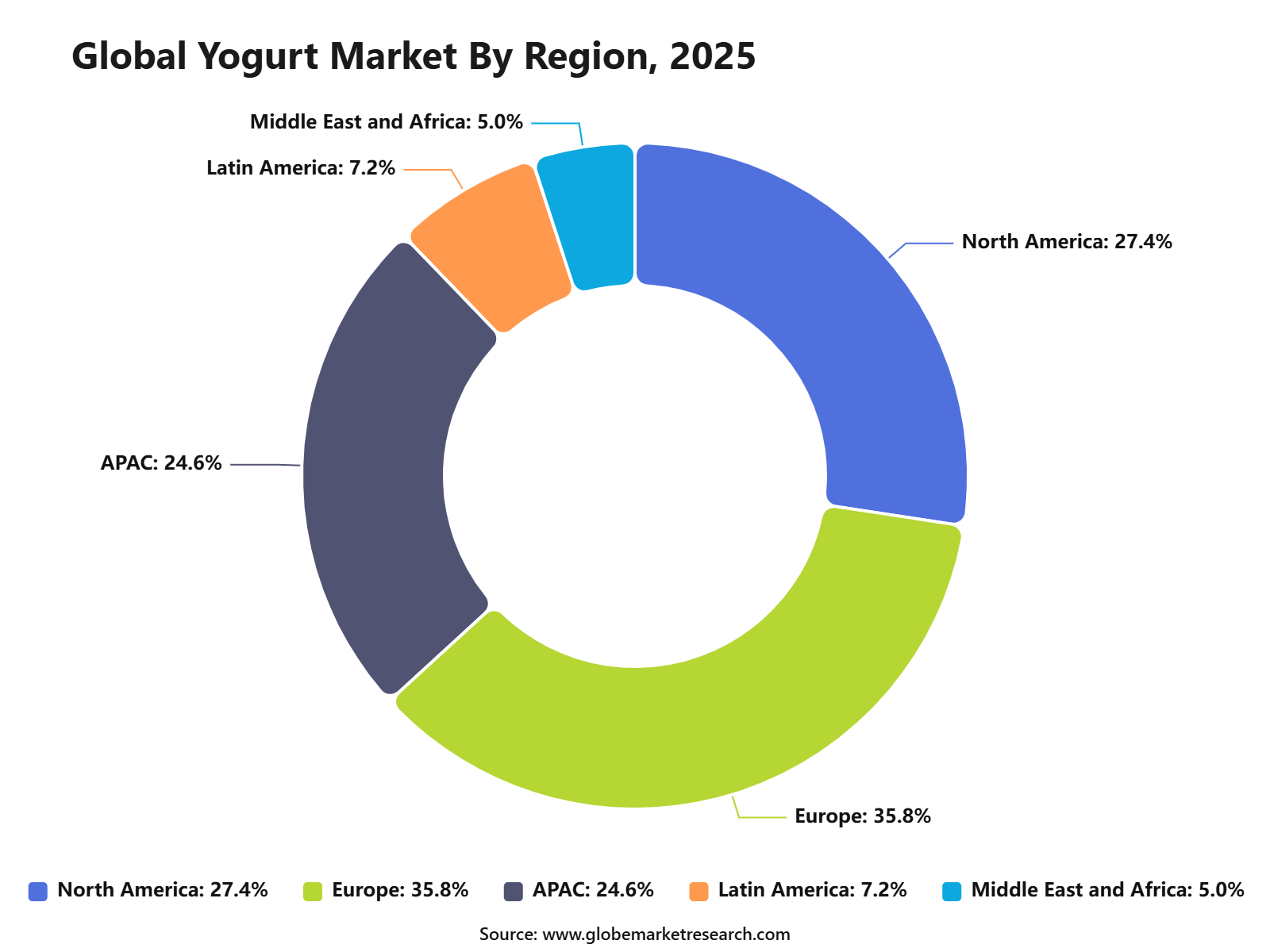
Europe led the yogurt market with 35.8% share, valued at USD 18.1 billion, supported by high dairy consumption, strong yogurt culture, mature retail networks, and rising demand for probiotic and protein-rich products.
Top Funding and Investment
Top Investments
Chobani announced a USD 1.2 billion investment to build its third U.S. dairy processing facility in Rome, New York. The approximately 1.4 million-square-foot plant will process more than 12 million pounds of milk per day and manufacture yogurt and other cultured dairy products. The development is expected to create over 1,000 full-time jobs.
The Gujarat Cooperative Milk Marketing Federation, which markets products under the Amul brand, announced an INR 600 crore, approximately USD 68.6 million, investment in an integrated dairy facility at Sankrail Food Park near Kolkata. The plant will have capacity to manufacture one million kilograms of curd per day and process approximately 1.5 million litres of milk daily across two development phases.
KRI-KRI advanced its three-year Greek Yogurt Dynamo investment program with a total budget of EUR 52.2 million. The program is focused on increasing yogurt and ice cream production capacity, improving operational efficiency, and modernizing manufacturing infrastructure. The company expected its total capital expenditure during 2025 to reach between EUR 21 million and EUR 25 million.
Danone Canada invested USD 9 million at its Boucherville manufacturing facility to introduce individual yogurt cups produced from PET resin. The new packaging line supports the company’s objective of incorporating approximately 30% recycled PET content while maintaining food-safety and product-quality standards. The investment directly supports locally manufactured yogurt brands and lower-impact packaging formats.
Arla Foods officially opened a yogurt factory at its integrated dairy farm in Damau, Kaduna State. The facility expands local yogurt manufacturing, milk processing, employment, and sourcing opportunities for Nigerian dairy farmers. It also strengthens Arla’s ability to manufacture cultured dairy products closer to regional consumers.
Top Funding Transactions
Chobani raised USD 650 million in equity capital to finance its next stage of manufacturing expansion. The proceeds were allocated to the new Rome, New York, production facility and capacity upgrades at its Twin Falls, Idaho, plant. The financing supports higher yogurt output, additional product innovation, and expanded milk procurement from U.S. dairy farms.
Organic yogurt producer Painterland Sisters completed a seven-figure seed funding round backed by Supernatural Ventures, Angel Group, and additional investors. The company did not disclose the exact amount. The capital was raised to support working capital, innovation, retail growth, and expanded production following its national Whole Foods Market launch. Painterland Sisters reported using approximately 8.7 million pounds of organic milk during 2024, providing a production base for further expansion.
Alternative dairy company 1.5 Degree raised USD 1 million in pre-Series A financing led by 35North Ventures. The company produces yogurt, smoothie yogurt bowls, milk alternatives, and related products for institutional and retail customers. Funding will support manufacturing scale-up and expansion into Mumbai, Pune, Bengaluru, Hyderabad, and Delhi, which together account for nearly 60% of India’s institutional foodservice opportunity.
Top Acquisitions
Lactalis USA, United States, June 2025: Acquisition of General Mills’ U.S. Yogurt Business
Lactalis USA completed the acquisition of General Mills’ U.S. yogurt operations. The acquired assets include the Yoplait, Go-Gurt, Oui, Mountain High, and brands, together with manufacturing facilities in Murfreesboro, Tennessee, and Reed City, Michigan.
The business generated approximately USD 1.2 billion in net sales during fiscal 2025. The acquisition expanded Lactalis’ cultured dairy portfolio, manufacturing capacity, retail distribution, and presence in the U.S. yogurt category.
Sodiaal, Canada, January 2025: Acquisition of General Mills’ Canadian Yogurt Business
Sodiaal completed the acquisition of General Mills’ Canadian yogurt operations. The transaction included the Canadian businesses of Yoplait and Liberté, along with the yogurt manufacturing facility in Saint-Hyacinthe, Quebec.
Through the acquisition, Sodiaal gained established yogurt brands, Canadian production infrastructure, employees, customer relationships, and retail distribution capabilities.
By Product Type
Greek-style yogurt accounted for 35.2% share of the Yogurt Market. This leading position is supported by strong consumer demand for high-protein, thick-texture, and premium yogurt products used in breakfast, snacks, smoothies, desserts, and fitness-focused diets.
The segment is widely preferred because Greek-style yogurt offers a creamy mouthfeel, higher protein content, and better satiety compared with many regular yogurt formats. It is commonly consumed with fruits, cereals, nuts, honey, and functional ingredients, making it suitable for both health-focused and indulgent product categories.
Demand is expected to remain strong as brands expand low-fat, no-added-sugar, probiotic, flavored, and single-serve Greek-style yogurt products. Growth will be supported by rising interest in protein-rich foods, digestive wellness, convenient snacking, and premium dairy consumption.
By Source
Dairy-based yogurt held 87.1% share of the Yogurt Market. This dominance is driven by strong consumer familiarity, wide product availability, established dairy supply chains, and the nutritional value associated with milk-based yogurt.
The segment is widely used across plain yogurt, Greek yogurt, flavored yogurt, drinkable yogurt, probiotic yogurt, and children’s yogurt products. Dairy-based yogurt is preferred because it provides protein, calcium, vitamins, probiotics, and a familiar taste profile across daily diets.
Demand is expected to remain high as consumers continue to view yogurt as a healthy and convenient food option. While plant-based alternatives are growing, dairy-based yogurt will continue to lead due to strong household penetration, broad retail availability, and continuous product innovation.
 iThe graph shows projected market growth until 2035 based on CAGR analysis. Actual outcomes may vary depending on changing demand, competition, and economic factors.To gain greater insights - request a sample report PDF
By Distribution Channel
Hypermarkets accounted for 43.1% share of the Yogurt Market. This leading position is supported by strong refrigerated storage capacity, wide brand availability, bulk purchasing options, and high consumer footfall.
Consumers prefer hypermarkets because they offer multiple yogurt types, pack sizes, flavors, price points, and promotional offers in one place. These stores also support strong visibility for Greek-style yogurt, probiotic yogurt, children’s yogurt, drinkable yogurt, and premium dairy products.
The segment is expected to maintain a strong position as organized retail continues to expand and consumers seek convenient grocery shopping formats. Demand will remain supported by chilled dairy sections, private-label launches, family packs, and attractive in-store promotions.
 iThe graph shows projected market growth until 2035 based on CAGR analysis. Actual outcomes may vary depending on changing demand, competition, and economic factors.To gain greater insights - request a sample report PDF
By Region
Europe accounted for 35.8% share of the Yogurt Market, reaching USD 18.1 billion. The region’s leadership is supported by strong dairy consumption, established yogurt production, and high consumer acceptance of plain, Greek-style, probiotic, and flavored yogurt products.
Germany, France, the United Kingdom, Italy, Spain, Poland, and the Netherlands are key contributors to regional demand. Europe benefits from mature dairy retail networks, strong product innovation, and a long-standing culture of yogurt consumption across breakfast, snacks, and functional food categories.
Europe is expected to maintain a strong position as demand continues for high-protein, low-sugar, probiotic, and premium yogurt formats. Growth will be supported by Greek-style yogurt, dairy-based products, hypermarket distribution, and rising consumer interest in digestive health and convenient nutrition.
 iThe graph shows projected market growth until 2035 based on CAGR analysis. Actual outcomes may vary depending on changing demand, competition, and economic factors.To gain greater insights - request a sample report PDF
Regional Impact Analysis
Europe leads the Yogurt Market with 35.8% share in 2026, valued at around USD 18.2 billion, supported by strong dairy consumption, fermented food culture, premium yogurt demand, and high retail penetration. Germany, France, UK, Italy, Spain, Netherlands, and Greece remain key regional markets.
North America remains important because of demand for Greek yogurt, high-protein dairy, low-sugar products, and convenient packaged foods. Asia Pacific supports future growth through rising disposable income, urbanization, modern grocery channels, and growing demand for functional dairy products.
Impact Factor | Estimated CAGR Impact | Regional Relevance | Market Impact |
|---|---|---|---|
Europe market leadership | +2.2% | Europe, 35.8% share in 2026 | Leads global value demand. |
Germany and France dairy consumption | +1.5% | Western Europe | Supports stable regional demand. |
UK and Italy premium yogurt demand | +1.2% | UK, Italy | Adds value growth. |
North America high-protein yogurt trend | +1.0% | U.S. and Canada | Supports Greek yogurt growth. |
Asia Pacific urban dairy adoption | +0.9% | China, India, Japan, South Korea | Builds future expansion. |
Protein Probiotics Drive Yogurt Growth
The most important factor in the Yogurt Market is demand for protein-rich, gut-health-focused, low-sugar dairy products. In 2025, IFIC reported that consumers defined healthy food mainly as a “good source of protein” at 38%, followed by “low in sugar” at 34%, which directly supports Greek yogurt, probiotic yogurt, drinkable yogurt, and high-protein dairy snacks. USDA NASS also reported 445.7 million pounds of plain and flavored yogurt production in January 2026, up 5.9% from January 2025, showing steady product demand.
For companies, the best strategy is to build yogurt portfolios around high protein, verified live cultures, reduced sugar, clean labels, and convenient single-serve packs. Sugar control is important because FDA’s 2026 Nutrition Facts guidance sets the Daily Value for added sugars at 50 grams per day, making low-sugar claims and transparent labeling more valuable for health-focused buyers. This factor is strong because it connects consumer health priorities, product innovation, and measurable dairy production demand in one clear growth direction.
Go-To-Market and Sales Economics
Yogurt producers should combine supermarket, convenience, foodservice, and institutional channels rather than depend on one route. U.S. retail and food-services sales reached USD 763.7 billion in May 2026, rising 6.9% year over year. Retailer-specific packs, reliable refrigeration, shelf monitoring, sampling, and menu support can improve listings, rotation, and repeat orders.
Online selling should be developed for multipacks, high-protein yogurt, lactose-free products, plant-based alternatives, and family subscriptions. U.S. e-commerce sales reached USD 326.7 billion in the first quarter of 2026 and represented 16.9% of retail sales. Insulated fulfilment, scheduled delivery, and customer data can support higher purchase frequency and targeted promotions.
Product development should emphasise functional benefits and familiar formats supported by clear sensory evidence. Danone reported first-quarter 2026 sales of EUR 6.71 billion, with like-for-like growth of 2.7%, led by 1.5% volume and mix growth. High-protein, Skyr, Kefir, and probiotic platforms can support premium positioning, cross-channel launches, and stronger consumer retention.
Risk Factors & Market Barriers
Milk supply and farmgate pricing remain important margin variables because yogurt plants require dependable daily volumes. USDA forecasts U.S. milk production of 236.4 billion pounds in 2026 and an all-milk price of USD 20.70 per hundredweight. Supply contracts, regional sourcing, yield control, and flexible pricing can reduce exposure to sudden procurement changes.
Packaging compliance will increase testing, redesign, and documentation requirements for cups, lids, sleeves, multipacks, and food-contact materials. The EU Packaging and Packaging Waste Regulation generally applies from 12 August 2026 and covers all packaging. Producers must improve recyclability and material selection without reducing seal integrity, shelf life, transport strength, or cold-chain performance.
Input inflation and weak volume can quickly reduce packaged-food profitability. General Mills reported fiscal third-quarter 2026 sales of USD 4.4 billion and a gross margin of 30.8%, down 310 basis points, mainly because of higher input costs. Yogurt companies should protect margins through energy efficiency, accurate forecasting, waste reduction, and disciplined promotional spending.
Revenue Potential Analysis
Revenue Landscape Across
North America offers revenue through Greek yogurt, high-protein formats, drinkable products, family tubs, and foodservice packs. Danone’s Americas Essential Dairy and Plant-Based sales reached EUR 1.77 billion in the first quarter of 2026, increasing 3.0% like for like. Growth can be supported through gym, workplace, healthcare, school, and convenience partnerships.
Europe provides opportunities in probiotic, Skyr, Kefir, organic, lactose-free, and plant-based yogurt. Danone’s Essential Dairy and Plant-Based sales in EMEA reached EUR 1.44 billion during the first quarter of 2026, with 3.2% like-for-like growth. Local flavours, reduced sugar, recyclable packaging, and retailer-specific ranges can strengthen distribution across diverse national markets.
Asia Pacific offers faster expansion where urban retail, convenience formats, and functional nutrition are developing. Danone reported EUR 95 million of Essential Dairy and Plant-Based sales in APAC during the first quarter of 2026, with 14.2% like-for-like growth. Local production, smaller packs, ambient-capable formats, and regionally adapted flavours can improve affordability and market reach.
Financial Impact
Category economics improve when volume growth is combined with premium mix and efficient manufacturing. Danone’s Essential Dairy and Plant-Based business generated EUR 3.30 billion in first-quarter 2026 sales, rising 3.4% like for like. High-protein products, probiotics, drinkable formats, and plant-based alternatives can increase revenue per unit when supported by controlled formulation and packaging costs.
Portfolio decisions can materially change reported margins and operating scale. General Mills’ fiscal third-quarter 2026 gross margin fell to 30.8%, while adjusted operating profit declined 32% in constant currency. The company also identified yogurt divestitures as a major comparability factor, showing that category ownership, channel mix, procurement costs, and portfolio focus directly influence financial performance.
Investment capacity should be assessed against secured retailer listings and achievable plant utilisation. Arla expects 2026 revenue of EUR 13.3 billion to EUR 14.1 billion, a net-profit share of 2.8% to 3.2%, and efficiency gains of EUR 90 million to EUR 110 million. Yogurt projects should be measured through yield, waste, working capital, and payback.
Drivers Impact Analysis
The Yogurt Market is driven by rising demand for healthy snacks, probiotic foods, dairy-based protein, digestive health products, and convenient breakfast options. Yogurt is widely consumed because it offers taste, nutrition, portability, and flexibility across plain, flavored, Greek, drinkable, and functional formats.
Europe leads the market due to strong dairy consumption, mature retail networks, high awareness of fermented dairy products, and demand for natural and probiotic foods. Germany, France, UK, Italy, Spain, Netherlands, and Greece remain important markets because of established yogurt consumption and premium dairy product demand.
Impact Factor | Estimated CAGR Impact | Regional Relevance | Market Impact |
|---|---|---|---|
Rising probiotic and digestive health demand | +2.0% | Europe, North America, Asia Pacific | Drives functional yogurt consumption. |
Growth in healthy snacking | +1.7% | Urban and health-focused markets | Supports daily yogurt use. |
Demand for high-protein dairy products | +1.4% | Europe and North America | Builds Greek yogurt and protein yogurt demand. |
Expansion of flavored and drinkable yogurt | +1.1% | Europe, Asia Pacific, Latin America | Adds convenience-led growth. |
Wider retail and online availability | +0.9% | Global grocery channels | Improves consumer access. |
Restraints Impact Analysis
The market faces restraints from milk price volatility, cold chain cost, sugar content concerns, and competition from plant-based dairy alternatives. Yogurt production depends on milk supply, cultures, packaging, refrigeration, and distribution efficiency.
Another restraint is product differentiation in a crowded dairy aisle. Brands must compete on taste, nutrition, price, clean-label claims, probiotic strength, flavor variety, and packaging convenience.
Impact Factor | Estimated CAGR Impact | Regional Relevance | Market Impact |
|---|---|---|---|
Milk price volatility | -1.0% | Global dairy producers | Affects margins and retail prices. |
Cold chain and storage cost | -0.8% | Retail and distribution networks | Raises operating complexity. |
Sugar and calorie concerns | -0.7% | Europe, North America, urban Asia | Pressures reformulation. |
Plant-based yogurt competition | -0.6% | Developed consumer markets | Limits some dairy-based demand. |
High brand and shelf competition | -0.5% | Supermarkets and convenience stores | Reduces pricing power. |
Opportunities Impact Analysis
Opportunities are strong in Greek yogurt, probiotic yogurt, drinkable yogurt, low-sugar yogurt, lactose-free yogurt, organic yogurt, plant-based yogurt, and kids’ yogurt. These product types benefit from demand for healthier, convenient, and functional dairy products.
Higher-value opportunities are emerging in high-protein yogurt, gut health formulations, clean-label products, premium fruit blends, fortified yogurt, and portion-controlled packs. Companies that combine taste, health benefits, and affordable pricing can capture stronger long-term demand.
Impact Factor | Estimated CAGR Impact | Regional Relevance | Market Impact |
|---|---|---|---|
Greek and high-protein yogurt growth | +1.9% | Europe, North America, Asia Pacific | Builds premium product demand. |
Probiotic and gut health yogurt | +1.6% | Europe and developed markets | Supports functional positioning. |
Low-sugar and clean-label products | +1.3% | Health-conscious consumers | Improves product acceptance. |
Lactose-free yogurt expansion | +1.0% | Europe, North America, Asia Pacific | Expands consumer base. |
Drinkable and on-the-go yogurt | +0.8% | Urban and convenience channels | Adds new consumption occasions. |
Challenges Impact Analysis
The main challenge is balancing taste, nutrition, and affordability. Consumers want yogurt that tastes good, but they also check sugar levels, protein content, fat level, additives, probiotic claims, and ingredient transparency.
Another challenge is maintaining culture activity, freshness, texture, and quality through refrigerated supply chains. Yogurt requires strong temperature control from production to retail shelf to protect taste, safety, and functional value.
Impact Factor | Estimated CAGR Impact | Regional Relevance | Market Impact |
|---|---|---|---|
Balancing taste and health claims | -0.9% | Global consumer markets | Affects repeat purchase. |
Maintaining cold chain freshness | -0.8% | Retail and export markets | Influences quality and safety. |
Probiotic stability and validation | -0.7% | Functional yogurt producers | Raises testing requirements. |
Managing short shelf life | -0.6% | Dairy supply chains | Increases inventory risk. |
Differentiation in crowded retail shelves | -0.5% | Mature yogurt markets | Requires stronger branding. |
Segment Covered in the Report
By Product Type
Greek-Style Yogurt
Regular Yogurt
Yogurt Drinks
Frozen Yogurt
Others
By Source
Dairy-Based
Plant-Based
By Distribution Channel
Hypermarkets
Supermarkets
Convenience Stores
Online Retail
Others
By Region
North America
Europe
Asia Pacific
Latin America
Middle East and Africa
Market Trend Analysis
The market trend is moving toward protein-rich yogurt, probiotic formulations, low-sugar recipes, clean-label dairy products, lactose-free options, and drinkable formats. Consumers are using yogurt as a breakfast product, snack, dessert alternative, and digestive health product.
Europe remains the largest value region because of strong fermented dairy culture, premium yogurt consumption, and high retail penetration. North America supports growth through Greek yogurt and functional dairy, while Asia Pacific is expanding through urbanization, modern retail, and rising health awareness.
Impact Factor | Estimated CAGR Impact | Regional Relevance | Market Impact |
|---|---|---|---|
High-protein yogurt trend rises | +1.8% | Europe, North America | Supports premium dairy demand. |
Probiotic and gut health products expand | +1.5% | Europe, North America, Asia Pacific | Builds functional food growth. |
Low-sugar yogurt demand increases | +1.2% | Health-focused markets | Supports reformulation. |
Drinkable yogurt gains popularity | +1.0% | Asia Pacific, Europe, Latin America | Adds convenience demand. |
Clean-label and organic yogurt grows | +0.8% | Europe and North America | Improves premium positioning. |
Investor Type Impact Matrix
Investors should focus on yogurt companies with strong milk sourcing, fermentation expertise, cold chain strength, brand loyalty, product innovation, and retail distribution. Taste, nutrition, shelf life, pricing, and clean-label credibility are key success factors.
Strategic investors can also target probiotic yogurt brands, Greek yogurt producers, lactose-free dairy companies, functional dairy ingredient suppliers, packaging firms, and refrigerated distribution partners. Companies that combine health positioning with reliable supply and strong retail access are better positioned for long-term growth.
Investor Type | Estimated CAGR Impact | Regional Relevance | Market Impact |
|---|---|---|---|
Yogurt Manufacturers | +1.5% | Global | Expands core dairy product supply. |
Probiotic and Functional Dairy Brands | +1.2% | Europe, North America, Asia Pacific | Supports health-focused demand. |
Greek Yogurt Producers | +1.0% | Europe and North America | Adds premium product value. |
Dairy Ingredient and Culture Suppliers | +0.8% | Yogurt supply chains | Improves formulation performance. |
Strategic Consumer Food Investors | +0.6% | Global dairy markets | Funds brand and capacity expansion. |
Recent Developments
In January 2025, Sodiaal completed the acquisition of Yoplait and Liberté Canada, adding established yogurt brands, a Quebec manufacturing facility and commercial capabilities to support product innovation and Canadian expansion.
In August 2025, Emmi reported 12.7% first-half sales growth, supported by acquisitions including Verde Campo and Mademoiselle Desserts, while expanding its international dairy, functional-nutrition and premium-dessert portfolio across markets worldwide.
In October 2025, FrieslandCampina received European Commission approval for its merger with Milcobel, combining dairy manufacturing, milk sourcing, innovation resources and branded consumer operations across yogurt, cheese and dairy ingredients.
Competitive Landscape
The market is characterized by intense competition among established players and emerging companies. Strategic partnerships, mergers and acquisitions, and product innovation are key strategies employed by market participants.
Key Market Players
Danone S.A.
Lactalis Group
Yoplait
Chobani
Fage International
General Mills
Nestlé S.A.
Müller
Arla Foods
Yakult Honsha
Meiji Holdings
The Hain Celestial Group
Stonyfield Farm
Emmi Group
FrieslandCampina
Other Key Players
Research Methodology
This market study is prepared using a combination of primary and secondary research. Primary research includes discussions with manufacturers, suppliers, distributors, consultants, industry experts, and end users. Secondary research covers company reports, government databases, trade associations, technical publications, regulatory sources, and trusted industry documents. The collected information is used to assess market demand, pricing trends, technology adoption, competitive activity, and regional performance.
AI language models are not used as primary data sources, and publicly available AI-generated content is not treated as market evidence. Computational tools may be used to support data processing, translation, data classification, and pattern identification. However, every published assessment is supported by verified sources, human review, and primary market discussions.
Market estimates are developed through top-down and bottom-up approaches and validated using data triangulation. Revenue, production, shipment, pricing, and application-level data are compared across multiple sources. Forecasts consider economic conditions, regulatory changes, investment activity, innovation, supply chain developments, and industry risks. All findings are reviewed through source verification and internal quality checks before publication.
Part I
Source Management & Input Data Standards
Who provides data, how sources are qualified, and what types of evidence are admissible.
Part II
Research Scope & Market Coverage
How we define the markets we assess and the parameters that govern each product.
Part III
Data Collection, Verification & Submission
The mechanics of gathering, cross-checking, and hierarchically ranking evidence.
Part IV
Assessment Determination & Quality Controls
How raw data becomes a published assessment — normalisation, expert judgement, and outlier exclusion.
Part V
Publication, Corrections & Revision
Our publication schedule, corrections policy, and methodology review cycle.
Part VI
Independence, Ethics & Complaints
Conflict-of-interest policies, editorial independence, and how clients raise concerns.
Google · Preferred Sources
Don't miss the latest market research insights and industry updates on Google.
Add Globe Market Research as a preferred source in the Google app to see our reports, analysis, and market stories in your news suggestions.
Meet the Team
This report was prepared by our expert analysts with deep industry knowledge and research experience.
Pratiksha K. is a Senior Research Analyst with more than five years of experience in market research, industry analysis, competitive intelligence, and business strategy. She has contributed to detailed market reports, customized research studies, company profiling, market sizing, trend analysis, and strategic consulting projects for clients across different regions. Her industry expertise covers Chemical and Material, Consumer Goods, Food & Beverages and Energy & Power. She closely evaluates changing customer requirements, technology developments, regulatory conditions, supply chain structures, investment activity, and competitive strategies to provide clear and practical market insights.
Sayali brings more than 7 years of experience to Globe Market Research, supporting the accuracy, clarity, and relevance of research content across multiple industries. She reviews market data, segment analysis, competitive insights, and industry trends to ensure each report meets strong quality standards and provides practical value to business decision-makers. Her expertise spans healthcare, information technology, consumer goods, and diverse cross-industry domains. With a strong focus on data reliability, structured analysis, and clear presentation, Sayali helps ensure that each research output delivers well-reviewed insights for clients, investors, consultants, and industry stakeholders.
Frequently Asked Questions
Related Reports
More in Food and Beverages
Food Colorants Market to Hit USD 8.6 Billion by 2035
Food Colorants Market Size, Share, Analysis By Type (Natural, Synthetic, Nature-Identical), By Form (Powder, Liquid, Gel), By Application (Beverages, Bakery and Confectionery, Dairy, Meat Products, Snacks, Other Applications), By Regional Insights, Business plan and Project Report, Investment Opportunities, Profitability, Industry Trends, Leading Companies and Growth Forecasts by 2026-2035
Sweeteners Market to Hit USD 145.7 Billion by 2035
Sweeteners Market Size, Share, Analysis "By Product (Sucrose, High-Fructose Corn Syrup, Glucose Syrup, High-Intensity Sweeteners, Other Products), By Form (Solid, Liquid), By Application (Bakery and Confectionery, Beverages, Dairy, Pharmaceuticals, Other Applications), By Regional Insights, Business plan and Project Report, Investment Opportunities, Profitability, Industry Trends, Leading Companies and Growth Forecasts by 2026-2035
Food Enzymes Market to Hit USD 7.5 Billion by 2035
Food Enzymes Market Size, Share, Analysis By Type (Carbohydrases, Proteases, Lipases, Other Enzymes), By Source (Microbial, Plant, Animal), By Application (Dairy Processing, Bakery, Beverages, Processed Foods, Animal Feed), By Regional Insights, Business plan and Project Report, Investment Opportunities, Profitability, Industry Trends, Leading Companies and Growth Forecasts by 2026-2035
Food Preservatives Market to Hit USD 8.0 Billion by 2035
Food Preservatives Market Size, Share, Analysis By Source (Natural, Synthetic), By Function (Antimicrobial, Antioxidant, Other Functions), By Application (Meat, Poultry and Seafood, Bakery, Dairy, Beverages, Snacks, Other Applications), By Regional Insights, Business plan and Project Report, Investment Opportunities, Profitability, Industry Trends, Leading Companies and Growth Forecasts by 2026-2035