

Revenue, 2026
USD 3.9 Bn
Forecast, 2035
USD 7.5 Bn
CAGR, 2026-2035
7.5%
Report Coverage
Global
Market Size and Forecast
The Global Food Enzymes Market was worth USD 3.9 billion in 2026 and is expected to reach USD 7.5 billion by 2035, growing at a CAGR of 7.5% from 2026 to 2035. Asia Pacific held the largest regional share of 35.5% in 2026, valued at around USD 1.3 billion, supported by rising processed food consumption, bakery production, dairy innovation, beverage manufacturing, and demand for better food quality.
The Food Enzymes Market includes amylases, proteases, lipases, cellulases, lactases, pectinases, and other enzyme solutions used to improve food processing and product performance. These enzymes are widely used in bakery, dairy, beverages, meat processing, confectionery, starch processing, brewing, and convenience foods. They help improve texture, flavor, shelf life, digestibility, yield, and production efficiency.
Market growth is being supported by rising demand for clean-label processing aids, natural ingredient solutions, and healthier food formulations. Food manufacturers are using enzymes to reduce sugar, improve dough handling, support lactose-free dairy products, enhance juice extraction, and improve protein processing. Demand is also increasing as companies look for efficient, sustainable, and cost-saving production methods.
Key Parameter | Report Details |
|---|---|
Market Revenue, 2026 | USD 3.9 Billion |
Projected Revenue, 2035 | USD 7.5 Billion |
CAGR (2026-2035) | 7.5% |
Largest Region | Asia Pacific (35.5%, USD 1.3 Bn) |
Market Concentration | Medium |
Forecast Period | 2026-2035 |
Asia Pacific is expected to remain a leading region due to its large food processing base, expanding middle-class population, and strong demand from China, India, Japan, South Korea, and Southeast Asian markets. Regional growth is supported by bakery expansion, dairy consumption, beverage innovation, and rising packaged food demand. Long-term market growth will depend on enzyme stability, regulatory approval, formulation expertise, cost efficiency, and wider use of enzymes in everyday food production.
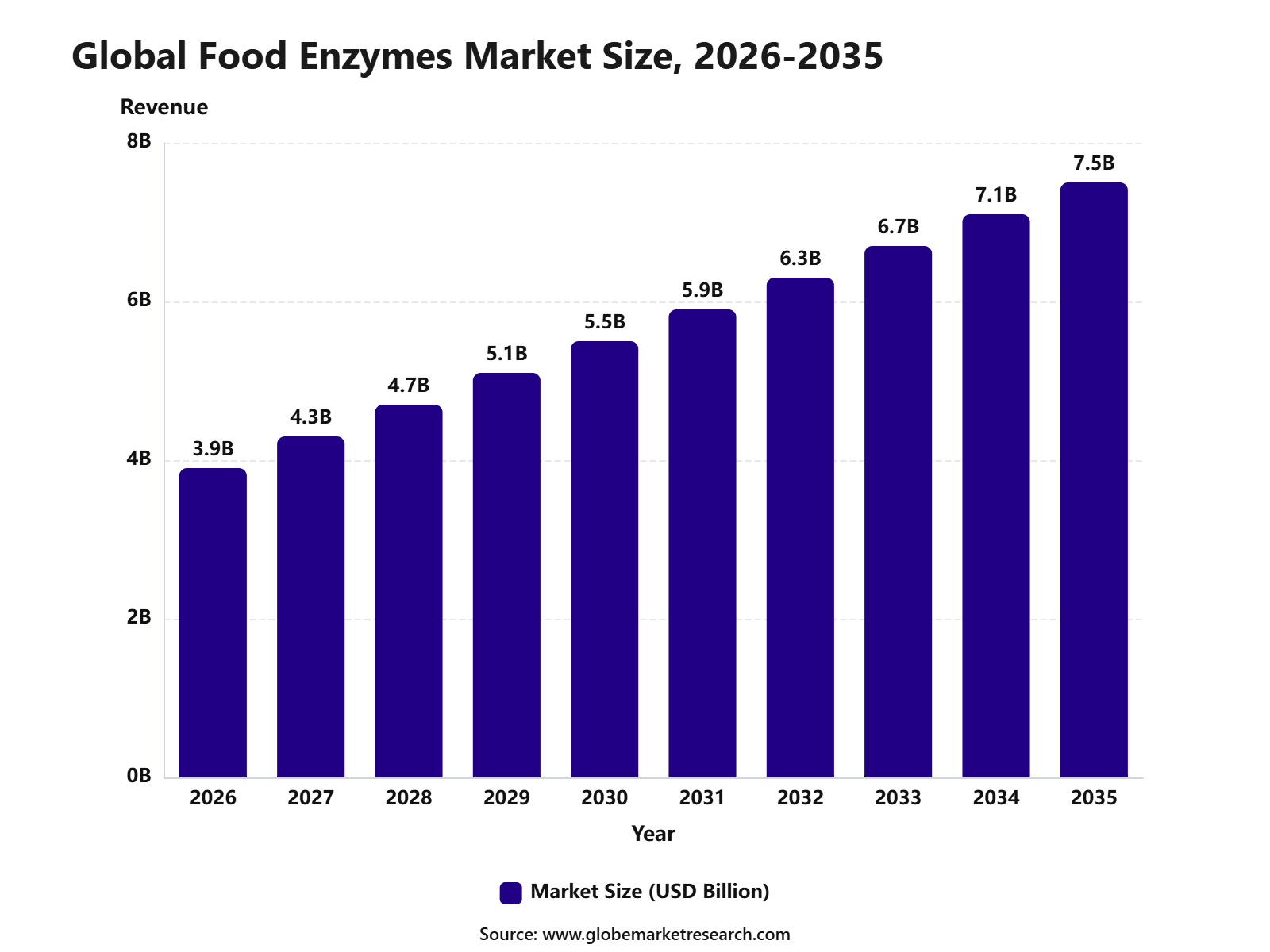 iThe graph shows projected market growth until 2035 based on CAGR analysis. Actual outcomes may vary depending on changing demand, competition, and economic factors.To gain greater insights - request a sample report PDF
Key Market Insights
Carbohydrases led the type segment with 40.3% share, supported by strong use in starch processing, baking, brewing, dairy formulations, and improving food texture and digestibility.
Microbial sources accounted for 46.5% share, driven by scalable production, consistent enzyme yield, cost efficiency, and wider use across food processing applications.
Dairy processing held 33.5% share by application, supported by rising use of enzymes in lactose reduction, cheese production, yogurt processing, flavor improvement, and milk protein modification.
Asia Pacific led the food enzymes market with 35.5% share, valued at USD 1.3 billion, supported by expanding dairy production, strong processed food demand, and growing enzyme adoption across China, India, Japan, and Southeast Asia.
Top Funding and Investment
Top Investments
In April 2026, Kerry opened an expanded biotechnology manufacturing hub in Carrigaline, Ireland. The facility significantly increases industrial production of lactase enzymes for lactose-free and sugar-reduced dairy products. It connects enzyme engineering and strain development with large-scale manufacturing and serves more than 200 customers across 80 countries.
In September 2025, Kerry established a biotechnology research and development centre in Leipzig, Germany. The facility focuses on enzyme and microbial-strain identification, enzyme engineering, fermentation development, process scale-up and production. Its work supports new enzyme solutions for food processing, nutrition, taste improvement and sustainable manufacturing.
In May 2025, BRAIN Biotech announced a new and enlarged production facility near Eindhoven, Netherlands, for its Breatec baking-enzyme business. The company also expanded its baking application centre to develop enzyme systems that improve dough processing, product consistency, freshness and production efficiency for industrial bakeries.
During 2025, Kerry invested further in bio-fermentation, enzyme and taste-technology capabilities while expanding production capacity across Asia Pacific, the Middle East, Africa and Latin America. The investments supported enzyme-based solutions for bakery, dairy and food processing, alongside fermentation-derived ingredients and natural extracts. Kerry did not disclose a separate enzyme-only investment amount.
In 2025, Voodoo Scientific progressed commercial testing of Viriato, an enzyme-based process that converts fermentation by-products responsible for harsh alcohol sensations into organic acids. The technology received a U.S. patent in July 2025 and entered scale-testing discussions with distilleries, including Southern Distilling. The development targets cleaner and smoother beverage processing without persistent enzyme residues.
Top Funding Developments
In September 2025, Cascade Bio raised USD 6 million to scale its biocatalyst platform. The company develops stabilized enzymes designed to operate under industrial processing conditions. The funding supports expanded enzyme development, manufacturing partnerships and commercialization across biomanufacturing applications, including processes relevant to food ingredients and specialty chemicals.
In March 2025, GigaCrop raised USD 4.5 million in pre-seed funding, led by Playground Global. The company uses machine learning to improve enzymes involved in photosynthesis, with the objective of increasing food-crop productivity while using the same land, water and fertilizer inputs.
In April 2025, Hoofprint Biome completed a USD 15 million Series A round led by SOSV, with participation from Amazon’s Climate Pledge Fund and other investors. The company develops microbiome and biological solutions designed to improve cattle feed conversion, productivity and methane performance, supporting enzyme- and microbe-based innovation across the wider food-production chain.
Top Acquisitions
In April 2026, Novonesis announced the acquisition of a production facility in Southeast Asia through an investment of approximately USD 50 million. The company acquired fermentation infrastructure and regional manufacturing capacity to strengthen production of biosolutions, including enzymes and microbial products used in food, beverages, agriculture and other industrial applications.
In May 2025, BRAIN Biotech bought out the minority shareholders in Breatec B.V., making the Dutch baking-enzyme specialist wholly owned. BRAIN acquired the remaining equity, full control of Breatec’s baking-enzyme portfolio, customer relationships, technical expertise and application-development capabilities.
By Type
Carbohydrases accounted for 40.3% share of the Food Enzymes Market. This leading position is supported by their wide use in breaking down carbohydrates into simpler sugars during food and beverage processing.
The segment is widely used in bakery, dairy, brewing, sweeteners, starch processing, fruit juice, and processed food applications. Carbohydrases help improve texture, sweetness, fermentation efficiency, shelf life, and product consistency across multiple food categories.
Demand is expected to remain strong as food manufacturers focus on better processing efficiency and improved product quality. Growth will be supported by rising use of carbohydrases in dairy processing, bakery products, beverage production, and clean-label food formulation.
By Source
Microbial enzymes accounted for 46.5% share of the Food Enzymes Market. This dominance is driven by their stable production, high enzyme yield, cost efficiency, and broad suitability for large-scale food processing.
The segment is widely preferred because microbial sources can produce enzymes with consistent quality and specific functional properties. These enzymes are used in dairy, bakery, brewing, starch conversion, protein processing, and fruit and vegetable processing applications.
Demand for microbial enzymes is expected to remain strong as manufacturers seek scalable, reliable, and efficient enzyme solutions. Their role in improving food texture, flavor, digestion, processing speed, and ingredient performance will continue to support segment leadership.
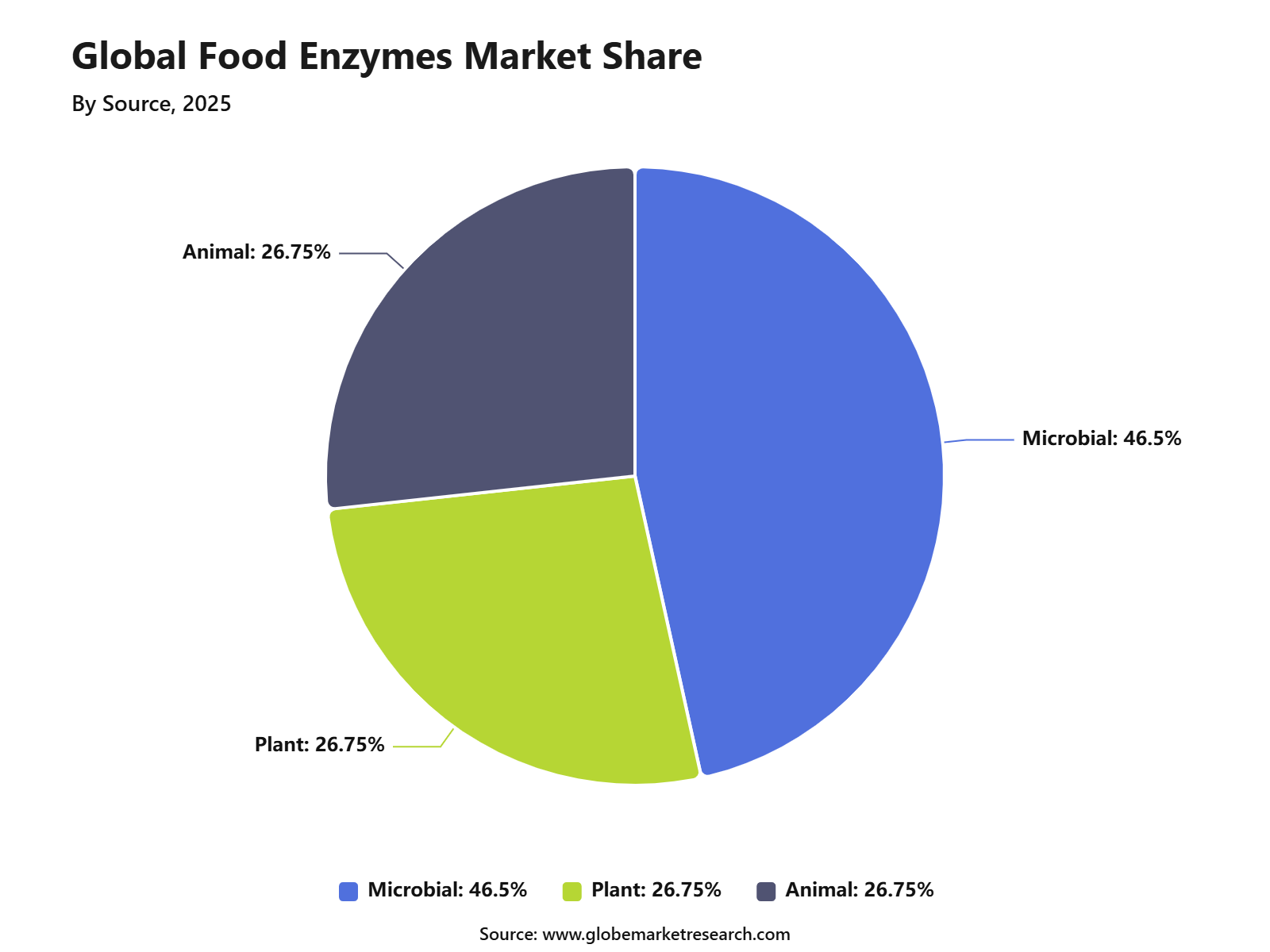 iThe graph shows projected market growth until 2035 based on CAGR analysis. Actual outcomes may vary depending on changing demand, competition, and economic factors.To gain greater insights - request a sample report PDF
By Application
Dairy processing accounted for 33.5% share of the Food Enzymes Market. This leading share is supported by high enzyme use in cheese production, lactose-free milk, yogurt, fermented dairy products, whey processing, and flavor development.
Food enzymes help dairy manufacturers improve milk coagulation, lactose breakdown, protein modification, texture, and taste consistency. Enzymes such as lactase, protease, and lipase are important in producing value-added dairy products and improving consumer tolerance.
Demand from dairy processing is expected to remain strong as consumers seek lactose-free, high-protein, fermented, and functional dairy products. Growth will be supported by innovation in cheese, yogurt, milk alternatives, and digestive-friendly dairy formulations.
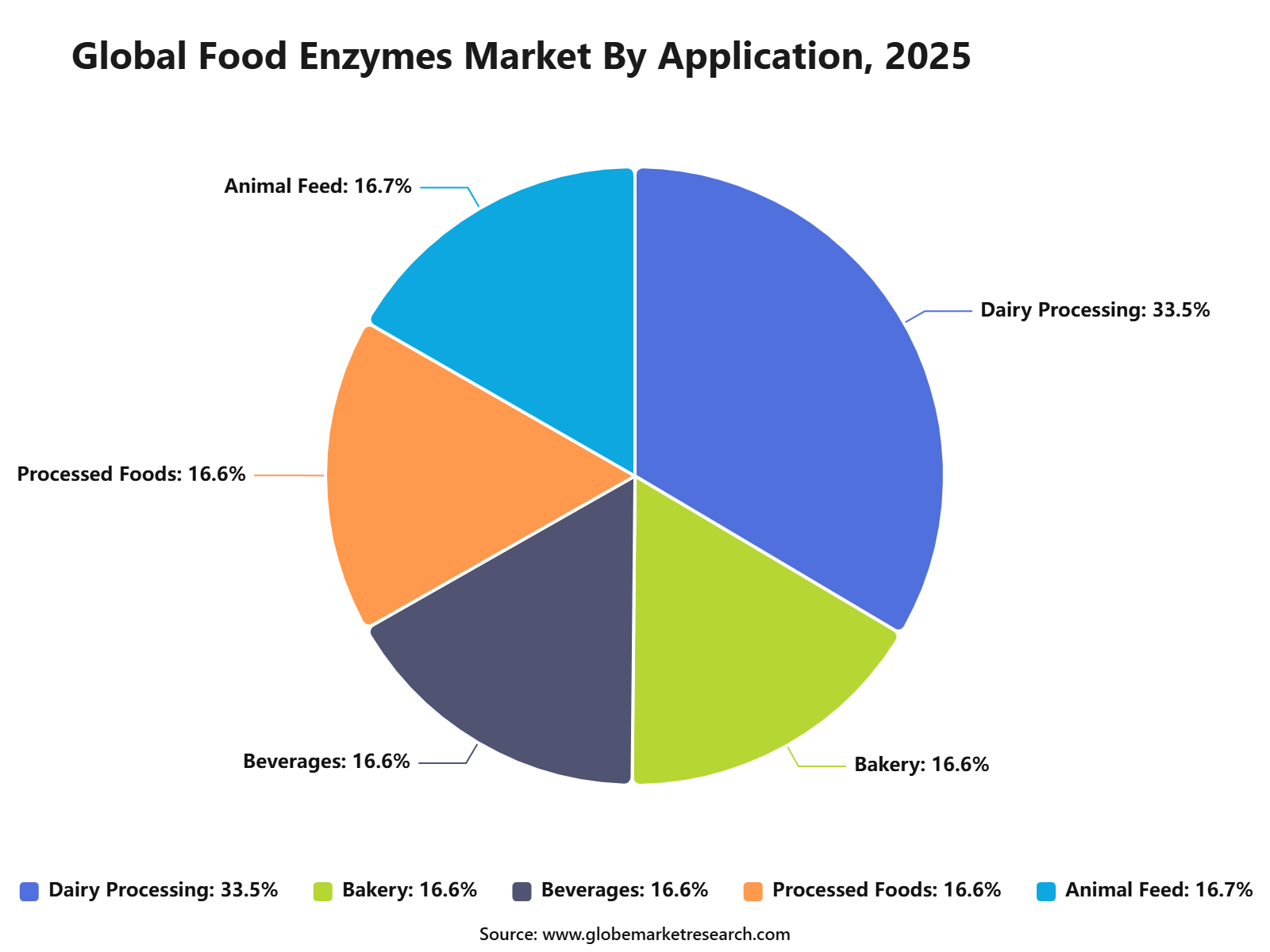 iThe graph shows projected market growth until 2035 based on CAGR analysis. Actual outcomes may vary depending on changing demand, competition, and economic factors.To gain greater insights - request a sample report PDF
By Region
Asia Pacific accounted for 35.5% share of the Food Enzymes Market, reaching USD 1.3 billion. The region’s leadership is supported by expanding food processing industries, rising dairy consumption, bakery growth, and increasing demand for packaged and convenience foods.
China, India, Japan, South Korea, Indonesia, Thailand, and Vietnam are key contributors to regional demand. The region benefits from large consumer populations, growing urban food consumption, and rising use of enzymes in dairy, bakery, beverage, and processed food production.
Asia Pacific is expected to maintain its leading position as food manufacturers expand capacity and improve processing efficiency. Demand will remain supported by carbohydrases, microbial enzyme sources, dairy processing, and growing consumer preference for high-quality processed food products.
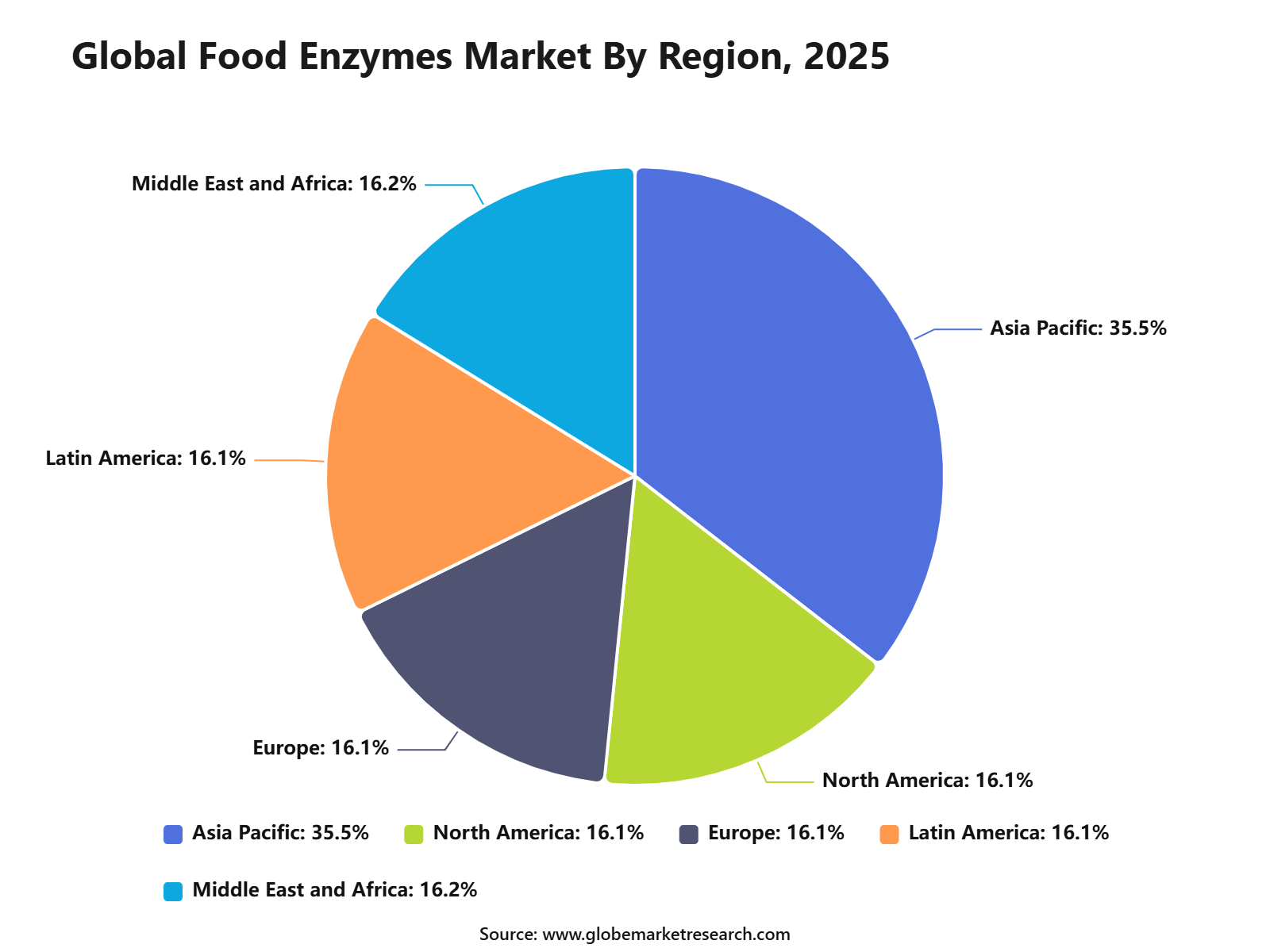 iThe graph shows projected market growth until 2035 based on CAGR analysis. Actual outcomes may vary depending on changing demand, competition, and economic factors.To gain greater insights - request a sample report PDF
Regional Impact Analysis
Asia Pacific leads the Food Enzymes Market with 35.5% share in 2026, valued at around USD 1.4 billion, supported by expanding food processing, rising dairy demand, bakery production growth, and increasing consumption of packaged foods. China and India remain major contributors due to large consumer bases and growing food manufacturing capacity.
North America remains important because of strong clean-label adoption, functional food demand, lactose-free dairy, and advanced food technology use. Europe supports steady growth through bakery innovation, dairy processing, brewing, and strict food quality standards.
Impact Factor | Estimated CAGR Impact | Regional Relevance | Market Impact |
|---|---|---|---|
Asia Pacific market leadership | +2.2% | Asia Pacific, 35.5% share in 2026 | Leads global value demand. |
China food processing expansion | +1.7% | China | Drives large-volume enzyme demand. |
India dairy and bakery growth | +1.4% | India | Supports future adoption. |
North America clean-label demand | +1.1% | U.S. and Canada | Adds premium enzyme use. |
Europe dairy and bakery innovation | +0.9% | Germany, France, UK, Netherlands | Supports specialty applications. |
Go-To-Market and Sales Economics
Food-enzyme suppliers should lead with application performance rather than ingredient volume. Bakeries, dairies, starch processors, beverage producers, and animal-feed manufacturers require different enzyme systems, testing methods, and dosing support. The United Kingdom’s largest food-manufacturing sectors include meat processing, dairy, bakery, animal feed, and grains, giving suppliers several concentrated customer groups for technical selling.
A direct-sales model is most effective for large processors because enzyme selection affects yield, texture, fermentation time, stability, and production consistency. Distributors remain important for smaller manufacturers requiring local inventory and regulatory support. Indonesia’s food-processing industry was valued at about USD 101 billion in 2026, showing the commercial value of building regional technical-service and distribution networks.
Sales economics should be tied to measurable production outcomes, including shorter processing cycles, improved raw-material use, lower rework, and consistent product quality. Suppliers can strengthen margins through formulation trials, plant audits, dosage optimization, and multi-year supply agreements. In early 2026, 82% of surveyed United Kingdom food manufacturers expected to raise prices because of higher energy costs.
Risk Factors & Market Barriers
Regulatory approval is a central market barrier because food enzymes require detailed information on identity, characterization, conditions of use, production organisms, genetic modification, and safety. EFSA’s May 2026 application procedure confirms that these elements must be included in dossiers. Suppliers without complete toxicology, exposure, manufacturing, and traceability records may face longer approval timelines and higher commercialization costs.
Market access in Europe remains demanding because food enzymes must undergo safety evaluation and receive authorization before inclusion on the Union list. Approval depends on consumer safety, technological need, and the prevention of misleading use. A June 2026 EFSA assessment evaluated an enzyme across six processes and calculated exposure of up to 0.506 milligrams TOS per kilogram body weight daily.
Operating costs create another barrier for both suppliers and customers. Fermentation-based enzyme production depends on energy, nutrients, water, quality control, and temperature-managed processing. United Kingdom food-manufacturer confidence fell to minus 64% in the first quarter of 2026, while 82% expected price increases, indicating stronger pressure on procurement budgets, qualification decisions, and supplier negotiations.
Revenue Potential Analysis
Revenue Landscape Across
Revenue opportunities are spread across bakery, dairy, brewing, starch conversion, juice processing, protein modification, and animal nutrition. The United Kingdom’s largest manufacturing categories include dairy, bakery, animal feed, and grains, all of which use enzymes for process improvement. Suppliers can expand revenue by offering application-specific blends instead of relying only on standardized, single-enzyme products.
Asia provides a broad customer base because processed-food production is expanding and many manufacturers depend on imported ingredients. Indonesia’s food-processing industry reached approximately USD 101 billion in 2026, while the United States held an 11% supplier share. Local warehousing, technical trials, competitive pack sizes, and distributor training can improve conversion among medium-sized regional processors.
European revenue potential is closely linked to regulatory readiness and specialized applications. Companies that can support exposure calculations, enzyme-use levels, manufacturing-process documentation, and safety submissions may secure stronger positions with multinational processors. EFSA’s assessment tools allow intended use levels to be entered as milligrams of total organic solids per kilogram of raw material across selected manufacturing processes.
Financial Impact
Food enzymes can improve financial performance by raising output consistency and reducing processing inefficiencies. The strongest value is created when enzyme dosage is linked to yield, cycle time, raw-material variation, and rejected-product rates. With 82% of surveyed United Kingdom manufacturers expecting price increases in early 2026, solutions that provide documented cost savings can receive greater purchasing attention.
Regulatory investment has a direct financial effect because incomplete dossiers can delay sales and increase testing expenses. EFSA requires information covering enzyme identity, production, intended use, and safety, while exposure must be assessed for relevant manufacturing processes. A 2026 evaluation reported exposure reaching 0.676 milligrams TOS per kilogram body weight daily across four applicable food-production processes.
Margin improvement is more likely when suppliers sell technical outcomes through long-term contracts rather than competing only on price per kilogram. Revenue can be supported through premium blends, customer-specific formulations, technical troubleshooting, and regulatory services. In a difficult operating environment, United Kingdom food-manufacturer confidence reached minus 64% in the first quarter of 2026, reinforcing demand for clear financial payback.
Raw Materials Drive Enzyme Growth
Reliable agricultural raw materials are the most important factor supporting the Food Enzymes Market because enzymes are widely used to improve food processing efficiency across grain, dairy, fruit and beverage production. According to the U.S. Department of Agriculture, total U.S. corn production reached approximately 15.8 billion bushels, while soybean production exceeded 4.3 billion bushels. These major agricultural inputs provide a strong foundation for enzyme applications in starch conversion, sweeteners, fermentation and food ingredient manufacturing.
Large-scale agricultural output also supports expansion in food processing industries that depend on enzyme technologies to improve yield, reduce waste and lower processing costs. Stable crop availability, efficient processing infrastructure and growing demand for value-added food products continue to strengthen long-term opportunities for enzyme manufacturers serving bakery, beverage, dairy and processed food industries.
Important Factor | Numeric Data |
|---|
U.S. corn production | 15.8 billion bushels |
U.S. soybean production | 4.3 billion bushels |
Corn harvested area | 86.8 million acres |
Soybean harvested area | 82.7 million acres |
Corn average yield | 181 bushels per acre |
Soybean average yield | 52.5 bushels per acre |
Corn used for food, seed and industry | 6.9 billion bushels |
Drivers Impact Analysis
The Food Enzymes Market is driven by rising demand for processed foods, dairy products, bakery items, beverages, plant-based foods, and clean-label formulations. Food enzymes help improve texture, flavor, shelf life, digestion, processing efficiency, and product consistency across multiple food categories.
Asia Pacific leads the market due to expanding food processing, rising dairy consumption, growing bakery production, and strong demand from China, India, Japan, South Korea, and Southeast Asia. The region’s large population base and increasing packaged food consumption support long-term enzyme adoption.
Impact Factor | Estimated CAGR Impact | Regional Relevance | Market Impact |
|---|---|---|---|
Growth in processed food production | +2.1% | Asia Pacific, Europe, North America | Drives core enzyme demand. |
Rising dairy processing demand | +1.8% | Asia Pacific and Europe | Supports lactase and protease use. |
Expansion of bakery applications | +1.5% | China, India, Japan, U.S. | Improves dough quality and freshness. |
Clean-label formulation trend | +1.2% | North America and Europe | Supports natural processing aids. |
Demand for higher processing efficiency | +1.0% | Global food manufacturers | Reduces cost and improves output. |
Restraints Impact Analysis
The market faces restraints from enzyme stability issues, high formulation cost, strict approval requirements, and sensitivity to temperature, pH, and processing conditions. Enzymes require careful handling because poor application can affect taste, texture, or product performance.
Another restraint is limited technical knowledge among smaller food processors. Enzyme-based formulation needs application expertise, testing, and process control, which can slow adoption in cost-sensitive markets.
Impact Factor | Estimated CAGR Impact | Regional Relevance | Market Impact |
|---|---|---|---|
High enzyme formulation cost | -0.9% | Small and mid-sized processors | Limits wider adoption. |
Temperature and pH sensitivity | -0.8% | Bakery, dairy, beverage processing | Affects performance consistency. |
Regulatory approval complexity | -0.7% | Global food markets | Adds compliance burden. |
Limited technical expertise | -0.6% | Emerging food processors | Slows application development. |
Product quality variation risk | -0.5% | Food manufacturers | Impacts consumer acceptance. |
Opportunities Impact Analysis
Opportunities are strong in dairy processing, bakery improvement, beverage clarification, plant-based protein processing, meat tenderization, starch processing, brewing, and sugar reduction. Enzymes help food brands improve product quality while supporting cleaner and more efficient production.
Higher-value opportunities are emerging in microbial enzymes, customized enzyme blends, digestive-friendly foods, lactose-free dairy, gluten management, and sustainable food processing. Suppliers that provide application support and tailored enzyme systems can capture stronger demand.
Impact Factor | Estimated CAGR Impact | Regional Relevance | Market Impact |
|---|---|---|---|
Lactose-free dairy growth | +2.0% | Asia Pacific, Europe, North America | Builds lactase demand. |
Plant-based food processing | +1.7% | U.S., Europe, China, India | Adds new enzyme applications. |
Customized enzyme blends | +1.4% | Food ingredient suppliers | Improves formulation value. |
Beverage clarification demand | +1.1% | Juice, wine, brewing markets | Supports pectinase and amylase use. |
Sustainable processing solutions | +0.9% | Global food manufacturers | Reduces waste and energy use. |
Challenges Impact Analysis
The main challenge is matching the right enzyme to the right food process. Each application needs specific activity, dosage, temperature control, pH range, and processing time to deliver consistent results.
Another challenge is consumer understanding. While enzymes are widely used in food production, some consumers may still misunderstand processing aids, especially in clean-label and natural food categories.
Impact Factor | Estimated CAGR Impact | Regional Relevance | Market Impact |
|---|---|---|---|
Application-specific formulation needs | -0.8% | Dairy, bakery, beverages | Requires technical support. |
Enzyme activity control challenges | -0.7% | Food processing facilities | Affects product consistency. |
Consumer misunderstanding of enzymes | -0.6% | Clean-label markets | Creates communication barriers. |
Supply chain quality variation | -0.5% | Global enzyme suppliers | Impacts reliability. |
Competition from conventional additives | -0.4% | Cost-sensitive food categories | Limits premium adoption. |
Segment Covered in the Report
By Type
Carbohydrases
Proteases
Lipases
Other Enzymes
By Source
Microbial
Plant
Animal
By Application
Dairy Processing
Bakery
Beverages
Processed Foods
Animal Feed
By Region
North America
Europe
Asia Pacific
Latin America
Middle East and Africa
Market Trend Analysis
The market trend is moving toward microbial enzymes, clean-label processing, lactose-free dairy, high-quality bakery enzymes, plant-based food improvement, and sustainable production. Food companies are using enzymes to improve product performance without relying heavily on synthetic additives.
Asia Pacific remains the largest value region because of strong food manufacturing growth, rising dairy and bakery consumption, and increasing demand for packaged foods. North America and Europe support innovation through clean-label reformulation, specialty foods, and premium processing solutions.
Impact Factor | Estimated CAGR Impact | Regional Relevance | Market Impact |
|---|---|---|---|
Microbial enzymes gain preference | +1.9% | Asia Pacific, Europe, North America | Supports scalable production. |
Clean-label processing expands | +1.6% | Developed food markets | Improves consumer acceptance. |
Dairy enzyme applications rise | +1.4% | Asia Pacific and Europe | Supports lactose-free products. |
Bakery enzyme innovation grows | +1.1% | Global bakery producers | Improves softness and shelf life. |
Plant-based formulation support increases | +0.9% | Vegan and alternative protein markets | Enhances taste and texture. |
Investor Type Impact Matrix
Investors should focus on companies with strong fermentation capability, enzyme application expertise, technical customer support, clean-label positioning, and scalable production. Product performance, regulatory knowledge, formulation support, and cost efficiency are key success factors.
Strategic investors can also target microbial enzyme producers, dairy enzyme specialists, bakery enzyme companies, fermentation technology firms, plant-based food ingredient suppliers, and specialty food ingredient manufacturers. Companies that combine innovation with application-specific support are better positioned for long-term growth.
Investor Type | Estimated CAGR Impact | Regional Relevance | Market Impact |
|---|---|---|---|
Microbial Enzyme Producers | +1.6% | Asia Pacific, Europe, North America | Expands core enzyme supply. |
Specialty Food Ingredient Companies | +1.3% | Global food processors | Supports broad application growth. |
Dairy Enzyme Specialists | +1.1% | Dairy-producing regions | Builds lactose-free product demand. |
Bakery Enzyme Solution Providers | +0.9% | Global bakery markets | Improves texture and shelf life. |
Strategic Food-Tech Investors | +0.7% | Global processed food markets | Funds innovation and scale-up. |
Recent Developments
May 2026: AB Enzymes expanded its commercial network across Mexico, Central America, and the Caribbean, appointing specialised distributors for food, baking, and flour-milling enzymes while strengthening local technical support, formulation assistance, and process optimisation.
April 2026: Kerry opened an expanded biotechnology manufacturing facility in Carrigaline, Ireland, significantly increasing industrial-scale lactase-enzyme capacity and supporting dairy manufacturers developing lactose-free and sugar-reduced milk, yoghurt, ice cream, and related products.
October 2025: BASF began evaluating strategic options for its feed-enzyme business, including potential partnerships. The portfolio covers phytase, xylanase, glucanase, and mannanase products, supported by established brands, technical expertise, and an active innovation pipeline.
Competitive Landscape
The market is characterized by intense competition among established players and emerging companies. Strategic partnerships, mergers and acquisitions, and product innovation are key strategies employed by market participants.
Key Market Players
Novonesis A/S
International Flavors & Fragrances Inc.
DSM-Firmenich
BASF SE
Kerry Group plc
AB Enzymes GmbH
Amano Enzyme Inc.
Advanced Enzyme Technologies Limited
Associated British Foods plc
Enzyme Development Corporation
Other Key Players
Research Methodology
This market study is prepared using a combination of primary and secondary research. Primary research includes discussions with manufacturers, suppliers, distributors, consultants, industry experts, and end users. Secondary research covers company reports, government databases, trade associations, technical publications, regulatory sources, and trusted industry documents. The collected information is used to assess market demand, pricing trends, technology adoption, competitive activity, and regional performance.
AI language models are not used as primary data sources, and publicly available AI-generated content is not treated as market evidence. Computational tools may be used to support data processing, translation, data classification, and pattern identification. However, every published assessment is supported by verified sources, human review, and primary market discussions.
Market estimates are developed through top-down and bottom-up approaches and validated using data triangulation. Revenue, production, shipment, pricing, and application-level data are compared across multiple sources. Forecasts consider economic conditions, regulatory changes, investment activity, innovation, supply chain developments, and industry risks. All findings are reviewed through source verification and internal quality checks before publication.
Part I
Source Management & Input Data Standards
Who provides data, how sources are qualified, and what types of evidence are admissible.
Part II
Research Scope & Market Coverage
How we define the markets we assess and the parameters that govern each product.
Part III
Data Collection, Verification & Submission
The mechanics of gathering, cross-checking, and hierarchically ranking evidence.
Part IV
Assessment Determination & Quality Controls
How raw data becomes a published assessment — normalisation, expert judgement, and outlier exclusion.
Part V
Publication, Corrections & Revision
Our publication schedule, corrections policy, and methodology review cycle.
Part VI
Independence, Ethics & Complaints
Conflict-of-interest policies, editorial independence, and how clients raise concerns.
Google · Preferred Sources
Don't miss the latest market research insights and industry updates on Google.
Add Globe Market Research as a preferred source in the Google app to see our reports, analysis, and market stories in your news suggestions.
Meet the Team
This report was prepared by our expert analysts with deep industry knowledge and research experience.
Pratiksha K. is a Senior Research Analyst with more than five years of experience in market research, industry analysis, competitive intelligence, and business strategy. She has contributed to detailed market reports, customized research studies, company profiling, market sizing, trend analysis, and strategic consulting projects for clients across different regions. Her industry expertise covers Chemical and Material, Consumer Goods, Food & Beverages and Energy & Power. She closely evaluates changing customer requirements, technology developments, regulatory conditions, supply chain structures, investment activity, and competitive strategies to provide clear and practical market insights.
Sayali brings more than 7 years of experience to Globe Market Research, supporting the accuracy, clarity, and relevance of research content across multiple industries. She reviews market data, segment analysis, competitive insights, and industry trends to ensure each report meets strong quality standards and provides practical value to business decision-makers. Her expertise spans healthcare, information technology, consumer goods, and diverse cross-industry domains. With a strong focus on data reliability, structured analysis, and clear presentation, Sayali helps ensure that each research output delivers well-reviewed insights for clients, investors, consultants, and industry stakeholders.
Frequently Asked Questions
Related Reports
More in Food and Beverages
Refrigerated Ready Meals Market to Hit USD 355.8 Billion by 2035
Refrigerated Ready Meals Market Size, Share, Analysis By Product (Refrigerated Meals, Frozen Meals, Shelf-Stable Meals, Canned Meals), By Meal Type (Vegetarian, Non-Vegetarian, Vegan), By Distribution Channel (Supermarkets and Hypermarkets, Convenience Stores, Online Retail, Specialty Stores), By Regional Insights, Business plan and Project Report, Investment Opportunities, Profitability, Industry Trends, Leading Companies and Growth Forecasts by 2026-2035
Frozen Desserts Market to Hit USD 298.8 Billion by 2035
Frozen Desserts Market Size, Share, Analysis By Product (Ice Cream, Frozen Yogurt, Gelato, Sorbet, Frozen Cakes, Other Products), By Consumption (Retail Consumption, Foodservice Consumption), By Distribution Channel (Supermarkets and Hypermarkets, Convenience Stores, Specialty Stores, Online Retail), By Regional Insights, Business plan and Project Report, Investment Opportunities, Profitability, Industry Trends, Leading Companies and Growth Forecasts by 2026-2035
Frozen Meat and Seafood Market to Hit USD 181.1 Billion by 2035
Frozen Meat and Seafood Market Size, Share, Analysis By Product (Frozen Meat, Frozen Seafood), By Seafood Form (Whole, Fillets, Processed Seafood, Other Forms), By Seafood End Use (Retail and Household, Foodservice, Industrial), By Regional Insights, Business plan and Project Report, Investment Opportunities, Profitability, Industry Trends, Leading Companies and Growth Forecasts by 2026-2035
Frozen Meals Market to Hit USD 74.2 Billion by 2035
Frozen Meals Market Size, Share, Analysis By Product (Frozen, Chilled, Canned, Shelf-Stable), By Meal Type (Vegetarian, Non-Vegetarian, Vegan), By Distribution Channel (Supermarkets and Hypermarkets, Online Retail, Convenience Stores, Specialty Stores), By Regional Insights, Business plan and Project Report, Investment Opportunities, Profitability, Industry Trends, Leading Companies and Growth Forecasts by 2026-2035