
Introduction
AI Toolkit Statistics: AI toolkits include coding assistants, agent frameworks, model libraries, software development kits, data infrastructure, and monitoring tools used to build and manage artificial intelligence applications. The latest evidence shows that AI-assisted development has moved into regular workflows, although human review, security controls, and output verification remain essential.
In January 2026, 74% of developers worldwide had adopted a specialized AI development tool, such as a coding assistant, AI editor, or coding agent. Separately, 84% of respondents in the 2025 Stack Overflow Developer Survey were already using or planning to use AI tools, while 50.6% of professional developers reported daily use.
Editor’s Choices
90% of professional developers regularly used at least one AI tool for coding and development work in January 2026.
Claude Code recorded a 91% customer satisfaction score and a Net Promoter Score of 54.
Google Antigravity reached 6% developer workplace adoption within approximately two months of its November 2025 launch.
14.9% of professional developers used AI agents at work every day, while another 9.2% used them weekly.
52% of developers reported that AI tools or AI agents had improved their productivity.
76% of developers did not plan to use AI for deployment and monitoring, while 69% rejected its use for project planning.
The Model Context Protocol gained 37,000 GitHub stars in less than eight months.
AI Toolkit Adoption Insights
The strongest adoption is being recorded in code generation, software engineering, learning, debugging, and repetitive task automation. Among developers using agents, 83.5% applied them to software engineering, while approximately 70% stated that agents reduced the time required for specific tasks. About 69% also reported increased productivity.
Open-source infrastructure is supporting this expansion. GitHub recorded more than 1.1 million public repositories using LLM SDKs, while Hugging Face expanded beyond 2 million public models. However, activity remains concentrated, as the 200 most-downloaded Hugging Face models represented 49.6% of model downloads despite accounting for only about 0.01% of available models.
The main opportunity is shifting from basic code completion toward integrated agent workflows, model management, testing, data retrieval, monitoring, and security. However, adoption should not be treated as evidence of complete reliability. The high levels of accuracy, privacy, and security concern indicate that successful deployment requires human review, access controls, testing procedures, audit records, and clear governance policies.
AI Toolkit Market Size and Growth
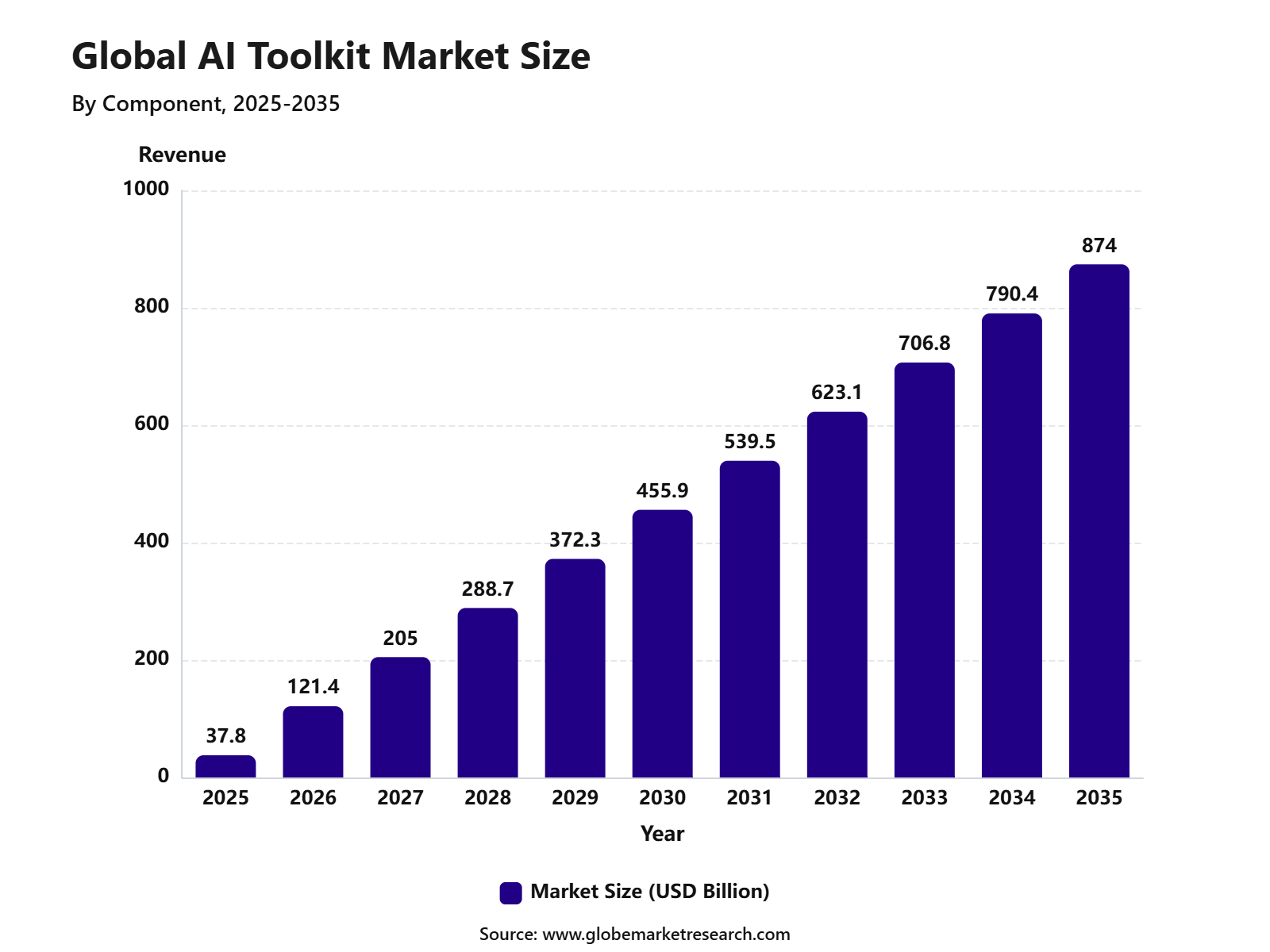
The global AI Toolkit Market was valued at USD 37.8 billion in 2025 and is projected to reach approximately USD 874.0 billion by 2035, growing at a CAGR of 36.9% from 2025 to 2035. North America led the market with a 38.7% share in 2025, representing approximately USD 14.6 billion. The U.S. market reached USD 10.2 billion and is expected to grow at a CAGR of 36.4%. Growth is being supported by increasing enterprise AI adoption, cloud-based model development and investment in generative and agentic AI applications.
Key Parameter | Report Details |
|---|---|
Market Revenue, 2025 | USD 37.8 Billion |
Projected Revenue, 2035 | USD 874.0 Billion |
CAGR, 2025-2035 | 36.9% |
Largest Region | North America, 38.7% Share |
U.S. Market Revenue, 2025 | USD 10.2 Billion |
U.S. CAGR, 2025-2035 | 36.4% |
Market Concentration | Medium |
Base Year | 2025 |
Forecast Period | 2025-2035 |
AI toolkits include software development kits, machine learning libraries, application programming interfaces, model orchestration frameworks, data preparation tools and testing platforms. These solutions help developers build, train, fine-tune, deploy, evaluate and manage AI applications. Integrated toolkits can shorten development cycles, improve model monitoring and simplify connections between foundation models, enterprise data, cloud services and business applications.
Demand is also being influenced by the rapid expansion of enterprise AI and AI-assisted software development. Stanford’s 2026 AI Index reported that 88% of surveyed organizations used AI in 2025, while 70% used generative AI in at least one business function. Microsoft reported in October 2025 that GitHub Copilot had more than 26 million users and GitHub supported over 180 million developers. These figures are strengthening demand for development frameworks, coding assistants, model libraries, evaluation tools and AI deployment platforms.
AI Toolkit Market Share Statistics
Platforms dominated the AI toolkit market with a 59.5% share, reflecting strong demand for integrated solutions that support AI model development, training, deployment, monitoring, and workflow management.
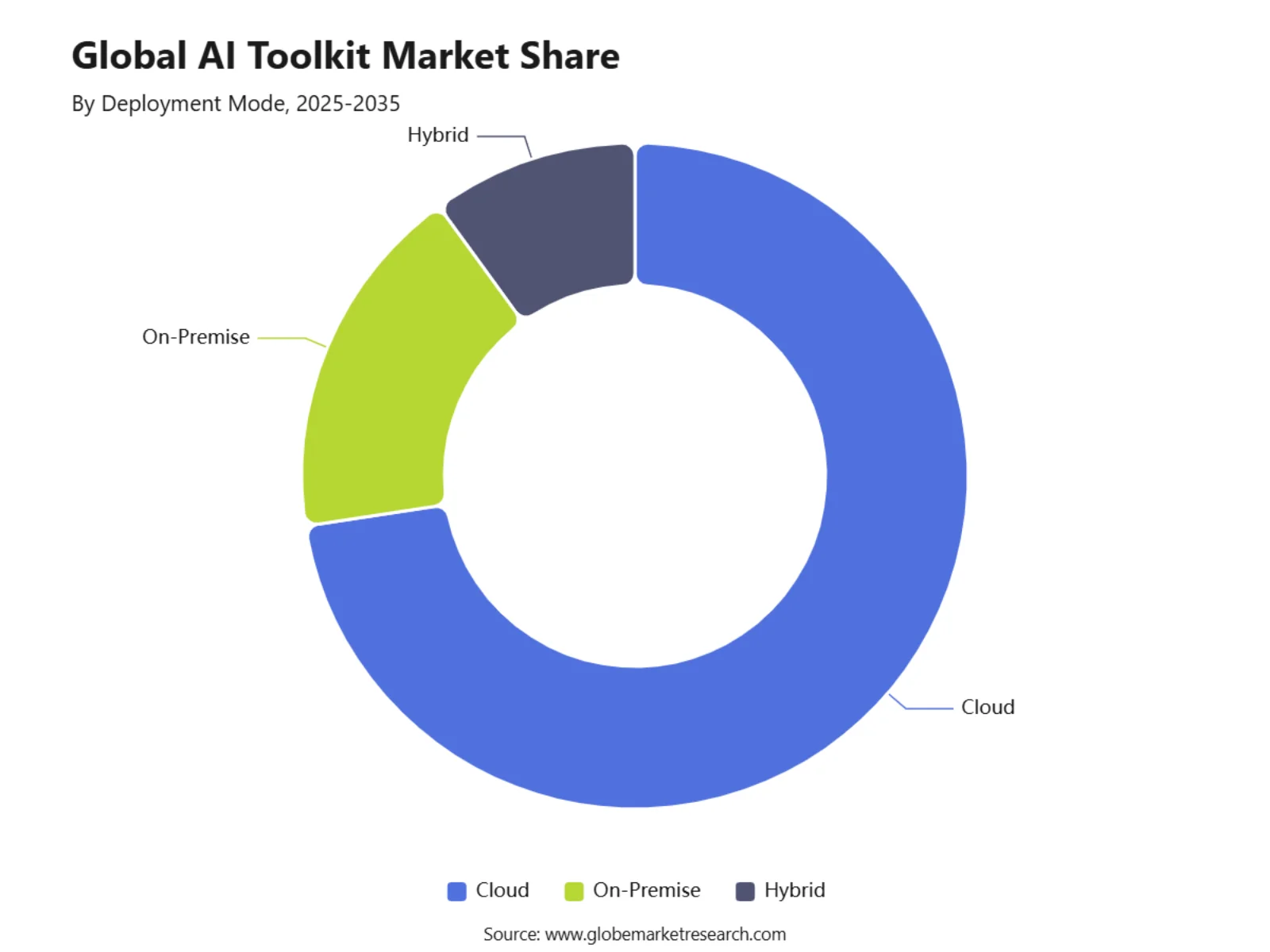
Cloud-based deployment captured a 72.6% share, supported by scalable computing capacity, faster implementation, flexible access, and lower initial infrastructure investment.
Machine learning accounted for the leading application share of 39.7%, driven by its growing use in predictive analytics, process automation, customer personalization, fraud detection, and operational decision-making.
Large enterprises represented 65.8% of the market, supported by larger technology budgets, advanced data systems, skilled AI teams, and broader implementation across departments.
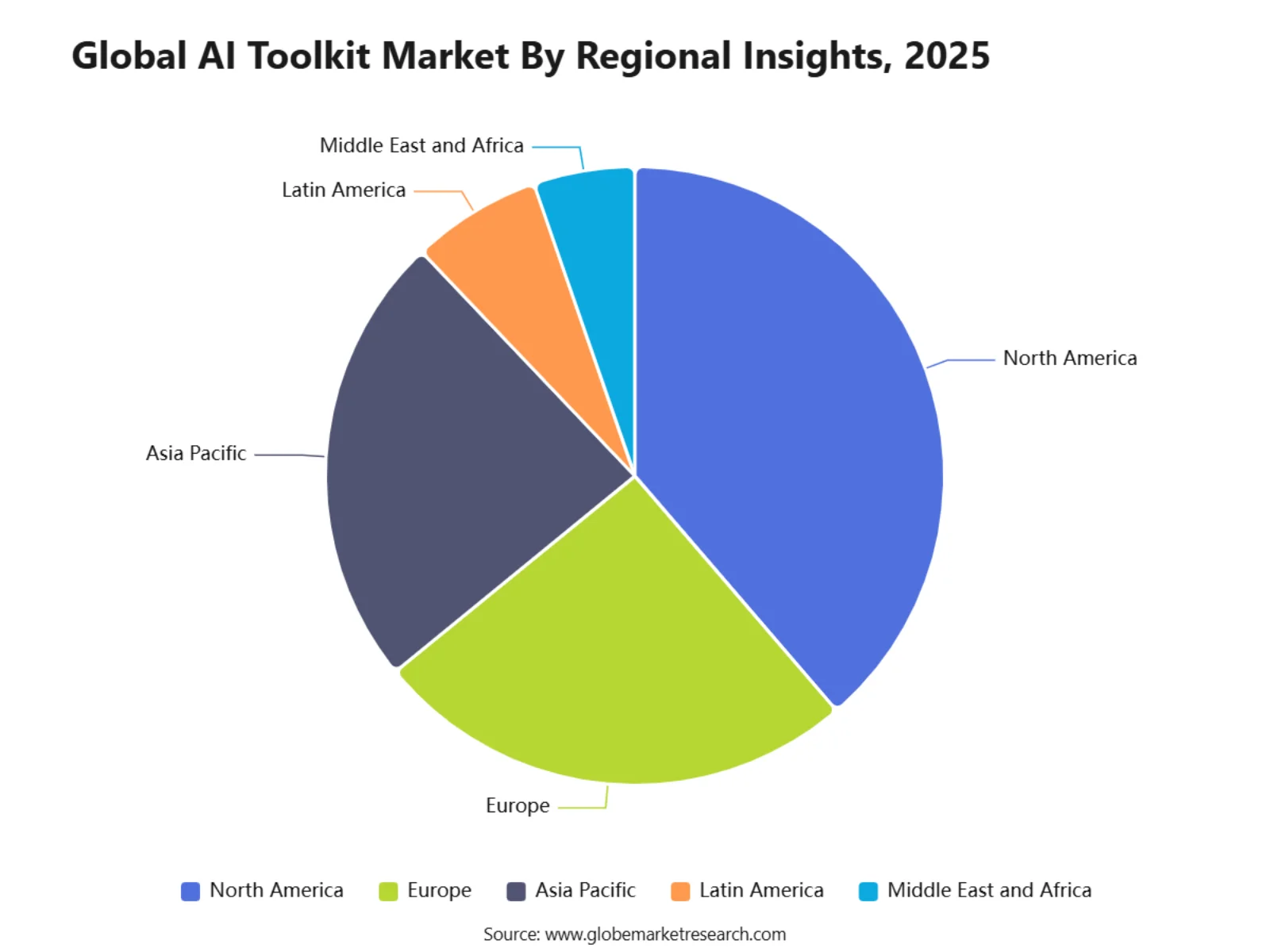
North America led the regional market with a 38.7% share, supported by high enterprise AI spending, advanced cloud infrastructure, strong technology adoption, and the presence of major AI platform providers.
The U.S. AI toolkit market reached USD 10.6 billion and is expected to expand at a CAGR of 36.4%, driven by increasing enterprise investment in generative AI, cloud-based development platforms, and AI software infrastructure.
By Component
Component | Market Share |
|---|---|
Platforms | 59.5% |
Tools | 25.8% |
Services | 14.7% |
By Deployment Mode
Deployment Mode | Market Share |
|---|---|
Cloud | 72.6% |
On-Premise | 17.4% |
Hybrid | 10.0% |
By Application
Application | Market Share |
|---|---|
Machine Learning | 39.7% |
Natural Language Processing | 16.8% |
Computer Vision | 13.5% |
Big Data Analytics | 10.9% |
Generative AI Tools | 8.7% |
AI Code Assistants | 6.2% |
Model Monitoring and Governance | 4.2% |
By End User
End User | Market Share |
|---|---|
Large Enterprises | 65.8% |
Small and Medium Enterprises | 18.6% |
Startups | 7.4% |
Individual Developers | 5.1% |
Academic and Research Institutions | 3.1% |
AI Toolkit Market Usage Statistics
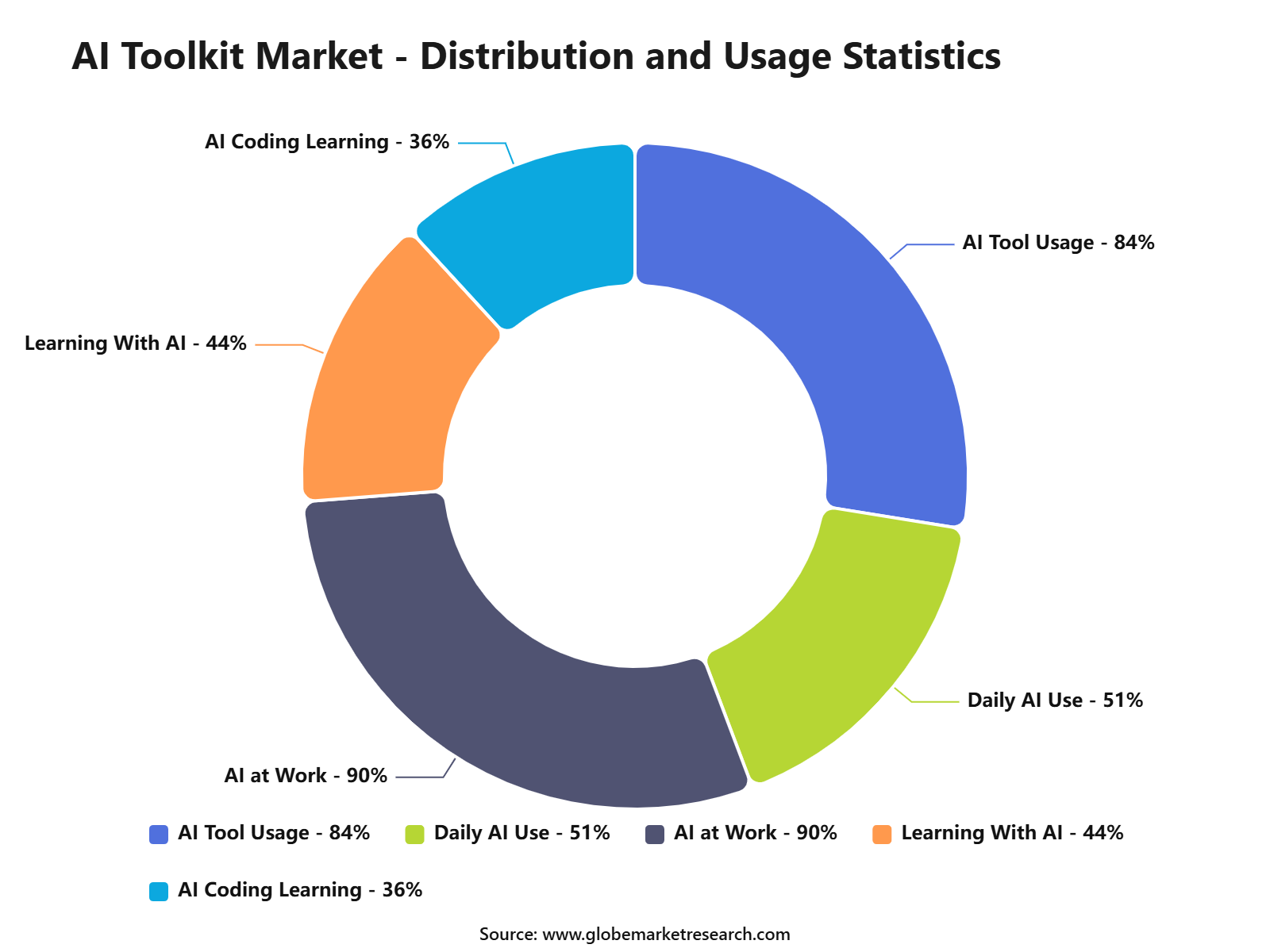
AI at Work: 90% of users apply AI tools in their professional activities.
AI Tool Usage: 84% of respondents use at least one AI tool.
Daily AI Use: 51% of users interact with AI tools every day.
Learning With AI: 44% use AI tools to support education and skill development.
AI Coding Learning: 36% use AI to learn programming and coding skills.
AI Toolkit Market - Regional Insights
Region | Market Share |
|---|---|
North America | 38.7% |
Europe | 25.4% |
Asia Pacific | 23.8% |
Latin America | 6.8% |
Middle East and Africa | 5.3% |
Leading AI Tools
AI Tool | Best Use | Key Capability | Current Pricing Indicator |
|---|---|---|---|
ChatGPT | Flexible statistical analysis | Executes Python and analyses uploaded files | Free plan available; Plus costs USD 20 monthly |
Julius AI | No-code data analysis | Converts natural-language questions into charts and summaries | Free plan; Plus starts at USD 20 monthly |
Datapad | Automated business dashboards | Uses AI agents to create dashboards and recommendations | Basic plan listed from USD 15 monthly when discounted |
GPT for Work | Large spreadsheet operations | Processes up to 1 million rows per bulk run | Starts free; paid access from USD 25 monthly |
Tableau AI | Enterprise visual analytics | Detects trends, drivers, and outliers | Standard Creator costs USD 75 per user monthly, billed annually |
ChatGPT With Advanced Data Analysis
ChatGPT allows users to upload Excel, CSV, PDF, JSON, and other supported files and request analyses using ordinary language. It writes and runs Python code to clean data, merge datasets, perform calculations, produce charts, and identify patterns. Free users can upload files and analyse data, although paid subscriptions provide higher usage limits and access to more advanced reasoning capabilities.
The tool can support descriptive statistics, correlations, regression, ANOVA, hypothesis testing, confidence intervals, forecasting, clustering, and time-series analysis. It can also generate diagnostic plots and explain statistical outputs. The analyst should still verify assumptions such as normality, independence, sample size, equal variance, missing values, and multicollinearity.
As of July 2026, GPT-5.6 is being introduced across ChatGPT, Codex, and the OpenAI API. Therefore, referring to the current product only as “GPT-5.3” may be outdated. ChatGPT Plus remains priced at USD 20 per month, while a free plan continues to be available.
Best for: Students, researchers, consultants, business analysts, data scientists, and users requiring flexible analysis.
Julius AI
Julius AI is designed for users who want to analyse spreadsheets or connected data without writing Python, R, or SQL. Files can be uploaded, questions can be entered in plain English, and the platform can return charts, tables, calculations, and written summaries. Analyses can also be saved and refreshed when updated data become available.
The platform is suitable for descriptive analysis, regression, forecasting, correlation testing, data exploration, and basic predictive modelling. Its conversational workflow makes it useful for users who need statistical guidance but do not have advanced programming experience.
Julius offers a free plan with notebooks, Google Drive connectivity, file storage, and 2 GB of RAM. The Plus plan is listed at USD 20 per month, or USD 16 per month under annual billing.
Best for: Students, marketing teams, financial analysts, consultants, and nontechnical business users.
Datapad
Datapad uses AI agents to analyse connected data and automatically build dashboards containing relevant metrics, visualisations, and layouts. Users can interact with their information through chat instead of manually constructing every chart or business intelligence report.
The platform is positioned toward operational and business analysis rather than formal academic statistics. It can help teams identify performance changes, monitor indicators, create strategic recommendations, and communicate results through dashboards. This makes it particularly relevant for sales, marketing, finance, and management reporting.
The published pricing page lists a discounted Basic rate of USD 15 per month, a Pro rate of USD 25 per user per month, and a Scale rate of USD 500 per workspace per month. The Pro plan includes unlimited dashboards and support for up to 10 non-database data sources. Pricing and promotional discounts should be checked before purchase.
Best for: Small businesses, operational teams, agencies, and companies requiring automated dashboards.
GPT for Work
GPT for Work operates directly inside Microsoft Excel and Google Sheets. It can assist with formulas, formatting, data cleaning, classification, translation, enrichment, research, and repeated operations across spreadsheet rows. Users can select from several AI providers or connect their own API keys.
Its main advantage is scale. The platform states that bulk runs can process as many as 1 million rows, with speeds of up to 1,000 cells per minute for supported workflows. These capabilities make it suitable for large spreadsheets that would be difficult to process through a standard conversational interface.
GPT for Work currently uses different pricing systems depending on when the workspace was created. New workspaces may receive subscription plans starting from USD 25 per month, while some existing users remain on pay-as-you-go pricing, with credit packs starting at USD 29.
Best for: Spreadsheet-heavy teams, ecommerce operators, financial analysts, researchers, and users processing large row-level datasets.
Tableau AI
Tableau AI combines generative AI with established business intelligence and data visualisation functions. Tableau Agent helps users explore data, build visualisations, create or explain calculated fields, and uncover findings through natural-language instructions.
Tableau Pulse automatically detects trends, drivers, and outliers and presents them through written summaries and visual explanations. The July 2026 release expanded conversational analysis to include period-over-period comparisons, trend analysis, composite analysis, heat maps, scatter plots, and other visual formats.
Tableau is more appropriate for governed enterprise reporting and reusable dashboards than for quick one-time statistical tests. Standard annual pricing is listed at USD 75 per user per month for Creator, USD 42 for Explorer, and USD 15 for Viewer. Enterprise Creator is listed at USD 115 per user per month.
Best for: Enterprises, analytics departments, management teams, and organisations requiring controlled dashboard distribution.
Additional Notable AI Analytics Tools
Claude for Excel can support spreadsheet analysis and formula-related work within Excel, but suitability depends on the available add-in, account plan, and organisational controls.
Microsoft Power BI with Copilot can assist report authors, business users, and data-model owners with report creation, summaries, and analytical questions. In India, Power BI Pro is listed at ₹1,165 per user per month, while Premium Per User is listed at ₹1,995 per user per month, billed annually and excluding applicable taxes.
Zoho Analytics with Zia is suitable for conversational business intelligence, automated reports, and dashboard creation across connected operational data.
Hugging Face is more suitable for technical users who want open models, datasets, libraries, and deployment options. By March 2026, the platform hosted more than 2 million models. However, usage was highly concentrated, with the top 200 models representing 49.6% of model downloads.
Key Advantages of AI in Statistics
Faster data preparation: Missing values, duplicate records, inconsistent labels, and incorrect formats can be identified more efficiently.
Simplified statistical testing: Users can request regression, correlation, ANOVA, t-tests, and other procedures using natural-language instructions.
Clearer interpretation: Complex statistical outputs can be converted into understandable explanations for nontechnical readers.
Automated visualisation: Charts, diagnostic plots, dashboards, and presentation-ready summaries can be generated rapidly.
Greater analytical scale: Spreadsheet tools such as GPT for Work can apply repeated operations across datasets containing up to 1 million rows.
Broader model access: Platforms can provide access to several language models, open-source models, or user-supplied API keys.
Recent Developments
In January 2026, GitHub expanded Copilot CLI with enhanced agents, context management, automation, scripting, custom agents, model management, and web access controls for terminal-native AI development.
In February 2026, GitHub made Copilot CLI generally available for all Copilot subscribers, positioning it as a terminal-native coding agent for command-line software development.
In February 2026, Anthropic announced that Apple’s Xcode 26.3 supports Claude Agent SDK, giving developers access to Claude Code capabilities such as subagents, background tasks, and plugins directly inside Xcode.
In April 2026, OpenAI updated its Agents SDK to support file inspection, command execution, code editing, long-horizon work, sandbox execution, tracing, approvals, handoffs, and durable agent workflows.
In May 2026, Google Cloud highlighted its Agent CLI and Agent Development Kit for building and interacting with AI agents across different developer environments, including tools such as Claude Code.
In May 2026, Google AI Studio added build-mode capabilities that allow developers to create and deploy web apps and native Android apps using natural language prompts with Gemini.
In June 2026, GitHub updated Copilot in Visual Studio Code with an Agents window, language model selection, bring-your-own-key options, and improved terminal safety features.
In June 2026, IBM researchers introduced AI Steerability 360, an open-source Python toolkit for steering large language models across prompts, model structure, internal states, and outputs.
Acquisitions
In January 2026, ClickHouse acquired Langfuse, an open-source AI engineering platform used for tracing, evaluating, and improving AI agents. The deal shows that AI observability is becoming part of broader data infrastructure.
In March 2026, OpenAI announced plans to acquire Promptfoo, an AI security and testing platform, to strengthen agentic security evaluation and model testing workflows. This supports demand for safer AI toolkits used in production development.
In March 2026, OpenAI announced plans to acquire Astral to bring open-source developer tooling into the Codex ecosystem. This is relevant because coding agents require fast, reliable, and developer-native infrastructure to support production software workflows.
In June 2026, OpenAI announced plans to acquire Ona to expand Codex with secure and persistent cloud environments for long-running AI agents. This supports the shift from short coding assistance to managed, multi-step software engineering agents.
In 2026, direct acquisitions of broad AI toolkit companies remained selective. Buyers appeared more focused on specific layers such as AI observability, agent security, coding infrastructure, AI runtime environments, and workflow automation rather than general-purpose AI software tools.
Funding and Investments
In January 2026, Emergent raised USD 70 million in Series B funding led by SoftBank Vision Fund and Khosla Ventures to expand its AI coding-agent platform and engineering teams in San Francisco and Bengaluru.
In February 2026, Braintrust raised USD 80 million in Series B funding at an USD 800 million valuation to accelerate AI observability and evaluation infrastructure.
In April 2026, SiFive raised USD 400 million in Series G funding at a USD 3.65 billion valuation to accelerate RISC-V CPU and AI IP solutions for data center applications. This is relevant to AI toolkit infrastructure because custom AI development increasingly depends on processor IP, compilers, and developer ecosystems.
In July 2026, TYLSemi raised USD 43 million in early funding to build modular chiplet components for custom AI chips based on open standards. This supports the hardware-toolkit side of AI development by lowering integration barriers for custom AI infrastructure.
In July 2026, Business Insider reported that Emergent secured USD 130 million in Series C funding, raising its valuation to USD 1.5 billion and supporting the broader rise of natural-language software development tools.
Market Impact
In 2026, AI toolkits are becoming essential because enterprises are moving from AI experiments to production AI systems. Developers now need tools for agent orchestration, retrieval, evaluation, tracing, prompt testing, cost control, model routing, permissions, deployment, and governance.
In 2026, agent development kits are becoming a major growth area. Google ADK, OpenAI Agents SDK, Claude Agent SDK, GitHub Copilot agents, and Microsoft-related agent tools show that developers are building systems that can plan, call tools, execute tasks, inspect files, and work across enterprise environments.
In 2026, AI observability is becoming a core buying requirement. Braintrust, Langfuse, LangSmith, Datadog integrations, and academic work on AI telemetry show that teams need to measure latency, cost, quality, hallucination risk, tool-use failures, and multi-step agent behavior before AI applications can be trusted in production.
In 2026, coding and app-building tools are one of the strongest commercial segments. GitHub Copilot CLI, OpenAI Codex, Claude Code, Cursor, Replit, Lovable, and Emergent show that AI toolkits are reducing the gap between idea, code, testing, and deployment.
In 2026, security and governance are becoming key differentiators. AI toolkits that offer sandboxing, approvals, role-based access, audit trails, testing, safe tool execution, and runtime monitoring are expected to gain stronger enterprise adoption.
Are you curious about the latest AI receptionist numbers and statistics? Visit - https://www.globemarketresearch.com/reports/ai-toolkit-market