

Revenue, 2026
USD 7.9 Bn
Forecast, 2035
USD 43.60 Bn
CAGR, 2026-2035
20.9%
Report Coverage
Global
Market Size and Forecast
Digital labor refers to AI agents, intelligent automation systems and software-based workers that perform business tasks with limited human intervention. These systems can interpret information, make decisions, communicate with customers, update enterprise applications and complete multi-step workflows. Adoption is expanding across customer service, sales, finance, human resources, information technology, cybersecurity, supply chain management and administrative operations.
According to Globe Market Research, the global Digital Labor Market was valued at USD 7.9 billion in 2026 and is projected to reach approximately USD 43.6 billion by 2035, growing at a CAGR of 20.9% from 2026 to 2035. North America commanded around 40.3% of the market, representing approximately USD 3.18 billion in 2026. Regional leadership is supported by advanced cloud infrastructure, early enterprise adoption of AI agents, strong software investment and growing demand for automated digital workflows.
Key Parameter | Report Details |
|---|---|
Market Revenue, 2026 | USD 7.9 Billion |
Projected Revenue, 2035 | USD 43.60 Billion |
CAGR, 2026-2035 | 20.9% |
Largest Region | North America, 40.3% Share |
Market Concentration | Medium |
Base Year | 2025 |
Forecast Period | 2026-2035 |
Enterprise applications are rapidly being redesigned to support AI-based workers. Industry expects task-specific AI agents to be integrated into 40% of enterprise applications by the end of 2026, compared with less than 5% in 2025. Deloitte found that employee access to AI increased by 50% during 2025, although only one in five companies had developed mature governance for autonomous agents. Microsoft also reported that 78% of business leaders were considering recruitment for new AI-related roles, while 41% expected teams to train agents and 36% expected employees to manage them within five years.
Agentic AI is expanding the role of digital labor from rule-based task automation to autonomous workflow execution. AI agents can understand objectives, plan actions, retrieve information, coordinate across applications and complete multistep processes with limited human intervention. In 2025, 46% of business leaders reported that their organizations were already using agents to fully automate workflows or business processes, particularly in customer service, marketing and product development. A further 82% planned to use digital agents to increase workforce capacity within 12 to 18 months.
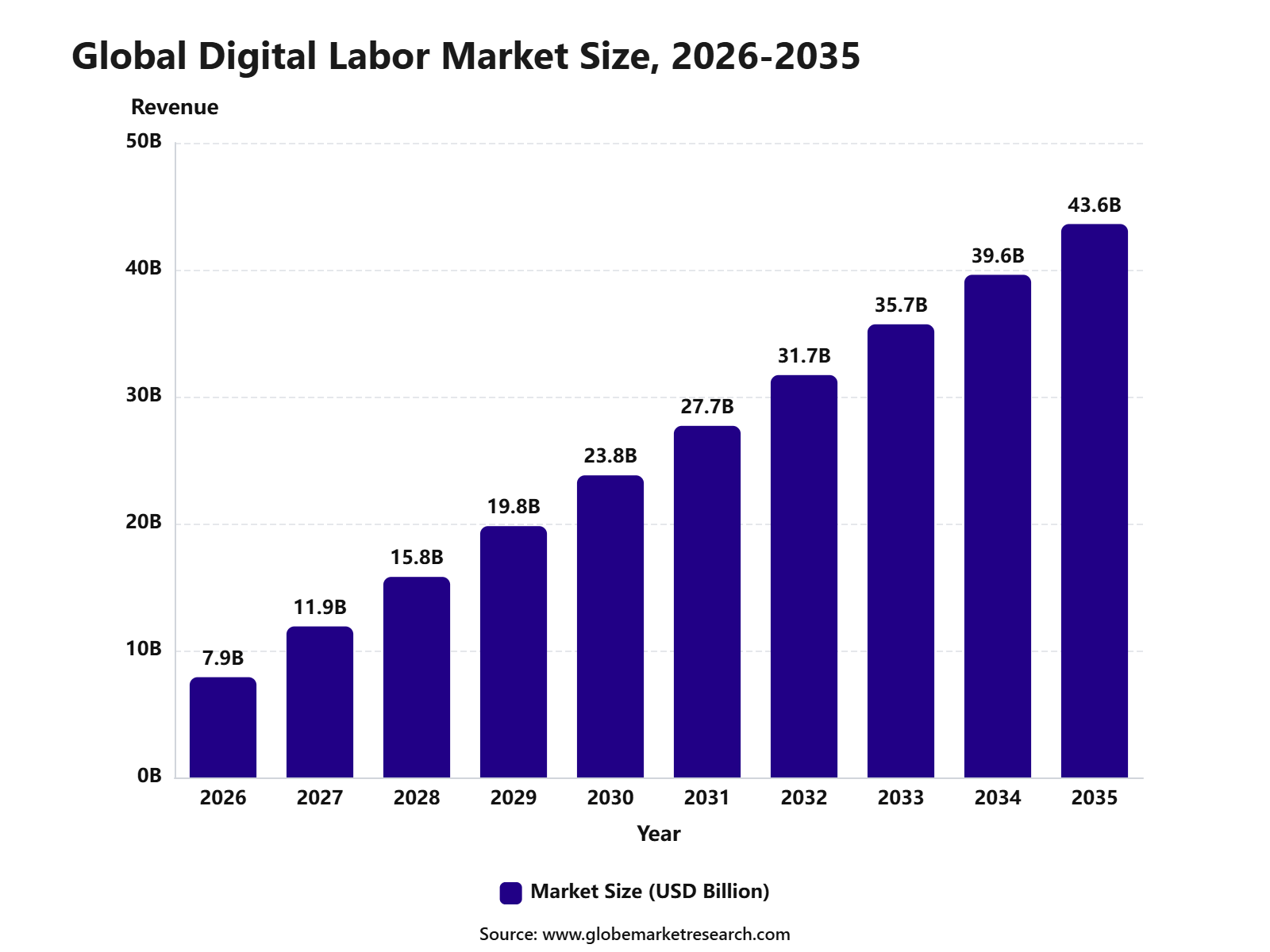 iThe graph shows projected market growth until 2035 based on CAGR analysis. Actual outcomes may vary depending on changing demand, competition, and economic factors.To gain greater insights - request a sample report PDF
The impact is expected to extend beyond productivity improvement by changing how work is allocated, measured and managed. Repetitive administrative activities can be assigned to digital workers operating continuously, while employees focus on customer relationships, judgment-based decisions, exception handling and strategic tasks. However, adoption remains dependent on measurable returns, trusted data, governance and workforce readiness. Only 25% of AI initiatives have delivered their expected return, while 16% have been scaled across the enterprise, indicating that implementation quality remains a major barrier.
Key Market Insights
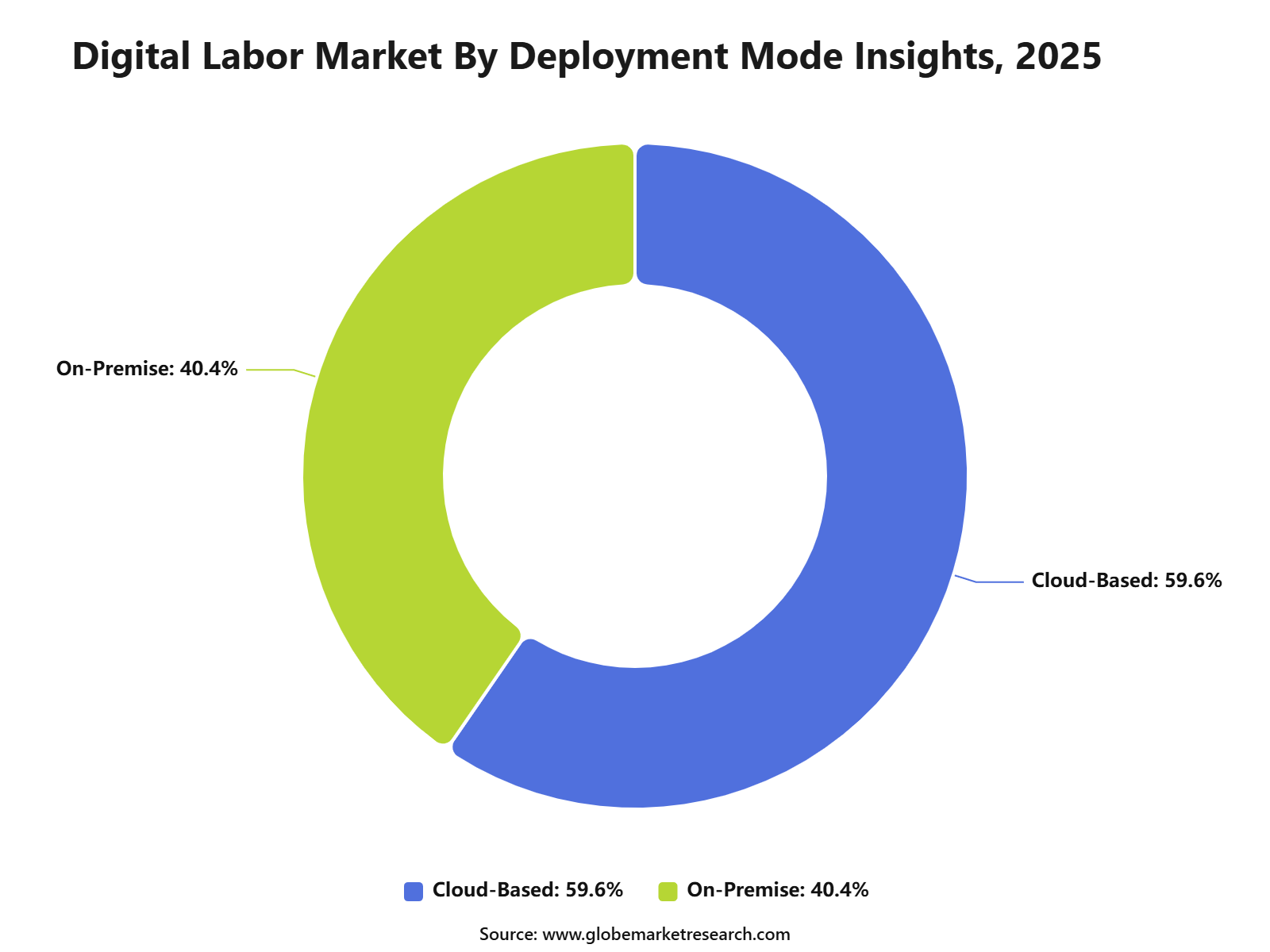
Cloud-based deployment led the deployment mode segment with 59.6% share, supported by scalable access, faster implementation, lower infrastructure cost, and easier integration with enterprise automation systems.
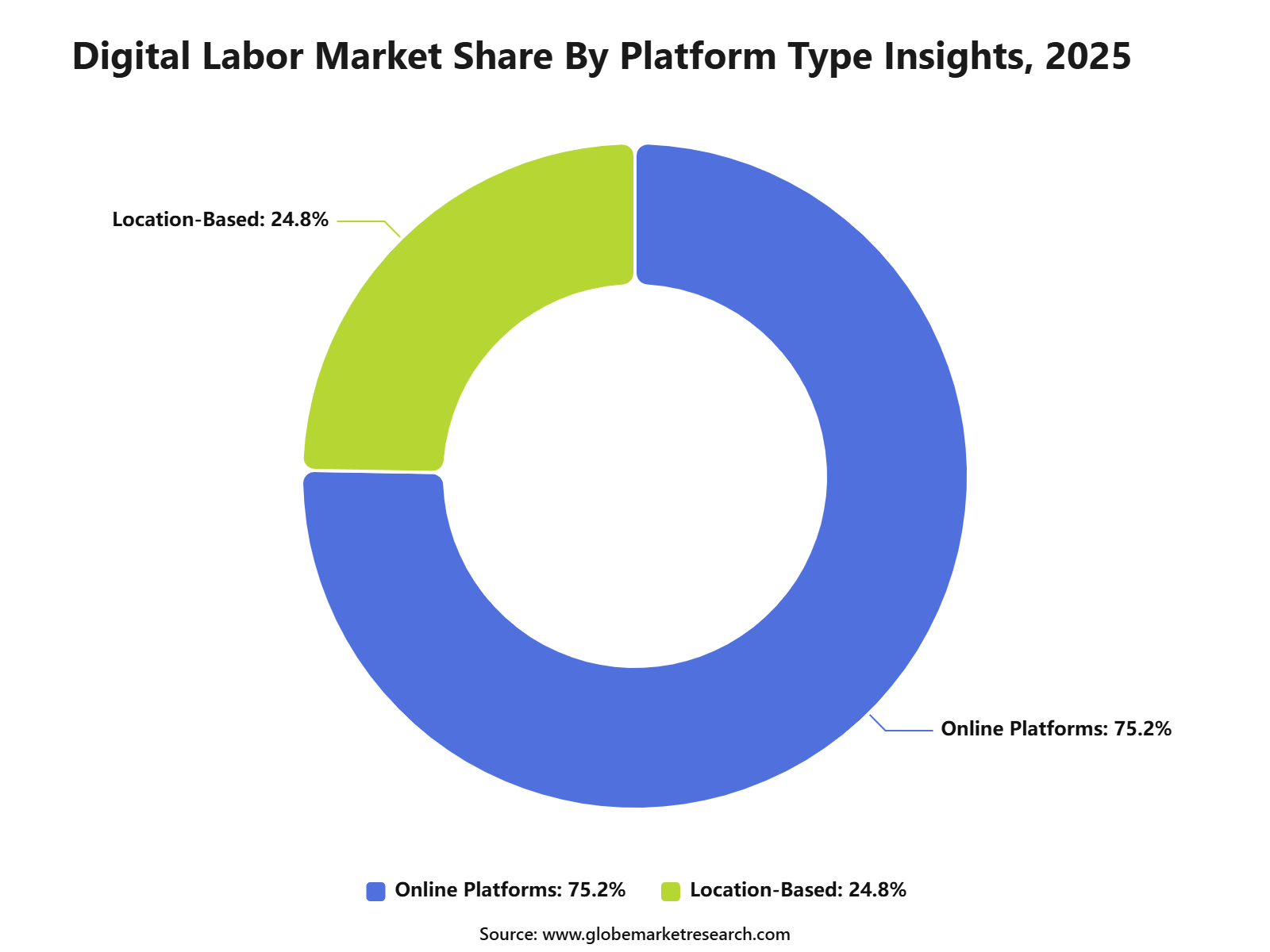
Online platforms accounted for 75.2% share, driven by strong demand for web-accessible digital labor tools, centralized workflow management, and remote business process automation.
Conversational AI agents held 36.8% share by digital worker type, supported by rising use in customer support, sales assistance, employee helpdesks, and automated communication workflows.
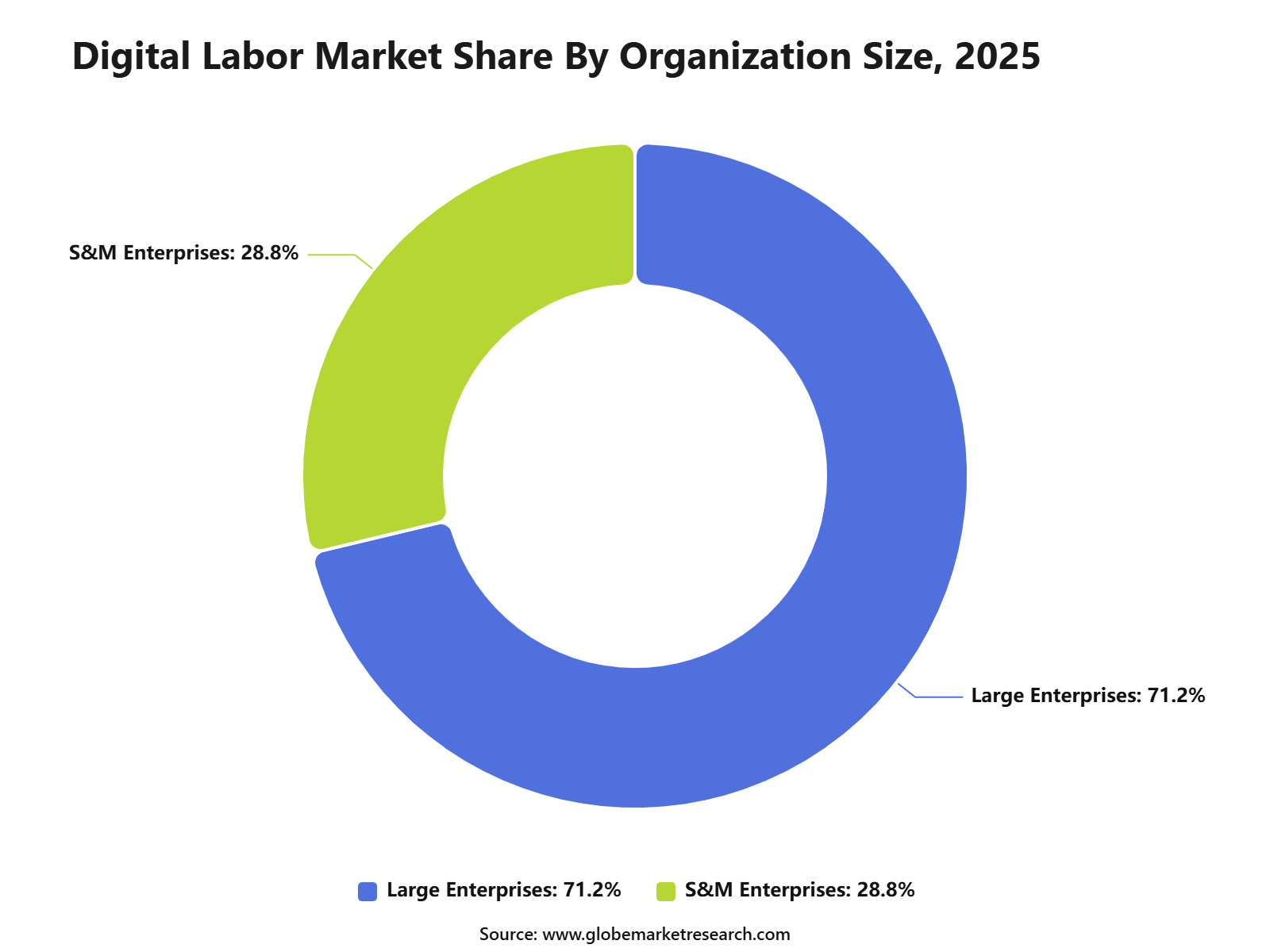
Large enterprises captured 71.2% share by organization size, driven by higher automation budgets, complex operations, and wider adoption of AI-powered digital workforce solutions.
Customer service led the application segment with an estimated 28.0% share, supported by demand for faster query handling, 24/7 support, ticket resolution, and customer engagement automation.
BFSI accounted for an estimated 25.0% share by industry, driven by strong use of digital labor for claims processing, fraud monitoring, customer onboarding, compliance, and back-office automation.
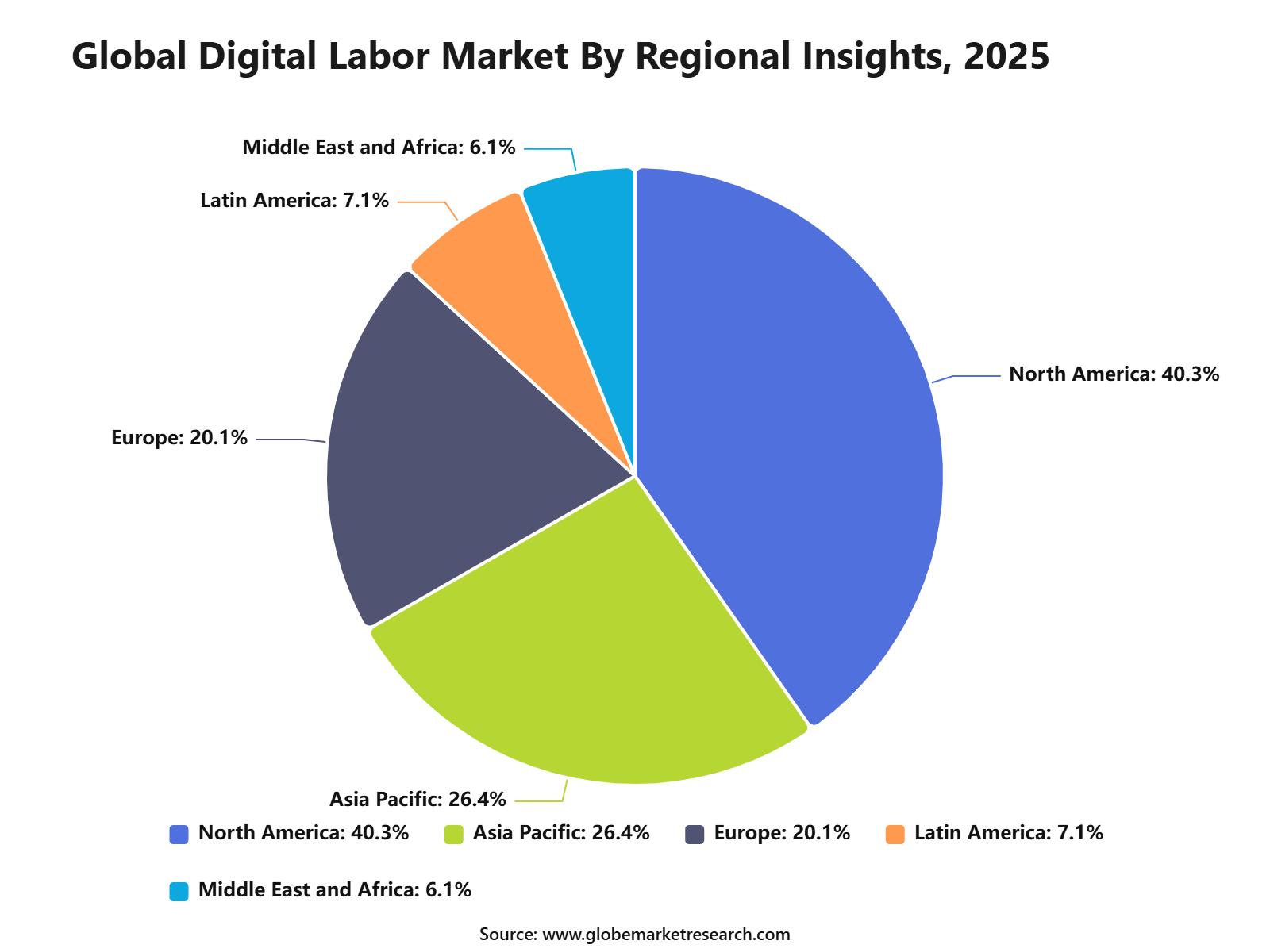
North America commanded 40.3% share of the digital labor market, supported by mature AI adoption, strong enterprise technology spending, cloud infrastructure, and demand for intelligent automation across industries.
Adoption Rate and Usage Statistics
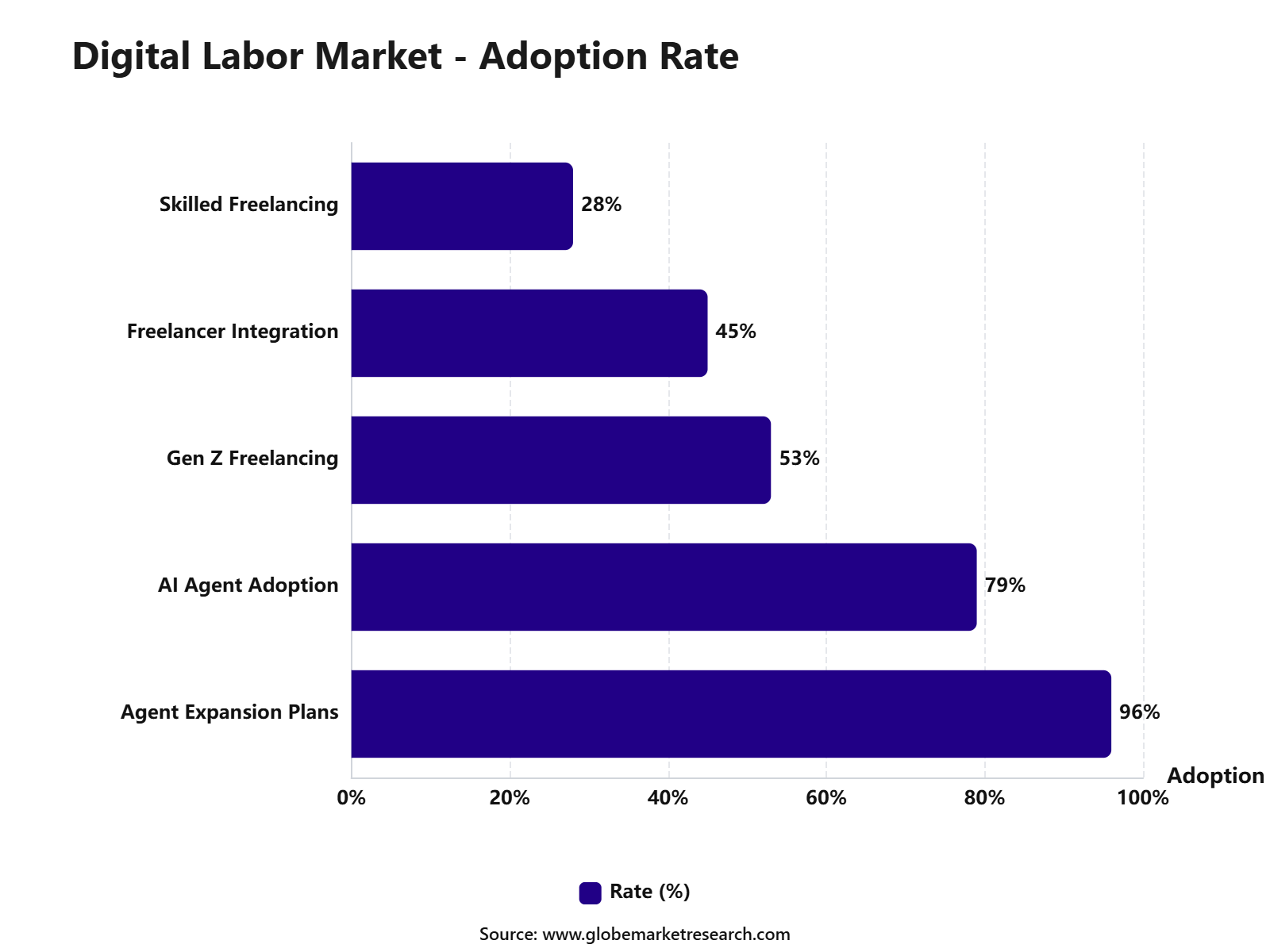
According to PwC, Cloudera and Upwork, digital labor adoption is increasing across AI-powered and human freelance work models. Around 79% of surveyed companies had adopted AI agents, while 96% of enterprise IT leaders planned to expand agent use. Skilled freelancing represented 28% of U.S. knowledge workers, rising to 53% among skilled Gen Z workers.
 iThe graph shows projected market growth until 2035 based on CAGR analysis. Actual outcomes may vary depending on changing demand, competition, and economic factors.To gain greater insights - request a sample report PDF
According to Upwork and PwC, more than 20 million skilled U.S. knowledge workers participated in freelance or independent work. Around 62% of skilled freelancers used AI tools several times per week, while AI-related work completed through Upwork increased by 60% year over year. Among companies adopting AI agents, 66% reported measurable productivity improvements.
Metric | Usage Value |
|---|---|
Independent Workers | Over 20 million |
Weekly AI Use | 62% of freelancers |
Agent Productivity Gains | 66% of adopters |
AI Work Growth | 60% year over year |
AI Specialists | Over 12,000 |
Deployment Mode Insights
Cloud-based deployment accounted for 59.6% of the Digital Labor Market by deployment mode. Its leading position is supported by flexible computing capacity, centralized software updates and easier integration with customer relationship management, enterprise resource planning and communication systems. Organizations can deploy digital workers across departments and locations without maintaining separate infrastructure at every operating site.
Eurostat reported that 52.74% of EU enterprises purchased cloud computing services in 2025. Among cloud users, 85.2% used cloud-based email, 71.7% used office software and 71.5% used file storage. These applications provide the digital foundation through which AI agents can access information, communicate with employees and complete routine business tasks.
Cloud deployment also makes it easier to add or remove digital workers as workloads change. However, buyers must evaluate data residency, access permissions, service reliability and computing costs before expanding deployment. Providers that offer secure integrations, activity monitoring and clear control over agent actions are likely to receive stronger enterprise demand.
 iThe graph shows projected market growth until 2035 based on CAGR analysis. Actual outcomes may vary depending on changing demand, competition, and economic factors.To gain greater insights - request a sample report PDF
Platform Type Insights
Online platforms represented 75.2% of the market by platform type. These platforms allow digital workers to support users through websites, customer portals, digital marketplaces, social channels and browser-based business applications. Their dominance is supported by continuous availability and the ability to serve a large number of users without requiring physical service locations.
The International Telecommunication Union estimated that 6 billion people, equal to 74% of the global population, were using the internet in 2025. This increased from 5.8 billion in 2024, although 2.2 billion people remained offline. The widening internet population provides a large base for online customer support, sales assistance and automated service delivery.
Online digital workers can assist users with account access, product discovery, order tracking, appointment booking and information requests. Performance depends on fast response times, accurate information and smooth transfer to human employees when necessary. Multilingual capability and compatibility across mobile and desktop browsers will also influence platform adoption.
 iThe graph shows projected market growth until 2035 based on CAGR analysis. Actual outcomes may vary depending on changing demand, competition, and economic factors.To gain greater insights - request a sample report PDF
Digital Worker Type Insights
Conversational AI agents accounted for 36.8% of the market by digital worker type. These agents interact with users through text or voice and can understand questions, retrieve information and complete defined actions. They are increasingly being used for service support, employee assistance, sales communication, research and administrative workflows.
Microsoft reported that more than 230,000 organizations were actively using Copilot Studio to develop and deploy custom agents in 2025. Customers created more than 3 million agents during the financial year, including over 1 million custom agents during the final quarter. This activity shows that conversational systems are moving beyond basic chatbots toward agents connected with business applications and data.
Digital Worker Type | Market Share |
|---|---|
Conversational AI Agents | 36.8% |
Robotic Process Automation Bots | 24.1% |
Autonomous AI Agents | 22.7% |
Digital Avatars | 16.4% |
Conversational agents are attractive because employees and customers can use natural language rather than learning a complex interface. Their performance is determined by response accuracy, contextual memory, language coverage and access to trusted information. Human review remains important for sensitive, complex or regulated interactions.
Organization Size Insights
Large enterprises held 71.2% of the Digital Labor Market by organization size. Their leading share is supported by large workforces, complex operating processes and significant volumes of customer and internal requests. These organizations can deploy digital workers across human resources, finance, procurement, information technology, sales and service departments.
The U.S. Census Bureau reported that overall business AI use remained between 17% and 20% from December 2025 to May 2026. Adoption was substantially higher among larger companies, with 37% of businesses employing at least 250 people reporting AI use. Among firms with 100 to 249 employees, the adoption rate reached 32% in the period ending May, 2026.
Large enterprises can spread implementation costs across more users and processes, making automation financially practical at scale. However, deployment becomes more complex because agents must operate across different systems, departments and regulatory environments. Central governance, employee training and clearly defined responsibilities are required to prevent fragmented or uncontrolled use.
 iThe graph shows projected market growth until 2035 based on CAGR analysis. Actual outcomes may vary depending on changing demand, competition, and economic factors.To gain greater insights - request a sample report PDF
Application Insights
Customer service accounted for an estimated 28.0% of the market by application. Digital workers can answer frequently asked questions, classify requests, retrieve account details and guide customers through routine processes. They also help human representatives by summarizing conversations and suggesting relevant information during live interactions.
Salesforce reported that AI agent adoption among customer service organizations increased from 39% in 2025 to 66% in 2026. Among organizations using these agents, 70% observed measurable value within 60 days of deployment. Service teams also estimated that AI was handling 30% of customer cases in 2025.
Application | Market Share |
|---|---|
Customer Service | 28.0% |
Sales and Marketing | 18.4% |
Operational Management | 15.8% |
Human Resources | 14.2% |
Research and Development | 12.1% |
Other Applications | 11.5% |
Customer service remains suitable for digital labor because interactions are frequent and many requests follow repeatable processes. Successful deployment depends on accurate answers, access to current customer information and reliable escalation to human representatives. Organizations must also monitor customer satisfaction, resolution quality and cases where automated responses create confusion.
Industry Insights
BFSI accounted for an estimated 25.0% of the Digital Labor Market by industry. Banks, insurance providers and financial institutions process large volumes of transactions, documents, customer requests and compliance checks. Digital workers are being used for customer onboarding, fraud review, claims support, document processing and internal knowledge assistance.
Statistics Canada reported that 40.4% of finance and insurance businesses used AI to produce goods or deliver services during the 12 months covered by its 2026 analysis. This was one of the highest adoption rates across Canadian industries. In the second quarter of 2025, 30.6% of finance and insurance businesses had reported AI use.
Industry Vertical | Market Share |
|---|---|
BFSI | 25.0% |
IT and Telecom | 20.4% |
Healthcare | 14.8% |
Retail and E-commerce | 13.2% |
Manufacturing | 11.1% |
Government and Public Sector | 9.0% |
Other Industries | 6.5% |
Financial institutions require stronger controls than many other industries because digital workers may access personal and financial information. A Central Bank of Kenya survey found that 60% of commercial banks had mechanisms for monitoring the performance and accuracy of their AI models. Audit records, explainable decisions and human approval will remain important for regulated processes.
Regional Insights
North America accounted for 40.3% of the Digital Labor Market. The region benefits from advanced cloud infrastructure, high enterprise software adoption and a large concentration of AI developers and digital service providers. Organizations in the United States and Canada are introducing digital workers across technology, finance, healthcare, professional services and customer-facing operations.
Statistics Canada reported that 12.2% of Canadian businesses used AI to produce goods or deliver services in the second quarter of 2025, doubling from 6.1% a year earlier. Virtual agents and chatbots were used by 24.8% of AI-adopting businesses, while the share of planned adopters selecting these applications reached 34.8% later in 2025.
Regional adoption is also supported by strong AI investment and enterprise technology spending. Stanford’s 2026 AI Index reported that U.S. private AI investment reached USD 285.9 billion in 2025, while 1,953 newly funded AI companies were recorded. Future deployment will be influenced by data protection, workforce readiness, computing costs and the ability to demonstrate reliable operating results.
 iThe graph shows projected market growth until 2035 based on CAGR analysis. Actual outcomes may vary depending on changing demand, competition, and economic factors.To gain greater insights - request a sample report PDF
Government Incentives for the Digital Labor Market
Government incentives for the digital labor market are focused on AI literacy, advanced technology training, apprenticeships and employer-led workforce development. In September 2025, the U.S. Department of Labor awarded more than USD 86 million to 14 states for training in AI, advanced manufacturing and other critical industries. A further USD 65 million was announced in February 2026 to help community colleges develop short-term training programs aligned with employer requirements.
The European Union is supporting digital employment through the Digital Europe Programme, which has an overall budget of EUR 8.1 billion for 2021 to 2027 and covers AI, cybersecurity, supercomputing and advanced digital skills. In June 2026, three grant agreements providing an EU contribution of EUR 25.4 million were signed to establish specialized academies for AI, quantum technologies and virtual worlds. These programs are intended to improve access to industry-relevant training and reduce shortages of qualified digital professionals.
India is expanding its skilled labor base through PM-SETU and the Skill India Digital Hub. PM-SETU has an approved outlay of INR 60,000 crore to modernize 1,000 government Industrial Training Institutes and five national training institutes through government, state and industry funding. The initiative supports modern equipment, employer-led course design and training aligned with changing labor demand, while the digital platform provides access to courses covering AI, coding, information technology and digital marketing.
Key Market Segments
By Deployment Mode
Cloud-Based
On-Premise
By Platform Type
Location-Based Platforms
Online Platforms
By Digital Worker Type
Conversational AI Agents
Robotic Process Automation Bots
Autonomous AI Agents
Digital Avatars
By Organization Size
Large Enterprises
Small and Medium-Sized Enterprises
By Application
Customer Service
Human Resources
Sales and Marketing
Operational Management
Research and Development
Other Applications
By Industry Vertical
IT and Telecom
BFSI
Healthcare
Retail and E-commerce
Manufacturing
Government and Public Sector
Other Industries
By Region
North America
Europe
Asia Pacific
Latin America
Middle East and Africa
Market Dynamics
Drivers Impact Analysis
The Digital Labor Market is driven by rising adoption of AI workers, robotic process automation, intelligent agents, workflow automation, virtual assistants, and autonomous business process tools. Companies are using digital labor to reduce repetitive work, improve productivity, speed up back-office tasks, and support 24/7 operations.
North America leads the market due to strong enterprise automation adoption, mature cloud infrastructure, high labor cost pressure, and early use of AI-based workflow systems. The U.S. remains the main contributor because of strong demand from BFSI, healthcare, IT services, retail, telecom, and enterprise software users.
Impact Factor | Estimated CAGR Impact | Regional Relevance | Market Impact |
|---|---|---|---|
Rising enterprise automation adoption | +6.2% | North America, Europe, Asia Pacific | Drives core digital labor deployment. |
Growth in AI agents and virtual workers | +5.5% | U.S., Canada, UK, Japan | Supports advanced workflow automation. |
Need to reduce operating cost | +4.8% | Large enterprises and service firms | Improves business case for adoption. |
Expansion of cloud-based automation tools | +4.0% | North America and Europe | Makes digital labor easier to scale. |
Demand for faster back-office processing | +3.4% | BFSI, healthcare, telecom, retail | Builds recurring enterprise demand. |
Restraints Impact Analysis
The market faces restraints from integration complexity, employee resistance, data privacy concerns, unclear ROI, and limited automation readiness in legacy systems. Many companies still need structured data, clean workflows, and proper governance before digital labor can scale. Another restraint is concern over job displacement and compliance. Digital workers can change how teams operate, so companies need strong change management, audit trails, security controls, and clear human oversight.
Impact Factor | Estimated CAGR Impact | Regional Relevance | Market Impact |
|---|---|---|---|
Legacy system integration complexity | -3.2% | Large enterprises | Slows deployment speed. |
Employee resistance and change management | -2.7% | Global workforce markets | Affects adoption confidence. |
Data privacy and security concerns | -2.4% | BFSI, healthcare, government | Raises compliance requirements. |
Unclear ROI in early deployments | -2.0% | Mid-sized enterprises | Delays investment decisions. |
Automation governance gaps | -1.6% | Regulated industries | Limits full-scale rollout. |
Opportunities Impact Analysis
Opportunities are strong in AI digital workers, RPA platforms, process mining, document automation, customer support bots, finance automation, HR automation, claims processing, and IT service automation. These applications benefit from rising demand for faster, cheaper, and more accurate business execution.
Higher-value opportunities are emerging in agentic automation, AI copilots, autonomous workflow orchestration, low-code automation, intelligent document processing, and industry-specific digital labor platforms. Providers that deliver measurable cost savings and safe automation can capture stronger demand.
Impact Factor | Estimated CAGR Impact | Regional Relevance | Market Impact |
|---|---|---|---|
AI digital worker platforms | +6.0% | North America, Europe, Asia Pacific | Builds core market opportunity. |
Agentic workflow automation | +5.3% | Enterprise software markets | Supports autonomous task execution. |
Intelligent document processing | +4.5% | BFSI, healthcare, logistics | Reduces manual data work. |
Low-code automation tools | +3.8% | Mid-market and enterprise users | Expands adoption beyond IT teams. |
Industry-specific digital labor solutions | +3.1% | Finance, healthcare, retail, telecom | Adds vertical growth potential. |
Challenges Impact Analysis
The main challenge is moving digital labor from small pilots to enterprise-wide deployment. Companies need workflow redesign, secure data access, system integration, employee training, and clear ownership before automation can deliver full value. Another challenge is maintaining accuracy and accountability. Digital workers must handle exceptions, follow business rules, avoid data errors, and escalate complex cases to human teams when needed.
Impact Factor | Estimated CAGR Impact | Regional Relevance | Market Impact |
|---|---|---|---|
Scaling pilots into production | -3.0% | Global enterprise markets | Slows revenue conversion. |
Managing exception handling | -2.5% | Complex business workflows | Affects automation reliability. |
Ensuring auditability and compliance | -2.1% | Regulated sectors | Raises governance needs. |
Workflow redesign requirements | -1.8% | Large organizations | Increases implementation effort. |
Vendor lock-in concerns | -1.5% | Enterprise buyers | Affects procurement decisions. |
Market Trend Analysis
The market trend is moving from simple rule-based bots toward AI-enabled digital workers that can read, summarize, decide, route, and execute business tasks. Enterprises are combining RPA, AI agents, process mining, workflow orchestration, and analytics to create more intelligent operating models.
North America remains the largest value region because of high enterprise software spending, strong automation maturity, and demand for productivity improvement. Asia Pacific is expanding through digital transformation, shared service centers, IT outsourcing, and cloud-based automation adoption.
Impact Factor | Estimated CAGR Impact | Regional Relevance | Market Impact |
|---|---|---|---|
Shift from RPA to AI digital labor | +5.8% | North America, Europe, Asia Pacific | Improves automation depth. |
Agentic automation adoption rises | +5.0% | Enterprise technology users | Enables multi-step task execution. |
Process mining integration grows | +4.1% | Large enterprises | Improves automation targeting. |
Human-in-the-loop workflows expand | +3.4% | Regulated and complex sectors | Supports safer adoption. |
Cloud-native automation platforms increase | +2.9% | Global digital enterprises | Supports faster deployment. |
Go-to-Market and Sales Economics
According to Globe Market Research, the go-to-market approach for the Digital Labor Market should focus on AI agents that can complete defined business tasks, use enterprise applications and work alongside employees. Customer service, sales, information technology, finance and human resources provide strong entry points. In 2025, 82% of business leaders expected to use digital labor to expand workforce capacity within 12 to 18 months.
Sales strategies should begin with specific workflows where completion time, accuracy, cost and human escalation can be measured. Vendors can offer process assessments, pilot deployments and integration services before moving customers toward wider adoption. Microsoft reported in 2025 that 46% of leaders were already using AI agents to fully automate workstreams or business processes, led by customer service, marketing and product development.
The strongest commercial model will combine platform subscriptions, usage-based pricing, implementation fees, managed services and employee training. Digital workers should be positioned as capacity-support tools rather than direct replacements for entire teams. In February 2026, 94% of sales leaders using AI agents stated that the technology was critical for meeting business demands, supporting outcome-based sales propositions.
Financial Impact
The financial impact of digital labor will depend on more than model quality or individual employee adoption. Companies must redesign workflows, assign accountability and provide managers with suitable operating controls. Microsoft’s 2026 workplace study found that organizational factors, including culture, management support and talent practices, accounted for 67% of reported AI impact, compared with 32% for individual factors.
Governance and integration will become direct cost factors as companies deploy more autonomous workers. Digital labor systems may access customer data, financial records, internal applications and third-party services, requiring permission controls and activity monitoring. Salesforce reported in February 2026 that only 54% of organizations had established centralized governance with formal oversight of their agentic AI capabilities.
Long-term profitability will depend on integrated data, reliable infrastructure and the ability to move beyond isolated automation projects. Fragmented systems can increase implementation costs and prevent agents from completing end-to-end tasks. ServiceNow’s June 2026 survey of 4,500 executives recorded an average enterprise AI maturity score of 51, indicating that adoption has progressed faster than operating readiness in many organizations.
Recent Developments
Market News
In January 2026, the World Economic Forum and Salesforce introduced an Agentforce-powered assistant for the World Economic Forum Annual Meeting in Davos. The system was designed to help more than 3,000 attendees search event information, prepare for meetings, access research, and make decisions using the Forum’s enterprise data.
In February 2026, Salesforce reported that enterprises were using an average of 12 AI agents, with the number expected to increase by 67% within two years. The study found that 83% of surveyed organizations had adopted AI agents across most or all functions, although half of deployed agents continued to operate in isolated systems.
In March 2026, Alibaba launched Wukong, an enterprise platform that coordinates multiple AI agents through one interface. The system can perform document editing, spreadsheet updates, meeting transcription, research, and other business activities through a desktop application or Alibaba’s DingTalk platform.
In March 2026, the U.S. Department of Labor announced the deployment of DOLA, an AI agent powered by Agentforce, within its National Contact Center. DOLA can collect intake information, open cases, answer public inquiries, identify relevant government services, and escalate complex matters to human employees across 28 departmental programmes.
In March 2026, IBM and ElevenLabs integrated enterprise voice technology with IBM watsonx Orchestrate. The combination provides businesses with access to more than 10,000 voices for AI agents used in customer service, employee support, payment workflows, healthcare interactions, and multilingual communications.
Mergers
In February 2026, OpenAI and Amazon entered a multiyear strategic partnership covering enterprise AI agents, cloud infrastructure, custom models, and production deployment. AWS became the exclusive third-party cloud distribution provider for OpenAI Frontier, a platform for building and managing teams of enterprise AI agents.
In June 2026, KPMG and Microsoft expanded their global partnership to combine consulting, enterprise software, AI agent governance, and workforce deployment. The arrangement enables KPMG to use its internal AI implementation experience when helping clients redesign operating models around digital labor.
In June 2026, Atos and Microsoft expanded their partnership to connect AI agents, identity management, cybersecurity, compliance, employee productivity, and consulting services. The collaboration is intended to provide regulated industries with a common environment for deploying both human-operated and independently credentialed AI workers.
In March 2026, IBM and ElevenLabs formed a technology partnership that connects voice generation with agent orchestration. The integration allows digital workers to communicate through natural speech while maintaining enterprise controls covering payments, healthcare data, data residency, security, and workflow governance.
Acquisitions
In March 2026, OpenAI announced the acquisition of Promptfoo, an AI security and evaluation platform used to test agent behaviour. Promptfoo’s technology is being integrated into OpenAI Frontier to support automated red teaming, prompt-injection testing, data-leak detection, compliance reporting, and monitoring of out-of-policy agent activity.
In March 2026, IBM completed its acquisition of Confluent. The acquired data-streaming platform is used by more than 6,500 enterprises, including 40% of the Fortune 500, and provides AI agents with real-time information across on-premises and hybrid-cloud systems.
In May 2026, OpenAI agreed to acquire Tomoro as part of the launch of the OpenAI Deployment Company. The acquisition adds approximately 150 forward-deployed engineers and deployment specialists who will help enterprises connect AI systems to their data, controls, tools, and operational processes.
In June 2026, Salesforce agreed to acquire Fin, formerly Intercom, for approximately USD 3.6 billion. Fin provides autonomous customer-service agents across live chat, email, WhatsApp, SMS, telephone, and Slack and serves a customer base of more than 30,000 companies.
Funding
In February 2026, Amazon agreed to invest USD 50 billion in OpenAI. The funding includes an initial USD 15 billion investment and a further USD 35 billion subject to agreed conditions, supporting enterprise AI agents, custom models, cloud infrastructure, and OpenAI Frontier distribution.
In May 2026, the OpenAI Deployment Company was launched with more than USD 4 billion of initial investment. OpenAI stated that the capital would be used to scale operations and acquire companies that can accelerate enterprise deployment, workflow redesign, and AI-assisted operating transformation.
In June 2026, NewCore emerged from stealth with USD 66 million in seed funding led by Cyberstarts, with participation from Index Ventures and Evolution Equity Partners. The company is developing identity, authorization, lifecycle, and revocation systems for AI agents operating as digital workers.
Competitive Landscape
The market is characterized by intense competition among established players and emerging companies. Strategic partnerships, mergers and acquisitions, and product innovation are key strategies employed by market participants.
Key Market Players
Aisera Inc.
Amazon Web Services, Inc.
Automatic Data Processing, Inc.
Automation Anywhere, Inc.
Conversica, Inc.
Upwork
Fiverr
Deel
Cresta
Google LLC
IBM Corporation
Microsoft Corporation
Oracle Corporation
Salesforce, Inc.
ServiceNow, Inc.
UKG Inc.
Verint Systems Inc.
Workday, Inc.
Other Key Players
Research Methodology
This market study is prepared using a combination of primary and secondary research. Primary research includes discussions with manufacturers, suppliers, distributors, consultants, industry experts, and end users. Secondary research covers company reports, government databases, trade associations, technical publications, regulatory sources, and trusted industry documents. The collected information is used to assess market demand, pricing trends, technology adoption, competitive activity, and regional performance.
AI language models are not used as primary data sources, and publicly available AI-generated content is not treated as market evidence. Computational tools may be used to support data processing, translation, data classification, and pattern identification. However, every published assessment is supported by verified sources, human review, and primary market discussions.
Market estimates are developed through top-down and bottom-up approaches and validated using data triangulation. Revenue, production, shipment, pricing, and application-level data are compared across multiple sources. Forecasts consider economic conditions, regulatory changes, investment activity, innovation, supply chain developments, and industry risks. All findings are reviewed through source verification and internal quality checks before publication.
Part I
Source Management & Input Data Standards
Who provides data, how sources are qualified, and what types of evidence are admissible.
Part II
Research Scope & Market Coverage
How we define the markets we assess and the parameters that govern each product.
Part III
Data Collection, Verification & Submission
The mechanics of gathering, cross-checking, and hierarchically ranking evidence.
Part IV
Assessment Determination & Quality Controls
How raw data becomes a published assessment — normalisation, expert judgement, and outlier exclusion.
Part V
Publication, Corrections & Revision
Our publication schedule, corrections policy, and methodology review cycle.
Part VI
Independence, Ethics & Complaints
Conflict-of-interest policies, editorial independence, and how clients raise concerns.
Google · Preferred Sources
Don't miss the latest market research insights and industry updates on Google.
Add Globe Market Research as a preferred source in the Google app to see our reports, analysis, and market stories in your news suggestions.
Meet the Team
This report was prepared by our expert analysts with deep industry knowledge and research experience.
Prashant S. is a Research Analyst at Globe Market Research with more than four years of experience in market research and industry analysis. He specializes in the Aerospace and Defence, Automotive and Transportation, Semiconductor and Electronics, Information and Technology sectors, with expertise in market sizing, trend analysis, competitive assessment, and industry forecasting. He applies primary and secondary research, data validation, company analysis, and market estimation methods to deliver reliable insights for strategic planning and business decision-making.
Sayali brings more than 7 years of experience to Globe Market Research, supporting the accuracy, clarity, and relevance of research content across multiple industries. She reviews market data, segment analysis, competitive insights, and industry trends to ensure each report meets strong quality standards and provides practical value to business decision-makers. Her expertise spans healthcare, information technology, consumer goods, and diverse cross-industry domains. With a strong focus on data reliability, structured analysis, and clear presentation, Sayali helps ensure that each research output delivers well-reviewed insights for clients, investors, consultants, and industry stakeholders.
Frequently Asked Questions
Related Reports
More in Information and Technology
Edtech SaaS Tools Market Size to hit USD 217.6 billion by 2035
EdTech SaaS Tools Market Size, Share, Trends and Growth Analysis Report By Software (Classroom Management Systems, Document Management Systems, Learning and Gamification Platforms, Learning Management Systems, Student Collaboration Systems, Assessment and Analytics Tools, Content Authoring Tools, Other Software), By Sector (Preschool, K-12, Higher Education, Other Education Sectors), By Deployment (Cloud-Based, Hybrid), By End Use (Businesses, Educational Institutions, Individual Learners and Consumers), By Regional Insights, Technology Trends, Competitive Landscape, Strategic Opportunities and Growth Forecast, 2026–2035
Marketing Technology Market Size to Reach USD 3,810.8 billion by 2035
Marketing Technology Market Size, Share, Trends and Growth Analysis Report By Marketing Type (Digital Marketing, Offline Marketing), By Product (Social Media Tools, Content Marketing Tools, Rich Media Tools, Marketing Automation Tools, Data and Analytics Tools, Sales Enablement Tools), By Deployment (Cloud-Based, On-Premises, Other Deployment Models), By Enterprise Type (Large Enterprises, Small and Medium-Sized Enterprises), By Application (IT and Telecommunication, Retail and E-commerce, Healthcare, Media and Entertainment, Sports and Events, BFSI, Real Estate, Other Applications), By Regional Insights, Technology Trends, Competitive Landscape, Strategic Opportunities and Growth Forecast, 2026-2035
AI Watermarking Market Size to hit USD 10.9 billion by 2035
AI Watermarking Market Size, Share, Trends and Growth Analysis Report By Type (Invisible Watermarking, Visible Watermarking), By Technology (Non-Reversible Watermarking, Reversible Watermarking), By Deployment (Cloud, On-Premises), By Application (Copyright Protection, Authentication and Security, Branding and Marketing, Other Applications), By Content Type (Video, Image, Model Watermarking, Audio, Text), By End Use (Media and Entertainment, BFSI, Healthcare, Government and Defense, Retail and E-commerce, Other End-Use Industries), By Regional Insights, Technology Trends, Regulatory Landscape, Competitive Analysis, Strategic Opportunities and Growth Forecast, 2026-2035
Environmental, Social and Governance (ESG) Consulting Market to hit USD 49.4 billion by 2035
Environmental, Social and Governance (ESG) Consulting Market Size, Share, Trends and Growth Analysis Report By Service Type (Testing, Auditing and Verification, Technical Support, Sustainability Marketing, Strategy and Planning, Other Services), By Enterprise Size (Small and Medium-Sized Enterprises, Large Enterprises), By End User (Corporates, Investors, Government Bodies, Non-Profit Organizations, Other End Users), By Industry Vertical (BFSI, Energy and Utilities, Manufacturing, Healthcare, Retail and Consumer Goods, IT and Telecom, Transportation and Logistics, Other Industries), By Regional Insights, Regulatory Trends, Competitive Landscape, Strategic Opportunities and Growth Forecast, 2026-2035