

Revenue, 2025
$ 8.9 Bn
Forecast, 2035
$ 17.3 Bn
CAGR, 2025-2035
6.9%
Report Coverage
Global
Market Size and Forecast
The Global Functional Beauty Foods Market was worth USD 8.9 billion in 2025 and is expected to reach USD 17.3 billion by 2035, growing at a CAGR of 6.9% from 2025 to 2035. Based on this growth rate, the market is estimated to reach around USD 9.7 billion in 2026. North America held the largest regional share of 32.9% in 2025, supported by strong demand for beauty-from-within nutrition, clean-label food products, wellness snacking, and functional ingredients targeting skin, hair, and aging support.
The Functional Beauty Foods Market includes food products formulated with ingredients that support appearance, skin health, hydration, hair strength, nail care, and overall wellness. These products include fortified snacks, collagen bars, probiotic foods, beauty cereals, functional yogurts, gummies, nutrition blends, and antioxidant-rich food formats. The market is closely linked with nutricosmetics, functional foods, dietary wellness, preventive beauty, and premium health-focused retail.
Key Parameter | Report Details |
|---|---|
Market Revenue, 2025 | USD 8.9 Billion |
Projected Revenue, 2035 | USD 17.3 Billion |
CAGR (2025-2035) | 6.9% |
Largest Region | North America (32.9% Share) |
Fastest Growing Region | Asia-Pacific |
Market Concentration | Medium |
Base Year | 2025 |
Forecast Period | 2025-2035 |
The market outlook remains positive as consumers increasingly prefer everyday food products that combine taste, nutrition, and beauty benefits. Growth can be attributed to rising demand for collagen-enriched foods, probiotic beauty nutrition, plant-based ingredients, and convenient wellness snacks. The expansion of clean-label formulations, personalized nutrition, and online health food channels is expected to support long-term market demand.
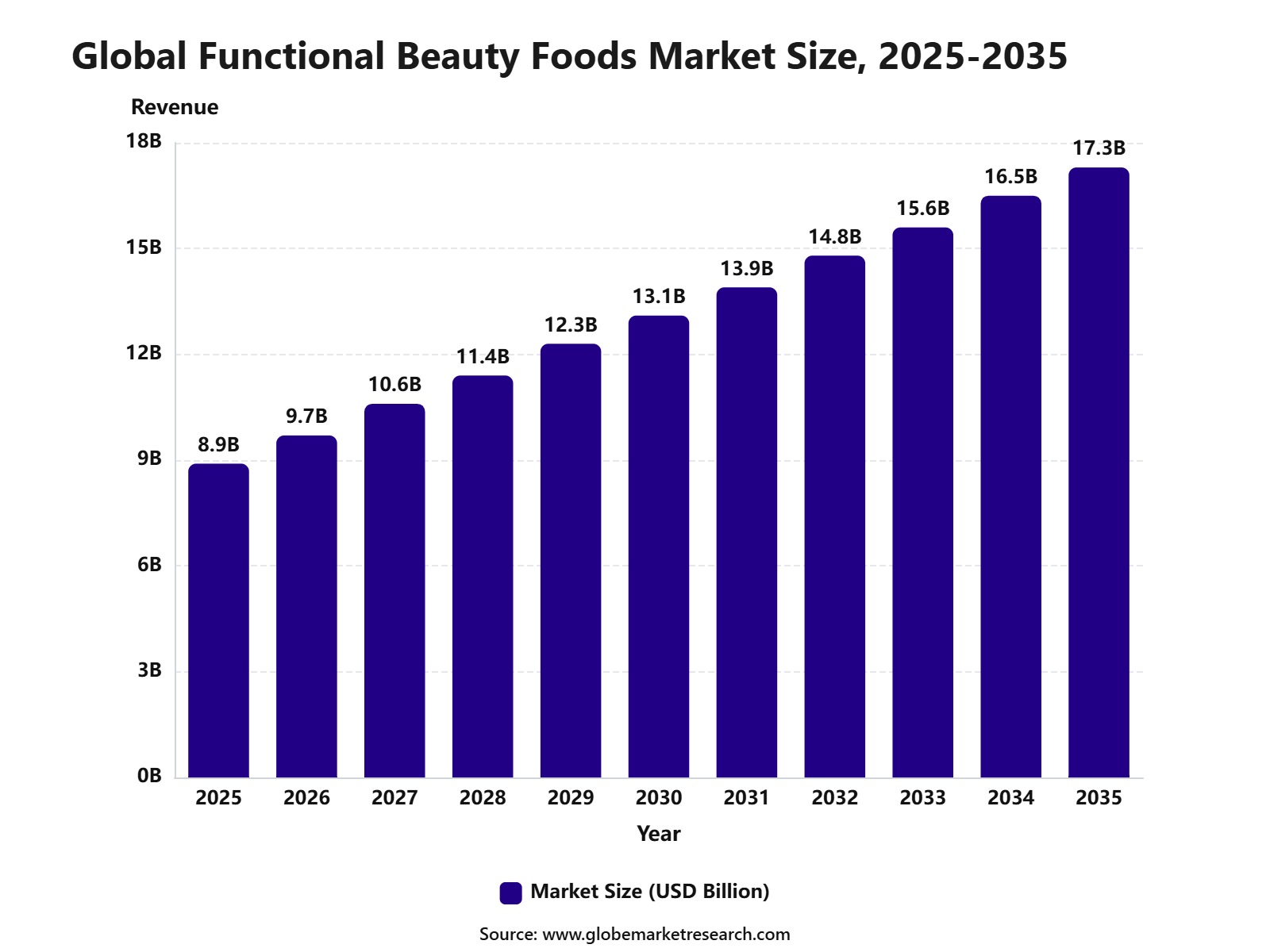 iThe graph shows projected market growth until 2035 based on CAGR analysis. Actual outcomes may vary depending on changing demand, competition, and economic factors.To gain greater insights - request a sample report PDF
Key Market Insights
Functional beverages led the product type segment with 43.3% share, supported by rising demand for convenient beauty-focused drinks that combine hydration, nutrition, and wellness benefits.
Vitamins accounted for 30.2% share by ingredient type, driven by their strong role in skin nourishment, antioxidant support, hair health, and daily beauty nutrition.
Skin health held 35.8% share by application, supported by growing consumer focus on glow, hydration, elasticity, anti-aging support, and preventive beauty care.
Online retail captured 37.6% share by distribution channel, driven by easy product discovery, subscription options, influencer-led promotion, and direct access to beauty wellness brands.
North America led the functional beauty foods market with 32.9% share, supported by strong wellness spending, high supplement adoption, growing beauty-from-within awareness, and expanding demand for functional nutrition products.
Top Funding and Investment
Ingredion announced an all-cash acquisition of Tate & Lyle with an implied enterprise value of about GBP 3.7 billion, or USD 5.0 billion. The deal strengthens food and beverage ingredient capabilities in mouthfeel, sweetening, fortification, texture, and nutrition-focused formulations.
IFF agreed to sell its Food Ingredients business to CVC for about USD 4.3 billion, equal to nearly 10x EBITDA. The business generated nearly USD 3.1 billion in 2025 sales and about USD 430.0 million EBITDA, with exposure to texturants, emulsifiers, plant-based solutions, and specialty food ingredients.
PepsiCo completed the acquisition of poppi for USD 1.95 billion, including USD 300.0 million in anticipated cash tax benefits, giving a net purchase price of USD 1.65 billion. poppi is a prebiotic soda brand positioned around functional beverage benefits and low-sugar consumption.
PepsiCo completed the acquisition of Siete Foods for USD 1.2 billion. Siete expands PepsiCo’s food portfolio with products focused on simple ingredients and positive choices, including grain-free snacks, tortillas, sauces, and related food products.
Flowers Foods agreed to acquire Simple Mills for USD 795.0 million in cash. Simple Mills offers better-for-you crackers, cookies, snack bars, and baking mixes, strengthening Flowers Foods’ position in clean-label and nutrition-focused snacking.
By Product Type
Functional beverages accounted for 43.3% share of the Functional Beauty Foods Market. This leading position is supported by rising consumer preference for convenient drinkable nutrition products that support skin health, hydration, glow, hair strength, and overall wellness.
The segment includes collagen drinks, vitamin-enriched beverages, antioxidant drinks, beauty shots, herbal infusions, probiotic drinks, and fortified waters. These products are preferred because they combine beauty benefits with easy daily consumption.
Demand for functional beverages is expected to remain strong as consumers look for simple beauty-from-within solutions. Product innovation in low-sugar, clean-label, plant-based, and ready-to-drink formats will continue to support this category.
By Ingredient Type
Vitamins held 30.2% share of the Functional Beauty Foods Market. This dominance can be attributed to their wide use in products designed for skin brightness, collagen support, hair strength, nail health, immunity, and healthy aging.
Vitamin C, vitamin E, biotin, vitamin A, vitamin D, and B-complex vitamins are commonly used in beauty food formulations. These ingredients are valued because they support antioxidant protection, skin repair, and overall nutritional balance.
The segment is expected to remain important as consumers increasingly connect beauty results with daily nutrition. Vitamins are widely accepted, easy to formulate, and suitable for beverages, gummies, powders, bars, capsules, and fortified snacks.
By Application
Skin health accounted for 35.8% share of the Functional Beauty Foods Market. This leading share is driven by strong demand for products that support hydration, elasticity, brightness, firmness, and protection from oxidative stress.
Functional beauty foods for skin health often include vitamins, collagen, antioxidants, hyaluronic acid, probiotics, minerals, and botanical extracts. These ingredients are used to support healthier-looking skin from within and complement external skincare routines.
The segment is expected to remain a major demand area as consumers focus on preventive beauty and long-term wellness. Rising interest in anti-aging, skin glow, and clean beauty nutrition will continue to support skin-focused product development.
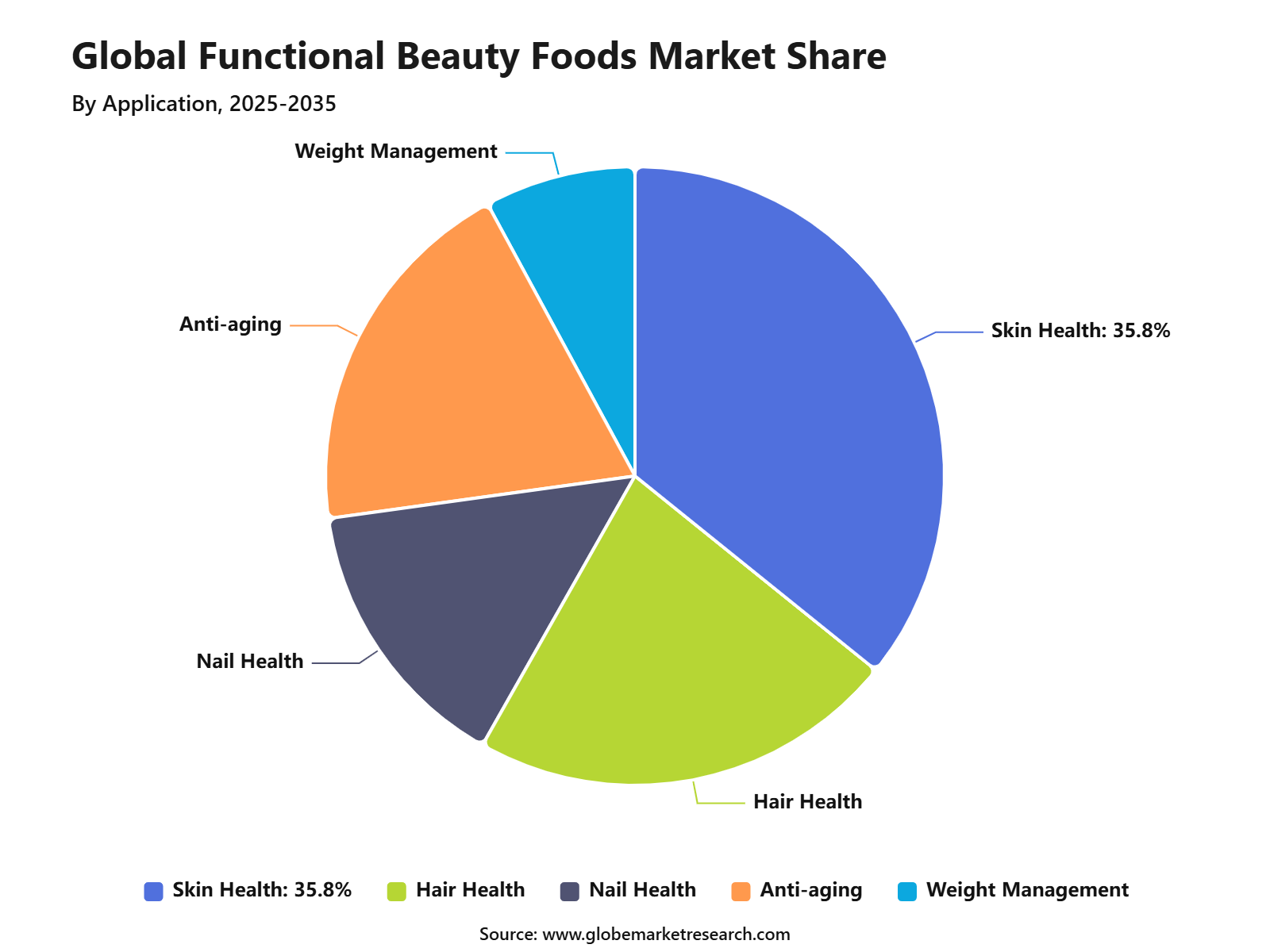 iThe graph shows projected market growth until 2035 based on CAGR analysis. Actual outcomes may vary depending on changing demand, competition, and economic factors.To gain greater insights - request a sample report PDF
By Distribution Channel
Online retail held 37.6% share of the Functional Beauty Foods Market. This leadership is supported by strong e-commerce adoption, direct-to-consumer beauty brands, subscription models, and wider access to premium wellness products.
Consumers prefer online channels because they offer product comparison, ingredient transparency, reviews, discounts, and convenient doorstep delivery. Social media and influencer marketing also play an important role in driving discovery of beauty food products.
The segment is expected to maintain strong growth as digital shopping becomes central to beauty and wellness purchasing. Online retail will continue to support niche brands, personalized nutrition products, and repeat purchases through subscription-based models.
By Region
North America accounted for 32.9% share of the Functional Beauty Foods Market, making it the leading regional market. Growth is supported by high wellness awareness, strong supplement usage, and rising demand for beauty-from-within products.
The United States and Canada are key contributors due to strong retail networks, advanced e-commerce platforms, and high consumer interest in collagen, vitamins, probiotics, antioxidants, and clean-label nutrition. Functional beverages, gummies, powders, and fortified snacks are gaining wider acceptance.
North America is expected to maintain a strong position as consumers continue to spend on preventive beauty, healthy aging, and convenient nutrition formats. Demand will be supported by product innovation, premium positioning, and strong digital marketing across beauty and wellness brands.
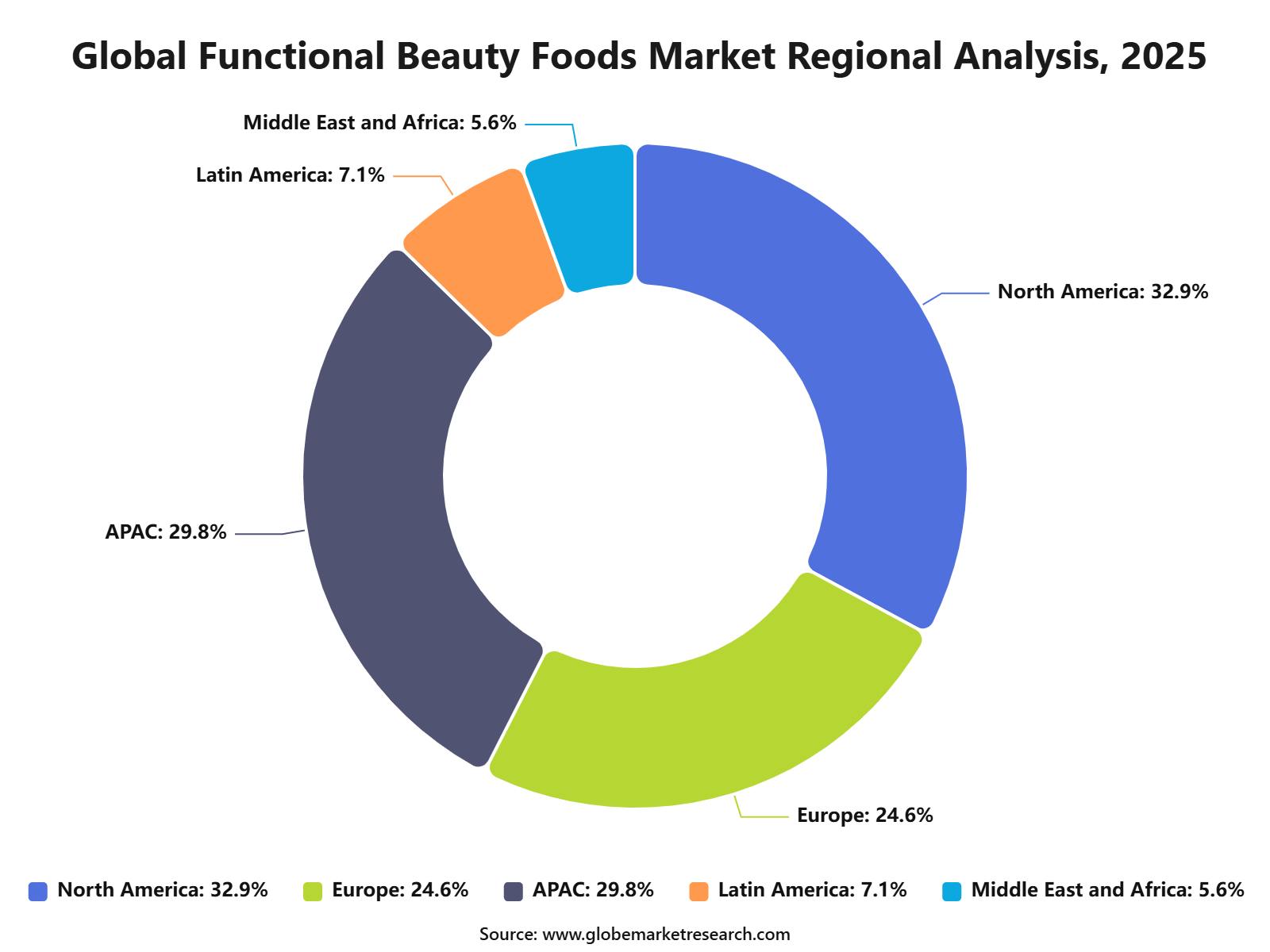 iThe graph shows projected market growth until 2035 based on CAGR analysis. Actual outcomes may vary depending on changing demand, competition, and economic factors.To gain greater insights - request a sample report PDF
Regional Impact Analysis
North America leads the Functional Beauty Foods Market with 32.9% share in 2025, supported by high functional food adoption, premium wellness spending, strong supplement culture, and demand for clean-label beauty nutrition. The U.S. remains the main regional driver due to strong retail and e-commerce demand for fortified snacks, beauty bars, and functional foods.
Europe remains important because of clean-label preferences, natural ingredient demand, and premium wellness food innovation. Asia Pacific is expected to build future demand through beauty-from-within culture, collagen food adoption, probiotic products, and expanding modern retail.
Impact Factor | Estimated CAGR Impact | Regional Relevance | Market Impact |
|---|---|---|---|
North America market leadership | +2.2% | North America, 32.9% share in 2025 | Leads global value demand. |
U.S. functional food adoption | +1.4% | U.S. | Drives regional demand. |
Canada clean-label wellness food demand | +0.9% | Canada | Supports premium products. |
Europe natural beauty food trend | +0.8% | Germany, UK, France, Italy | Builds clean-label growth. |
Asia Pacific beauty-from-within growth | +0.7% | Japan, South Korea, China, India | Supports future scale. |
Go-To-Market and Sales Economics
Functional beauty foods are best commercialized through supermarkets, pharmacies, wellness retailers, beauty-led DTC stores, cafés, gyms, and online subscription channels. The strongest products include collagen bars, probiotic yogurts, vitamin snacks, antioxidant granola, protein bites, and skin-hydration foods. U.S. retail e-commerce sales reached USD 326.7 billion in Q1 2026, supporting repeat online food purchases.
Sales economics are supported when beauty claims are connected with daily eating occasions such as breakfast, snacking, post-workout use, and evening wellness routines. Nestlé reported 3.5% organic growth in Q1 2026, with Food & Snacks showing stronger real internal growth led by confectionery. This confirms demand for branded, value-added food formats.
The most effective go-to-market model combines nutrition science, clean labeling, taste, and convenience. Danone reported Q1 2026 sales of EUR 6.708 billion, up 2.7% on a like-for-like basis, with growth led by volume and mix. Functional dairy, high-protein foods, kefir, and gut-health formats remain useful entry points for beauty-linked food innovation.
Risk Factors & Market Barriers
The main barrier is claim substantiation because functional beauty foods often promise glow, hydration, anti-ageing, hair support, or gut-skin benefits. The FTC states that health-related product claims must be truthful, not misleading, and supported by science. This creates compliance pressure for brands using influencer marketing, testimonials, or strong before-after claims.
Sugar, calories, and ultra-processed positioning can restrict adoption, especially when beauty foods are sold as gummies, bars, cereals, or sweet snacks. FDA’s 2026 added-sugars guidance states that added sugar should remain below 10% of daily calories, equal to 50 grams per day on a 2,000-calorie diet.
Regulatory differences across markets can slow global expansion. In the U.S., FDA notes that structure or function claims can describe how nutrients support normal body function, but they must not mislead consumers. In Europe, permitted and non-authorised nutrition and health claims are listed in the EU Register, making label localization essential.
Revenue Potential Analysis
Revenue Landscape Across
Revenue is spread across collagen-enriched foods, probiotic dairy, beauty cereals, functional chocolates, vitamin snacks, antioxidant fruit products, high-protein bakery, and nut-based bars. Clinical support is strongest where active ingredients are used at meaningful levels. A 2026 review covering 16 meta-analyses and 113 randomized trials found measurable collagen benefits across skin and musculoskeletal outcomes.
Large food and wellbeing companies are creating a stronger revenue base for beauty nutrition. Unilever’s Beauty & Wellbeing business includes health and wellbeing products, including vitamins, minerals, and supplements, and recorded EUR 12.8 billion turnover in 2025. In Q1 2026, Beauty & Wellbeing sales grew 3.6%, with volume growth of 1.9%.
Functional beauty food revenue is also supported by broader health-focused nutrition demand. Danone’s Q1 2026 sales grew through positive volume and price contribution, while Nestlé’s Q1 2026 performance showed stronger growth momentum across categories. This supports opportunities for beauty snacks, skin-health dairy, collagen foods, and gut-skin products in premium retail channels.
Financial Impact
Functional beauty foods can improve financial performance through premium pricing, repeat consumption, and stronger basket value than basic snacks. Products that combine beauty, protein, gut health, and convenience can command higher shelf visibility. E-commerce also supports subscriptions, bundles, and consumer education, with online retail representing a large sales route in Q1 2026.
Margin pressure remains linked to collagen peptides, probiotics, vitamins, flavors, clean-label ingredients, testing, and packaging. Brands must also reformulate around sugar and calorie limits to protect long-term demand. The financial impact improves when a product offers clear dosage, strong taste, verified claims, and lower return risk from disappointed consumers.
The strongest financial returns are expected from brands that position functional beauty foods as daily nutrition rather than short-term beauty fixes. Evidence-backed collagen, fermented dairy, antioxidant fruits, and high-protein snacks can support repeat purchase. Companies with established retail access, food safety systems, and compliance teams are better placed to scale profitably.
Drivers Impact Analysis
The Functional Beauty Foods Market is driven by rising demand for beauty-from-within nutrition, skin health foods, collagen-enriched snacks, antioxidant-rich products, probiotic foods, and fortified wellness foods. Consumers are increasingly choosing daily food formats that support beauty, hydration, anti-aging, hair health, and overall wellness.
North America leads the market due to strong functional food adoption, premium wellness spending, clean-label preferences, and high interest in skin, hair, and healthy aging products. The U.S. remains the key regional contributor because of strong demand across fortified snacks, protein-enriched foods, beauty bars, functional cereals, and wellness-focused retail channels.
Impact Factor | Estimated CAGR Impact | Regional Relevance | Market Impact |
|---|---|---|---|
Rising demand for beauty-from-within nutrition | +1.8% | North America, Europe, Asia Pacific | Drives core growth. |
Growth in fortified and functional foods | +1.5% | U.S., Canada, Europe, Japan | Supports category expansion. |
Increasing focus on skin health and aging | +1.3% | Premium wellness markets | Builds daily-use demand. |
Clean-label and natural ingredient preference | +1.1% | North America and Europe | Improves consumer trust. |
Expansion of probiotic and antioxidant foods | +0.9% | Global health-conscious consumers | Adds functional value. |
Restraints Impact Analysis
The market faces restraints from high product pricing, limited consumer awareness, and difficulty proving visible beauty benefits through food formats. Functional beauty foods need clear ingredient positioning, credible claims, and strong taste to encourage repeat purchase.
Another restraint is competition from beauty supplements, gummies, drinks, powders, and traditional skin care products. Many consumers still prefer capsules or topical products because they are easier to associate with specific beauty outcomes.
Impact Factor | Estimated CAGR Impact | Regional Relevance | Market Impact |
|---|---|---|---|
High premium product pricing | -0.9% | North America, Europe, urban Asia | Limits mass adoption. |
Limited awareness of beauty food benefits | -0.8% | Emerging consumer markets | Slows category education. |
Competition from supplements and gummies | -0.7% | Global beauty nutrition markets | Pressures format preference. |
Strict beauty and health claim rules | -0.6% | U.S., Canada, Europe, Japan | Restricts marketing flexibility. |
Taste and texture challenges | -0.5% | Fortified snacks and bars | Affects repeat purchase. |
Opportunities Impact Analysis
Opportunities are strong in collagen-enriched foods, antioxidant snacks, probiotic beauty foods, vitamin-fortified cereals, protein beauty bars, functional yogurts, and beauty-focused confectionery. These formats can support skin glow, hydration, hair strength, nail health, and healthy aging positioning.
Higher-value opportunities are also emerging in clean-label functional foods, plant-based beauty nutrition, personalized wellness foods, and e-commerce-led beauty food subscriptions. Brands that combine taste, convenience, and credible beauty ingredients can build stronger consumer loyalty.
Impact Factor | Estimated CAGR Impact | Regional Relevance | Market Impact |
|---|---|---|---|
Collagen-enriched food products | +1.7% | North America, Europe, Asia Pacific | Builds premium demand. |
Probiotic beauty food expansion | +1.4% | U.S., Canada, Japan, South Korea | Supports gut-skin positioning. |
Antioxidant-rich snacks and bars | +1.2% | Health-conscious markets | Adds daily-use value. |
Plant-based beauty foods | +1.0% | North America, Europe, urban Asia | Supports clean-label growth. |
Personalized functional food programs | +0.8% | Digital wellness channels | Creates recurring demand. |
Challenges Impact Analysis
The main challenge is delivering beauty benefits through food while maintaining taste, texture, shelf life, and nutritional balance. Ingredients such as collagen, vitamins, minerals, probiotics, and antioxidants require careful formulation to remain stable and appealing.
Another challenge is building consumer trust. Functional beauty foods must communicate benefits clearly without making exaggerated claims, especially in markets with strict food labeling and supplement regulations.
Impact Factor | Estimated CAGR Impact | Regional Relevance | Market Impact |
|---|---|---|---|
Maintaining active ingredient stability | -0.8% | Functional food manufacturers | Affects product quality. |
Proving visible beauty outcomes | -0.7% | Global beauty consumers | Impacts repeat purchase. |
Balancing taste with functionality | -0.6% | Snacks, bars, cereals, yogurts | Influences consumer acceptance. |
Managing clean-label formulation limits | -0.5% | North America and Europe | Raises development complexity. |
Avoiding misleading beauty claims | -0.4% | Regulated food markets | Protects brand credibility. |
Segment Covered in the Report
By Product Type
Functional Beverages
Nutraceuticals
Functional Snacks
Dietary Supplements
By Ingredient Type
Vitamins
Minerals
Herbs
Amino Acids
Probiotics
By Application
Skin Health
Hair Health
Nail Health
Anti-aging
Weight Management
By Distribution Channel
Online Retail
Supermarkets
Pharmacies
Specialty Stores
By Region
North America
Europe
Asia Pacific
Latin America
Middle East and Africa
Market Trend Analysis
The market trend is moving toward collagen foods, probiotic beauty snacks, antioxidant-rich products, fortified breakfast foods, protein beauty bars, and clean-label wellness snacks. Skin health remains a major functional area because consumers associate beauty foods with glow, hydration, elasticity, and anti-aging support.
Convenient formats are also gaining traction because consumers prefer beauty nutrition that fits into daily eating routines. Bars, yogurts, cereals, snacks, gummies-like food formats, and ready-to-eat products are becoming more visible across supermarkets, specialty stores, and online channels.
Impact Factor | Estimated CAGR Impact | Regional Relevance | Market Impact |
|---|---|---|---|
Collagen-based functional foods grow | +1.6% | North America, Europe, Asia Pacific | Leads premium innovation. |
Probiotic beauty foods gain traction | +1.3% | U.S., Canada, Japan, South Korea | Supports gut-skin health. |
Antioxidant snacks expand | +1.1% | Global wellness markets | Adds functional appeal. |
Protein beauty bars increase | +0.9% | Fitness and wellness consumers | Builds cross-category demand. |
Clean-label fortified foods rise | +0.8% | North America and Europe | Improves trust and adoption. |
Investor Type Impact Matrix
Investors should focus on functional beauty food brands with strong ingredient credibility, clean-label positioning, attractive taste, stable formulations, and access to supermarkets, specialty stores, and online channels. Repeat purchase, product education, and clear beauty positioning are key success factors.
Strategic investors can also target collagen ingredient suppliers, probiotic food companies, fortified snack producers, clean-label formulation firms, and personalized wellness platforms. Companies that combine food enjoyment with credible beauty benefits are better positioned for long-term growth.
Investor Type | Estimated CAGR Impact | Regional Relevance | Market Impact |
|---|---|---|---|
Functional Beauty Food Brands | +1.5% | Global | Expands beauty food supply. |
Collagen and Active Ingredient Suppliers | +1.2% | North America, Europe, Asia Pacific | Supports premium formulations. |
Probiotic and Fortified Food Producers | +1.0% | North America, Europe, Japan | Builds functional demand. |
Clean-label Snack Manufacturers | +0.8% | North America and Europe | Improves product differentiation. |
Strategic Beauty and Wellness Investors | +0.7% | Global beauty nutrition markets | Funds product expansion. |
Recent Developments
May 2026: Herbalife reported Q1 2026 net sales of USD 1.3 billion, up 7.8% year over year and 5.4% in constant currency, supporting its nutrition and skin-support portfolio momentum.
April 2026: Kraft Mac & Cheese introduced Restaurant Edition in three varieties. Each serving provides 10 g protein, strengthening functional comfort-food positioning through premium cheese, distinctive pasta shapes and restaurant-inspired recipes.
March 2026: Vital Proteins, part of Nestlé Health Science, unveiled Collagen Sparkling Water at Expo West 2026. The 12-ounce can was priced at USD 2.50, with a 12-pack at USD 17.99.
February 2026: General Mills said fiscal 2026 new-product net sales were expected to rise about 25%, driven by innovation focused on better-for-you benefits such as protein and fiber.
Competitive Landscape
The market is characterized by intense competition among established players and emerging companies. Strategic partnerships, mergers and acquisitions, and product innovation are key strategies employed by market participants.
Key Market Players
Nestlé S.A.
Herbalife Nutrition Ltd.
Amway Corporation
DuPont
Kraft Heinz Company
Unilever PLC
PepsiCo, Inc.
Danone S.A.
General Mills, Inc.
BASF SE
Glanbia plc
Shiseido Company Limited
Amorepacific Corporation
FANCL Corporation
Meiji Holdings Co., Ltd.
Other Key Players
Research Methodology
This market study is prepared using a combination of primary and secondary research. Primary research includes discussions with manufacturers, suppliers, distributors, consultants, industry experts, and end users. Secondary research covers company reports, government databases, trade associations, technical publications, regulatory sources, and trusted industry documents. The collected information is used to assess market demand, pricing trends, technology adoption, competitive activity, and regional performance.
AI language models are not used as primary data sources, and publicly available AI-generated content is not treated as market evidence. Computational tools may be used to support data processing, translation, data classification, and pattern identification. However, every published assessment is supported by verified sources, human review, and primary market discussions.
Market estimates are developed through top-down and bottom-up approaches and validated using data triangulation. Revenue, production, shipment, pricing, and application-level data are compared across multiple sources. Forecasts consider economic conditions, regulatory changes, investment activity, innovation, supply chain developments, and industry risks. All findings are reviewed through source verification and internal quality checks before publication.
Part I
Source Management & Input Data Standards
Who provides data, how sources are qualified, and what types of evidence are admissible.
Part II
Research Scope & Market Coverage
How we define the markets we assess and the parameters that govern each product.
Part III
Data Collection, Verification & Submission
The mechanics of gathering, cross-checking, and hierarchically ranking evidence.
Part IV
Assessment Determination & Quality Controls
How raw data becomes a published assessment — normalisation, expert judgement, and outlier exclusion.
Part V
Publication, Corrections & Revision
Our publication schedule, corrections policy, and methodology review cycle.
Part VI
Independence, Ethics & Complaints
Conflict-of-interest policies, editorial independence, and how clients raise concerns.
Google · Preferred Sources
Don't miss the latest market research insights and industry updates on Google.
Add Globe Market Research as a preferred source in the Google app to see our reports, analysis, and market stories in your news suggestions.
Meet the Team
This report was prepared by our expert analysts with deep industry knowledge and research experience.
Pratiksha K. is a Senior Research Analyst with more than five years of experience in market research, industry analysis, competitive intelligence, and business strategy. She has contributed to detailed market reports, customized research studies, company profiling, market sizing, trend analysis, and strategic consulting projects for clients across different regions. Her industry expertise covers Chemical and Material, Consumer Goods, Food & Beverages and Energy & Power. She closely evaluates changing customer requirements, technology developments, regulatory conditions, supply chain structures, investment activity, and competitive strategies to provide clear and practical market insights.
Sayali brings more than 7 years of experience to Globe Market Research, supporting the accuracy, clarity, and relevance of research content across multiple industries. She reviews market data, segment analysis, competitive insights, and industry trends to ensure each report meets strong quality standards and provides practical value to business decision-makers. Her expertise spans healthcare, information technology, consumer goods, and diverse cross-industry domains. With a strong focus on data reliability, structured analysis, and clear presentation, Sayali helps ensure that each research output delivers well-reviewed insights for clients, investors, consultants, and industry stakeholders.
Frequently Asked Questions
Related Reports
More in Food and Beverages
Food Preservatives Market to Hit USD 8.0 Billion by 2035
Food Preservatives Market Size, Share, Analysis By Source (Natural, Synthetic), By Function (Antimicrobial, Antioxidant, Other Functions), By Application (Meat, Poultry and Seafood, Bakery, Dairy, Beverages, Snacks, Other Applications), By Regional Insights, Business plan and Project Report, Investment Opportunities, Profitability, Industry Trends, Leading Companies and Growth Forecasts by 2026-2035
Mezcal Market to Hit USD 6.1 Billion by 2035 | CAGR of 9.1%
Mezcal Market Size, Share, Analysis By Product (Joven, Reposado, Añejo, Others), By Formulation: (100% Agave, Blended Mezcal), By Distribution Channel (On-Trade, Off-Trade, Online Retail, Specialty Stores, Others), By Price Range (Premium / Luxury, Standard, Economy), By Regional Insights, Business plan and Project Report, Investment Opportunities, Profitability, Industry Trends, Leading Companies and Growth Forecasts by 2026-2035
Food Flavors and Enhancers Market to Hit USD 18.40 Bn by 2035 | CAGR of 6.1%
Food Flavors and Enhancers Market Size, Share, Analysis By Product Type (Glutamates, Yeast Extracts, Acidulants, Hydrolyzed Vegetable Protein, Others), By Source (Plant-Based, Synthetic, Microbial, Animal-Based, Others), By Application (Processed Foods, Soups & Sauces, Snacks, Meat Products, Beverages, Others), By Regional Insights, Business plan and Project Report, Investment Opportunities, Profitability, Industry Trends, Leading Companies and Growth Forecasts by 2026-2035
Ready-to-Cook Food Market to Hit USD 10.3 Bn by 2035 | CAGR of 8.1%
Ready-to-Cook Food Market Size, Share, Analysis By Product Type (Frozen Meals, Ready-to-Cook Mixes, Meal Kits, Instant Food Products, Others), By Distribution Channel (Supermarkets & Hypermarkets, Convenience Stores, Online Retail, Specialty Stores, Others), By End User (Household / Residential, Foodservice, Institutional, Others), By Cuisine Type (Western Cuisine, Asian Cuisine, Italian Cuisine, Indian Cuisine, Others), By Regional Insights, Business plan and Project Report, Investment Opportunities, Profitability, Industry Trends, Leading Companies and Growth Forecasts by 2026-2035