

Revenue, 2025
$ 5.5 Bn
Forecast, 2035
$ 12.9 Bn
CAGR, 2025-2035
8.9%
Report Coverage
Global
Market Size and Forecast
The Global Collagen Supplements Market was worth USD 5.5 billion in 2025 and is expected to reach USD 12.9 billion by 2035, growing at a CAGR of 8.9% from 2025 to 2035. Based on this growth rate, the market is estimated to reach around USD 6.2 billion in 2026. Asia Pacific held the largest regional share of 36.3% in 2025, supported by rising beauty-from-within demand, growing use of anti-aging supplements, strong wellness awareness, and expanding online supplement sales.
The Collagen Supplements Market includes collagen-based products formulated to support skin elasticity, hair strength, nail health, joint comfort, and overall wellness. These products are available in powders, capsules, tablets, gummies, drinks, and liquid shots, using sources such as bovine, marine, porcine, and poultry collagen. The market is closely linked with nutraceuticals, functional foods, beauty supplements, sports nutrition, and preventive healthcare.
Key Parameter | Report Details |
|---|---|
Market Revenue, 2025 | USD 5.5 Billion |
Projected Revenue, 2035 | USD 12.9 Billion |
CAGR (2025-2035) | 8.9% |
Largest Region | Asia Pacific (36.3% Share) |
Market Concentration | Medium |
Base Year | 2025 |
Forecast Period | 2025-2035 |
The market outlook remains strong as consumers increasingly prefer convenient nutrition products that support beauty and healthy aging. Growth can be attributed to rising demand for collagen peptides, clean-label formulations, marine collagen products, and functional beauty beverages. The expansion of e-commerce, personalized nutrition, and premium wellness branding is expected to support long-term market demand.
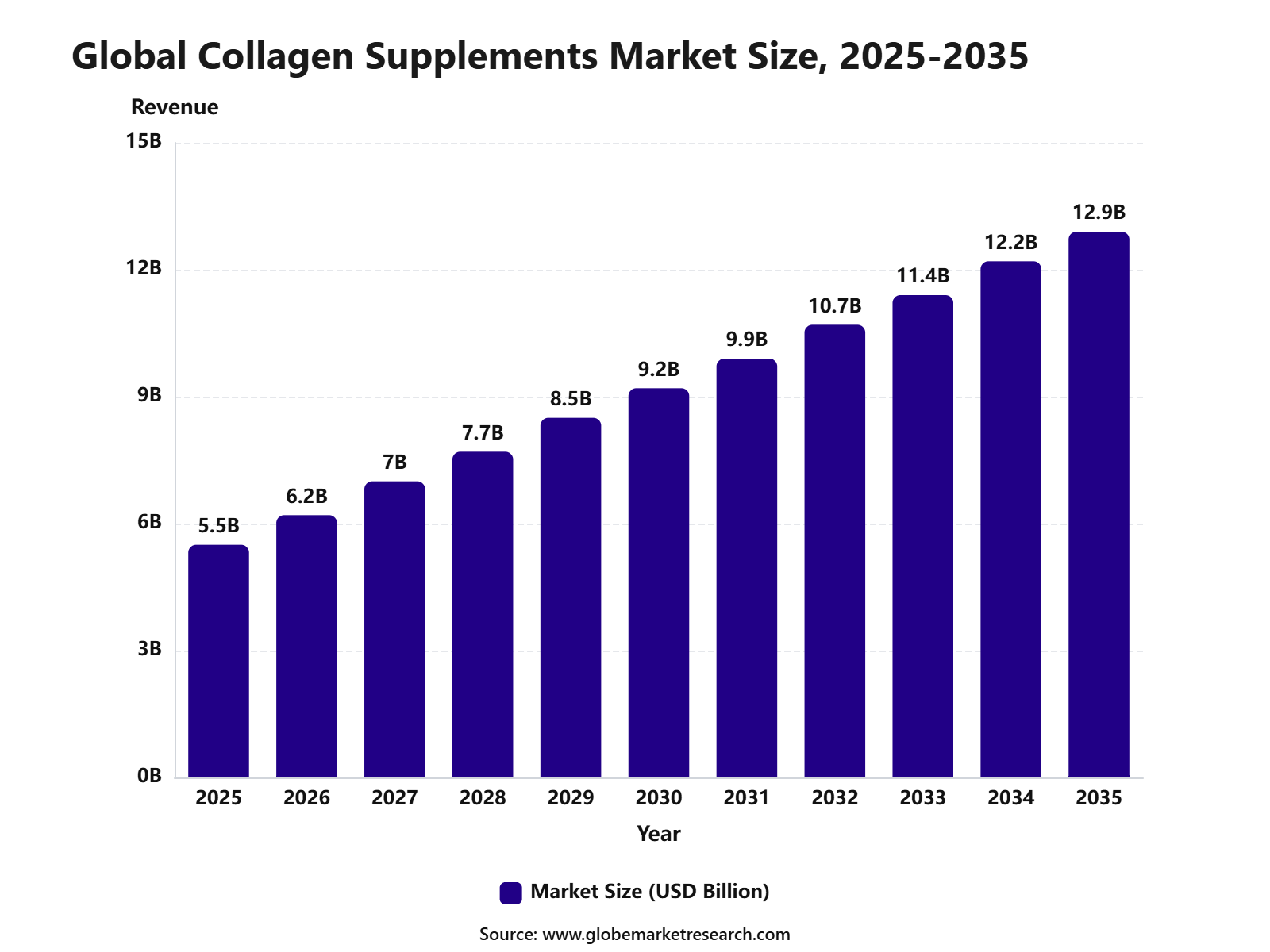 iThe graph shows projected market growth until 2035 based on CAGR analysis. Actual outcomes may vary depending on changing demand, competition, and economic factors.To gain greater insights - request a sample report PDF
Key Market Insights
Hydrolyzed collagen led the product type segment with 64.7% share, supported by its easy absorption, strong use in beauty supplements, and growing demand for skin, joint, bone, and hair health support.
Powder form accounted for 59.4% share, driven by flexible dosage, easy mixing with beverages and foods, longer shelf life, and strong adoption in daily wellness routines.
Bovine collagen held 43.9% share by source, supported by wide availability, cost efficiency, high collagen yield, and broad use in supplements targeting skin elasticity, joint comfort, and overall wellness.
Asia Pacific held 36.3% share of the collagen supplements market, supported by rising beauty-from-within trends, strong skincare awareness, growing supplement consumption, and increasing demand from China, Japan, South Korea, and India.
Top Funding and Investment
In May 2025, Darling Ingredients and Tessenderlo Group agreed to combine Rousselot and PB Leiner into Nextida. The transaction was structured as a non-cash strategic combination, with no initial cash investment. The new company is expected to generate about USD 1.5 billion in annual revenue, with 200,000 metric tons of gelatin and collagen capacity across 23 facilities, and closing is expected in 2026.
In August 2025, Geltor secured fresh equity funding led by Starlight Ventures and iSelect Fund, bringing its total funding to about USD 137.0 million. The company reported around 75% revenue growth during the period and is expanding animal-free collagen polypeptides for topical and ingestible nutrition products.
Supply6 raised Rs. 48 crore in July 2026 in a round led by Unilever Ventures, with participation from Zeropearl VC. The funds are being used for product innovation, clinical research, supply chain, digital experience, and expansion across D2C, marketplaces, and quick commerce. The company reported Rs. 75 crore ARR, with expected Rs. 100 crore ARR within 3 to 4 months.
Nitta Gelatin India’s collagen peptide expansion project involved Rs. 460.0 million investment and was expected to commission in July 2025. The project increases collagen peptide capacity from 600 MT/year to 1,150 MT/year, supporting dietary supplements, healthcare products, joint health, and beauty-from-within applications.
By Product Type
Hydrolyzed collagen accounted for 64.7% share of the Collagen Supplements Market. This leading position is supported by its high absorption, easy digestibility, and wide use in products focused on skin elasticity, joint comfort, bone health, hair strength, and nail support.
The segment is preferred because hydrolyzed collagen is broken down into smaller peptides, making it suitable for powders, capsules, tablets, gummies, and ready-to-drink formats. It is widely used in beauty supplements, sports nutrition, healthy aging products, and wellness formulations.
Demand is expected to remain strong as consumers continue to prefer collagen products that are easy to mix, convenient to consume, and linked with visible beauty and mobility benefits. Product innovation in flavored powders, sachets, and combination formulas will further support this segment.
By Form
Powder form held 59.4% share of the Collagen Supplements Market. Its dominance can be attributed to easy blending, flexible dosage, longer shelf life, and strong suitability for daily nutrition routines.
Collagen powder is commonly mixed with water, coffee, smoothies, protein shakes, juices, and functional beverages. This form is widely preferred by consumers who want higher collagen intake per serving compared with capsules or gummies.
The segment is expected to maintain a strong position as brands launch flavored, unflavored, single-serve, and multi-ingredient powder products. Demand will be supported by beauty-from-within trends, active lifestyle consumers, and growing interest in convenient wellness formats.
By Source
Bovine collagen accounted for 43.9% share of the Collagen Supplements Market. This leadership is driven by its broad availability, cost efficiency, high collagen yield, and strong use in skin, joint, bone, and muscle support products.
Bovine collagen is mainly sourced from cattle hides and bones and is rich in type I and type III collagen. These collagen types are commonly associated with skin structure, connective tissue support, and overall body repair functions.
Demand for bovine collagen is expected to remain steady due to its established supply chain and wide product use. However, manufacturers are also expanding marine, porcine, and alternative collagen options to meet different dietary, religious, and clean-label preferences.
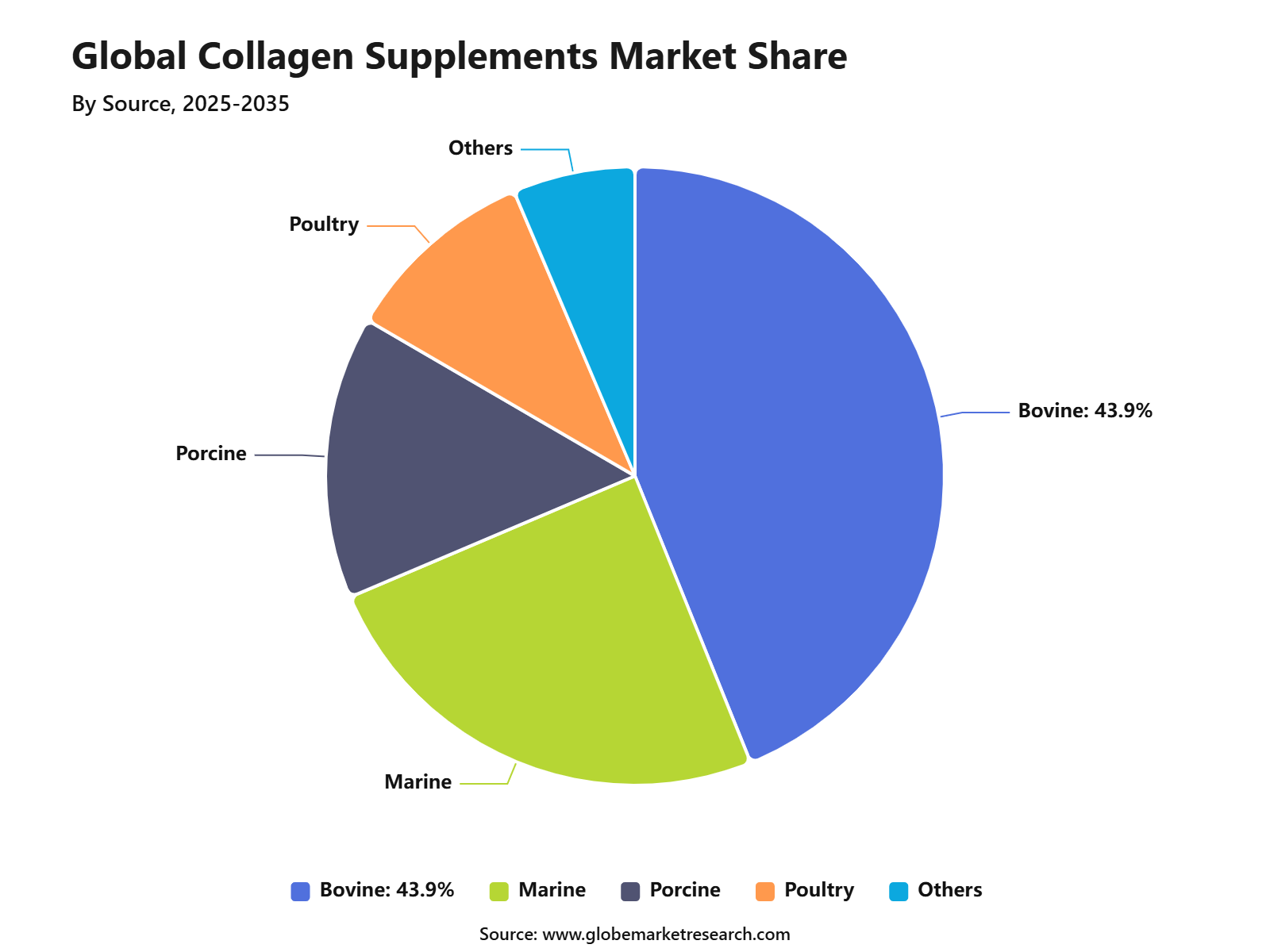 iThe graph shows projected market growth until 2035 based on CAGR analysis. Actual outcomes may vary depending on changing demand, competition, and economic factors.To gain greater insights - request a sample report PDF
By Region
Asia Pacific accounted for 36.3% share of the Collagen Supplements Market, making it the leading regional market. Growth is supported by strong beauty awareness, rising disposable income, aging populations, and increasing demand for skin, hair, nail, and joint health supplements.
Japan, China, South Korea, India, Australia, and Southeast Asian countries are key demand centers. The region benefits from strong skin care culture, functional food adoption, e-commerce growth, and high acceptance of collagen-based powders, drinks, capsules, and beauty supplements.
Asia Pacific is expected to maintain its leading position as consumers continue to spend on preventive wellness and beauty-from-within products. Demand will be further supported by product innovation, local flavor formats, and wider retail and online distribution.
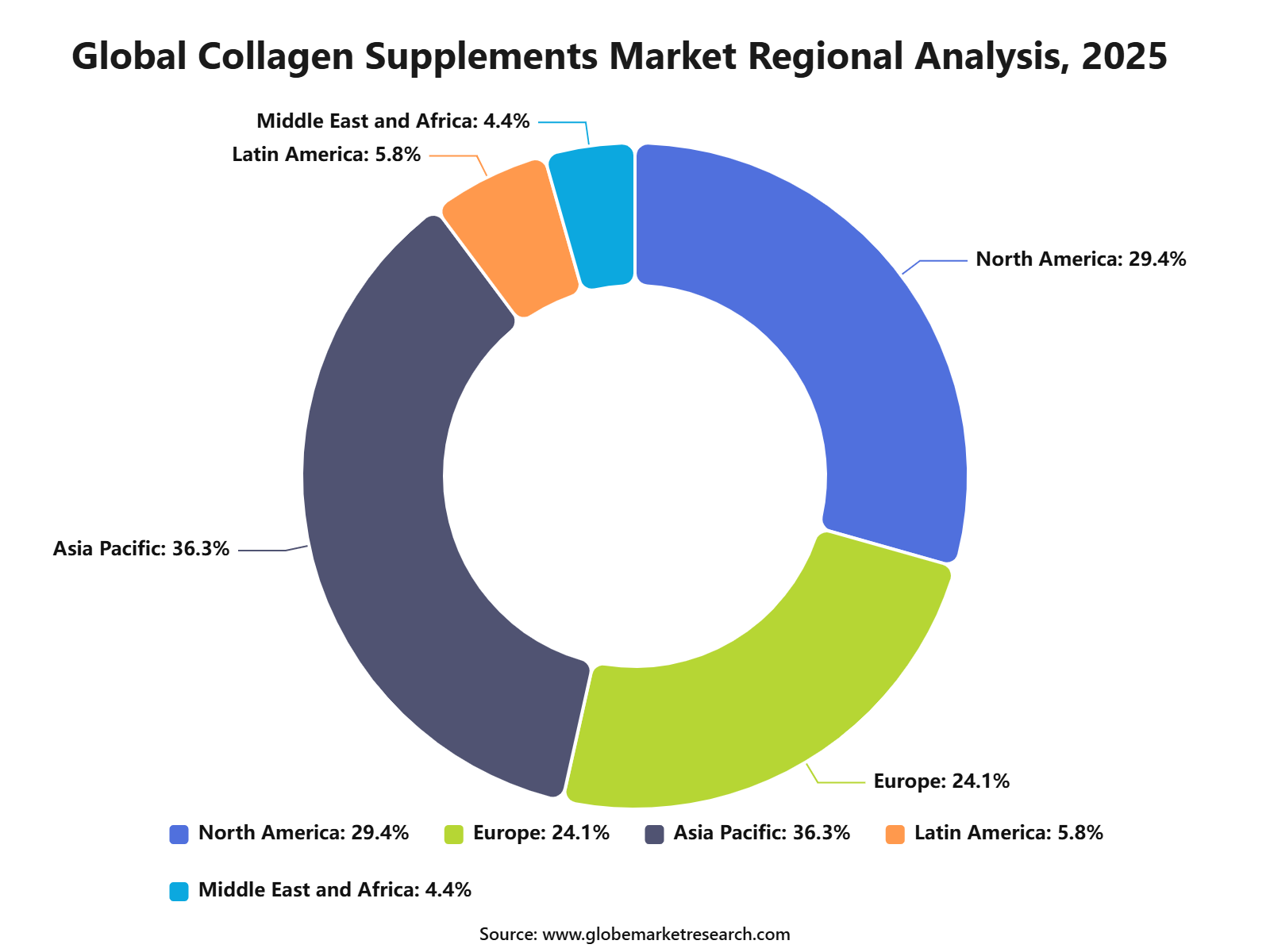 iThe graph shows projected market growth until 2035 based on CAGR analysis. Actual outcomes may vary depending on changing demand, competition, and economic factors.To gain greater insights - request a sample report PDF
Regional Impact Analysis
Asia Pacific leads the Collagen Supplements Market with 36.3% share in 2025, supported by beauty-from-within demand, aging consumers, skin care routines, and strong acceptance of functional supplements. Japan, South Korea, China, India, and Southeast Asia remain key regional contributors.
North America remains important because of sports nutrition, active aging, clean-label supplements, and strong online sales. Europe supports premium demand through natural ingredients, traceability, regulatory quality standards, and consumer focus on healthy aging.
Impact Factor | Estimated CAGR Impact | Regional Relevance | Market Impact |
|---|---|---|---|
Asia Pacific market leadership | +2.8% | Asia Pacific, 36.3% share in 2025 | Leads global demand. |
Japan and South Korea beauty nutrition demand | +1.7% | Japan, South Korea | Supports premium adoption. |
China and India wellness spending | +1.3% | China, India | Builds future volume. |
North America sports and aging demand | +1.0% | U.S. and Canada | Adds value growth. |
Europe clean-label collagen trend | +0.8% | Germany, France, UK, Italy | Supports premium positioning. |
Go-To-Market and Sales Economics
Collagen supplements are being sold through pharmacies, beauty retail, sports nutrition stores, dermatology-linked channels, supermarkets, Amazon, DTC subscriptions, and wellness clinics. Online distribution remains important because U.S. retail e-commerce sales reached USD 326.7 billion in Q1 2026 and accounted for 16.8% of total retail sales. This supports repeat collagen powder, capsule, gummy, and sachet purchases.
The sales model is moving from generic protein positioning to beauty, joint health, active aging, and recovery-led use cases. A 2026 umbrella review covering 16 meta-analyses, 113 randomized controlled trials, and around 8,000 participants found notable benefits across skin and musculoskeletal outcomes, although strength of evidence varied by endpoint.
Retail economics are strengthened when collagen is sold as a daily-use product with premium flavors, clean-label claims, vitamin C pairing, and subscription refills. THG reported 7.0% Q1 2026 revenue growth, while THG Nutrition grew 8.8% and expanded into higher-margin categories, including collagen, creatine, hydration, and activewear.
Risk Factors & Market Barriers
Regulatory risk remains high because collagen supplements must avoid disease-treatment claims and must be supported by competent scientific evidence. The FTC states that health claims for supplements can be deceptive when scientific limits are not clearly communicated. This creates risk for brands using aggressive anti-aging, arthritis, hair-loss, or skin-repair promises.
Manufacturing quality is another major barrier, especially for powders and blended formulas. In May 2026, the FDA issued a warning letter to Hearthy Foods after identifying serious CGMP violations involving dietary supplements, including Collagen and Collagen+ With Hyaluronic Acid products. This shows why testing, batch records, specifications, and supplier controls are essential.
Evidence quality can also affect adoption. A 2025 meta-analysis of 23 randomized controlled trials with 1,474 participants found improvements in skin hydration, elasticity, and wrinkles overall, but reported no effect in studies without pharmaceutical-company funding. This can increase buyer caution and force brands to invest in stronger independent validation.
Revenue Potential Analysis
Revenue Landscape Across
Revenue is spread across beauty-from-within products, joint health supplements, sports nutrition, healthy aging, hair and nail support, functional beverages, and women’s wellness packs. Collagen is widely positioned because it is the body’s most abundant protein and accounts for about 30% of total body protein, supporting skin, tendons, ligaments, muscles, and bones.
The U.S. remains a strong revenue base due to large-format retail and online repeat buying. Vital Proteins, owned by Nestlé Health Science, built distribution across 35,000 retail doors in North America and Europe with 150 SKUs, including collagen supplements, beverages, and food products. This shows the importance of broad retail access.
Beauty and wellbeing companies are also expanding into supplements. Unilever’s Beauty & Wellbeing business includes health and wellbeing products, such as vitamins, minerals, and supplements, and recorded EUR 12.8 billion turnover in 2025. Its Q1 2026 Beauty & Wellbeing sales grew 3.6%, showing continued demand for wellness-linked beauty portfolios.
Financial Impact
Collagen supplements can create attractive financial returns because daily consumption improves repeat purchase, basket size, and subscription retention. Financial value is strongest when products combine hydrolyzed collagen peptides with vitamin C, hyaluronic acid, or functional flavors. The 2026 review found stronger benefits with consistent longer-term use, supporting monthly refill and premium pack economics.
Margin pressure remains tied to collagen source, flavor systems, packaging, influencer costs, retailer allowances, and compliance testing. Brands using bovine, marine, or chicken collagen must manage sourcing transparency and allergen expectations. FDA oversight also adds cost because dietary supplements are regulated under a different framework than conventional foods and drugs.
The strongest financial impact is expected from brands that prove benefits, maintain quality, and sell through both retail and DTC channels. E-commerce growth gives collagen brands a low-friction route for education, reviews, bundles, and subscriptions, while store placement supports trust and discovery. This blended model improves customer acquisition and lifetime value.
Drivers Impact Analysis
The Collagen Supplements Market is driven by rising demand for skin health, anti-aging nutrition, joint support, bone health, hair care, nail strengthening, and active lifestyle wellness. Consumers are using collagen supplements as part of daily beauty and preventive health routines.
Asia Pacific leads the market due to strong beauty-from-within culture, aging population, supplement acceptance, and demand for skin elasticity and hydration products. Japan, South Korea, China, India, and Southeast Asia remain major contributors because of high beauty awareness and growing wellness spending.
Impact Factor | Estimated CAGR Impact | Regional Relevance | Market Impact |
|---|---|---|---|
Rising demand for skin health supplements | +2.4% | Asia Pacific, Europe, North America | Drives core growth. |
Growth in anti-aging and beauty nutrition | +2.0% | Japan, South Korea, China, U.S. | Supports premium demand. |
Increasing joint and bone health awareness | +1.7% | Aging and active populations | Expands consumer base. |
Growth in hair, skin, and nails products | +1.4% | India, China, U.S., Europe | Adds daily-use demand. |
Rising preventive wellness spending | +1.2% | Urban consumer markets | Supports repeat purchases. |
Restraints Impact Analysis
The market faces restraints from product quality concerns, unclear benefit perception, and high competition from vitamins, protein powders, and beauty supplements. Consumers often compare collagen products based on source, dosage, format, clinical support, and brand trust.
Another restraint is sensitivity around animal-derived ingredients. Bovine, marine, porcine, and poultry-based collagen products can face dietary, religious, allergen, sustainability, and vegan preference barriers in some markets.
Impact Factor | Estimated CAGR Impact | Regional Relevance | Market Impact |
|---|---|---|---|
Consumer skepticism over visible results | -1.0% | Global supplement markets | Slows repeat purchase. |
Quality and purity concerns | -0.9% | Asia Pacific, Europe, North America | Raises trust requirements. |
High premium product pricing | -0.8% | Emerging consumer markets | Restricts affordability. |
Dietary and source-based restrictions | -0.7% | Middle East, India, vegan markets | Limits consumer reach. |
Competition from other supplements | -0.6% | Global wellness markets | Pressures brand differentiation. |
Opportunities Impact Analysis
Opportunities are strong in hydrolyzed collagen, collagen peptides, marine collagen, bovine collagen, beauty powders, capsules, gummies, ready-to-drink formats, and functional foods. These products support skin elasticity, hydration, joint comfort, and active aging claims.
Higher-value opportunities are also emerging in personalized collagen nutrition, clean-label formulations, sugar-free gummies, and collagen products combined with vitamin C, hyaluronic acid, biotin, zinc, and antioxidants. Brands that combine strong science with easy daily formats can build long-term loyalty.
Impact Factor | Estimated CAGR Impact | Regional Relevance | Market Impact |
|---|---|---|---|
Hydrolyzed collagen expansion | +2.3% | Asia Pacific, Europe, North America | Leads product demand. |
Marine collagen growth | +1.9% | Japan, South Korea, China, Europe | Supports premium positioning. |
Collagen gummies and capsules | +1.6% | U.S., India, Southeast Asia | Improves convenience. |
Collagen beauty drinks | +1.3% | Japan, South Korea, China | Adds high-value format growth. |
Combination formulas with vitamins | +1.1% | Global wellness markets | Improves product appeal. |
Challenges Impact Analysis
The main challenge is proving visible benefits across skin, joint, hair, nail, and bone health use cases. Collagen supplements often require consistent intake over several weeks, so consumer education and realistic claims are important.
Another challenge is maintaining ingredient stability, taste, solubility, and bioavailability across powders, liquids, gummies, capsules, and tablets. Poor taste, odor, clumping, or weak formulation can reduce repeat purchase.
Impact Factor | Estimated CAGR Impact | Regional Relevance | Market Impact |
|---|---|---|---|
Proving measurable product benefits | -1.0% | Global consumers | Affects brand trust. |
Managing long usage cycles | -0.8% | Beauty and wellness consumers | Requires strong education. |
Taste and odor challenges | -0.7% | Powders and drinks | Impacts user experience. |
Maintaining bioavailability | -0.6% | Premium supplement makers | Supports performance claims. |
Ensuring source traceability | -0.5% | Europe, North America, Asia Pacific | Protects product credibility. |
Segment Covered in the Report
By Product Type
Hydrolyzed Collagen
Gelatin
Native Collagen
Others
By Form
Powder
Capsules/Tablets
Liquid
Gummies
Softgels
Others
By Source
Bovine
Porcine
Poultry
Others
By Region
North America
Europe
Asia Pacific
Latin America
Middle East and Africa
Market Trend Analysis
The market trend is moving toward hydrolyzed collagen, collagen peptides, powder formats, beauty gummies, marine collagen, and skin-focused formulations. Hydrolyzed collagen remains popular because it is easier to absorb and can be used across powders, drinks, tablets, and capsules.
Powder remains an important format because consumers can mix it with water, coffee, smoothies, and functional beverages. Gummies and ready-to-drink formats are also growing as younger consumers prefer convenient and taste-friendly options.
Impact Factor | Estimated CAGR Impact | Regional Relevance | Market Impact |
|---|---|---|---|
Hydrolyzed collagen remains dominant | +2.2% | Global supplement markets | Leads product growth. |
Powder format adoption increases | +1.8% | Asia Pacific, North America, Europe | Supports daily routines. |
Marine collagen gains premium appeal | +1.5% | Japan, South Korea, Europe | Builds value demand. |
Gummies and chewables grow | +1.3% | U.S., India, Southeast Asia | Improves convenience. |
Beauty-from-within trend strengthens | +1.1% | Asia Pacific and premium markets | Supports skin care demand. |
Investor Type Impact Matrix
Investors should focus on collagen supplement companies with strong ingredient sourcing, hydrolysis capability, clinical support, clean-label positioning, and attractive formats. Brand trust, product quality, and repeat purchase behavior are key success factors.
Strategic investors can also target collagen peptide suppliers, marine collagen producers, gummy manufacturers, beauty drink brands, and personalized wellness platforms. Companies that combine science-backed claims with convenient daily-use products are better positioned for long-term growth.
Investor Type | Estimated CAGR Impact | Regional Relevance | Market Impact |
|---|---|---|---|
Collagen Supplement Brands | +2.0% | Global | Expands beauty and wellness supply. |
Collagen Peptide Suppliers | +1.7% | Asia Pacific, Europe, North America | Supports premium formulations. |
Marine and Bovine Collagen Producers | +1.4% | Japan, China, Europe, U.S. | Builds source-based value. |
Gummies, Powder, and Drink Manufacturers | +1.2% | Global consumer markets | Drives convenient formats. |
Strategic Wellness Investors | +1.0% | Asia Pacific, Europe, North America | Funds product expansion. |
Recent Developments
April 2026: TOSLA and Geltor launched a vegan Signaling Collagen Shot featuring PrimaColl. The 30 mL cherry-raspberry liquid supplement contains 1 gram of biomimetic type 21 signaling collagen per bottle.
May 2026: Herbalife reported Q1 2026 net sales of USD 1.3 billion, up 7.8% year over year. Its SKIN Collagen Beauty Booster remained linked to beauty nutrition and collagen-based skin support.
July 2026: Amway continued offering n* by Nutrilite Collagen Shots. The cherry-berry ready-to-drink shot combines collagen, hyaluronic acid and acerola cherry superfruit to support healthy skin from the inside out.
Competitive Landscape
The market is characterized by intense competition among established players and emerging companies. Strategic partnerships, mergers and acquisitions, and product innovation are key strategies employed by market participants.
Key Market Players
Nestlé S.A.
Vital Proteins LLC
GNC Holdings, LLC
Shiseido Company Limited
Gelita AG
The Bountiful Company
Garden of Life
Ancient Nutrition
HUM Nutrition
NeoCell
Youtheory
Sports Research
Nutrafol
Amway Corporation
Herbalife Nutrition
Other Key Players
Research Methodology
This market study is prepared using a combination of primary and secondary research. Primary research includes discussions with manufacturers, suppliers, distributors, consultants, industry experts, and end users. Secondary research covers company reports, government databases, trade associations, technical publications, regulatory sources, and trusted industry documents. The collected information is used to assess market demand, pricing trends, technology adoption, competitive activity, and regional performance.
AI language models are not used as primary data sources, and publicly available AI-generated content is not treated as market evidence. Computational tools may be used to support data processing, translation, data classification, and pattern identification. However, every published assessment is supported by verified sources, human review, and primary market discussions.
Market estimates are developed through top-down and bottom-up approaches and validated using data triangulation. Revenue, production, shipment, pricing, and application-level data are compared across multiple sources. Forecasts consider economic conditions, regulatory changes, investment activity, innovation, supply chain developments, and industry risks. All findings are reviewed through source verification and internal quality checks before publication.
Part I
Source Management & Input Data Standards
Who provides data, how sources are qualified, and what types of evidence are admissible.
Part II
Research Scope & Market Coverage
How we define the markets we assess and the parameters that govern each product.
Part III
Data Collection, Verification & Submission
The mechanics of gathering, cross-checking, and hierarchically ranking evidence.
Part IV
Assessment Determination & Quality Controls
How raw data becomes a published assessment — normalisation, expert judgement, and outlier exclusion.
Part V
Publication, Corrections & Revision
Our publication schedule, corrections policy, and methodology review cycle.
Part VI
Independence, Ethics & Complaints
Conflict-of-interest policies, editorial independence, and how clients raise concerns.
Google · Preferred Sources
Don't miss the latest market research insights and industry updates on Google.
Add Globe Market Research as a preferred source in the Google app to see our reports, analysis, and market stories in your news suggestions.
Meet the Team
This report was prepared by our expert analysts with deep industry knowledge and research experience.
Kimaya brings more than five years of experience in market research, content review, and industry analysis to Globe Market Research. She plays an important role in maintaining the accuracy, clarity, consistency, and relevance of research content across a wide range of industries. Her responsibilities include reviewing market data, segment analysis, competitive landscapes, industry trends, company developments, and strategic insights. Each report is carefully assessed to ensure that the findings are supported by reliable data, presented in a structured format, and aligned with the information needs of business decision-makers. Kimaya has research experience across healthcare, information technology, consumer goods, and several cross-industry domains.
Pratiksha K. is a Senior Research Analyst with more than five years of experience in market research, industry analysis, competitive intelligence, and business strategy. She has contributed to detailed market reports, customized research studies, company profiling, market sizing, trend analysis, and strategic consulting projects for clients across different regions. Her industry expertise covers Chemical and Material, Consumer Goods, Food & Beverages and Energy & Power. She closely evaluates changing customer requirements, technology developments, regulatory conditions, supply chain structures, investment activity, and competitive strategies to provide clear and practical market insights.
Frequently Asked Questions
Related Reports
More in Food and Beverages
Refrigerated Ready Meals Market to Hit USD 355.8 Billion by 2035
Refrigerated Ready Meals Market Size, Share, Analysis By Product (Refrigerated Meals, Frozen Meals, Shelf-Stable Meals, Canned Meals), By Meal Type (Vegetarian, Non-Vegetarian, Vegan), By Distribution Channel (Supermarkets and Hypermarkets, Convenience Stores, Online Retail, Specialty Stores), By Regional Insights, Business plan and Project Report, Investment Opportunities, Profitability, Industry Trends, Leading Companies and Growth Forecasts by 2026-2035
Frozen Desserts Market to Hit USD 298.8 Billion by 2035
Frozen Desserts Market Size, Share, Analysis By Product (Ice Cream, Frozen Yogurt, Gelato, Sorbet, Frozen Cakes, Other Products), By Consumption (Retail Consumption, Foodservice Consumption), By Distribution Channel (Supermarkets and Hypermarkets, Convenience Stores, Specialty Stores, Online Retail), By Regional Insights, Business plan and Project Report, Investment Opportunities, Profitability, Industry Trends, Leading Companies and Growth Forecasts by 2026-2035
Frozen Meat and Seafood Market to Hit USD 181.1 Billion by 2035
Frozen Meat and Seafood Market Size, Share, Analysis By Product (Frozen Meat, Frozen Seafood), By Seafood Form (Whole, Fillets, Processed Seafood, Other Forms), By Seafood End Use (Retail and Household, Foodservice, Industrial), By Regional Insights, Business plan and Project Report, Investment Opportunities, Profitability, Industry Trends, Leading Companies and Growth Forecasts by 2026-2035
Frozen Meals Market to Hit USD 74.2 Billion by 2035
Frozen Meals Market Size, Share, Analysis By Product (Frozen, Chilled, Canned, Shelf-Stable), By Meal Type (Vegetarian, Non-Vegetarian, Vegan), By Distribution Channel (Supermarkets and Hypermarkets, Online Retail, Convenience Stores, Specialty Stores), By Regional Insights, Business plan and Project Report, Investment Opportunities, Profitability, Industry Trends, Leading Companies and Growth Forecasts by 2026-2035