Revenue, 2025
USD 2.6 Bn
Forecast, 2035
USD 8.3 Bn
CAGR, 2025-2035
12.3%
Report Coverage
Global
Market Size and Forecast
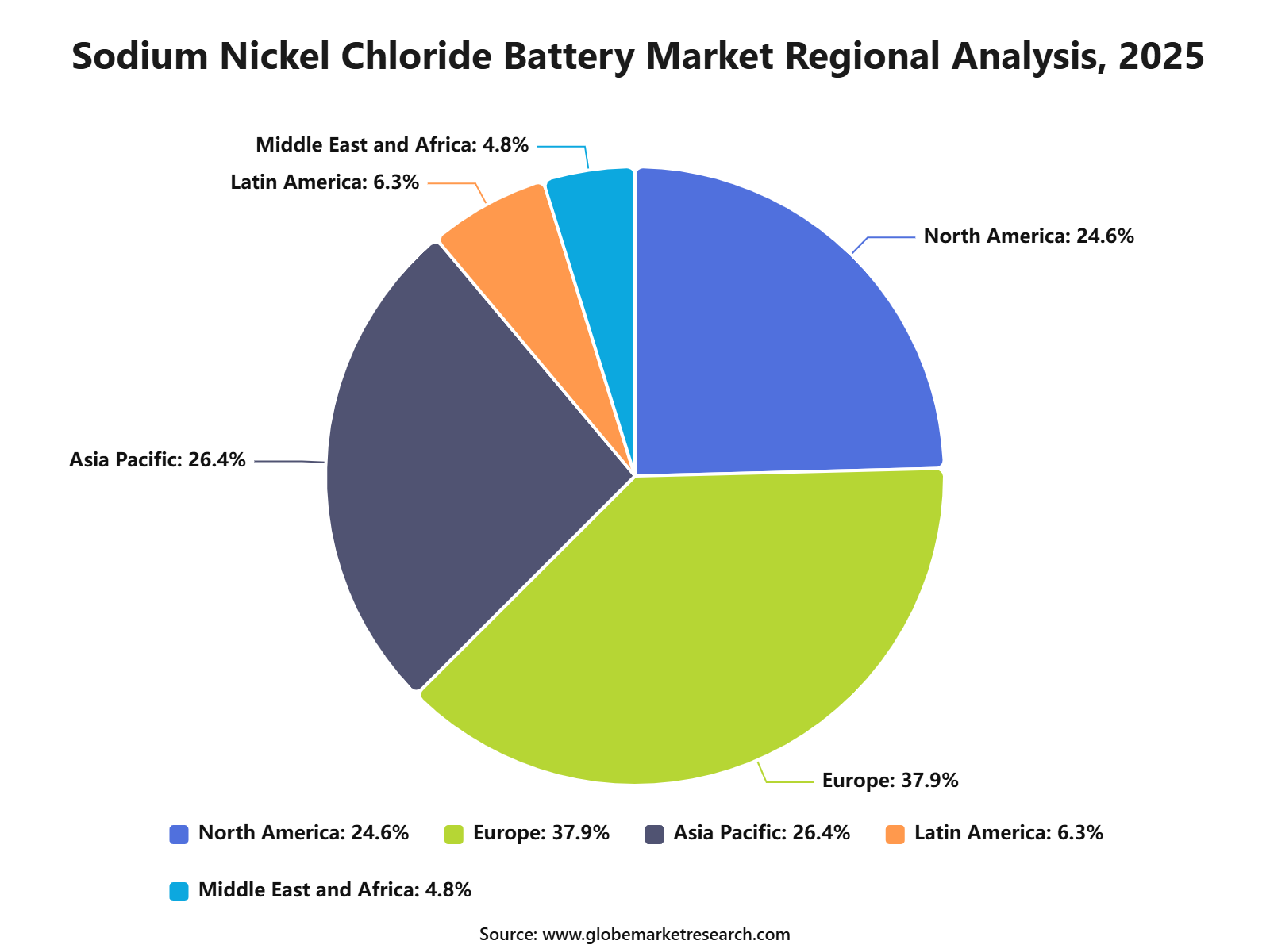
The Global Sodium Nickel Chloride Battery Market was worth USD 2.6 billion in 2025 and is expected to reach USD 8.3 billion by 2035, growing at a CAGR of 12.3% from 2025 to 2035. Based on this growth rate, the market is estimated to reach around USD 3.2 billion in 2026. Europe held the largest regional share of 37.9% in 2025, valued at around USD 0.9 billion, supported by grid storage projects, clean energy policies, industrial backup power demand, and growing interest in safer high-temperature battery systems.
The Sodium Nickel Chloride Battery Market includes rechargeable battery systems that use molten sodium and nickel chloride chemistry for reliable energy storage. These batteries are used in stationary storage, telecom backup systems, renewable energy integration, grid support, industrial power backup, and electric mobility applications where safety, long cycle life, and thermal stability are important. The market is closely linked with renewable power balancing, energy resilience, and long-duration storage needs.
Key Parameter | Report Details |
|---|---|
Market Revenue, 2025 | USD 2.6 Billion |
Projected Revenue, 2035 | USD 8.3 Billion |
CAGR (2025-2035) | 12.3% |
Largest Region | Europe (37.9%, USD 0.9 Bn) |
Fastest Growing Region | Asia Pacific |
Market Concentration | Medium |
Base Year | 2024 |
Forecast Period | 2025-2035 |
The market outlook remains positive as utilities, industries, and infrastructure operators look for battery technologies beyond conventional lithium-ion systems. Growth can be attributed to rising demand for safer battery chemistries, renewable energy storage expansion, and increasing need for dependable backup power in harsh operating conditions. Europe’s focus on energy security, clean power integration, and non-lithium battery innovation is expected to support long-term market demand.
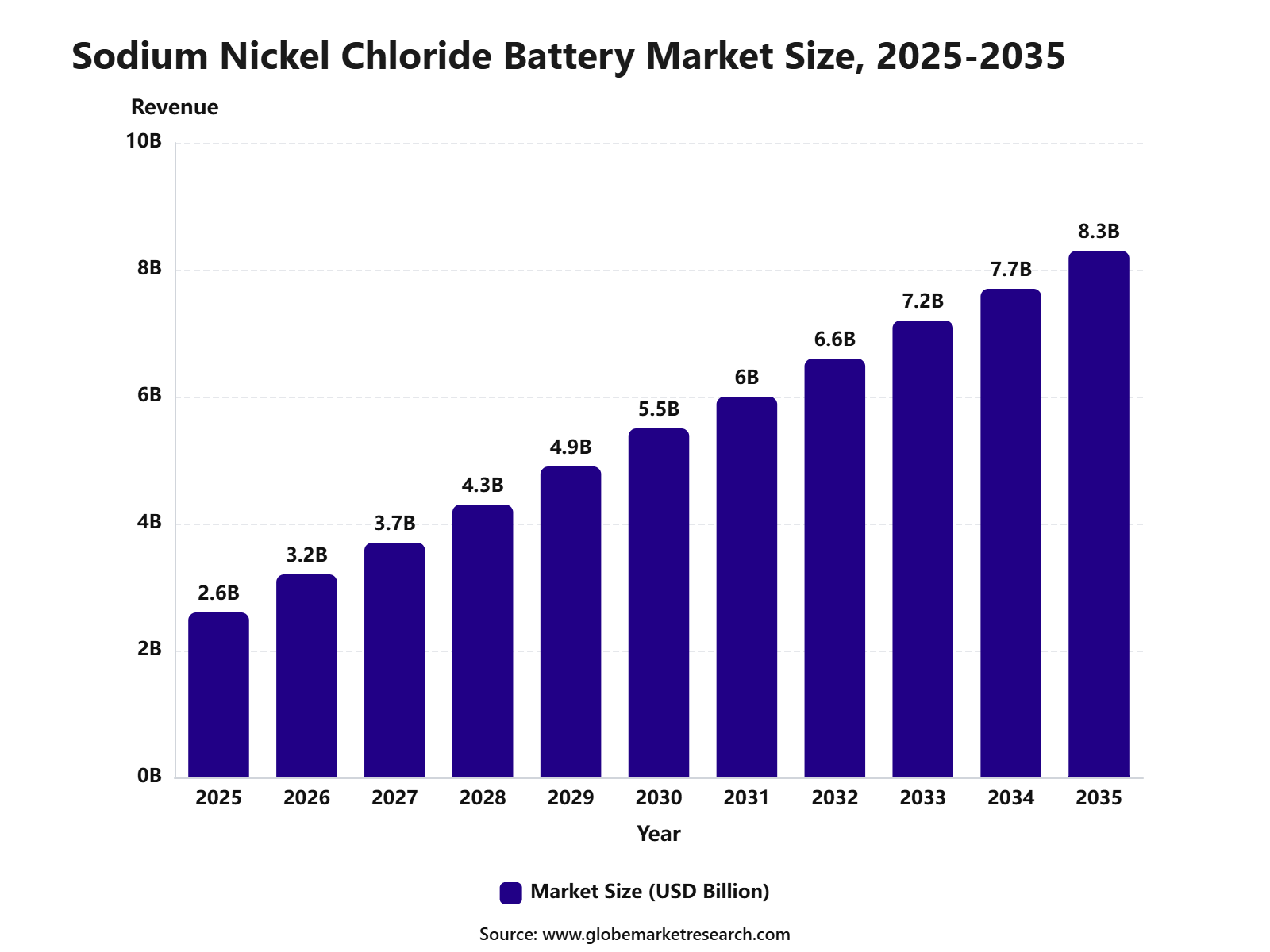 iThe graph shows projected market growth until 2035 based on CAGR analysis. Actual outcomes may vary depending on changing demand, competition, and economic factors.To gain greater insights - request a sample report PDF
Key Market Insights
Stationary sodium nickel chloride batteries led the product type segment with 69.2% share, supported by their strong use in grid backup, renewable energy storage, telecom power, and industrial stationary applications.
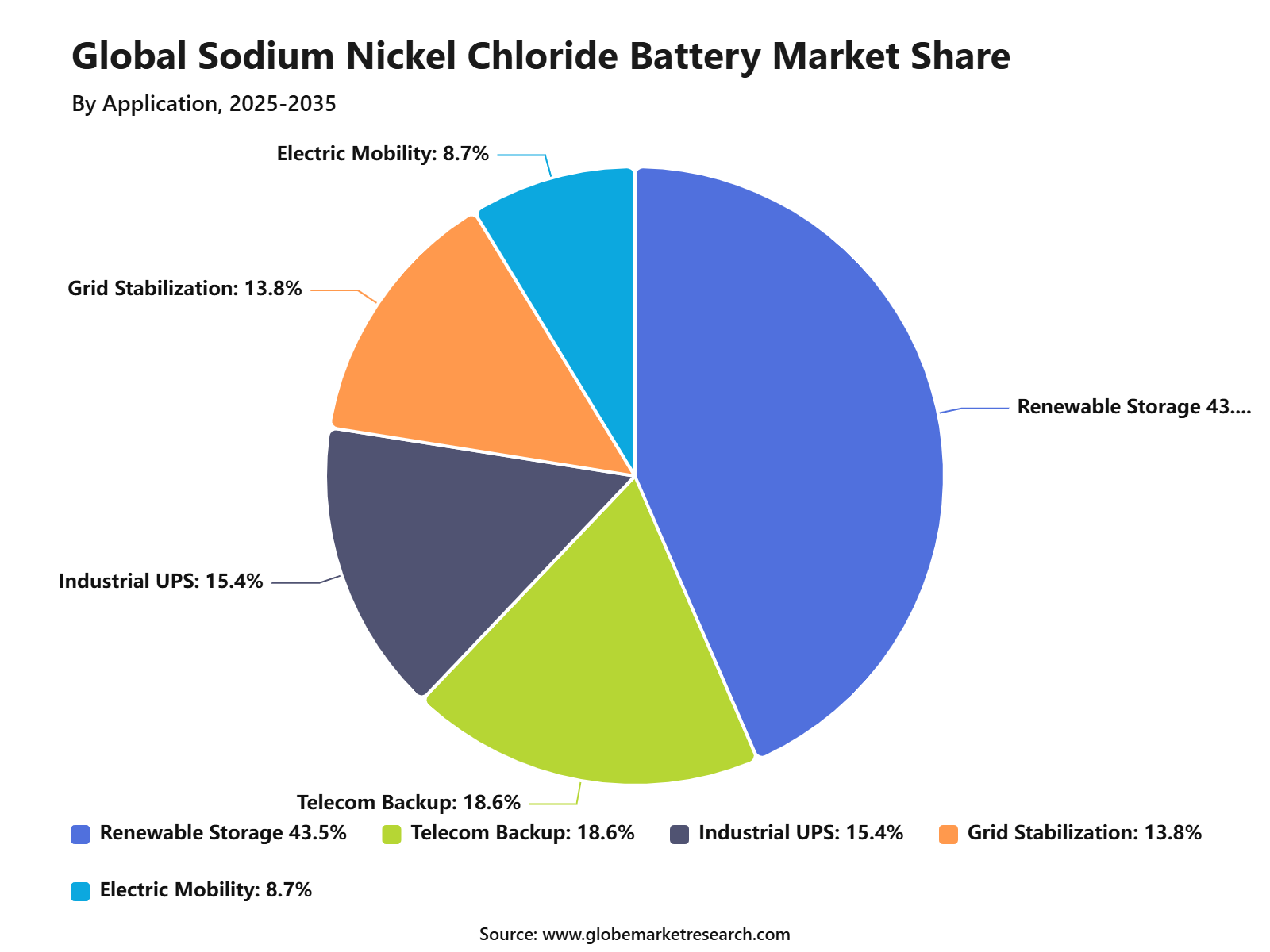
Renewable energy storage accounted for 43.5% share by application, driven by rising demand for stable, safe, and long-duration battery systems that support solar and wind power integration.
Europe led the sodium nickel chloride battery market with 37.9% share, valued at USD 0.9 billion, supported by strong renewable energy adoption, grid modernization efforts, and growing demand for reliable stationary energy storage solutions.
Top Funding and Investment
Top Investments
Altech continued the financing and development process for its 120 MWh CERENERGY sodium nickel chloride battery facility at Schwarze Pumpe in Saxony. The proposed plant is designed to manufacture up to 120 one-MWh GridPacks annually. The deadline for achieving full financial close was extended to 30 September 2026.
Desert Mountain Energy signed a non-binding letter of intent to establish a joint venture for constructing and operating a sodium nickel chloride battery manufacturing facility in Roswell, New Mexico. The proposed plant would treat produced water for cooling and processing, while recovered sodium would be used directly in SNC battery production.
AMPower agreed to manufacture sodium nickel chloride cells, battery management systems, thermal systems, and grid-ready battery packs for Altech. AMPower disclosed existing production capacity of approximately 100 MWh annually, with the ability to increase capacity to 200 MWh annually with limited additional capital expenditure. Products will be distributed across Europe, Australia, and the United States.
Altech completed the engineering design of a 35 kWh sodium nickel chloride UPS cabinet containing four ZEBRA battery modules. Factory acceptance testing was scheduled for March 2026, followed by deployment at five trial locations in the Netherlands, including gas transmission facilities, industrial control sites, and safety-critical infrastructure.
HORIEN secured an order to install sodium metal chloride batteries for backup safety systems on an FPSO serving Eni’s Geng North gas development. The FPSO project has an estimated total value of USD 2.5 billion to USD 3.5 billion, although the battery contract value was not disclosed. The vessel will operate in water depths reaching 2,000 metres.
Top Funding Transactions
Germany’s federal STARK economic development program provided conditional binding funding approval of up to EUR 46.7 million for the CERENERGY project. The grant is intended to cover approximately 30% of eligible project capital expenditure. Funding remained conditional on project financial close and the approval of funds through Germany’s 2026 federal budget.
Altech completed an AUD 6 million equity placement through the issuance of 133.3 million ordinary shares at AUD 0.045 per share. Investors also received one option for every two shares, exercisable at AUD 0.065. The proceeds were allocated to battery trials, commercial sales activities, prototype completion, project financing, and production-scale assessments.
Altech secured a bearer bond facility from major shareholder Deutsche Balaton AG. The available amount was revised from EUR 2.5 million to EUR 2.0 million, carrying annual interest of 7.0% and maturing on 31 October 2026. The entire EUR 2.0 million facility had been drawn by 30 September 2025.
Trusted Acquisition
Altech acquired Altech Advanced Materials’ 25% equity interest in Altech Energy Holdings GmbH, which indirectly represented an additional 18.75% interest in the CERENERGY sodium chloride battery project. The transaction also included the associated shareholder loans. Altech’s total CERENERGY ownership increased to 75%, while Fraunhofer IKTS retained the remaining 25%.
As consideration for the combined project acquisitions, Altech issued approximately 532 million fully paid shares to Altech Advanced Materials, resulting in the seller holding approximately 21% of Altech. The transaction was completed on 1 September 2025.
By Product Type
Stationary sodium nickel chloride batteries accounted for 69.2% share of the Sodium Nickel Chloride Battery Market. This leading position is supported by their strong use in fixed energy storage systems, backup power, telecom infrastructure, renewable energy integration, and industrial power reliability applications.
The segment is widely preferred because sodium nickel chloride batteries offer high safety, long operating life, deep discharge capability, and stable performance in demanding temperature conditions. These features make them suitable for stationary installations where reliability and low maintenance are important.
Demand is expected to remain strong as utilities, industries, and commercial users invest in long-duration and stable energy storage systems. Their suitability for grid support, renewable energy storage, and backup power will continue to support segment leadership.
By Application
Renewable energy storage accounted for 43.5% share of the Sodium Nickel Chloride Battery Market. This dominance is driven by the growing need to store electricity generated from solar, wind, and other intermittent renewable energy sources.
Sodium nickel chloride batteries are used to balance power supply, reduce renewable energy curtailment, and provide backup during low-generation periods. Their ability to operate safely and support repeated charge-discharge cycles makes them useful for renewable power projects and distributed energy systems.
The segment is expected to remain a major demand area as countries increase clean energy capacity and modernize grid infrastructure. Demand will be supported by utility-scale storage, microgrids, off-grid renewable systems, and industrial users seeking stable low-carbon power supply.
 iThe graph shows projected market growth until 2035 based on CAGR analysis. Actual outcomes may vary depending on changing demand, competition, and economic factors.To gain greater insights - request a sample report PDF
By Region
Europe accounted for 37.9% share of the Sodium Nickel Chloride Battery Market, reaching USD 0.9 billion. The region’s leadership is supported by strong renewable energy deployment, grid modernization programs, and rising demand for safer stationary energy storage technologies.
Germany, Italy, France, the United Kingdom, Spain, Switzerland, and Nordic countries are key contributors to regional demand. Europe benefits from mature clean energy policies, high adoption of distributed power systems, and continued investment in storage technologies that support renewable electricity integration.
Europe is expected to maintain a strong position as energy storage becomes more important for grid stability and decarbonization. Demand will remain supported by renewable power expansion, industrial backup needs, telecom power systems, and long-duration storage projects across the region.
 iThe graph shows projected market growth until 2035 based on CAGR analysis. Actual outcomes may vary depending on changing demand, competition, and economic factors.To gain greater insights - request a sample report PDF
Regional Impact Analysis
Europe leads the Sodium Nickel Chloride Battery Market with 37.9% share in 2025, valued at around USD 1.0 billion, supported by renewable energy integration, grid modernization, industrial backup power demand, and preference for safer stationary battery systems. Germany, Italy, Switzerland, France, and the UK remain key regional markets.
North America remains important because of demand from grid storage, telecom backup, industrial power reliability, and remote infrastructure. Asia Pacific supports future growth through renewable deployment, telecom expansion, industrial power needs, and distributed energy storage projects in China, India, Japan, South Korea, and Southeast Asia.
Impact Factor | Estimated CAGR Impact | Regional Relevance | Market Impact |
|---|---|---|---|
Europe market leadership | +3.4% | Europe, 37.9% share in 2025 | Leads global value demand. |
Germany and Italy storage demand | +2.2% | Germany, Italy | Supports regional adoption. |
Switzerland and France industrial backup use | +1.7% | Switzerland, France | Adds stable demand. |
North America grid and telecom backup | +1.4% | U.S. and Canada | Builds future opportunity. |
Asia Pacific renewable and telecom growth | +1.6% | China, India, Japan, South Korea | Supports future scale. |
Go-To-Market and Sales Economics
The strongest route to market is stationary storage, where four-to-six-hour discharge capability can support solar shifting, grid balancing, and industrial resilience. The IEA reported 108 GW of battery additions in 2025, with about 80% installed at utility scale. Suppliers should therefore prioritise utilities, renewable developers, engineering contractors, and independent power producers.
Sales channels should combine direct enterprise contracts with trained regional integrators serving telecom, oil and gas, railways, utilities, marine, and remote industrial sites. HORIEN states that its salt batteries operate from minus 40°C to 60°C without air conditioning and provide more than 20 years of floating life, supporting lifecycle-based selling rather than upfront-price competition.
Commercial conversion should begin with pilot systems, performance guarantees, and multi-year service agreements before larger framework orders are pursued. Altech’s planned German line is designed for 120 MWh annually, using 60 kWh battery packs and 1 MWh GridPacks. Standardised modules can simplify installation, shorten commissioning, and create recurring monitoring and maintenance revenue.
Risk Factors & Market Barriers
The principal barrier is intense competition from lithium iron phosphate technology. The IEA reported that LFP represented around 90% of global battery-storage deployments in 2025, while average battery prices declined by 8%. Sodium nickel chloride suppliers must prove lower lifetime cost, stronger safety, longer service life, and dependable operation under harsh temperatures.
Technical positioning is limited by the chemistry’s operating requirements. Fraunhofer reports an internal operating temperature near 300°C and charge or discharge rates between 0.25C and 1C. These characteristics are suitable for stationary applications but can restrict rapid-power, lightweight, and frequently idle use cases, requiring strong insulation, thermal controls, and careful system engineering.
Nickel exposure creates procurement and pricing risk despite sodium chloride availability. USGS estimated 2025 global nickel mine output at 3.9 million tonnes, including 2.6 million tonnes from Indonesia. Australian production fell 54%, Philippine output declined 24%, and the average nickel price decreased 11%, demonstrating both geographic concentration and sharp supply-side volatility.
Revenue Potential Analysis
Revenue Landscape Across
Grid-connected renewable projects offer the largest revenue pool. IRENA’s 2026 statistics reported that 692 GW of renewable capacity was added in 2025, representing 85.6% of worldwide power additions. Solar contributed 510 GW and wind added 159 GW. This expansion increases demand for daily energy shifting, capacity support, renewable smoothing, and long-duration storage solutions.
Data centres represent an emerging opportunity for safe, stationary backup and load management. The IEA’s 2026 outlook expects data-centre electricity consumption to increase from 485 TWh in 2025 to 950 TWh by 2030. It also indicates that 20 to 25 GW of battery storage could be installed in data centres globally by 2030.
Revenue can also be developed across telecom towers, rail networks, oil and gas facilities, marine systems, microgrids, and commercial buildings. The IEA reported that battery-based uninterruptible-power-supply additions increased 30% to 45 GW in 2025. Harsh-site reliability, low maintenance, remote diagnostics, and long warranties can support premium service contracts in these applications.
Financial Impact
Lifecycle economics can improve when energy efficiency, replacement frequency, and cooling costs are included in procurement decisions. Fraunhofer reports efficiency above 90%, service life exceeding 10 years, around 4,500 cycles, and full recyclability for its CERENERGY platform. These attributes can reduce total ownership costs, although project-specific duty cycles and thermal losses must be validated.
Material economics provide both opportunity and uncertainty. The IEA reported that lithium prices at the start of 2026 were more than double year-earlier levels, although still about 70% below the 2022 peak. Sodium nickel chloride systems avoid lithium and cobalt exposure, but manufacturers remain affected by nickel prices, ceramic production yields, financing costs, and factory utilisation.
Altech’s published feasibility case illustrates potential manufacturing economics but should not be treated as realised performance. For a 120 MWh annual plant, the company projects €106 million in revenue, €51 million in EBITDA, a 47% margin, 19% internal rate of return, and 3.7-year payback, against €156 million capital expenditure and €23 million working capital.
Drivers Impact Analysis
The Sodium Nickel Chloride Battery Market is driven by rising demand for safe stationary energy storage, telecom backup, grid stabilization, industrial power backup, renewable energy integration, and long-duration battery systems. Sodium nickel chloride batteries are valued for thermal stability, deep discharge capability, and suitability for demanding stationary applications.
Europe leads the market due to strong renewable energy deployment, grid modernization, industrial energy storage demand, and focus on safer battery chemistries. Germany, Italy, Switzerland, France, and the UK remain important markets because of distributed energy storage, backup power needs, and clean energy infrastructure investment.
Impact Factor | Estimated CAGR Impact | Regional Relevance | Market Impact |
|---|---|---|---|
Rising stationary energy storage demand | +3.3% | Europe, North America, Asia Pacific | Drives core market growth. |
Renewable energy integration needs | +2.8% | Europe and Asia Pacific | Supports grid balancing. |
Telecom and industrial backup power demand | +2.4% | Europe, Middle East, Africa, Asia Pacific | Adds reliable backup applications. |
Safety advantages over some chemistries | +2.0% | Regulated and industrial markets | Improves adoption confidence. |
Demand for long-duration discharge systems | +1.6% | Grid and remote power users | Supports niche growth. |
Restraints Impact Analysis
The market faces restraints from high operating temperature requirements, limited supplier base, competition from lithium-ion batteries, and higher system integration complexity. Sodium nickel chloride batteries need thermal management, insulation, and controlled operation, which can increase system cost and maintenance planning.
Another restraint is lower mainstream awareness compared with lithium-ion, sodium-ion, and lead-acid batteries. Many buyers still choose widely available technologies with larger manufacturing ecosystems, stronger service networks, and broader installer familiarity.
Impact Factor | Estimated CAGR Impact | Regional Relevance | Market Impact |
|---|---|---|---|
High operating temperature requirement | -1.6% | Global battery users | Adds system complexity. |
Strong competition from lithium-ion | -1.4% | Energy storage and backup markets | Limits broader adoption. |
Limited manufacturing and supplier base | -1.2% | Europe and global markets | Restricts scalability. |
Higher upfront system integration cost | -1.0% | Industrial and telecom users | Slows purchasing decisions. |
Lower market awareness | -0.8% | Emerging energy storage markets | Reduces sales reach. |
Opportunities Impact Analysis
Opportunities are strong in stationary storage, telecom backup, renewable energy storage, microgrids, industrial UPS, remote power systems, and grid stabilization. These applications benefit from batteries that can operate safely, discharge deeply, and support long service life.
Higher-value opportunities are emerging in solar-plus-storage projects, off-grid industrial sites, railway backup systems, utility-scale storage pilots, and critical infrastructure backup. Companies that improve thermal efficiency, reduce cost, and provide turnkey systems can capture stronger long-term demand.
Impact Factor | Estimated CAGR Impact | Regional Relevance | Market Impact |
|---|---|---|---|
Stationary storage deployment | +3.1% | Europe, North America, Asia Pacific | Builds main opportunity base. |
Telecom tower backup systems | +2.6% | Europe, Africa, Asia Pacific | Adds recurring demand. |
Renewable microgrid applications | +2.2% | Remote and island markets | Supports off-grid reliability. |
Industrial UPS and backup power | +1.8% | Manufacturing and process industries | Improves power continuity. |
Grid stabilization projects | +1.5% | Europe and developed power markets | Supports flexible energy use. |
Challenges Impact Analysis
The main challenge is competing against faster-scaling battery chemistries. Lithium-ion, LFP, sodium-ion, and flow batteries are gaining strong investment, so sodium nickel chloride suppliers need clear differentiation in safety, reliability, and long-duration performance.
Another challenge is maintaining performance under real operating conditions. These batteries need stable thermal control, proper cycling strategy, and strong system design to deliver expected lifetime value across backup, grid, and industrial use cases.
Impact Factor | Estimated CAGR Impact | Regional Relevance | Market Impact |
|---|---|---|---|
Competing with larger battery ecosystems | -1.4% | Global battery markets | Affects scale and pricing. |
Thermal management requirements | -1.2% | Stationary and telecom systems | Raises operational needs. |
Limited installer and service network | -1.0% | Emerging markets | Slows deployment. |
Proving lifecycle economics | -0.8% | Utilities and industrial buyers | Influences purchase confidence. |
Scaling production consistently | -0.7% | Battery manufacturers | Affects delivery capacity. |
Segment Covered in the Report
By Product Type
Stationary Sodium Nickel Chloride Batteries
Mobile Sodium Nickel Chloride Batteries
Industrial Sodium Nickel Chloride Batteries
Backup Power Battery Systems
By Application
Renewable Energy Storage
Telecom Backup
Industrial UPS
Grid Stabilization
Electric Mobility
By Region
North America
Europe
Asia Pacific
Latin America
Middle East and Africa
Market Trend Analysis
The market trend is moving toward safer stationary storage, renewable-linked backup systems, telecom energy storage, modular battery cabinets, and grid-support applications. Buyers are focusing on systems that offer reliability, safety, and longer operating life in fixed-location energy storage projects.
Europe remains the largest value region because of renewable integration, grid reliability needs, and industrial energy storage programs. North America and Asia Pacific support future growth through microgrids, telecom backup, remote infrastructure, and clean power storage demand.
Impact Factor | Estimated CAGR Impact | Regional Relevance | Market Impact |
|---|---|---|---|
Stationary storage systems expand | +3.0% | Europe, North America, Asia Pacific | Leads market direction. |
Renewable-linked backup grows | +2.5% | Europe and island grids | Supports clean power stability. |
Modular battery cabinet adoption rises | +2.0% | Industrial and telecom users | Improves installation flexibility. |
Long-duration storage interest increases | +1.7% | Grid and remote power markets | Adds future opportunity. |
Safety-focused chemistry selection grows | +1.4% | Critical infrastructure users | Builds buyer confidence. |
Investor Type Impact Matrix
Investors should focus on companies with strong sodium nickel chloride battery design, thermal management capability, system integration expertise, and proven stationary storage deployments. Safety, cycle life, backup reliability, and service support are key success factors.
Strategic investors can also target battery system integrators, telecom backup providers, thermal control technology firms, energy storage software providers, and modular storage manufacturers. Companies that connect safe battery chemistry with reliable stationary power applications are better positioned for long-term growth.
Investor Type | Estimated CAGR Impact | Regional Relevance | Market Impact |
|---|---|---|---|
Sodium Nickel Chloride Battery Manufacturers | +2.6% | Global | Expands core battery supply. |
Stationary Storage System Integrators | +2.1% | Europe, North America, Asia Pacific | Supports grid and backup use. |
Telecom Backup Power Providers | +1.7% | Europe, Africa, Asia Pacific | Builds recurring demand. |
Thermal Management Technology Firms | +1.4% | Battery system markets | Improves operating efficiency. |
Strategic Energy Storage Investors | +1.2% | Global clean energy markets | Funds scale and deployment. |
Recent Developments
In January 2026, Altech Batteries received conditional German approval for up to EUR 46 million, covering about 30% of eligible investment for its planned 120 MWh CERENERGY sodium-nickel-chloride battery factory in Saxony.
In February 2026, A123 Systems acquired a battery technology and laboratory facility in Burlington, Massachusetts, expanding United States research in advanced materials, lithium-ion chemistries, grid-scale storage systems, and automotive battery development.
In January 2025, Exide Technologies launched Solition Telecom, a lithium-iron-phosphate backup system featuring smart battery management for telecom base stations. The development expanded Exide’s lithium portfolio rather than sodium-nickel-chloride battery operations.
In October 2025, EnerSys reported that it had acquired Rebel Systems and integrated it with Bren-Tronics, strengthening its defense and tactical energy-storage portfolio. These capabilities focus on lithium-based and hybrid power systems.
Competitive Landscape
The market is characterized by intense competition among established players and emerging companies. Strategic partnerships, mergers and acquisitions, and product innovation are key strategies employed by market participants.
Key Market Players
FZSoNick
Altech Batteries
Ceramatec
SAFT
FIAMM Energy Technology
NGK Insulators
A123 Systems
Crown Battery Manufacturing
Exide Technologies
EnerSys
Sonnenschein
Beta Research
GE Energy Storage
Other Key Players
Research Methodology
This market study is prepared using a combination of primary and secondary research. Primary research includes discussions with manufacturers, suppliers, distributors, consultants, industry experts, and end users. Secondary research covers company reports, government databases, trade associations, technical publications, regulatory sources, and trusted industry documents. The collected information is used to assess market demand, pricing trends, technology adoption, competitive activity, and regional performance.
AI language models are not used as primary data sources, and publicly available AI-generated content is not treated as market evidence. Computational tools may be used to support data processing, translation, data classification, and pattern identification. However, every published assessment is supported by verified sources, human review, and primary market discussions.
Market estimates are developed through top-down and bottom-up approaches and validated using data triangulation. Revenue, production, shipment, pricing, and application-level data are compared across multiple sources. Forecasts consider economic conditions, regulatory changes, investment activity, innovation, supply chain developments, and industry risks. All findings are reviewed through source verification and internal quality checks before publication.
Part I
Source Management & Input Data Standards
Who provides data, how sources are qualified, and what types of evidence are admissible.
Part II
Research Scope & Market Coverage
How we define the markets we assess and the parameters that govern each product.
Part III
Data Collection, Verification & Submission
The mechanics of gathering, cross-checking, and hierarchically ranking evidence.
Part IV
Assessment Determination & Quality Controls
How raw data becomes a published assessment — normalisation, expert judgement, and outlier exclusion.
Part V
Publication, Corrections & Revision
Our publication schedule, corrections policy, and methodology review cycle.
Part VI
Independence, Ethics & Complaints
Conflict-of-interest policies, editorial independence, and how clients raise concerns.
Google · Preferred Sources
Don't miss the latest market research insights and industry updates on Google.
Add Globe Market Research as a preferred source in the Google app to see our reports, analysis, and market stories in your news suggestions.
Meet the Team
This report was prepared by our expert analysts with deep industry knowledge and research experience.
Pratiksha K. is a Senior Research Analyst with more than five years of experience in market research, industry analysis, competitive intelligence, and business strategy. She has contributed to detailed market reports, customized research studies, company profiling, market sizing, trend analysis, and strategic consulting projects for clients across different regions. Her industry expertise covers Chemical and Material, Consumer Goods, Food & Beverages and Energy & Power. She closely evaluates changing customer requirements, technology developments, regulatory conditions, supply chain structures, investment activity, and competitive strategies to provide clear and practical market insights.
Sayali brings more than 7 years of experience to Globe Market Research, supporting the accuracy, clarity, and relevance of research content across multiple industries. She reviews market data, segment analysis, competitive insights, and industry trends to ensure each report meets strong quality standards and provides practical value to business decision-makers. Her expertise spans healthcare, information technology, consumer goods, and diverse cross-industry domains. With a strong focus on data reliability, structured analysis, and clear presentation, Sayali helps ensure that each research output delivers well-reviewed insights for clients, investors, consultants, and industry stakeholders.
Frequently Asked Questions
Related Reports
More in Energy and Power
Oil and Gas Turbomachinery Market to Hit USD 26.9 Billion by 2035
Oil and Gas Turbomachinery Market Size, Share, Analysis By Type (Gas Compressors, Gas and Steam Turbines, Pumps, Other Types), By Deployment (Onshore, Offshore), By Industry (Upstream, Midstream, Downstream), By Regional Insights, Business plan and Project Report, Investment Opportunities, Profitability, Industry Trends, Leading Companies and Growth Forecasts by 2025-2035
Liquefied Natural Gas (LNG) Bunkering Market to Hit USD 51.7 Billion by 2035
Liquefied Natural Gas (LNG) Bunkering Market Size, Share, Analysis By Product Type (Ship-to-Ship, Truck-to-Ship, Port-to-Ship, Portable Tanks), By Application (Cargo Fleet, Tanker Fleet, Container Fleet, Ferries, Inland Vessels, Others), By Regional Insights, Business plan and Project Report, Investment Opportunities, Profitability, Industry Trends, Leading Companies and Growth Forecasts by 2025-2035
Wind Energy Market to Hit USD 348.1 Billion by 2035
Wind Energy Market Size, Share, Analysis By Location (Onshore, Offshore), By Application (Utility, Non-Utility), By Component(Turbine, Support Structure, Electrical Infrastructure, Others), By Regional Insights, Business plan and Project Report, Investment Opportunities, Profitability, Industry Trends, Leading Companies and Growth Forecasts by 2025-2035
Power EPC Market to Hit USD 1,516.1 Billion by 2035
Power EPC Market Size, Share, Analysis By Type of Power Generation (Thermal Power, Renewable Energy, Nuclear Power, Hydropower, Others), By Service Type (Engineering, Procurement, Construction), By Equipment Type (Steam Turbines, Gas Turbines, Solar PV Systems, Wind Turbines, Boilers, Generators, Others), By Regional Insights, Business plan and Project Report, Investment Opportunities, Profitability, Industry Trends, Leading Companies and Growth Forecasts by 2025-2035