

Revenue, 2026
USD 295.2 Bn
Forecast, 2035
USD 538.2 Bn
CAGR, 2026-2035
6.9%
Report Coverage
Global
Market Size and Forecast
The Global Savory Snacks Market was worth USD 295.2 billion in 2026 and is expected to reach USD 538.2 billion by 2035, growing at a CAGR of 6.9% from 2026 to 2035. North America held the largest regional share of 39.8% in 2026, valued at around USD 117.4 billion, supported by strong snacking culture, high retail availability, premium flavor innovation, and rising demand for convenient packaged food products.
The Savory Snacks Market includes chips, extruded snacks, nuts and seeds, popcorn, pretzels, meat snacks, cheese snacks, crackers, tortilla chips, and other salted snack products. These products are widely consumed between meals, during travel, at workplaces, in schools, during entertainment, and as part of quick food occasions. The market is closely linked with convenience eating, changing lifestyles, retail expansion, and flavor-led product innovation.
Market growth is being supported by consumers looking for tasty, portable, and ready-to-eat snack options. Demand is increasing for baked snacks, high-protein snacks, low-sodium products, gluten-free options, plant-based ingredients, and bold flavor profiles. Brands are also improving packaging formats, portion sizes, and healthier formulations to attract families, young consumers, fitness-focused buyers, and premium snack shoppers.
Key Parameter | Report Details |
|---|---|
Market Revenue, 2026 | USD 295.2 Billion |
Projected Revenue, 2035 | USD 538.2 Billion |
CAGR (2026-2035) | 6.9% |
Largest Region | North America (39.8%, USD 117.4 Bn) |
Fastest Growing Region | Asia Pacific |
Market Concentration | Medium |
Base Year | 2025 |
Forecast Period | 2026-2035 |
North America is expected to remain a leading region due to its mature packaged food industry, strong supermarket and convenience store networks, and high consumer spending on snack products. Online grocery platforms and quick-commerce channels are also improving product reach. Long-term growth will depend on healthier ingredient choices, clean-label positioning, flavor variety, sustainable packaging, and strong brand differentiation.
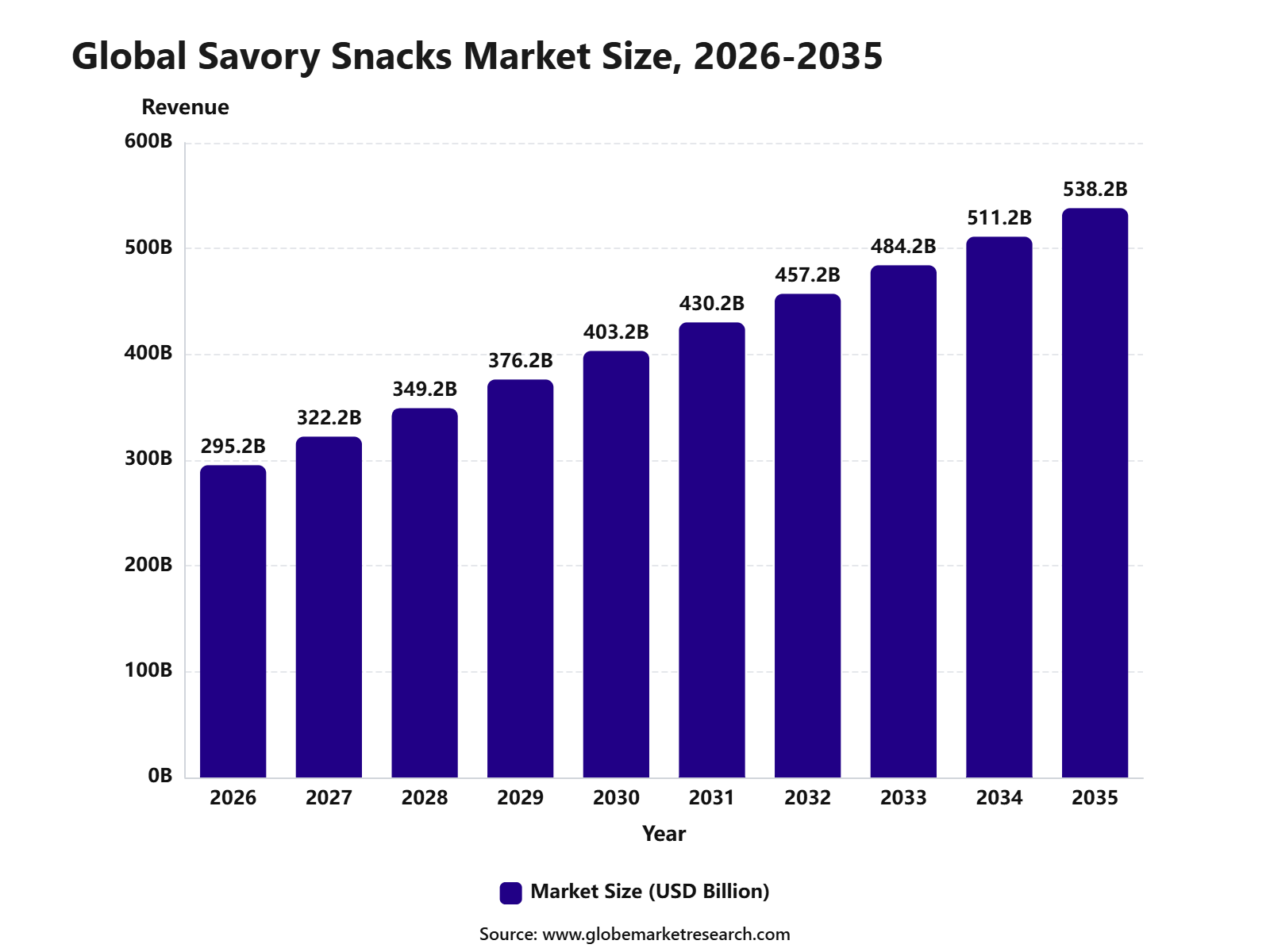 iThe graph shows projected market growth until 2035 based on CAGR analysis. Actual outcomes may vary depending on changing demand, competition, and economic factors.To gain greater insights - request a sample report PDF
Key Market Insights
Chips and crisps led the product type segment with 40.2% share, supported by strong demand for convenient, ready-to-eat, and widely available snack products.
Flavored snacks accounted for 74.8% share by flavor profile, driven by consumer preference for bold tastes, regional flavors, spicy variants, and premium seasoning options.
Conventional savory snacks held 79.2% share by category, supported by broad retail availability, affordable pricing, familiar taste profiles, and high repeat purchases.
Supermarkets and hypermarkets captured 45.3% share by distribution channel, driven by strong shelf visibility, wide brand selection, promotional offers, and regular household snack purchases.
North America led the savory snacks market with 39.8% share, valued at USD 117.4 billion, supported by high snack consumption, mature retail networks, strong brand presence, and growing demand for flavored packaged snacks.
Top Funding and Investment
Top Investments
Calbee confirmed an investment of JPY 31.4 billion, excluding land, in its Setouchi Hiroshima Factory, which commenced operations in January 2025. The facility produces potato chips, Jagabee potato snacks, and wheat-based snacks. Its annual production capacity is valued at approximately JPY 28 billion, strengthening Calbee’s automated manufacturing and domestic supply capabilities.
Utz Brands increased its 2025 capital expenditure forecast to approximately USD 100 million. Most of the spending was allocated to expanding supply-chain network capabilities and accelerating manufacturing productivity. The investment supports Utz’s portfolio of potato chips, tortilla chips, pretzels, cheese snacks, pork rinds, and other salty snack products.
pladis allocated GBP 33 million to modernize its Aintree facility, where Jacob’s Cream Crackers are manufactured, including new ovens and supporting infrastructure. A further GBP 2 million was assigned to the savory assortments department in Carlisle, supporting the recruitment and training of 48 employees. These projects form part of a wider GBP 68 million UK manufacturing program scheduled for completion by the end of 2026.
Zweifel confirmed an investment of CHF 40 million in a new snack production plant at its Spreitenbach site. The facility is expected to increase the production volume and manufacturing efficiency of potato chips and other snacks. The company had already exceeded 10,000 tonnes of annual chips and snack production, while the new plant is scheduled to enter operation in spring 2027.
Wyandot Snacks announced a USD 7.7 million investment to modernize its manufacturing facility in Marion, Ohio. The program includes new machinery and advanced production equipment for private-label savory snacks. The expansion will create 67 jobs while retaining more than 260 existing positions and strengthening the company’s contract manufacturing capacity.
Top Funding Transactions
Farmley completed a USD 42 million Series C funding round led by L Catterton, with participation from existing shareholders including DSG Consumer Partners. The financing will be used to expand Farmley’s dried fruit, nut, seed, makhana, trail-mix, and flavored snack portfolio while strengthening distribution, product development, sourcing, and operating capacity.
Wonderland Foods raised INR 140 crore in its first institutional funding round, led by Asha Ventures and British International Investment. The capital will finance a green processing facility in Greater Noida, support new value-added nut and dry-fruit snack products, expand distribution, and create more than 1,000 formal jobs, primarily for women.
Beyond Snack raised USD 8.3 million in funding led by 12 Flags Group. Enrission India Capital, NAB Ventures, and Faad Network also participated. The banana-chip producer will use the funding to enter new markets, develop additional savory snack products, and improve its supply-chain infrastructure. At the time of the transaction, its products were sold through approximately 20,000 retail outlets and 12 international markets.
Top Acquisitions
PepsiCo, United States, January 2025: Acquisition of Siete Foods for USD 1.2 Billion
PepsiCo completed the USD 1.2 billion cash acquisition of Garza Food Ventures LLC, operating as Siete Foods. PepsiCo acquired all outstanding equity in the company, including the Siete brand and its portfolio of tortilla chips, grain-free tortillas, taco shells, salsas, sauces, seasonings, and other Mexican-American food products.
The transaction added an established savory-snack platform with strong retail distribution and simple-ingredient positioning to PepsiCo’s North American foods business. Siete’s operations, intellectual property, customer relationships, and brand-development capabilities were also transferred through the acquisition.
The Hershey Company, United States, November 2025: Acquisition of LesserEvil for USD 815.2 Million
The Hershey Company completed the acquisition of LesserEvil, an organic popcorn and puffed-snack manufacturer, for total purchase consideration of approximately USD 815.2 million. Initial cash consideration totalled about USD 769.1 million, with additional performance-based payments possible under the acquisition agreement.
Hershey acquired LesserEvil’s popcorn and puffed-snack portfolio, manufacturing capacity, trademarks, customer relationships, distribution access, and operating assets. The preliminary purchase allocation included USD 303 million for trademarks, USD 301.5 million for customer relationships, and USD 15.6 million for property, plant, and equipment.
By Product Type
Chips and crisps accounted for 40.2% share of the Savory Snacks Market. This leading position is supported by strong consumer demand for convenient, ready-to-eat, and affordable snack products across households, offices, schools, travel, retail stores, and foodservice channels.
The segment is widely preferred because chips and crisps offer familiar taste, easy availability, multiple pack sizes, and broad flavor options. Potato chips, tortilla chips, vegetable crisps, multigrain chips, and baked crisps are commonly consumed as everyday snacks and party foods.
Demand is expected to remain strong as brands expand healthier, baked, low-salt, high-protein, and premium chip formats. Growth will be supported by impulse purchases, online grocery sales, convenience retail, and continuous flavor innovation across regional and global snack brands.
By Flavor Profile
Flavored savory snacks held 74.8% share of the Savory Snacks Market. This dominance is driven by strong consumer preference for bold, spicy, cheesy, barbecue, sour cream, tangy, herb-based, and region-specific taste profiles.
The segment benefits from frequent product innovation, seasonal launches, and local taste customization. Flavored snacks help brands differentiate products and increase repeat purchases, especially among young consumers and households seeking variety in everyday snacking.
Demand is expected to remain high as consumers continue to explore new and intense flavor experiences. Spicy, ethnic, fusion, and limited-edition flavors will remain important growth drivers across chips, crisps, extruded snacks, popcorn, nuts, and snack mixes.
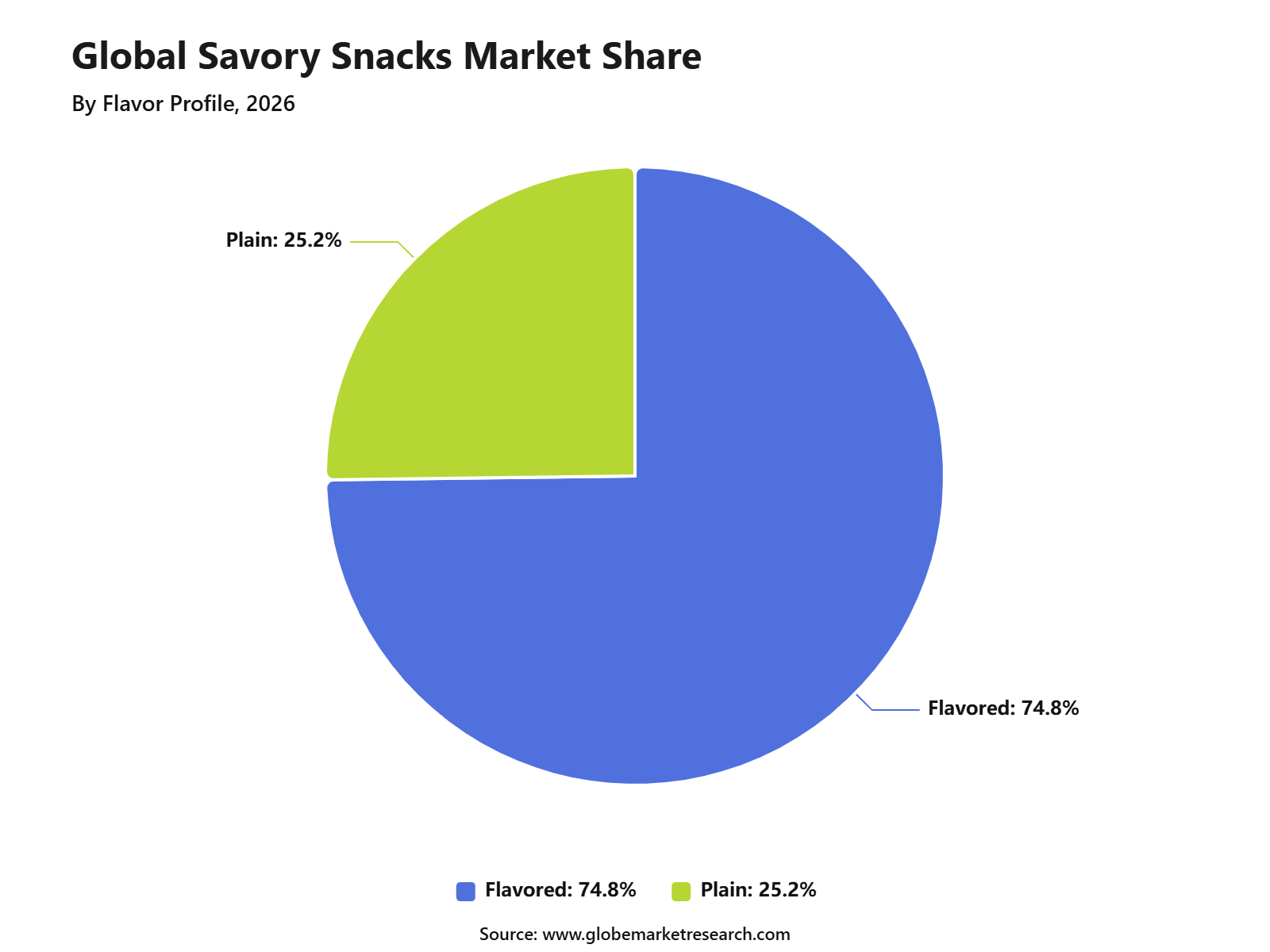 iThe graph shows projected market growth until 2035 based on CAGR analysis. Actual outcomes may vary depending on changing demand, competition, and economic factors.To gain greater insights - request a sample report PDF
By Category
Conventional savory snacks accounted for 79.2% share of the Savory Snacks Market. This leading share is supported by strong mass-market demand, wide retail availability, lower pricing, and established consumer acceptance across urban and rural markets.
The segment includes regular chips, crisps, extruded snacks, salted nuts, popcorn, pretzels, and snack mixes produced through standard sourcing and processing methods. Conventional products remain popular because they are affordable, familiar, and available in multiple flavors and pack sizes.
Demand is expected to remain strong as conventional snacks continue to serve high-volume consumption occasions. However, brands are also adding better-for-you options within conventional ranges, including reduced sodium, baked formats, smaller portions, and cleaner ingredient labels.
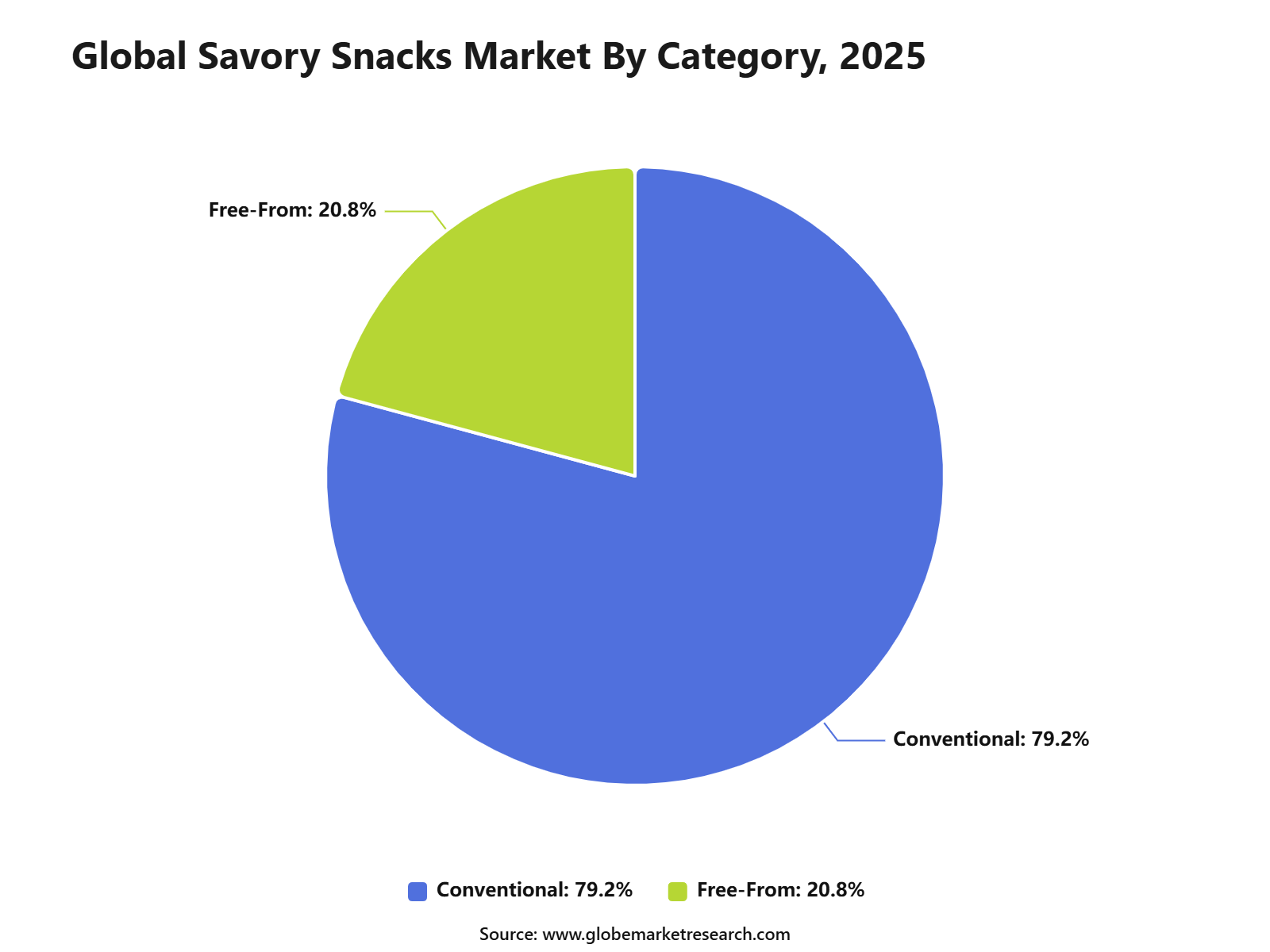 iThe graph shows projected market growth until 2035 based on CAGR analysis. Actual outcomes may vary depending on changing demand, competition, and economic factors.To gain greater insights - request a sample report PDF
By Distribution Channel
Supermarkets and hypermarkets accounted for 45.3% share of the Savory Snacks Market. This leading channel is supported by strong shelf visibility, wide product variety, promotional discounts, bulk packs, and easy access to both global and local snack brands.
Consumers prefer these stores because they can compare brands, flavors, prices, pack sizes, and nutrition labels in one place. Savory snacks also benefit from high-traffic shelf placement, checkout displays, family-size packs, and in-store promotions that encourage impulse buying.
The segment is expected to maintain a strong position as organized retail continues to expand. Demand will remain supported by private-label launches, premium snack aisles, multi-pack formats, and better availability of flavored and healthier savory snack options.
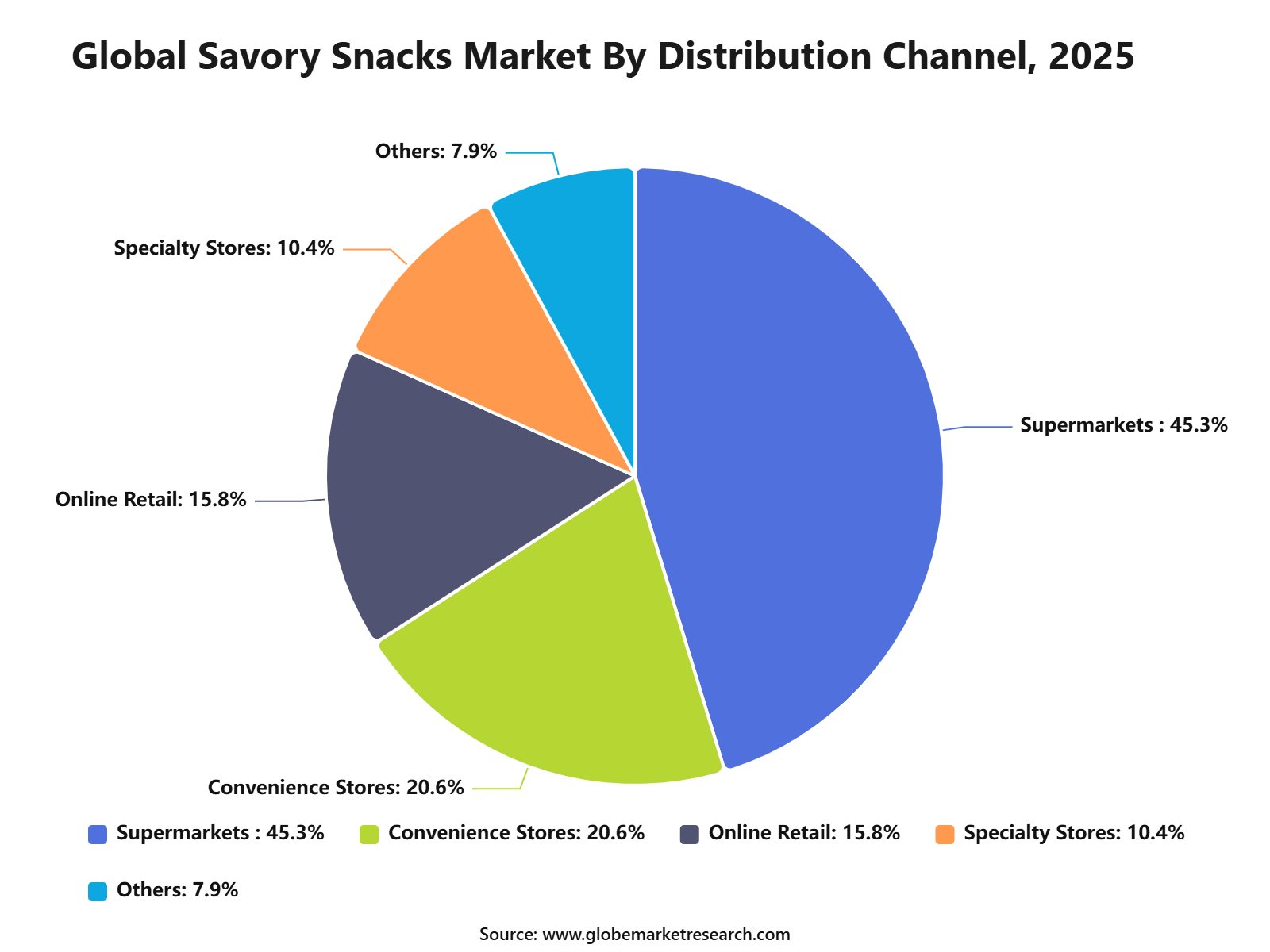 iThe graph shows projected market growth until 2035 based on CAGR analysis. Actual outcomes may vary depending on changing demand, competition, and economic factors.To gain greater insights - request a sample report PDF
By Region
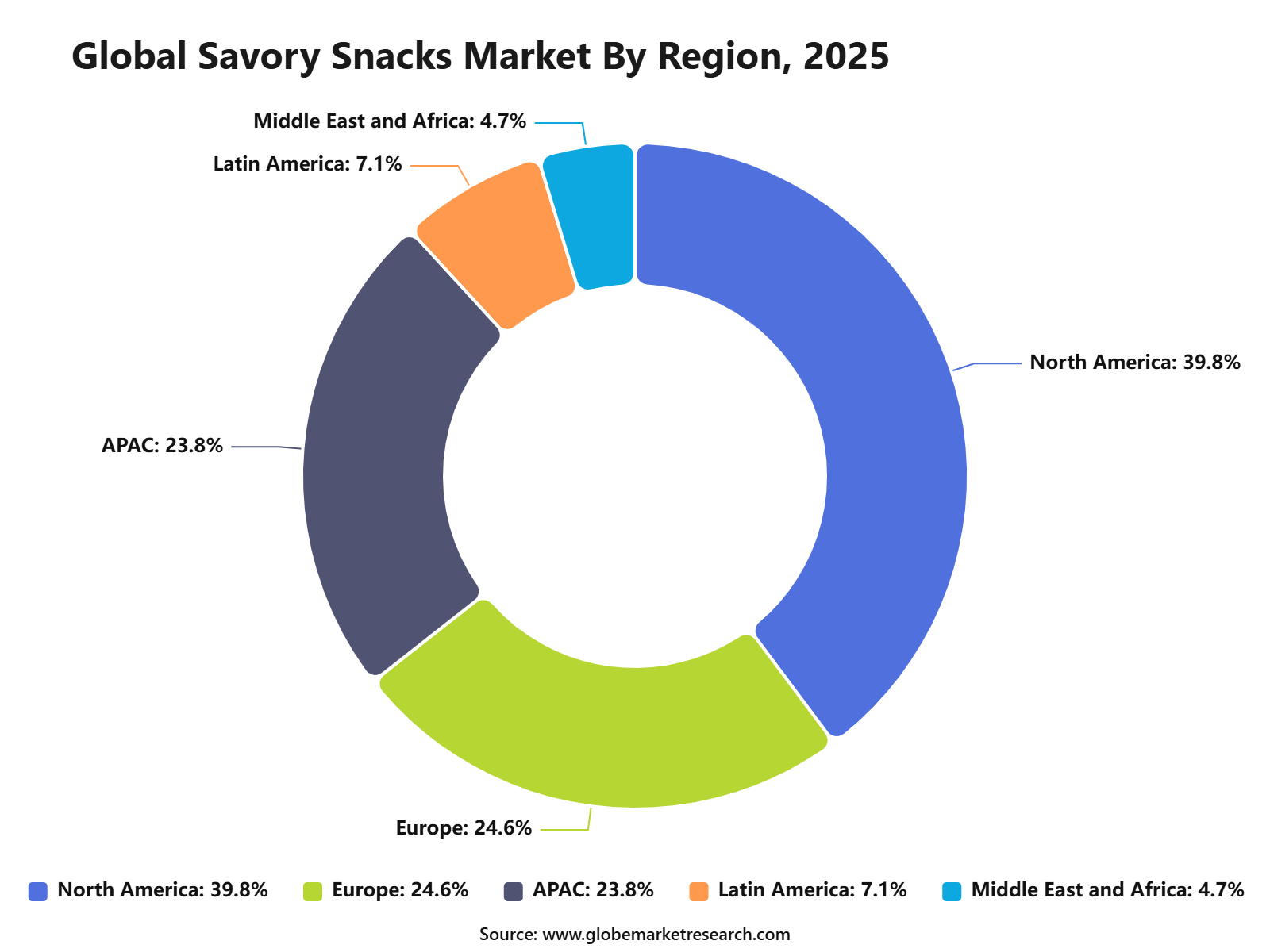
North America accounted for 39.8% share of the Savory Snacks Market, reaching USD 117.4 billion. The region’s leadership is supported by high snack consumption, strong convenience retail networks, established packaged food brands, and high demand for flavored, ready-to-eat snack products.
The United States and Canada are key contributors due to strong demand for chips, crisps, popcorn, pretzels, tortilla chips, meat snacks, nuts, and snack mixes. Consumers in the region prefer savory snacks for at-home consumption, social gatherings, sports viewing, travel, work breaks, and on-the-go eating.
North America is expected to maintain a strong position as brands continue to expand premium, spicy, baked, plant-based, and protein-enriched savory snacks. Demand will remain supported by supermarkets, hypermarkets, convenience stores, club stores, vending channels, and online grocery platforms.
 iThe graph shows projected market growth until 2035 based on CAGR analysis. Actual outcomes may vary depending on changing demand, competition, and economic factors.To gain greater insights - request a sample report PDF
Regional Impact Analysis
North America leads the Savory Snacks Market with 39.8% share in 2026, valued at around USD 117.5 billion, supported by high snack consumption, strong packaged food brands, wide retail distribution, and frequent product innovation. The U.S. remains the largest contributor due to strong demand for chips, popcorn, pretzels, crackers, meat snacks, and nut-based snacks.
Europe remains important because of demand for premium, clean-label, and portion-controlled snacks. Asia Pacific supports future growth through urbanization, rising disposable income, modern retail expansion, and increasing demand for localized savory snack flavors.
Impact Factor | Estimated CAGR Impact | Regional Relevance | Market Impact |
|---|---|---|---|
North America market leadership | +2.2% | North America, 39.8% share in 2026 | Leads global value demand. |
U.S. packaged snack culture | +1.6% | U.S. | Drives regional sales volume. |
Canada better-for-you snack demand | +1.1% | Canada | Supports premium product growth. |
Europe clean-label snack preference | +0.9% | UK, Germany, France, Italy | Adds value-led demand. |
Asia Pacific local flavor expansion | +0.8% | China, India, Japan, Southeast Asia | Builds future growth. |
Protein Snacks Drive Savory Growth
The most important factor in the Savory Snacks Market is the shift toward better-for-you snacking, led by protein, fiber, low sugar, low sodium, and convenient eating. In 2025, IFIC reported that consumers defined healthy food by good source of protein, 38%, low in sugar, 34%, good source of fiber, 28%, and low sodium, 28%, which directly supports reformulated chips, popcorn, pretzels, nuts, pulse snacks, and baked savory snacks.
For companies, the most important factors are protein enrichment, lower-sodium seasoning, clean-label ingredients, baked or roasted formats, and portion-controlled packs. In 2025, According to the industry report, U.S. ready-to-eat protein category at USD 7.7 billion, with 8% sales growth, while protein snacks grew 47.5%, showing that savory snacks with functional nutrition are becoming a strong product development path.
Go-To-Market and Sales Economics
Savory snack producers should combine supermarkets, convenience stores, foodservice outlets, and mass retailers within one account strategy. U.S. retail and food-services sales reached USD 763.7 billion in May 2026, increasing 6.9% year over year. Retailer-specific pack sizes, dependable replenishment, checkout placement, and promotional planning can improve shelf rotation and repeat purchases.
Online channels should be developed for multipacks, variety boxes, subscriptions, and limited-edition flavors. U.S. retail e-commerce sales reached USD 326.7 billion in the first quarter of 2026 and represented 16.9% of total retail sales. First-party consumer data, targeted offers, and efficient parcel packaging can strengthen retention while reducing dependence on physical shelf space.
Convenience retail remains important for single-serve chips, pretzels, nuts, popcorn, and extruded snacks. The United States had 151,975 convenience stores at the end of 2025, while merchandise and foodservice generated 35.0% of average store sales and 57.4% of gross profit. Strong distributor coverage and impulse-focused merchandising can expand sales per outlet.
Risk Factors & Market Barriers
Cooking-oil inflation presents a direct margin risk because frying represents a major variable cost. USDA forecasts the 2026/27 U.S. soybean-oil price at 70 cents per pound and canola oil at 78 cents, up 11% year over year. Flexible oil formulations, forward contracts, and controlled fryer usage can reduce exposure without weakening texture or flavor.
Corn supply conditions require careful procurement across tortilla chips, corn puffs, and other extruded products. USDA estimated 95.3 million planted corn acres in 2026, down 3%, while June stocks reached 5.29 billion bushels, up 14%. Manufacturers should balance harvest contracts, inventory coverage, and recipe flexibility because acreage and available stocks are moving in different directions.
Packaging compliance will create redesign, testing, and documentation costs for bags, trays, films, labels, and multipacks. The European Union’s Packaging and Packaging Waste Regulation will generally apply from 12 August 2026 and covers all packaging. Producers must improve recyclability and material efficiency without reducing barrier protection, seal strength, freshness, transport durability, or production-line speed.
Revenue Potential Analysis
Revenue Landscape Across
North America provides large-scale revenue through potato chips, tortilla chips, pretzels, popcorn, nuts, and mixed snack platforms. PepsiCo Foods North America generated USD 6.33 billion in first-quarter 2026 revenue, with reported sales increasing 2% and convenient-food volume rising 2%. Affordable packs, flavor innovation, and wider distribution can support further account growth.
Europe, the Middle East, and Africa offer revenue through local flavors, premium formats, sharing packs, and affordable single-serve products. PepsiCo’s EMEA segment recorded USD 2.82 billion in first-quarter 2026 revenue, increasing 18% on a reported basis. Local manufacturing, halal compliance, regional seasoning systems, and retailer-specific ranges can improve availability and commercial relevance.
Latin America and Asia Pacific provide expansion opportunities through urban retail, traditional trade, convenience channels, and localized seasoning profiles. PepsiCo reported first-quarter 2026 food revenue of USD 1.93 billion in Latin America and USD 1.14 billion in Asia Pacific. Smaller packs, local sourcing, heat-resistant packaging, and distributor incentives can improve reach and affordability.
Financial Impact
Scale and productivity can support strong earnings when volume growth is combined with disciplined pricing. PepsiCo Foods North America produced USD 1.43 billion in reported operating profit during the first quarter of 2026, although profit declined 7%. Manufacturers should measure contribution by brand, pack size, channel, and promotion to prevent revenue growth from masking weaker unit economics.
Demand softness and inflation can quickly weaken snack profitability. Campbell’s Snacks generated USD 940 million in fiscal third-quarter 2026 sales and USD 95 million in operating earnings. Sales fell 4%, while operating earnings declined 32%, demonstrating the financial importance of volume recovery, supply-chain productivity, price realization, and disciplined marketing investment.
Cash generation determines how much can be invested in new flavors, packaging lines, automation, and distribution capacity. Campbell’s generated USD 839 million of operating cash flow during the first nine months of fiscal 2026 and spent USD 297 million on capital projects. Cost savings reached USD 200 million toward a fiscal 2028 target of USD 375 million.
Drivers Impact Analysis
The Savory Snacks Market is driven by rising demand for convenient snacking, busy lifestyles, flavor innovation, retail expansion, and growing consumption of chips, crackers, popcorn, nuts, seeds, pretzels, and extruded snacks. Consumers are using savory snacks for quick hunger relief, social occasions, travel, office breaks, and entertainment.
North America leads the market due to strong snack culture, wide supermarket and convenience store penetration, high demand for branded packaged foods, and strong product innovation. The U.S. remains the main regional contributor because of large consumption of potato chips, tortilla chips, popcorn, meat snacks, and better-for-you salty snacks.
Impact Factor | Estimated CAGR Impact | Regional Relevance | Market Impact |
|---|---|---|---|
Rising demand for convenient snacks | +2.0% | North America, Europe, Asia Pacific | Drives regular savory snack consumption. |
Growth in flavor innovation | +1.6% | U.S., Canada, Europe, Asia Pacific | Supports repeat purchases. |
Strong retail and convenience channels | +1.4% | North America and developed markets | Improves product reach. |
Increasing at-home entertainment snacking | +1.1% | U.S., Canada, Europe | Builds multipack and sharing demand. |
Premium and better-for-you snack demand | +0.9% | Urban and health-focused consumers | Adds value growth. |
Restraints Impact Analysis
The market faces restraints from health concerns around sodium, fat, calories, artificial ingredients, and ultra-processed foods. Many consumers are reducing traditional salty snacks or shifting toward baked, low-sodium, high-protein, or natural alternatives.
Another restraint is ingredient and packaging cost volatility. Potatoes, corn, wheat, edible oils, nuts, seasoning ingredients, and flexible packaging materials can affect production cost and retail pricing.
Impact Factor | Estimated CAGR Impact | Regional Relevance | Market Impact |
|---|---|---|---|
Sodium and fat health concerns | -0.9% | North America, Europe, urban Asia | Pressures reformulation. |
Ingredient cost volatility | -0.8% | Global snack producers | Affects margins and pricing. |
Competition from fresh and healthy snacks | -0.6% | Developed consumer markets | Limits some traditional snack demand. |
Private-label price competition | -0.5% | Retail-driven markets | Reduces pricing power. |
Packaging sustainability pressure | -0.4% | North America and Europe | Raises material innovation cost. |
Opportunities Impact Analysis
Opportunities are strong in baked snacks, air-popped snacks, low-sodium chips, high-protein snacks, nut and seed mixes, popcorn, vegetable chips, lentil snacks, chickpea snacks, and portion-controlled packs. These products benefit from demand for taste, convenience, and healthier positioning.
Higher-value opportunities are emerging in global flavors, spicy snacks, clean-label ingredients, premium tortilla chips, meat snacks, functional snacks, and sustainable packaging. Brands that combine taste, crunch, nutrition, affordability, and strong shelf visibility can capture stronger demand.
Impact Factor | Estimated CAGR Impact | Regional Relevance | Market Impact |
|---|---|---|---|
Better-for-you savory snacks | +1.9% | North America, Europe, Asia Pacific | Builds premium demand. |
High-protein and nut-based snacks | +1.5% | U.S., Canada, Europe | Supports functional snacking. |
Spicy and global flavor innovation | +1.3% | North America and urban markets | Improves consumer engagement. |
Portion-controlled multipacks | +1.0% | Household and school snack markets | Supports daily consumption. |
Sustainable packaging formats | +0.8% | Developed packaged food markets | Strengthens brand positioning. |
Challenges Impact Analysis
The main challenge is balancing taste, health, and price. Consumers want bold flavors and satisfying texture, but they also check sodium, oil type, calories, ingredient lists, protein, fiber, and portion size.
Another challenge is maintaining quality across high-volume production and distribution. Savory snacks must remain crisp, fresh, flavorful, and visually appealing across storage, transport, retail shelves, and e-commerce delivery.
Impact Factor | Estimated CAGR Impact | Regional Relevance | Market Impact |
|---|---|---|---|
Balancing taste and nutrition | -0.8% | Global consumer markets | Affects repeat purchase. |
Maintaining crispness and freshness | -0.7% | Packaged snack manufacturers | Influences product quality. |
Managing oil and seasoning consistency | -0.6% | Chips, extruded snacks, crackers | Impacts taste and brand trust. |
Retail shelf competition | -0.5% | Supermarkets and convenience stores | Limits brand visibility. |
Meeting packaging waste expectations | -0.4% | North America and Europe | Requires material upgrades. |
Segment Covered in the Report
By Product Type
Chips & Crisps
Nuts
Seeds & Trail Mixes
Savory Biscuits & Crackers
Puffed Snacks
Others
By Flavor Profile
Flavored
Plain
By Category
Conventional
Free-From
By Distribution Channel
Supermarkets & Hypermarkets
Convenience Stores
Online Retail
Specialty Stores
Others
By Region
North America
Europe
Asia Pacific
Latin America
Middle East and Africa
Market Trend Analysis
The market trend is moving toward bold flavors, baked and air-popped snacks, protein-rich products, clean-label claims, premium ingredients, and portion-controlled packs. Consumers are choosing savory snacks for everyday eating, social sharing, lunchboxes, movie nights, and travel occasions.
North America remains the largest value region because of mature snack habits, strong brand portfolios, large retail networks, and high demand for innovation. Europe supports clean-label and premium demand, while Asia Pacific is expanding through urbanization, modern retail, and localized flavor preferences.
Impact Factor | Estimated CAGR Impact | Regional Relevance | Market Impact |
|---|---|---|---|
Bold and spicy flavor trends | +1.8% | North America, Asia Pacific, Latin America | Supports new product launches. |
Baked and air-popped snacks grow | +1.4% | Health-focused markets | Improves better-for-you appeal. |
Premium tortilla and potato chips expand | +1.1% | U.S., Canada, Europe | Adds value growth. |
Clean-label snack demand rises | +0.9% | North America and Europe | Improves consumer trust. |
Sharing packs and multipacks increase | +0.7% | Retail and household channels | Supports higher basket value. |
Investor Type Impact Matrix
Investors should focus on companies with strong retail distribution, flavor innovation, manufacturing scale, brand loyalty, and exposure to better-for-you snack categories. Taste, texture, price, packaging, and shelf visibility are key success factors.
Strategic investors can also target savory snack brands, private-label manufacturers, seasoning suppliers, nut and seed processors, popcorn producers, baked snack companies, and packaging innovators. Companies that combine strong flavor appeal with health-focused reformulation are better positioned for long-term growth.
Investor Type | Estimated CAGR Impact | Regional Relevance | Market Impact |
|---|---|---|---|
Savory Snack Manufacturers | +1.5% | Global | Expands core packaged snack supply. |
Better-for-You Snack Brands | +1.2% | North America, Europe, Asia Pacific | Supports premium growth. |
Private-Label Snack Producers | +1.0% | Retail-driven markets | Builds value segment demand. |
Seasoning and Ingredient Suppliers | +0.8% | Snack manufacturing supply chains | Supports flavor innovation. |
Strategic Consumer Food Investors | +0.6% | Global snack markets | Funds brand and channel expansion. |
Recent Developments
In May 2026, Kraft Heinz’s Ore-Ida launched Dino and Star Tater Tots, its first new shapes in nearly twenty years, extending the potato-snack portfolio for families, children, and convenience-focused household meal occasions.
In March 2026, General Mills agreed to sell its Brazilian business, including the Yoki snack and food portfolio, to 3corações, continuing portfolio reshaping, operational simplification, and resource prioritization across its global operations.
In March 2026, Calbee announced new corn-snack production lines at its Hiroshima Hatsukaichi factory, increasing Japan Frito-Lay capacity for Mike Popcorn, Doritos, and related products by approximately 50% while improving domestic supply resilience.
In January 2026, The Campbell’s Company announced closure of its Hyannis plant and consolidation of Cape Cod and Kettle Brand potato-chip production into larger, more efficient United States facilities within its snacks network.
Competitive Landscape
The market is characterized by intense competition among established players and emerging companies. Strategic partnerships, mergers and acquisitions, and product innovation are key strategies employed by market participants.
Key Market Players
PepsiCo
Kellogg Company
General Mills
Mondelez International
The Kraft Heinz Company
Calbee Inc.
Conagra Brands
ITC Limited
Grupo Bimbo
Campbell Soup Company
Utz Brands
Intersnack Group
Nestlé S.A.
Hain Celestial Group
Haldiram’s
Other Key Players
Research Methodology
This market study is prepared using a combination of primary and secondary research. Primary research includes discussions with manufacturers, suppliers, distributors, consultants, industry experts, and end users. Secondary research covers company reports, government databases, trade associations, technical publications, regulatory sources, and trusted industry documents. The collected information is used to assess market demand, pricing trends, technology adoption, competitive activity, and regional performance.
AI language models are not used as primary data sources, and publicly available AI-generated content is not treated as market evidence. Computational tools may be used to support data processing, translation, data classification, and pattern identification. However, every published assessment is supported by verified sources, human review, and primary market discussions.
Market estimates are developed through top-down and bottom-up approaches and validated using data triangulation. Revenue, production, shipment, pricing, and application-level data are compared across multiple sources. Forecasts consider economic conditions, regulatory changes, investment activity, innovation, supply chain developments, and industry risks. All findings are reviewed through source verification and internal quality checks before publication.
Part I
Source Management & Input Data Standards
Who provides data, how sources are qualified, and what types of evidence are admissible.
Part II
Research Scope & Market Coverage
How we define the markets we assess and the parameters that govern each product.
Part III
Data Collection, Verification & Submission
The mechanics of gathering, cross-checking, and hierarchically ranking evidence.
Part IV
Assessment Determination & Quality Controls
How raw data becomes a published assessment — normalisation, expert judgement, and outlier exclusion.
Part V
Publication, Corrections & Revision
Our publication schedule, corrections policy, and methodology review cycle.
Part VI
Independence, Ethics & Complaints
Conflict-of-interest policies, editorial independence, and how clients raise concerns.
Google · Preferred Sources
Don't miss the latest market research insights and industry updates on Google.
Add Globe Market Research as a preferred source in the Google app to see our reports, analysis, and market stories in your news suggestions.
Meet the Team
This report was prepared by our expert analysts with deep industry knowledge and research experience.
Pratiksha K. is a Senior Research Analyst with more than five years of experience in market research, industry analysis, competitive intelligence, and business strategy. She has contributed to detailed market reports, customized research studies, company profiling, market sizing, trend analysis, and strategic consulting projects for clients across different regions. Her industry expertise covers Chemical and Material, Consumer Goods, Food & Beverages and Energy & Power. She closely evaluates changing customer requirements, technology developments, regulatory conditions, supply chain structures, investment activity, and competitive strategies to provide clear and practical market insights.
Sayali brings more than 7 years of experience to Globe Market Research, supporting the accuracy, clarity, and relevance of research content across multiple industries. She reviews market data, segment analysis, competitive insights, and industry trends to ensure each report meets strong quality standards and provides practical value to business decision-makers. Her expertise spans healthcare, information technology, consumer goods, and diverse cross-industry domains. With a strong focus on data reliability, structured analysis, and clear presentation, Sayali helps ensure that each research output delivers well-reviewed insights for clients, investors, consultants, and industry stakeholders.
Frequently Asked Questions
Related Reports
More in Food and Beverages
Frozen Desserts Market to Hit USD 298.8 Billion by 2035
Frozen Desserts Market Size, Share, Analysis By Product (Ice Cream, Frozen Yogurt, Gelato, Sorbet, Frozen Cakes, Other Products), By Consumption (Retail Consumption, Foodservice Consumption), By Distribution Channel (Supermarkets and Hypermarkets, Convenience Stores, Specialty Stores, Online Retail), By Regional Insights, Business plan and Project Report, Investment Opportunities, Profitability, Industry Trends, Leading Companies and Growth Forecasts by 2026-2035
Frozen Meat and Seafood Market to Hit USD 181.1 Billion by 2035
Frozen Meat and Seafood Market Size, Share, Analysis By Product (Frozen Meat, Frozen Seafood), By Seafood Form (Whole, Fillets, Processed Seafood, Other Forms), By Seafood End Use (Retail and Household, Foodservice, Industrial), By Regional Insights, Business plan and Project Report, Investment Opportunities, Profitability, Industry Trends, Leading Companies and Growth Forecasts by 2026-2035
Frozen Meals Market to Hit USD 74.2 Billion by 2035
Frozen Meals Market Size, Share, Analysis By Product (Frozen, Chilled, Canned, Shelf-Stable), By Meal Type (Vegetarian, Non-Vegetarian, Vegan), By Distribution Channel (Supermarkets and Hypermarkets, Online Retail, Convenience Stores, Specialty Stores), By Regional Insights, Business plan and Project Report, Investment Opportunities, Profitability, Industry Trends, Leading Companies and Growth Forecasts by 2026-2035
Food Colorants Market to Hit USD 8.6 Billion by 2035
Food Colorants Market Size, Share, Analysis By Type (Natural, Synthetic, Nature-Identical), By Form (Powder, Liquid, Gel), By Application (Beverages, Bakery and Confectionery, Dairy, Meat Products, Snacks, Other Applications), By Regional Insights, Business plan and Project Report, Investment Opportunities, Profitability, Industry Trends, Leading Companies and Growth Forecasts by 2026-2035