

Revenue, 2025
USD 6.9 Bn
Forecast, 2035
USD 68.5 Bn
CAGR, 2025-2035
25.8%
Report Coverage
Global
Market Size and Forecast
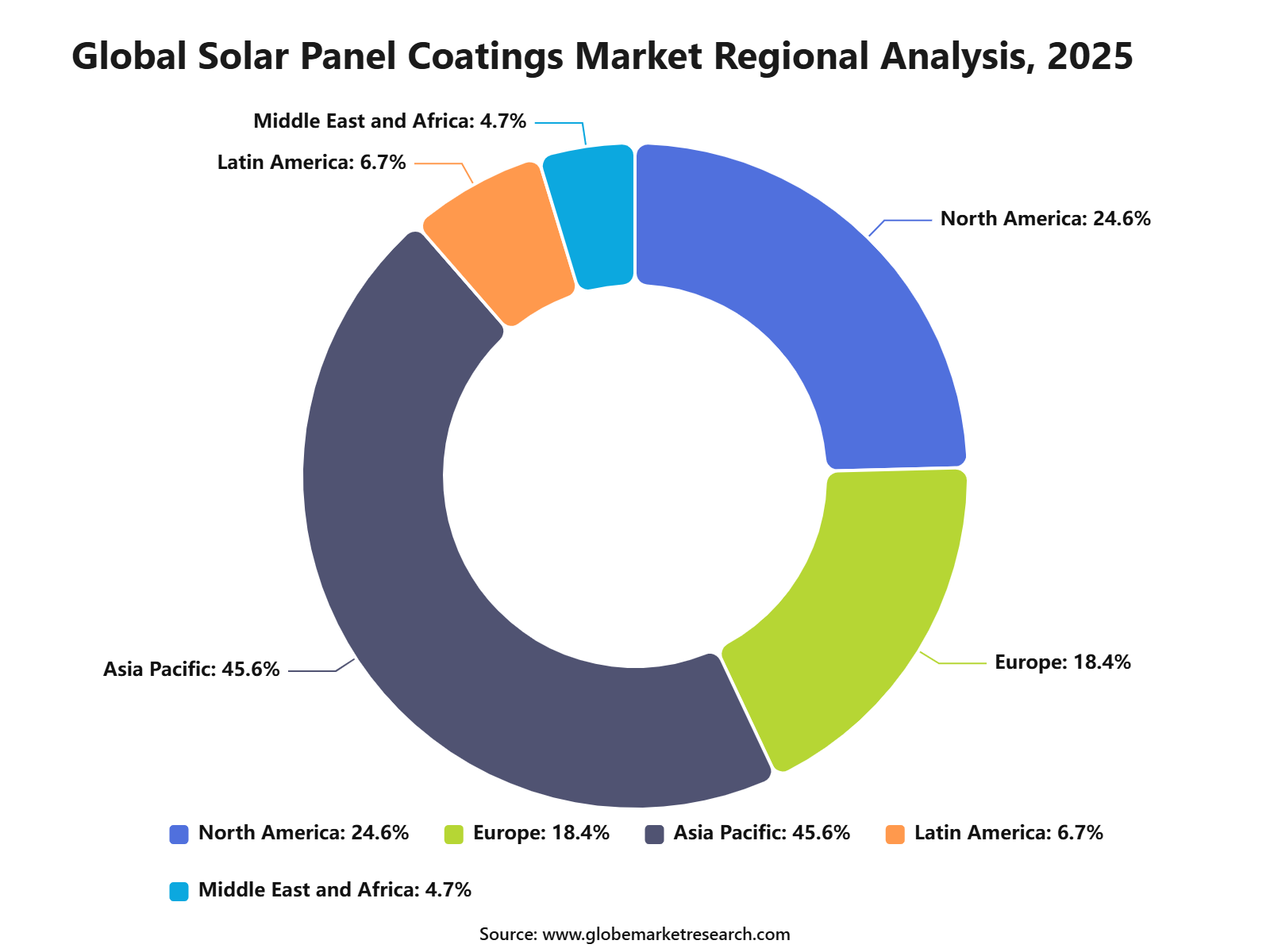
The Global Solar Panel Coatings Market was worth USD 6.9 billion in 2025 and is expected to reach USD 68.5 billion by 2035, growing at a CAGR of 25.8% from 2025 to 2035. Based on this growth rate, the market is estimated to reach around USD 13.1 billion in 2026. Asia Pacific held the largest regional share of 45.6% in 2025, valued at around USD 3.1 billion, supported by large solar module production, utility-scale solar installations, rooftop PV growth, and rising demand for high-efficiency photovoltaic systems.
The Solar Panel Coatings Market includes protective and performance-enhancing coatings applied to photovoltaic panels to improve light absorption, reduce dust buildup, prevent reflection, and protect surfaces from moisture, UV exposure, abrasion, and harsh weather. These coatings include anti-reflective, self-cleaning, hydrophobic, anti-soiling, anti-corrosion, and transparent conductive coatings. The market is closely linked with solar panel efficiency, module durability, clean energy deployment, and long-term power output.
Key Parameter | Report Details |
|---|---|
Market Revenue, 2025 | USD 6.9 Billion |
Projected Revenue, 2035 | USD 68.5 Billion |
CAGR (2025-2035) | 25.8% |
Largest Region | Asia Pacific (45.6%, USD 3.1 Bn) |
Fastest Growing Region | North America |
Market Concentration | Medium |
Base Year | 2024 |
Forecast Period | 2025-2035 |
The market outlook remains strong as solar project developers and panel manufacturers focus on improving energy yield and reducing maintenance costs. Growth can be attributed to rising solar capacity additions, demand for longer module life, and increasing use of coatings that improve performance in dusty, humid, and high-temperature regions. The expansion of Asia Pacific solar manufacturing, advanced coating materials, and large renewable energy projects is expected to support long-term market demand.
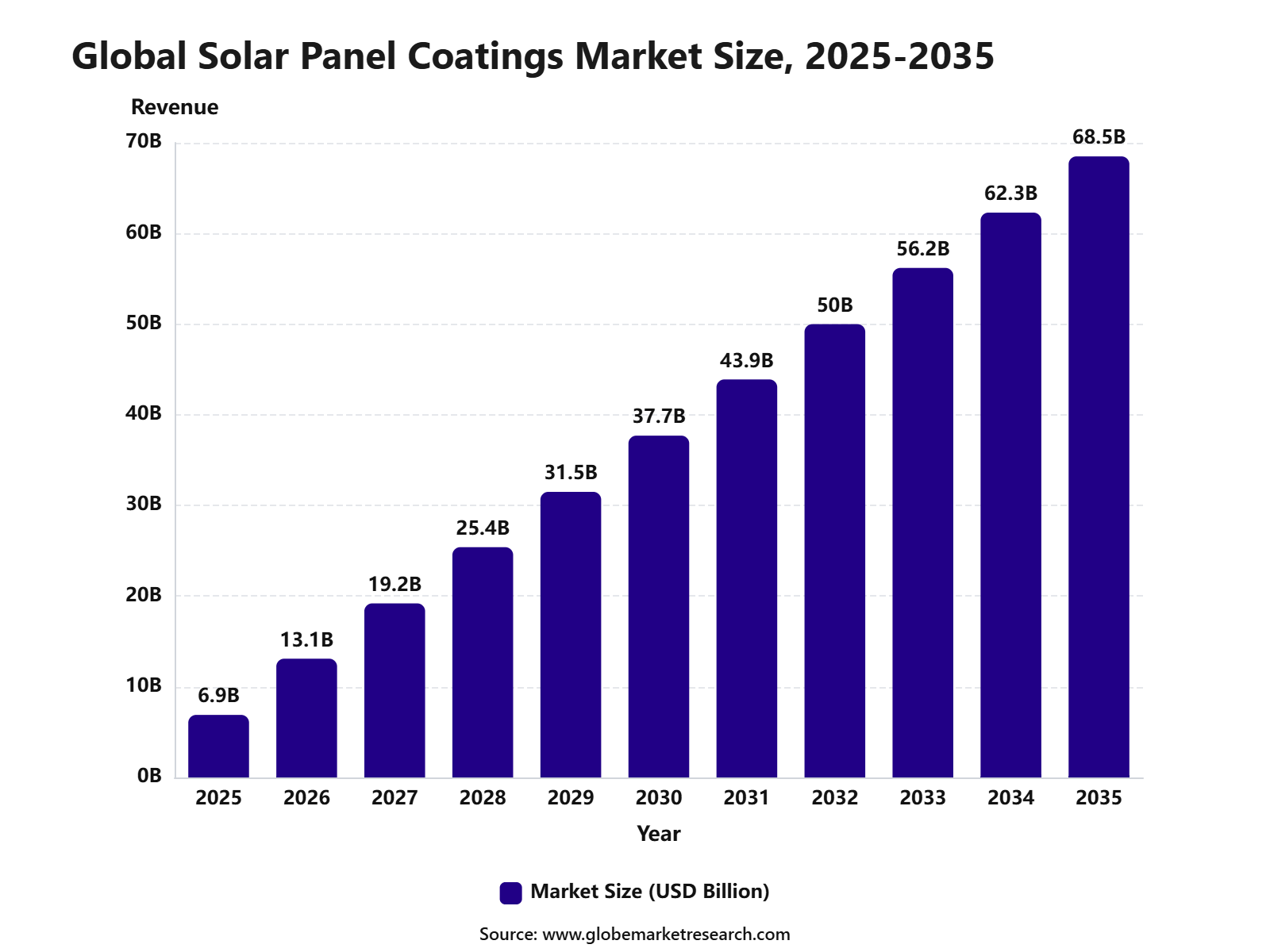 iThe graph shows projected market growth until 2035 based on CAGR analysis. Actual outcomes may vary depending on changing demand, competition, and economic factors.To gain greater insights - request a sample report PDF
Key Market Insights
Anti-reflective coatings led the coating type segment with 43.5% share, supported by their ability to reduce light reflection, improve solar absorption, and increase panel energy output.
Silicon-based coatings accounted for 47.3% share by material type, driven by their strong durability, weather resistance, and compatibility with widely used solar panel technologies.
Commercial applications held 40.9% share, supported by rising solar installations across offices, warehouses, industrial facilities, malls, and institutional buildings.
Solar panel manufacturers captured 45.3% share by end user, driven by growing demand for performance-enhancing coatings that improve panel efficiency, surface protection, and long-term reliability.
Asia Pacific led the solar panel coatings market with 45.6% share, valued at USD 3.1 billion, supported by large solar manufacturing capacity, expanding renewable energy projects, and strong demand across China, India, Japan, and Southeast Asia.
Top Funding and Investment
Top Investments
Hanwha Solutions announced that it would invest KRW 100 billion in a pilot production line for perovskite tandem solar cells. The wider investment plan also includes KRW 800 billion for solar manufacturing expansion, including TOPCon conversion and future tandem mass production. This is relevant to solar panel coatings because perovskite tandem cells use thin functional layers applied over silicon cells to improve light conversion efficiency.
Sekisui Chemical advanced its film-type perovskite solar cell production plan, with the first 100 MW production line linked with an investment level of about JPY 90 billion. The company’s scale-up plan is focused on flexible perovskite solar films, which are made through thin-film coating and deposition processes. This supports next-generation coating-based solar panel technology for rooftops, building surfaces, and lightweight installations.
BC Jindal Group announced the first phase of a larger renewable component manufacturing plan, with about Rs 4,000 crore targeted initially. The plan includes 1,200 tonnes per day of solar glass capacity, along with 2 GW solar cell and module capacity and 4 GWh battery storage. The solar glass capacity is important for the coatings market because anti-reflective and anti-soiling coatings are applied on solar glass to improve module performance and durability.
Gold Plus Glass announced a major solar glass manufacturing expansion in Karnataka with a total project investment of about Rs 2,500 crore. The facility includes solar glass manufacturing capacity of 109,500 metric tons per year. This strengthens the coated solar glass supply chain, as solar glass is the base material used for anti-reflective and weather-resistant coating applications in PV modules.
Borosil Renewables planned to invest about Rs 900 crore to expand solar glass capacity at Bharuch, Gujarat, from 6.5 GW to 10 GW by July 2026. The company offers solar glass with anti-reflective coating and anti-soiling coating, and its AR-coated solar glass is designed to provide transmission beyond 94%. This makes the expansion directly relevant to coated solar glass supply for PV modules.
Top Funding Developments
Tandem PV raised USD 50 million through Series A funding and debt financing. The funding is being used to commercialize U.S.-made perovskite solar modules, which use a perovskite layer over conventional silicon to improve panel efficiency. This funding supports one of the most direct coating-based technology routes in solar panels.
Dazheng Micro-Nano completed more than RMB 100 million in Series A3 financing. The funding is being used to accelerate construction of a 100 MW flexible perovskite thin-film solar cell production line in Xiamen. The company’s technology is relevant to solar panel coatings because flexible perovskite cells depend on thin-film coating processes rather than conventional rigid crystalline silicon module production alone.
Perovskia Solar received a €2.25 million EIC Accelerator grant, equal to about CHF 2.1 million or USD 2.4 million. The company said the funding would support efficiency improvements, automated manufacturing scale-up, durability testing, and IP expansion for its custom perovskite photovoltaic cells. The funding is relevant to coated solar technologies because perovskite PV uses thin light-absorbing layers suitable for indoor, IoT, and low-light applications.
Top Acquisition
g-neration.energy acquired Kromatix Glass Tech SA and restarted production of Kromatix coloured solar glass. What it acquired included trademark rights, technology, and patents for high-performance coloured solar glass, including a specialized glass coating process for building-integrated photovoltaics. Production capacity was stated at up to 400 m² per week for fully tempered safety glass and 500 m² per week for heat-strengthened safety glass.
By Coating Type
Anti-reflective coatings accounted for 43.5% share of the Solar Panel Coatings Market. This leading position is supported by their ability to reduce light reflection and increase the amount of sunlight absorbed by solar cells.
These coatings are widely used on photovoltaic glass to improve module efficiency and energy output. By allowing more light to pass through the panel surface, anti-reflective coatings help improve power generation, especially in commercial and utility-scale solar installations.
Demand is expected to remain strong as solar panel manufacturers focus on higher module performance and better long-term returns. The growing need for efficient solar systems across rooftops, solar farms, and commercial facilities will continue to support this coating type.
By Material Type
Silicon-based coatings held 47.3% share of the Solar Panel Coatings Market. This dominance is driven by their strong durability, optical clarity, weather resistance, and compatibility with photovoltaic glass and silicon-based solar modules.
These coatings are preferred because they can improve surface protection while supporting better light transmission. Silicon-based materials are widely used in anti-reflective, hydrophobic, self-cleaning, and protective coating systems for solar panels.
The segment is expected to maintain strong demand as solar installations increase in harsh outdoor environments. Their ability to protect panels from dust, moisture, UV exposure, and temperature changes supports longer module life and better energy performance.
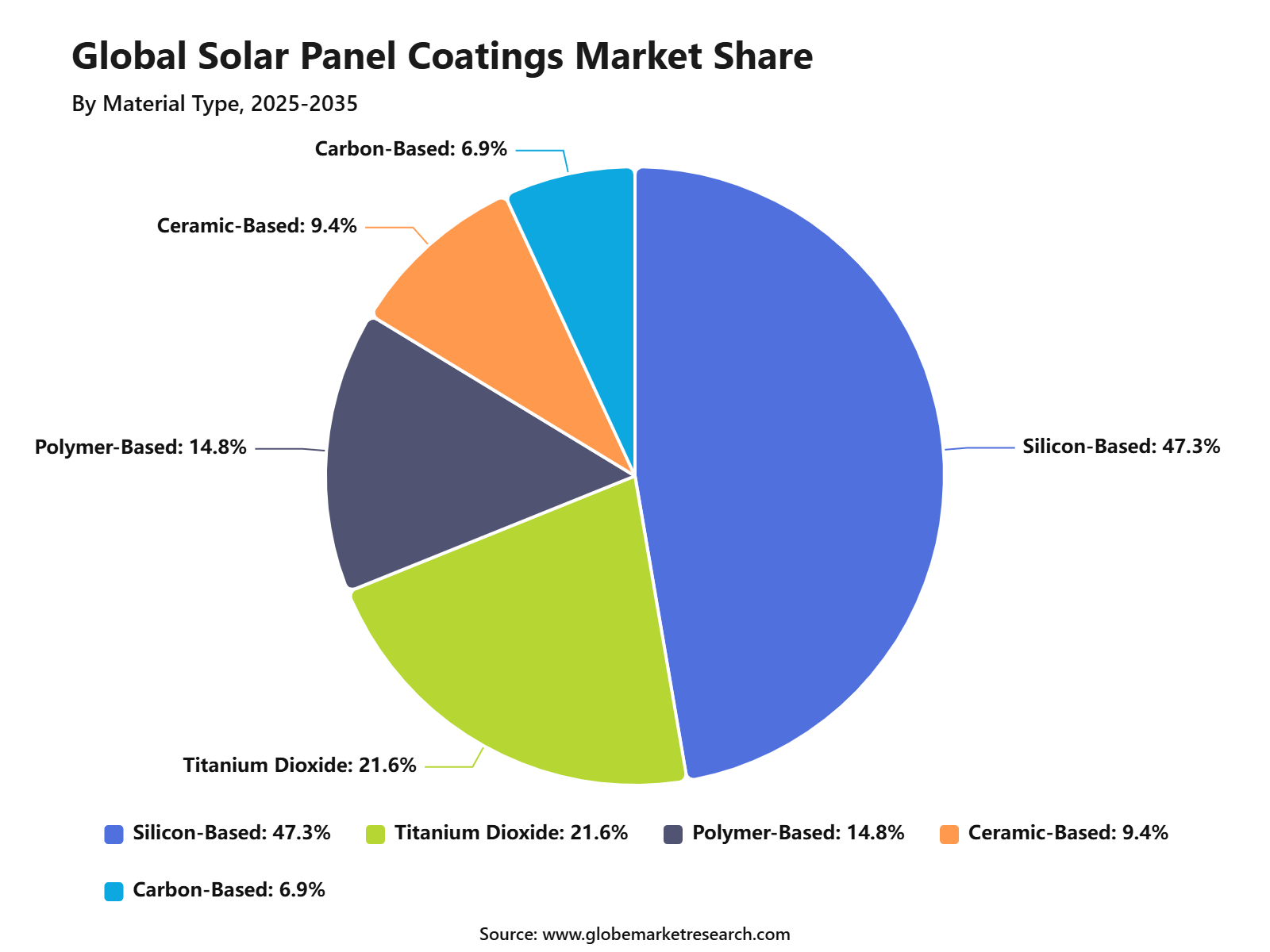 iThe graph shows projected market growth until 2035 based on CAGR analysis. Actual outcomes may vary depending on changing demand, competition, and economic factors.To gain greater insights - request a sample report PDF
By Application
Commercial applications accounted for 40.9% share of the Solar Panel Coatings Market. This leading share is supported by rising solar adoption across offices, factories, warehouses, malls, schools, hospitals, and other commercial buildings.
Solar panel coatings are important in commercial systems because these projects require stable power generation and lower maintenance costs. Anti-reflective and protective coatings help improve energy output, reduce dust buildup, and extend panel performance over time.
The segment is expected to remain a major demand area as businesses invest in rooftop solar, energy savings, and lower carbon operations. Commercial users are increasingly choosing coated solar panels to improve system efficiency and reduce long-term operating expenses.
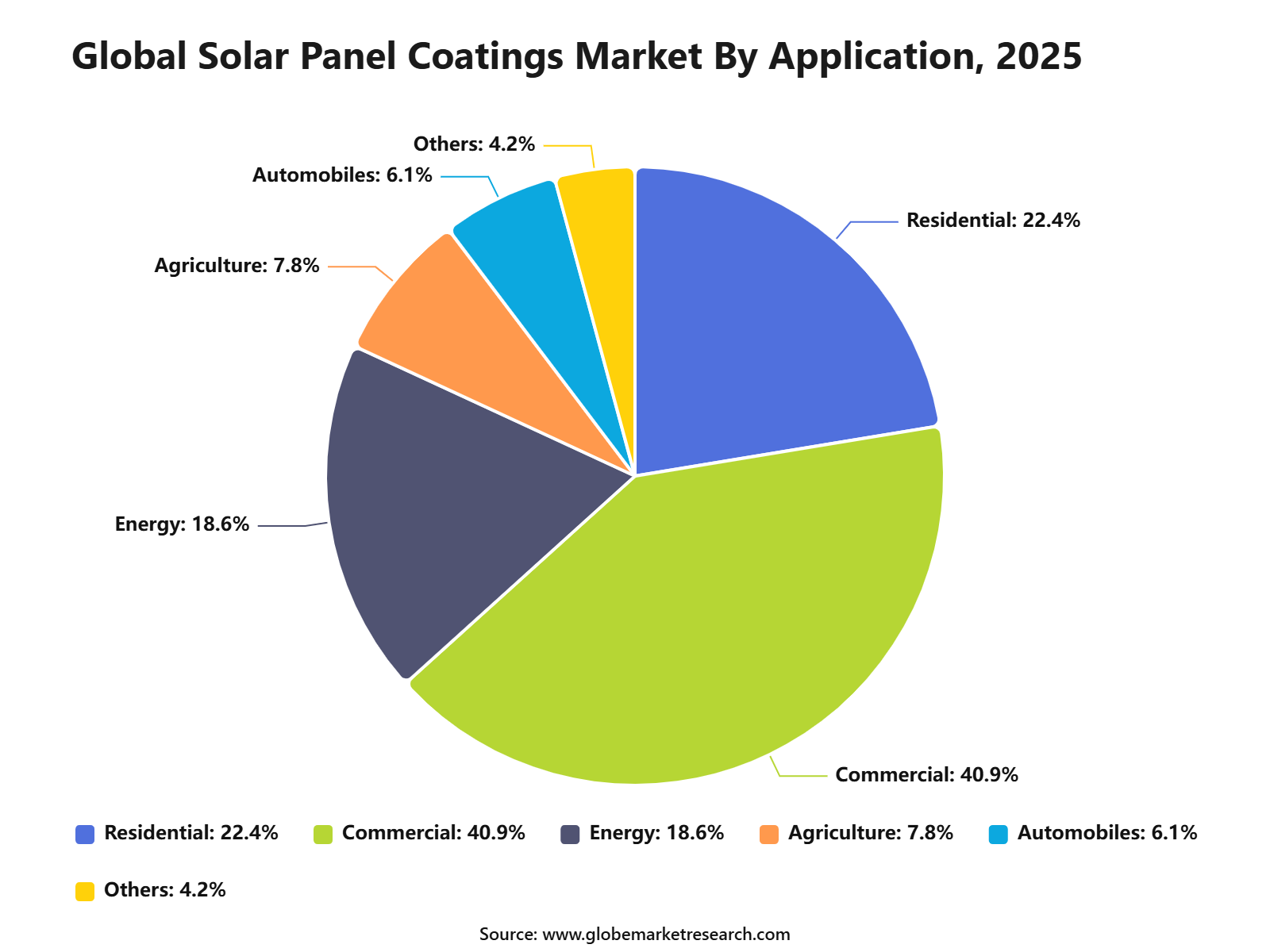 iThe graph shows projected market growth until 2035 based on CAGR analysis. Actual outcomes may vary depending on changing demand, competition, and economic factors.To gain greater insights - request a sample report PDF
By End User
Solar panel manufacturers accounted for 45.3% share of the Solar Panel Coatings Market. This leading position is supported by the direct use of coatings during module production to improve panel efficiency, durability, and surface protection.
Manufacturers apply coatings to improve light capture, reduce soiling, protect glass surfaces, and increase resistance to weather-related damage. These coatings help strengthen module quality and support better performance warranties in competitive solar markets.
Demand from solar panel manufacturers is expected to remain strong as module producers focus on efficiency gains and product differentiation. The need for high-performance panels across residential, commercial, and utility projects will continue to support coating adoption at the manufacturing stage.
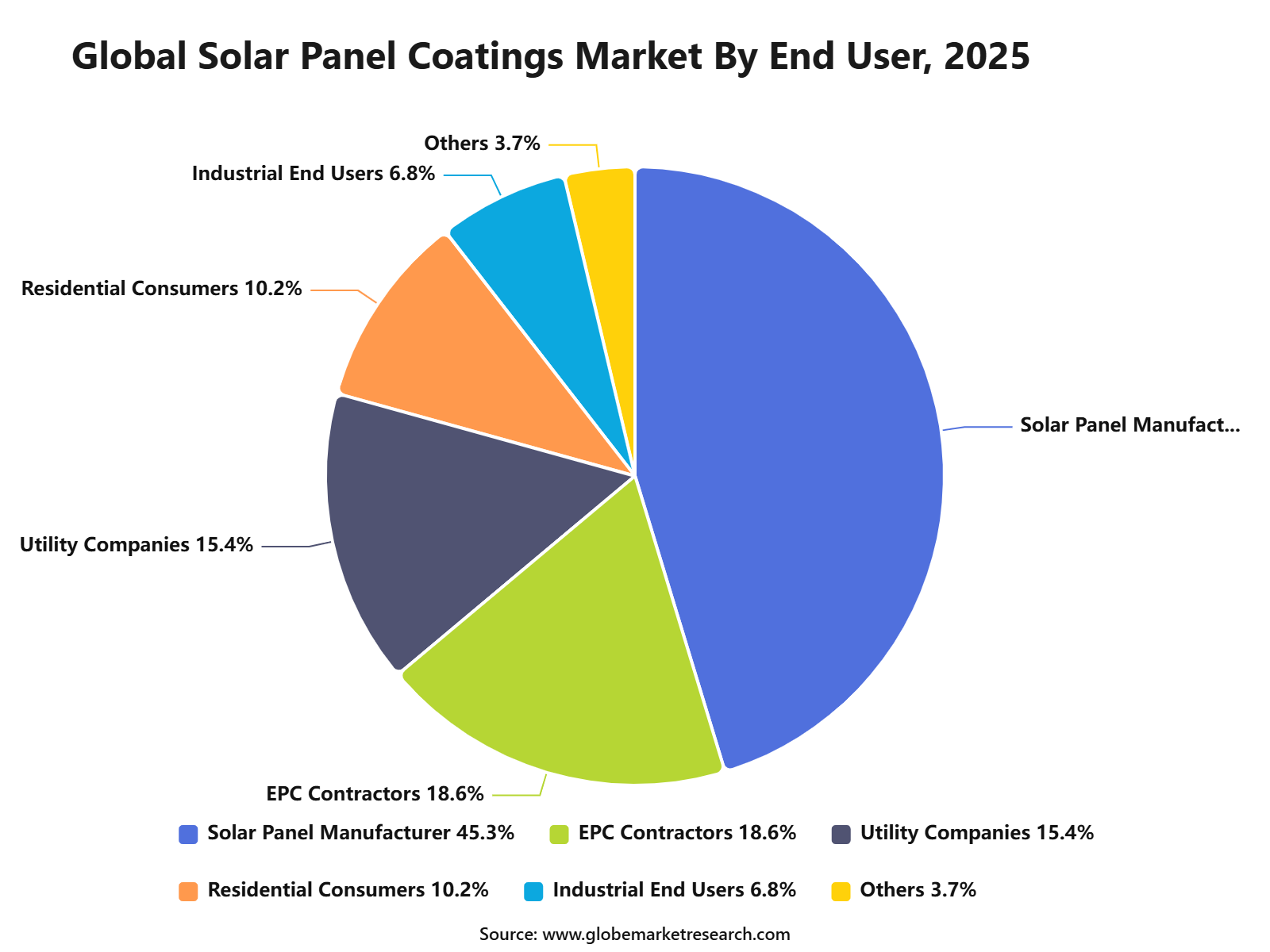 iThe graph shows projected market growth until 2035 based on CAGR analysis. Actual outcomes may vary depending on changing demand, competition, and economic factors.To gain greater insights - request a sample report PDF
By Region
Asia Pacific accounted for 45.6% share of the Solar Panel Coatings Market, reaching USD 3.1 billion. The region’s leadership is supported by strong solar panel manufacturing, large-scale solar installations, and rising renewable energy investment across major economies.
China, India, Japan, South Korea, Australia, and Southeast Asian countries are key contributors to regional demand. The region benefits from large photovoltaic production capacity, growing rooftop solar adoption, and strong government support for clean power expansion.
Asia Pacific is expected to maintain its leading position as solar manufacturing and deployment continue to rise. Demand for anti-reflective, silicon-based, self-cleaning, and protective coatings will remain strong as producers and project developers focus on higher efficiency and longer panel life.
 iThe graph shows projected market growth until 2035 based on CAGR analysis. Actual outcomes may vary depending on changing demand, competition, and economic factors.To gain greater insights - request a sample report PDF
Regional Impact Analysis
Asia Pacific leads the Solar Panel Coatings Market with 45.6% share in 2025, valued at around USD 3.1 billion, supported by large solar module production, rising PV installations, and strong demand for high-efficiency solar technologies. China and India remain major regional contributors due to solar manufacturing scale and large renewable energy deployment.
North America remains important because of utility-scale solar farms, rooftop solar adoption, and growing demand for coatings that improve panel output and reduce cleaning costs. Europe supports value growth through renewable energy targets, premium solar modules, building-integrated solar, and sustainability-focused power projects.
Go-To-Market and Sales Economics
Solar panel coatings are commercialized through module manufacturers, solar glass producers, EPC contractors, O&M providers, coating applicators, and retrofit service partners. Demand is tied to solar installation growth. IRENA reported that solar capacity increased by 511 GW in 2025, reaching 2,392 GW, which expands the addressable base for anti-reflective and anti-soiling coatings.
Sales economics are strongest when coatings improve module output without changing the full system design. Anti-reflective coatings reduce front-glass reflection losses of around 4%, and such coatings are now used on more than 90% of commercial PV modules. This supports factory-applied coating demand across mainstream crystalline silicon modules.
The go-to-market route should focus on utility solar, rooftop solar, desert projects, floating solar, and dusty industrial locations. The U.S. installed 7.8 GWdc of solar capacity in Q1 2026, despite a 27% year-over-year decline. This shows that coating suppliers must win through yield improvement, warranty support, and proven field performance.
Risk Factors & Market Barriers
The main barrier is durability, because coatings must survive UV exposure, heat, humidity, sand abrasion, cleaning cycles, hail, and chemical contact. If coating performance declines faster than expected, project owners may lose yield benefits. Research has shown anti-reflective coating lifetime can range from less than 1 year to more than 15 years.
Soiling performance is also site-specific, which makes standard selling difficult. IEA PVPS states that soiling is the second-most influential factor after irradiance and can reduce annual PV energy production by 3% to 5%, causing around EUR 3 billion to EUR 5 billion in economic losses.
Another barrier is customer proof. Developers want field data, accelerated testing, module compatibility, warranty clarity, and bankability before accepting new coatings. NREL’s soiling map uses the insolation-weighted soiling ratio, where 0.95 indicates 5% annual energy loss. This highlights why location-specific validation is required before commercial rollout.
Revenue Potential Analysis
Revenue Landscape Across
Revenue is spread across anti-reflective coatings, anti-soiling coatings, hydrophobic coatings, self-cleaning coatings, abrasion-resistant coatings, cooling coatings, and retrofit coating services. Utility-scale solar remains the largest opportunity because IEA reported that global renewable capacity additions reached 800 GW in 2025, with solar PV providing more than three-quarters of new renewable capacity.
Rooftop solar also creates revenue for coated glass and replacement modules. In the European Union, solar PV additions reached almost 70 GW in 2025, while Germany added 17 GW and Spain added a record 14 GW. These high-volume rooftop and commercial installations support demand for higher-transmission, low-maintenance module surfaces.
Desert, mining, agricultural, and dry-climate projects create higher-value revenue because dust and cleaning costs directly affect returns. In Europe, one 2025 study found average annual soiling loss of 0.9% if rainfall cleans perfectly, but up to 5.3% if rain cleaning effectiveness is only 10%.
Financial Impact
Solar panel coatings create financial impact by improving light transmission, reducing cleaning needs, lowering soiling losses, and protecting long-term power output. The value is strongest where a small yield gain affects large assets. With global solar capacity at 2,392 GW in 2025, even modest performance improvement can create meaningful energy value.
Project economics depend on coating cost, service life, cleaning frequency, water availability, degradation rate, and warranty acceptance. Anti-soiling coatings are most attractive in dusty areas where washing is costly or water is scarce. IEA PVPS links soiling losses with higher operating, cleaning, and capital expenditure, making coatings part of asset-performance strategy.
The strongest financial returns are expected from factory-applied anti-reflective glass, durable anti-soiling surfaces, bifacial module coatings, and retrofit coatings for high-dust assets. However, suppliers must prove lifecycle value, not only initial efficiency gain. Bankable field data, accelerated aging results, and module-maker partnerships will decide long-term commercial success.
Drivers Impact Analysis
The Solar Panel Coatings Market is driven by rising solar PV installations, demand for higher module efficiency, harsh outdoor exposure, dust accumulation, and the need to reduce maintenance costs. Coatings improve panel performance by offering anti-reflective, self-cleaning, anti-soiling, hydrophobic, and corrosion-resistant benefits.
Asia Pacific leads the market due to large solar manufacturing capacity, fast solar farm deployment, rooftop solar growth, and strong demand from China, India, Japan, South Korea, and Australia. The region benefits from both high panel production and large-scale solar project installation.
Impact Factor | Estimated CAGR Impact | Regional Relevance | Market Impact |
|---|---|---|---|
Rising solar PV installations | +7.2% | Asia Pacific, Europe, North America | Drives core coating demand. |
Need for higher solar panel efficiency | +6.4% | Utility and rooftop solar markets | Improves energy output. |
Growth in anti-soiling coating demand | +5.5% | Dust-prone and dry regions | Reduces cleaning frequency. |
Expansion of solar module manufacturing | +4.6% | China, India, South Korea, Southeast Asia | Supports coating integration. |
Demand for lower maintenance cost | +3.8% | Utility-scale solar farms | Improves project economics. |
Restraints Impact Analysis
The market faces restraints from coating durability concerns, added manufacturing cost, performance variation across climates, and limited awareness among smaller solar installers. Coatings must prove long-term performance under UV exposure, rain, heat, dust, humidity, and temperature changes.
Another restraint is the need for compatibility with different module designs and glass types. If coatings reduce transparency, wear off quickly, or create quality issues during lamination and installation, adoption can slow.
Impact Factor | Estimated CAGR Impact | Regional Relevance | Market Impact |
|---|---|---|---|
Long-term durability concerns | -3.4% | Global solar panel users | Affects customer trust. |
Added coating and processing cost | -3.0% | Module manufacturers | Limits use in low-cost panels. |
Performance variation by climate | -2.6% | Desert, coastal, humid regions | Requires site-specific validation. |
Limited awareness among small installers | -2.1% | Emerging rooftop markets | Slows wider adoption. |
Compatibility with module glass | -1.8% | Solar manufacturing lines | Adds testing needs. |
Opportunities Impact Analysis
Opportunities are strong in anti-reflective coatings, self-cleaning coatings, anti-soiling coatings, hydrophobic coatings, corrosion-resistant coatings, and coatings for bifacial solar modules. These applications benefit from rising demand for better energy yield and lower operating cost.
Higher-value opportunities are also emerging in desert solar farms, floating solar, agrivoltaics, rooftop solar, and high-efficiency module production. Companies that can deliver durable, transparent, and cost-effective coatings can capture stronger long-term demand.
Impact Factor | Estimated CAGR Impact | Regional Relevance | Market Impact |
|---|---|---|---|
Anti-reflective coating adoption | +7.0% | Asia Pacific, Europe, North America | Improves module efficiency. |
Self-cleaning coating demand | +6.0% | Dusty and water-stressed regions | Reduces maintenance cost. |
Coatings for bifacial modules | +5.1% | Utility-scale solar markets | Supports higher energy yield. |
Floating solar coating applications | +4.2% | Asia Pacific and island markets | Adds moisture protection value. |
Desert solar farm applications | +3.6% | India, China, Middle East, Australia | Builds anti-soiling demand. |
Challenges Impact Analysis
The main challenge is proving measurable energy gain over the full life of solar panels. Developers and module makers need clear evidence that coatings improve generation without reducing panel reliability or warranty performance.
Another challenge is scaling coating production with consistent quality. Solar panel coatings require precise thickness, optical clarity, adhesion, scratch resistance, and weather stability to work across high-volume module production.
Impact Factor | Estimated CAGR Impact | Regional Relevance | Market Impact |
|---|---|---|---|
Proving long-term energy gain | -3.1% | Utility and commercial solar projects | Affects buying decisions. |
Maintaining coating consistency | -2.7% | Solar module factories | Impacts product quality. |
Withstanding UV and weather exposure | -2.3% | Global outdoor solar assets | Protects coating life. |
Meeting warranty expectations | -1.9% | Module makers and project owners | Supports bankability. |
Scaling cost-effective production | -1.6% | High-volume manufacturing regions | Affects adoption speed. |
Segment Covered in the Report
By Coating Type
Anti-Reflective
Hydrophobic
Self-Cleaning
Anti-Soiling
Anti-Corrosion
UV-Resistant
By Material Type
Silicon-Based
Titanium Dioxide
Ceramic-Based
By Application
Residential
Commercial
Energy
Agriculture
Automobiles
Others
By End User
Solar Panel Manufacturers
EPC Contractors
Utility Companies
Residential Consumers
Industrial End Users
Others
By Region
North America
Europe
Asia Pacific
Latin America
Middle East and Africa
Market Trend Analysis
The market trend is moving toward anti-soiling coatings, self-cleaning surfaces, nano-coatings, hydrophobic layers, anti-reflective glass, and coatings for bifacial and high-efficiency solar modules. Solar developers are focusing on energy yield improvement instead of only panel cost reduction.
Asia Pacific remains the largest value region because of its strong solar module manufacturing and large project pipeline. Europe, North America, and the Middle East also support demand through utility-scale solar farms, rooftop solar growth, and performance-focused renewable investments.
Impact Factor | Estimated CAGR Impact | Regional Relevance | Market Impact |
|---|---|---|---|
Nano-coating technology expands | +6.7% | Asia Pacific, Europe, North America | Improves coating performance. |
Anti-soiling coatings gain priority | +5.8% | Dust-prone solar regions | Reduces cleaning needs. |
Self-cleaning solar glass adoption rises | +4.9% | Utility and rooftop solar markets | Improves long-term output. |
Bifacial module coating demand grows | +4.1% | Large solar farms | Supports premium modules. |
Hydrophobic coatings increase | +3.4% | Coastal, humid, and rainy regions | Improves panel protection. |
Investor Type Impact Matrix
Investors should focus on coating companies with proven durability, high transparency, strong adhesion, scalable manufacturing, and partnerships with solar glass or module producers. Performance validation, cost efficiency, and warranty compatibility are key success factors.
Strategic investors can also target nano-coating developers, solar glass suppliers, anti-soiling technology firms, coating equipment providers, and solar module surface treatment companies. Companies that improve energy yield while lowering maintenance cost are better positioned for long-term growth.
Investor Type | Estimated CAGR Impact | Regional Relevance | Market Impact |
|---|---|---|---|
Solar Panel Coating Manufacturers | +6.0% | Global | Expands coating supply. |
Nano-Coating Technology Providers | +5.0% | Asia Pacific, Europe, North America | Supports advanced surface performance. |
Solar Glass Manufacturers | +4.2% | Module production hubs | Builds integrated product value. |
Anti-Soiling Solution Providers | +3.5% | Desert and dusty regions | Improves solar farm economics. |
Strategic Renewable Technology Investors | +2.9% | Global solar markets | Funds efficiency and scale. |
Recent Developments
June 2026: 3M reported USD 1.2 billion in 2025 research spending and highlighted light-management films for passive cooling and greenhouse solar generation, with the greenhouse system capable of supplying up to 65% of annual electricity demand.
April 2026: PPG reported higher growth-related investment spending in aerospace and protective and marine coatings. Industrial Coatings sales rose 4%, while Performance Coatings growth continued to be supported by demand for advanced products.
January 2026: Kriya Materials detailed its hollow-silica route for PFAS-free ultra-low-refractive-index coatings, reaching RI 1.16. The platform supports antireflective stacks, solar-energy uses and scalable coating formats across multiple optical substrates without fluorinated chemistry.
Competitive Landscape
The market is characterized by intense competition among established players and emerging companies. Strategic partnerships, mergers and acquisitions, and product innovation are key strategies employed by market participants.
Key Market Players
3M
PPG Industries
Sherwin-Williams
AkzoNobel
Arkema
DSM
Fenzi Group
Unelko Corporation
Ferro Corporation
NanoTech Coatings
Diamon-Fusion International
Kriya Materials
Other Key Players
Research Methodology
This market study is prepared using a combination of primary and secondary research. Primary research includes discussions with manufacturers, suppliers, distributors, consultants, industry experts, and end users. Secondary research covers company reports, government databases, trade associations, technical publications, regulatory sources, and trusted industry documents. The collected information is used to assess market demand, pricing trends, technology adoption, competitive activity, and regional performance.
AI language models are not used as primary data sources, and publicly available AI-generated content is not treated as market evidence. Computational tools may be used to support data processing, translation, data classification, and pattern identification. However, every published assessment is supported by verified sources, human review, and primary market discussions.
Market estimates are developed through top-down and bottom-up approaches and validated using data triangulation. Revenue, production, shipment, pricing, and application-level data are compared across multiple sources. Forecasts consider economic conditions, regulatory changes, investment activity, innovation, supply chain developments, and industry risks. All findings are reviewed through source verification and internal quality checks before publication.
Part I
Source Management & Input Data Standards
Who provides data, how sources are qualified, and what types of evidence are admissible.
Part II
Research Scope & Market Coverage
How we define the markets we assess and the parameters that govern each product.
Part III
Data Collection, Verification & Submission
The mechanics of gathering, cross-checking, and hierarchically ranking evidence.
Part IV
Assessment Determination & Quality Controls
How raw data becomes a published assessment — normalisation, expert judgement, and outlier exclusion.
Part V
Publication, Corrections & Revision
Our publication schedule, corrections policy, and methodology review cycle.
Part VI
Independence, Ethics & Complaints
Conflict-of-interest policies, editorial independence, and how clients raise concerns.
Google · Preferred Sources
Don't miss the latest market research insights and industry updates on Google.
Add Globe Market Research as a preferred source in the Google app to see our reports, analysis, and market stories in your news suggestions.
Meet the Team
This report was prepared by our expert analysts with deep industry knowledge and research experience.
Pratiksha K. is a Senior Research Analyst with more than five years of experience in market research, industry analysis, competitive intelligence, and business strategy. She has contributed to detailed market reports, customized research studies, company profiling, market sizing, trend analysis, and strategic consulting projects for clients across different regions. Her industry expertise covers Chemical and Material, Consumer Goods, Food & Beverages and Energy & Power. She closely evaluates changing customer requirements, technology developments, regulatory conditions, supply chain structures, investment activity, and competitive strategies to provide clear and practical market insights.
Sayali brings more than 7 years of experience to Globe Market Research, supporting the accuracy, clarity, and relevance of research content across multiple industries. She reviews market data, segment analysis, competitive insights, and industry trends to ensure each report meets strong quality standards and provides practical value to business decision-makers. Her expertise spans healthcare, information technology, consumer goods, and diverse cross-industry domains. With a strong focus on data reliability, structured analysis, and clear presentation, Sayali helps ensure that each research output delivers well-reviewed insights for clients, investors, consultants, and industry stakeholders.
Frequently Asked Questions
Related Reports
More in Energy and Power
Oil and Gas Turbomachinery Market to Hit USD 26.9 Billion by 2035
Oil and Gas Turbomachinery Market Size, Share, Analysis By Type (Gas Compressors, Gas and Steam Turbines, Pumps, Other Types), By Deployment (Onshore, Offshore), By Industry (Upstream, Midstream, Downstream), By Regional Insights, Business plan and Project Report, Investment Opportunities, Profitability, Industry Trends, Leading Companies and Growth Forecasts by 2025-2035
Liquefied Natural Gas (LNG) Bunkering Market to Hit USD 51.7 Billion by 2035
Liquefied Natural Gas (LNG) Bunkering Market Size, Share, Analysis By Product Type (Ship-to-Ship, Truck-to-Ship, Port-to-Ship, Portable Tanks), By Application (Cargo Fleet, Tanker Fleet, Container Fleet, Ferries, Inland Vessels, Others), By Regional Insights, Business plan and Project Report, Investment Opportunities, Profitability, Industry Trends, Leading Companies and Growth Forecasts by 2025-2035
Wind Energy Market to Hit USD 348.1 Billion by 2035
Wind Energy Market Size, Share, Analysis By Location (Onshore, Offshore), By Application (Utility, Non-Utility), By Component(Turbine, Support Structure, Electrical Infrastructure, Others), By Regional Insights, Business plan and Project Report, Investment Opportunities, Profitability, Industry Trends, Leading Companies and Growth Forecasts by 2025-2035
Power EPC Market to Hit USD 1,516.1 Billion by 2035
Power EPC Market Size, Share, Analysis By Type of Power Generation (Thermal Power, Renewable Energy, Nuclear Power, Hydropower, Others), By Service Type (Engineering, Procurement, Construction), By Equipment Type (Steam Turbines, Gas Turbines, Solar PV Systems, Wind Turbines, Boilers, Generators, Others), By Regional Insights, Business plan and Project Report, Investment Opportunities, Profitability, Industry Trends, Leading Companies and Growth Forecasts by 2025-2035