

Revenue, 2025
$ 255.4 Bn
Forecast, 2035
$ 772.2 Bn
CAGR, 2025-2035
11.7%
Report Coverage
Global
Market Size and Forecast
The Global Organic Food Market was worth USD 255.4 billion in 2025 and is expected to reach USD 772.2 billion by 2035, growing at a CAGR of 11.7% from 2025 to 2035. Based on this growth rate, the market is estimated to reach around USD 307.1 billion in 2026. North America held the largest regional share of 44.8% in 2025, valued at around USD 114.4 billion, supported by strong demand for clean-label foods, certified organic products, premium grocery formats, and health-focused consumer spending.
The Organic Food Market includes food products grown and processed without synthetic pesticides, chemical fertilizers, genetically modified ingredients, or artificial additives. These products include organic fruits, vegetables, dairy, meat, cereals, snacks, beverages, baby food, packaged foods, and bakery items. The market is closely linked with certified farming, sustainable agriculture, food safety standards, retail distribution, and premium food consumption.
Key Parameter | Report Details |
|---|---|
Market Revenue, 2025 | USD 255.4 Billion |
Projected Revenue, 2035 | USD 772.2 Billion |
CAGR (2025-2035) | 11.7% |
Largest Region | North America (44.8%, USD 114.4 Bn) |
Fastest Growing Region | Asia Pacific |
Market Concentration | Medium |
Base Year | 2025 |
Forecast Period | 2025-2035 |
The market outlook remains strong as consumers continue to prioritize natural ingredients, transparency, and healthier eating habits. Growth can be attributed to rising demand for organic packaged foods, fresh produce, plant-based options, and chemical-free food products. The expansion of organic farming, online grocery platforms, and private-label organic brands is expected to support long-term market demand.
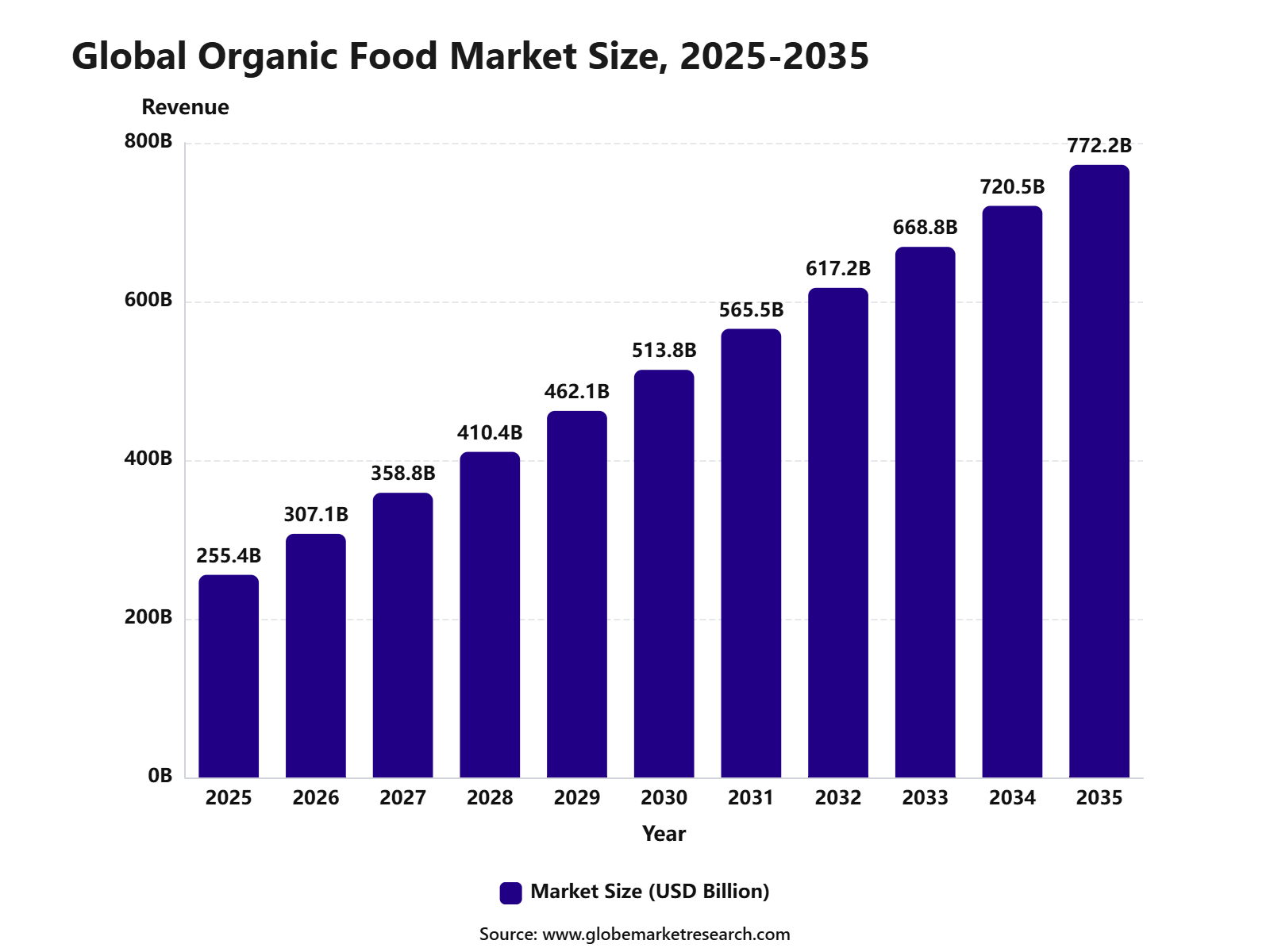 iThe graph shows projected market growth until 2035 based on CAGR analysis. Actual outcomes may vary depending on changing demand, competition, and economic factors.To gain greater insights - request a sample report PDF
Key Market Insights
Organic fruits and vegetables led the product type segment with 32.2% share, supported by strong consumer demand for fresh, chemical-free, nutrient-rich, and naturally grown food products.
Online channels accounted for 37.3% share, driven by easy product access, home delivery, subscription-based grocery models, and rising consumer preference for convenient organic food shopping.
North America led the organic food market with 44.8% share, valued at USD 114.4 billion, supported by high health awareness, strong organic certification systems, mature retail networks, and growing demand for clean-label food products.
Top Funding, Investment and Acquisition
Top Investment
In 2026, USDA Organic Market Development Grant program had approximately USD 85 million available to support certified organic production, processing, manufacturing, storage, distribution, and consumer market development.
In November 2025, Ireland allocated EUR 58.6 million in Budget 2026 for the Organic Farming Scheme to support farmers and encourage organic food production.
In October 2025, India reported INR 205.46 crore released under PKVY for FY 2024 to 2025, supporting organic farming, certification, branding, and market linkages.
In January 2025, Ireland allocated EUR 3.5 million under the Organic Processing Investment Grant Scheme for licensed organic operators, with grant aid at 60% of eligible costs.
In July 2025, Maharashtra announced Krishi Samruddhi Yojana with INR 5,000 crore annual investment from FY 2025 to 2026, including support for organic farming and value-chain development.
Top Funding
In February 2026, Once Upon a Farm raised nearly USD 198 million through its U.S. IPO; the company sells organic children’s food products including cold-pressed pouches, frozen meals, and oat bars.
In October 2025, Two Brothers Organic Farms raised INR 110 crore in Series B funding from 360 ONE Asset, Rainmatter Investments, Narotam Sekhsaria Family Office, and IGNITE Growth LLP.
In March 2025, GoodSam Foods raised USD 9.0 million in Series A funding led by Alive Ventures and Desert Bloom, supporting organic nuts, organic coffee, cocoa products, and fruit chips.
Top Acquisition
In June 2025, ITC completed the acquisition of Sresta Natural Bioproducts, owner of the 24 Mantra Organic brand, for INR 472.50 crore.
In December 2025, Laird Superfood agreed to acquire Navitas LLC, a premium organic superfoods brand, for USD 38.5 million in cash; the deal was supported by a USD 50 million convertible preferred equity investment from Nexus Capital.
By Product Type
Organic fruits and vegetables accounted for 32.2% share of the Organic Food Market. This leading position is supported by strong consumer demand for fresh, chemical-free, and naturally grown food products used in daily diets.
The segment is widely preferred because fruits and vegetables are high-frequency purchases across households, supermarkets, specialty stores, and online grocery platforms. Consumers are increasingly choosing organic produce due to concerns over pesticide residues, food safety, nutrition, and sustainable farming practices.
Demand is expected to remain strong as health-focused consumers continue to shift toward clean-label and minimally processed foods. Wider availability of organic produce through retail chains, farm-to-home delivery, and e-commerce grocery platforms will further support this segment.
By Distribution Channel
Online distribution held 37.3% share of the Organic Food Market. This dominance is driven by rising use of e-commerce grocery platforms, direct-to-consumer organic brands, subscription boxes, and quick-commerce delivery services.
Consumers prefer online channels because they offer wider product variety, transparent labeling, easy comparison, doorstep delivery, and access to certified organic brands. Online platforms are especially important for urban consumers who seek convenience and regular access to fresh organic foods.
The segment is expected to maintain strong growth as digital grocery adoption expands. Demand will be supported by recurring purchase models, farm-fresh delivery, premium organic product listings, and growing consumer trust in online food quality standards.
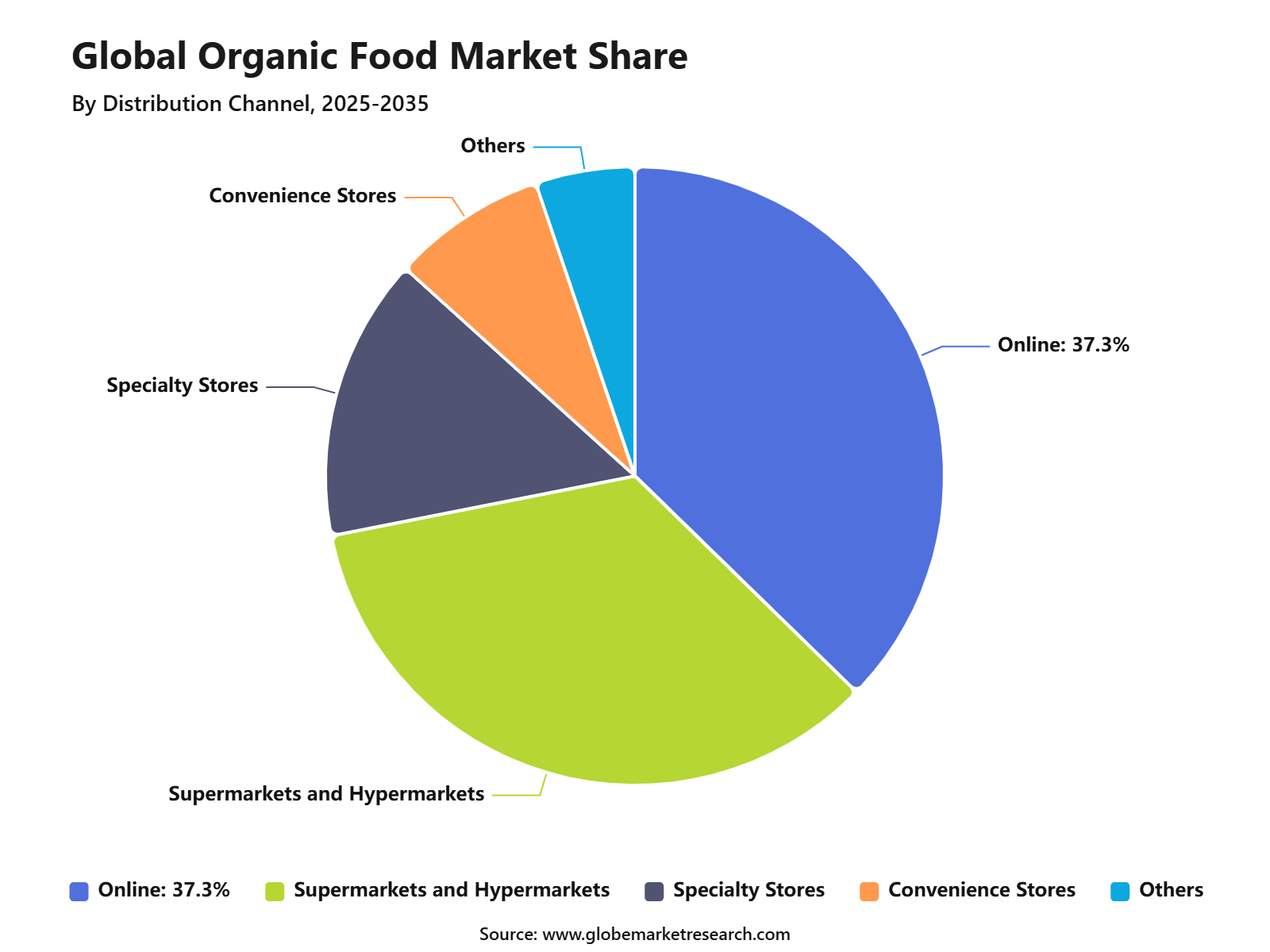 iThe graph shows projected market growth until 2035 based on CAGR analysis. Actual outcomes may vary depending on changing demand, competition, and economic factors.To gain greater insights - request a sample report PDF
By Region
North America accounted for 44.8% share of the Organic Food Market, reaching USD 114.4 billion. The region’s leadership is supported by high consumer awareness, strong retail infrastructure, and growing preference for clean-label, natural, and certified organic food products.
The United States and Canada are key contributors due to strong demand for organic fruits, vegetables, dairy products, snacks, beverages, meat, and packaged foods. Organic food products are widely available through supermarkets, specialty stores, farmers markets, online grocery platforms, and subscription-based delivery services.
North America is expected to maintain a strong position as consumers continue to prioritize health, food safety, sustainability, and ingredient transparency. Product innovation, premium private labels, and wider online availability will continue to support regional market growth.
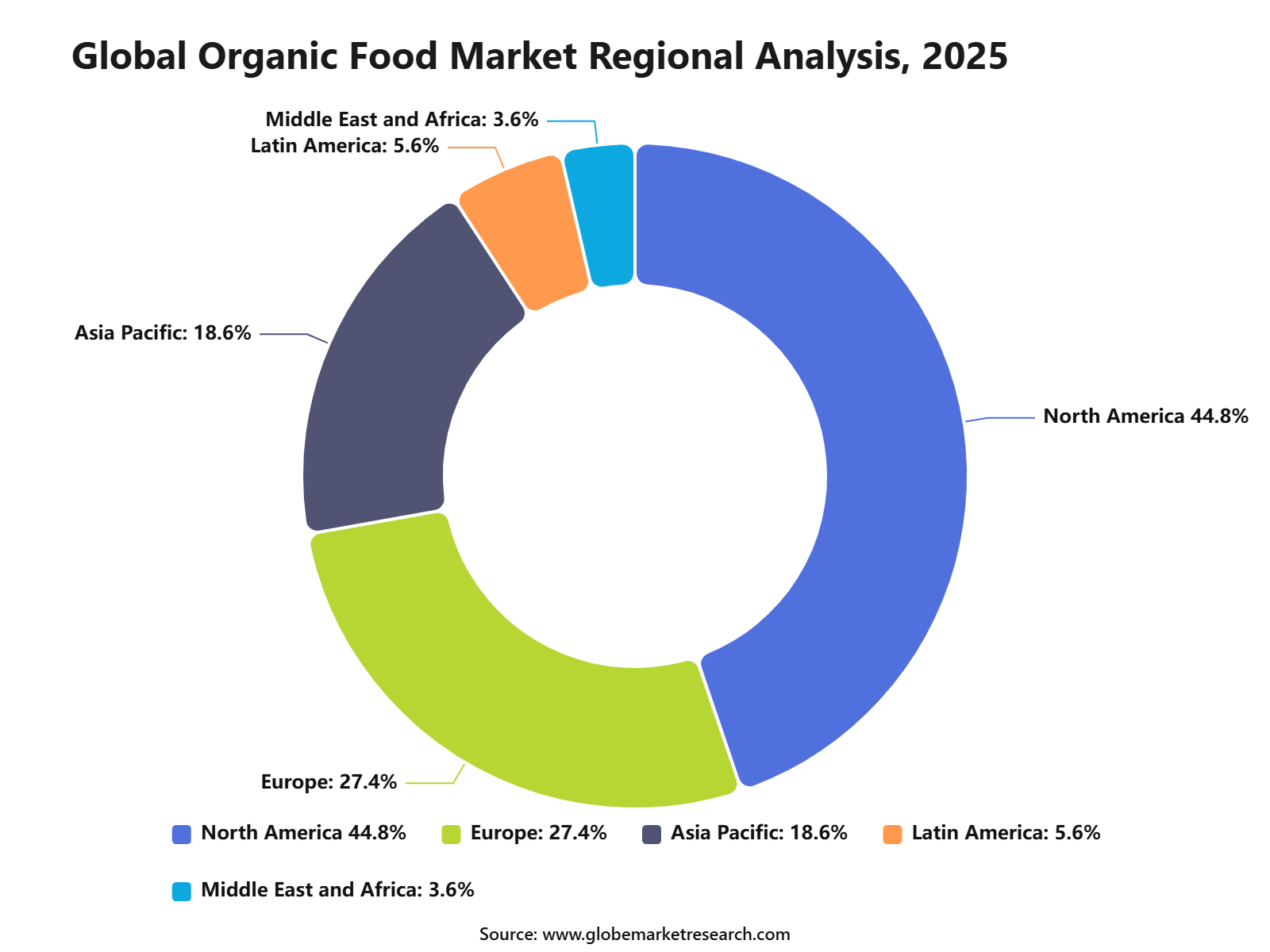 iThe graph shows projected market growth until 2035 based on CAGR analysis. Actual outcomes may vary depending on changing demand, competition, and economic factors.To gain greater insights - request a sample report PDF
Regional Impact Analysis
North America leads the Organic Food Market with 44.8% share in 2025, equal to about USD 114.4 billion, supported by strong organic retail availability, high consumer trust, premium grocery spending, and mature certification systems. The U.S. remains the main regional driver due to strong demand across organic produce, dairy, packaged foods, beverages, and snacks.
Europe remains important because of strict food quality standards, sustainability-focused consumers, and strong organic farming support. Asia Pacific is expected to build future demand through rising disposable income, food safety awareness, online grocery growth, and premium health-focused consumption.
Impact Factor | Estimated CAGR Impact | Regional Relevance | Market Impact |
|---|---|---|---|
North America market leadership | +3.5% | North America, 44.8% share in 2025 | Leads global value demand. |
U.S. organic grocery strength | +2.3% | U.S. | Drives regional growth. |
Canada clean-label food demand | +1.5% | Canada | Supports premium consumption. |
Europe organic retail maturity | +1.3% | Germany, France, UK, Italy | Builds stable value demand. |
Asia Pacific food safety awareness | +1.1% | China, India, Japan, South Korea | Supports future growth. |
Go-To-Market and Sales Economics
Organic food is best commercialized through supermarkets, organic specialty stores, farm retail, e-commerce, foodservice, private label, and export-led distribution. In the U.S., organic food sales reached USD 70.1 billion in 2025, with 6.1% penetration of the total food market. Growth was 6.9%, compared with 2.3% for the overall food market.
Fresh produce remains the strongest entry point because shoppers trust visible, everyday organic products first. In 2025, U.S. organic produce sales reached USD 22.7 billion and accounted for nearly 30% of total organic sales. Berries reached USD 4.4 billion, citrus grew 18.1%, and organic bananas crossed USD 1 billion.
The sales model should focus on trust, certification, clean ingredients, and repeat grocery baskets. Global organic food and drink sales reached almost EUR 145 billion in 2025, while organic farming was practiced in more than 180 countries across nearly 99 million hectares, managed by at least 4.8 million farmers.
Risk Factors & Market Barriers
Certification integrity is the largest barrier because organic premiums depend on consumer trust. USDA’s Strengthening Organic Enforcement rule was fully implemented on March 19, 2024, and businesses in organic supply chains must comply or face penalties. This increases documentation, traceability, importer verification, and supplier-audit needs for brands and retailers.
Supply availability can restrict growth because organic farming requires certified land, compliant inputs, and controlled handling. In the EU, more than 381,000 organic farmers are active, 30% more than in 2018, yet the sector still needs stronger processing, logistics, cooperation models, and digitalisation to improve competitiveness.
Regulatory differences across countries can also slow exports and product launches. USDA’s National Organic Program develops and enforces consistent U.S. standards, while accredited certifiers verify that farms and businesses meet organic rules. This protects trust, but it also raises compliance costs for small producers, importers, and multi-country brands.
Revenue Potential Analysis
Revenue Landscape Across
Revenue is spread across organic produce, dairy, eggs, meat, grocery, snacks, baby food, beverages, cereals, pantry staples, and frozen food. In the U.S., organic grocery sales reached USD 15.7 billion in 2025, while organic baby food and formula grew 8.8% and represented 11.0% of organic grocery sales.
Europe remains a major revenue landscape because organic has strong retail acceptance and policy support. In 2024, EU organic farmland reached 18.1 million hectares, organic producers increased to 438,447, and the EU organic retail market grew 5% to EUR 49.5 billion. Average organic consumption reached EUR 110 per person.
Global trade also supports revenue expansion. In 2024, combined organic imports into the EU and U.S. reached 5.9 million metric tons, up 12.3%. Mexico, Ecuador, and Canada were the largest exporters to these markets, showing strong demand for cross-border certified organic fruits, vegetables, grains, and processed food ingredients.
Financial Impact
Organic food can improve financial performance through premium pricing, stronger customer loyalty, and higher basket value. The financial case is strongest in produce, baby food, beverages, snacks, and shelf-stable grocery, where shoppers pay more for certification, cleaner labels, pesticide concerns, and perceived product integrity. Repeat grocery frequency supports stable retailer revenue.
Policy support can improve farmer economics and supply expansion. The European Commission reported that organic hectares receive EUR 148 in specific EU support on average, in addition to other income support. Proposed rule adjustments are also expected to create EUR 47.8 million in annual direct administrative cost savings.
Financial risk remains linked to inflation, certification cost, fraud prevention, weaker household spending, and limited domestic supply in some categories. The strongest returns are expected from brands that combine verified sourcing, affordable pack sizes, strong private-label partnerships, and omnichannel distribution. Compliance and traceability should be treated as profit protection, not only regulation.
Drivers Impact Analysis
The Organic Food Market is driven by rising demand for chemical-free food, clean-label products, organic fruits and vegetables, organic dairy, organic packaged foods, and better-for-you grocery options. Consumers are increasingly choosing organic food due to concerns around pesticide residues, food safety, nutrition, sustainability, and long-term wellness.
North America leads the market due to strong organic retail penetration, high consumer spending on premium food, wide supermarket availability, and mature organic certification systems. The U.S. remains the key regional contributor because of strong demand across fresh produce, dairy, meat, snacks, beverages, and packaged organic foods.
Impact Factor | Estimated CAGR Impact | Regional Relevance | Market Impact |
|---|---|---|---|
Rising demand for clean-label food | +3.1% | North America, Europe, Asia Pacific | Drives core market growth. |
Growth in organic fruits and vegetables | +2.6% | U.S., Canada, Europe, Japan | Supports daily consumption. |
Increasing health and wellness awareness | +2.2% | Urban and premium consumers | Builds repeat demand. |
Expansion of organic packaged foods | +1.8% | North America and Europe | Adds convenience-led growth. |
Wider supermarket and online availability | +1.5% | U.S., Canada, UK, Germany | Improves consumer access. |
Restraints Impact Analysis
The market faces restraints from high product pricing, limited organic farming scale, certification complexity, and supply chain challenges. Organic food often costs more because of lower yields, higher labor needs, strict compliance, and separate handling systems.
Another restraint is inconsistent availability across regions and product categories. Fresh organic produce, dairy, meat, and packaged products require strong sourcing, cold chain, traceability, and quality control to maintain consumer trust.
Impact Factor | Estimated CAGR Impact | Regional Relevance | Market Impact |
|---|---|---|---|
High price premium over conventional food | -1.5% | Global consumer markets | Limits mass adoption. |
Limited organic farming capacity | -1.2% | Emerging and supply-constrained markets | Restricts product availability. |
Certification and compliance burden | -1.0% | North America, Europe, Japan | Raises producer cost. |
Supply chain and traceability complexity | -0.9% | Fresh and packaged organic foods | Affects reliability. |
Risk of organic fraud and mislabeling | -0.7% | Global retail markets | Weakens consumer trust. |
Opportunities Impact Analysis
Opportunities are strong in organic fruits and vegetables, organic dairy, organic snacks, organic beverages, organic baby food, organic meat, frozen organic meals, and plant-based organic products. These categories benefit from premium grocery demand and rising consumer interest in safer food choices.
Higher-value opportunities are also emerging in private-label organic products, online organic grocery platforms, farm-to-consumer supply chains, and organic convenience foods. Retailers and brands that offer trusted certification, better affordability, and wider product variety can capture stronger growth.
Impact Factor | Estimated CAGR Impact | Regional Relevance | Market Impact |
|---|---|---|---|
Organic fresh produce expansion | +2.9% | North America, Europe, Asia Pacific | Builds high-volume demand. |
Organic dairy and beverages | +2.3% | U.S., Canada, Europe, Australia | Adds recurring consumption. |
Organic snacks and packaged foods | +2.0% | Urban retail markets | Supports convenience growth. |
Organic baby food demand | +1.6% | North America, Europe, China | Creates premium category value. |
Online organic grocery platforms | +1.3% | U.S., Canada, UK, India | Expands direct access. |
Challenges Impact Analysis
The main challenge is scaling organic supply while keeping prices affordable. Organic farming needs certified land, approved inputs, strong soil management, and reliable sourcing, which makes rapid expansion difficult.
Another challenge is maintaining quality and freshness across long supply chains. Organic products, especially fresh produce and dairy, require careful storage, transport, and inventory management to reduce spoilage and protect margins.
Impact Factor | Estimated CAGR Impact | Regional Relevance | Market Impact |
|---|---|---|---|
Scaling certified organic production | -1.3% | Global organic farming regions | Limits supply growth. |
Keeping organic products affordable | -1.1% | Mass retail consumers | Affects adoption speed. |
Managing freshness and spoilage | -0.9% | Fresh produce and dairy | Pressures margins. |
Maintaining strong traceability | -0.8% | North America, Europe, Asia Pacific | Protects certification trust. |
Reducing supply-demand mismatch | -0.6% | Seasonal and imported products | Improves retail reliability. |
Segment Covered in the Report
By Product Type
Organic Fruits and Vegetables
Organic Processed Food
Organic Meat
Poultry and Dairy
Organic Beverages
Organic Spices and Pulses
Others
By Distribution Channel
Online
Supermarkets and Hypermarkets
Specialty Stores
Convenience Stores
Others
By Region
North America
Europe
Asia Pacific
Latin America
Middle East and Africa
Market Trend Analysis
The market trend is moving toward organic fresh produce, organic dairy, organic snacks, clean-label packaged foods, organic beverages, organic baby food, and plant-based organic products. Consumers are shifting from occasional organic purchases to regular basket-level buying across multiple categories.
Private-label organic products are also gaining traction because they make organic food more accessible to mainstream consumers. North America remains the value leader, while Europe and Asia Pacific continue to grow through premium grocery retail, online food delivery, and rising health awareness.
Impact Factor | Estimated CAGR Impact | Regional Relevance | Market Impact |
|---|---|---|---|
Organic fresh produce remains dominant | +2.8% | North America, Europe, Asia Pacific | Leads daily-use demand. |
Private-label organic food expands | +2.2% | U.S., Canada, Europe | Improves affordability. |
Organic packaged foods gain share | +1.8% | Urban retail and online channels | Adds convenience value. |
Plant-based organic products rise | +1.5% | North America and Europe | Supports health-led demand. |
Organic baby and kids’ food grows | +1.2% | Premium family consumers | Builds trust-based demand. |
Investor Type Impact Matrix
Investors should focus on organic food companies with strong certified sourcing, retail distribution, cold chain capability, brand trust, and exposure to high-repeat categories such as produce, dairy, packaged foods, and snacks. Price positioning, traceability, and supply reliability are key success factors.
Strategic investors can also target organic farms, private-label organic producers, organic packaged food brands, online organic grocery platforms, and certified supply chain service providers. Companies that improve affordability while maintaining trust and quality are better positioned for long-term growth.
Investor Type | Estimated CAGR Impact | Regional Relevance | Market Impact |
|---|---|---|---|
Organic Food Brands | +2.4% | Global | Expands trusted organic supply. |
Organic Fresh Produce Suppliers | +2.0% | North America, Europe, Asia Pacific | Supports high-volume demand. |
Organic Dairy and Packaged Food Companies | +1.7% | U.S., Canada, Europe | Builds recurring consumption. |
Online Organic Grocery Platforms | +1.3% | Urban and premium markets | Improves customer reach. |
Strategic Food and Retail Investors | +1.1% | Global organic food markets | Funds supply chain expansion. |
Recent Developments
In March 2026, Organic Valley introduced Protein Plus ultra-filtered organic milk with 50% more protein and 50% less sugar, strengthening its organic dairy portfolio for nutrition-focused households.
In November 2025, Frito-Lay introduced Simply NKD Cheetos and Doritos, removing added colors and artificial flavors while keeping core taste, as PepsiCo Foods expanded cleaner-label snack choices for health-aware consumers.
In January 2025, Newman’s Own promoted its 100% profits-to-charity model, encouraging more companies to adopt purpose-led food business structures while continuing work across sauces, dressings, pizza and organic-linked grocery products
Competitive Landscape
The market is characterized by intense competition among established players and emerging companies. Strategic partnerships, mergers and acquisitions, and product innovation are key strategies employed by market participants.
Key Market Players
Newman's Own, Inc.
Whole Foods Market IP. L.P.
Frito-Lay
Dole Food Co., Inc.
The Kroger Co., Inc.
Clif Bar & Company
Organic Valley.
Dean Foods
Other Key Players
Research Methodology
This market study is prepared using a combination of primary and secondary research. Primary research includes discussions with manufacturers, suppliers, distributors, consultants, industry experts, and end users. Secondary research covers company reports, government databases, trade associations, technical publications, regulatory sources, and trusted industry documents. The collected information is used to assess market demand, pricing trends, technology adoption, competitive activity, and regional performance.
AI language models are not used as primary data sources, and publicly available AI-generated content is not treated as market evidence. Computational tools may be used to support data processing, translation, data classification, and pattern identification. However, every published assessment is supported by verified sources, human review, and primary market discussions.
Market estimates are developed through top-down and bottom-up approaches and validated using data triangulation. Revenue, production, shipment, pricing, and application-level data are compared across multiple sources. Forecasts consider economic conditions, regulatory changes, investment activity, innovation, supply chain developments, and industry risks. All findings are reviewed through source verification and internal quality checks before publication.
Part I
Source Management & Input Data Standards
Who provides data, how sources are qualified, and what types of evidence are admissible.
Part II
Research Scope & Market Coverage
How we define the markets we assess and the parameters that govern each product.
Part III
Data Collection, Verification & Submission
The mechanics of gathering, cross-checking, and hierarchically ranking evidence.
Part IV
Assessment Determination & Quality Controls
How raw data becomes a published assessment — normalisation, expert judgement, and outlier exclusion.
Part V
Publication, Corrections & Revision
Our publication schedule, corrections policy, and methodology review cycle.
Part VI
Independence, Ethics & Complaints
Conflict-of-interest policies, editorial independence, and how clients raise concerns.
Google · Preferred Sources
Don't miss the latest market research insights and industry updates on Google.
Add Globe Market Research as a preferred source in the Google app to see our reports, analysis, and market stories in your news suggestions.
Meet the Team
This report was prepared by our expert analysts with deep industry knowledge and research experience.
Kimaya brings more than five years of experience in market research, content review, and industry analysis to Globe Market Research. She plays an important role in maintaining the accuracy, clarity, consistency, and relevance of research content across a wide range of industries. Her responsibilities include reviewing market data, segment analysis, competitive landscapes, industry trends, company developments, and strategic insights. Each report is carefully assessed to ensure that the findings are supported by reliable data, presented in a structured format, and aligned with the information needs of business decision-makers. Kimaya has research experience across healthcare, information technology, consumer goods, and several cross-industry domains.
Pratiksha K. is a Senior Research Analyst with more than five years of experience in market research, industry analysis, competitive intelligence, and business strategy. She has contributed to detailed market reports, customized research studies, company profiling, market sizing, trend analysis, and strategic consulting projects for clients across different regions. Her industry expertise covers Chemical and Material, Consumer Goods, Food & Beverages and Energy & Power. She closely evaluates changing customer requirements, technology developments, regulatory conditions, supply chain structures, investment activity, and competitive strategies to provide clear and practical market insights.
Frequently Asked Questions
Related Reports
More in Food and Beverages
Refrigerated Ready Meals Market to Hit USD 355.8 Billion by 2035
Refrigerated Ready Meals Market Size, Share, Analysis By Product (Refrigerated Meals, Frozen Meals, Shelf-Stable Meals, Canned Meals), By Meal Type (Vegetarian, Non-Vegetarian, Vegan), By Distribution Channel (Supermarkets and Hypermarkets, Convenience Stores, Online Retail, Specialty Stores), By Regional Insights, Business plan and Project Report, Investment Opportunities, Profitability, Industry Trends, Leading Companies and Growth Forecasts by 2026-2035
Frozen Desserts Market to Hit USD 298.8 Billion by 2035
Frozen Desserts Market Size, Share, Analysis By Product (Ice Cream, Frozen Yogurt, Gelato, Sorbet, Frozen Cakes, Other Products), By Consumption (Retail Consumption, Foodservice Consumption), By Distribution Channel (Supermarkets and Hypermarkets, Convenience Stores, Specialty Stores, Online Retail), By Regional Insights, Business plan and Project Report, Investment Opportunities, Profitability, Industry Trends, Leading Companies and Growth Forecasts by 2026-2035
Frozen Meat and Seafood Market to Hit USD 181.1 Billion by 2035
Frozen Meat and Seafood Market Size, Share, Analysis By Product (Frozen Meat, Frozen Seafood), By Seafood Form (Whole, Fillets, Processed Seafood, Other Forms), By Seafood End Use (Retail and Household, Foodservice, Industrial), By Regional Insights, Business plan and Project Report, Investment Opportunities, Profitability, Industry Trends, Leading Companies and Growth Forecasts by 2026-2035
Frozen Meals Market to Hit USD 74.2 Billion by 2035
Frozen Meals Market Size, Share, Analysis By Product (Frozen, Chilled, Canned, Shelf-Stable), By Meal Type (Vegetarian, Non-Vegetarian, Vegan), By Distribution Channel (Supermarkets and Hypermarkets, Online Retail, Convenience Stores, Specialty Stores), By Regional Insights, Business plan and Project Report, Investment Opportunities, Profitability, Industry Trends, Leading Companies and Growth Forecasts by 2026-2035