

Revenue, 2025
$ 57.8 Bn
Forecast, 2035
$ 135.5 Bn
CAGR, 2025-2035
8.9%
Report Coverage
Global
Market Size and Forecast
The Global Protein-Enriched Food Market was worth USD 57.8 billion in 2025 and is expected to reach USD 135.5 billion by 2035, growing at a CAGR of 8.9% from 2025 to 2035. Based on this growth rate, the market is estimated to reach around USD 65.6 billion in 2026. North America held the largest regional share of 37.1% in 2025, valued at around USD 21.4 billion, supported by strong demand for high-protein snacks, sports nutrition foods, meal replacements, and health-focused packaged products.
The Protein-Enriched Food Market includes food products fortified with animal-based, plant-based, dairy-based, and alternative protein ingredients to support nutrition, muscle health, weight management, and active lifestyles. These products include protein bars, cereals, bakery products, snacks, dairy foods, ready meals, meat alternatives, and functional food formats. The market is closely linked with wellness nutrition, fitness trends, convenience foods, and clean-label product innovation.
Key Parameter | Report Details |
|---|---|
Market Revenue, 2025 | USD 57.8 Billion |
Projected Revenue, 2035 | USD 135.5 Billion |
CAGR (2025-2035) | 8.9% |
Largest Region | North America (37.1%, USD 21.4 Bn) |
Fastest Growing Region | Asia Pacific |
Market Concentration | Medium |
Base Year | 2025 |
Forecast Period | 2025-2035 |
The market outlook remains strong as consumers increasingly seek protein-rich foods for daily health, satiety, and performance support. Growth can be attributed to rising demand for plant-based protein foods, convenient high-protein snacks, and fortified everyday meals. The expansion of retail health food aisles, online nutrition platforms, and personalized dietary products is expected to support long-term market demand.
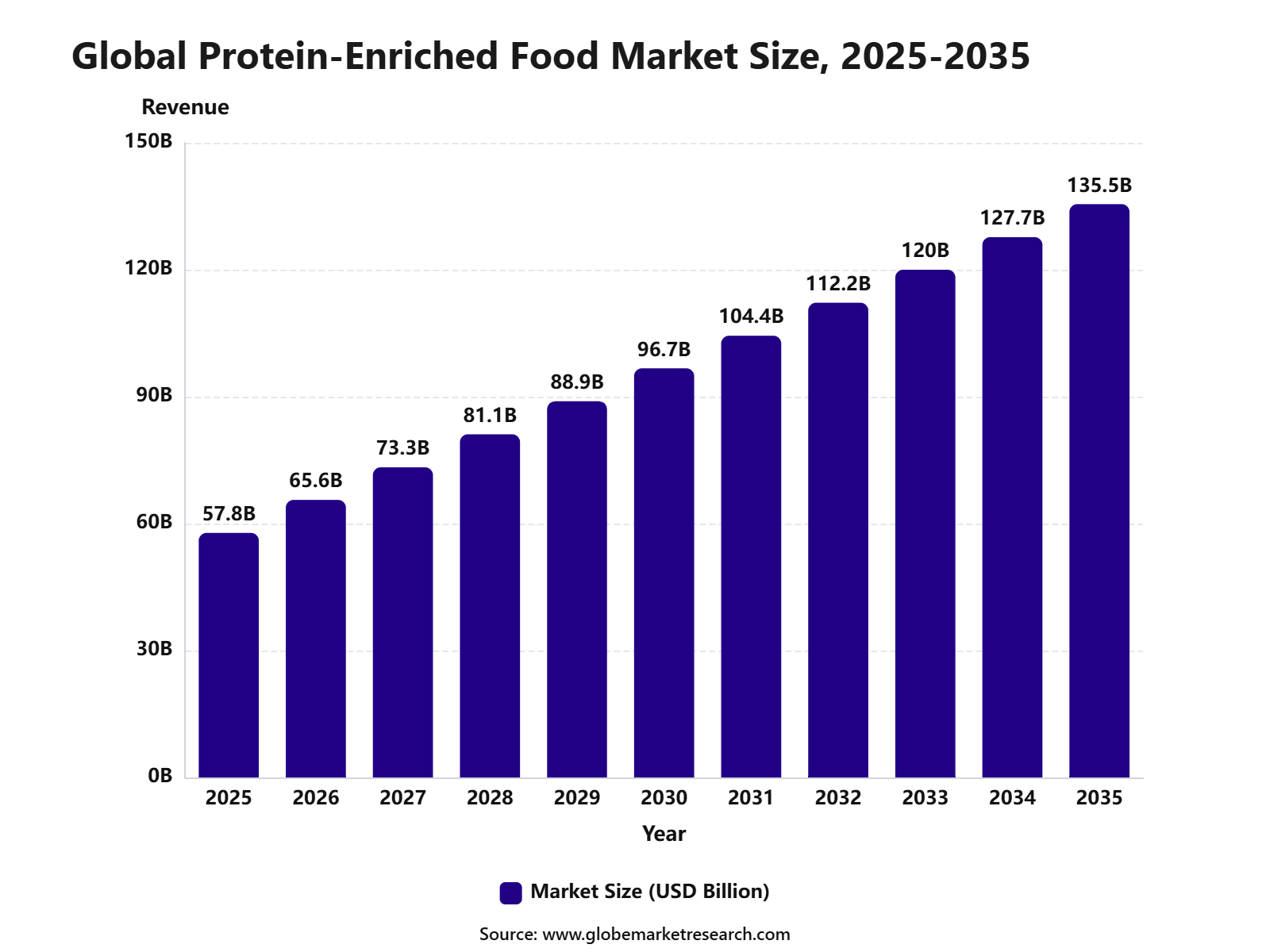 iThe graph shows projected market growth until 2035 based on CAGR analysis. Actual outcomes may vary depending on changing demand, competition, and economic factors.To gain greater insights - request a sample report PDF
Key Market Insights
High-protein packaged foods led the product type segment with 61.3% share, supported by strong demand for convenient protein snacks, ready-to-eat meals, bars, cereals, and fortified packaged food products.
Offline channels accounted for 75.5% share, driven by supermarkets, hypermarkets, health food stores, convenience stores, and consumer preference for checking product labels before purchase.
North America led the protein-enriched food market with 37.1% share, valued at USD 21.4 billion, supported by high fitness awareness, strong demand for protein-based diets, mature retail networks, and rising consumption of functional packaged foods.
Top Funding and Investment
Top Investment
In April 2025, Chobani announced a USD 1.2 billion investment to build its third U.S. dairy processing plant in New York, supporting yogurt and high-protein dairy capacity expansion.
In May 2025, Bel Group announced more than USD 350 million in U.S. investments, including a USD 200 million Brookings expansion for Mini Babybel capacity, around USD 130 million at Nampa, and nearly USD 20 million for The Laughing Cow and Boursin production.
In 2026, Agropur announced more than USD 130 million in investments across its Wisconsin and South Dakota dairy plants to expand value-added protein and whey-related production.
In May 2026, FrieslandCampina announced an investment programme of more than EUR 90 million to grow high-value whey protein production.
In April 2025, EIB granted a EUR 50 million loan to Lantmännen for a pea protein isolate factory in Sweden, covering around half of the project investment cost; the facility will process over 40,000 tonnes of peas annually.
Top Funding
In March 2026, Standing Ovation raised USD 34.2 million, including USD 28.5 million Series B equity and USD 5.7 million non-dilutive financing, to scale dairy proteins made through precision fermentation.
In June 2026, Stars + Honey received a USD 24.0 million growth equity investment from VMG Partners for its collagen protein bar business and national retail expansion.
In May 2026, MOSH raised USD 13.0 million in Series A funding led by Main Street Advisors to scale its brain-health nutrition brand and launch MOSH High Protein bars with 20 grams of protein.
Top Acquisition
In March 2026, Danone agreed to acquire Huel, a complete nutrition company offering protein shakes, powders, bars, and meal solutions, for about USD 1.2 billion.
In November 2025, ETİ Gıda agreed to acquire TRUBAR, a Canadian plant-based protein snack and protein bar company, in a deal valued at around C$201 million, or about USD 143 million.
By Product Type
High-protein packaged foods accounted for 61.3% share of the Protein-Enriched Food Market. This leading position is supported by strong consumer demand for convenient, ready-to-eat, and nutrition-focused food products that help support muscle health, satiety, weight management, and active lifestyles.
The segment includes protein bars, protein cookies, fortified snacks, high-protein cereals, ready meals, bakery products, and dairy-based packaged foods. These products are widely preferred because they combine daily nutrition with convenience, making them suitable for working professionals, fitness consumers, students, and health-conscious households.
Demand is expected to remain strong as brands continue to launch clean-label, low-sugar, plant-based, and high-fiber protein products. Wider availability across supermarkets, convenience stores, gyms, and online channels will further support the growth of high-protein packaged foods.
By Distribution Channel
Offline distribution held 75.5% share of the Protein-Enriched Food Market. This dominance is driven by strong sales through supermarkets, hypermarkets, convenience stores, specialty nutrition stores, pharmacies, gyms, and health food outlets.
Consumers often prefer offline stores because they can compare labels, check product formats, review pricing, and make quick purchases. High-protein foods are also frequently bought as impulse products, especially protein bars, snacks, drinks, and ready-to-eat items placed near checkout counters or health sections.
The segment is expected to maintain its leading position as organized retail expands and protein-enriched foods become part of mainstream grocery shelves. In-store promotions, sampling, brand visibility, and bundled offers will continue to support offline sales.
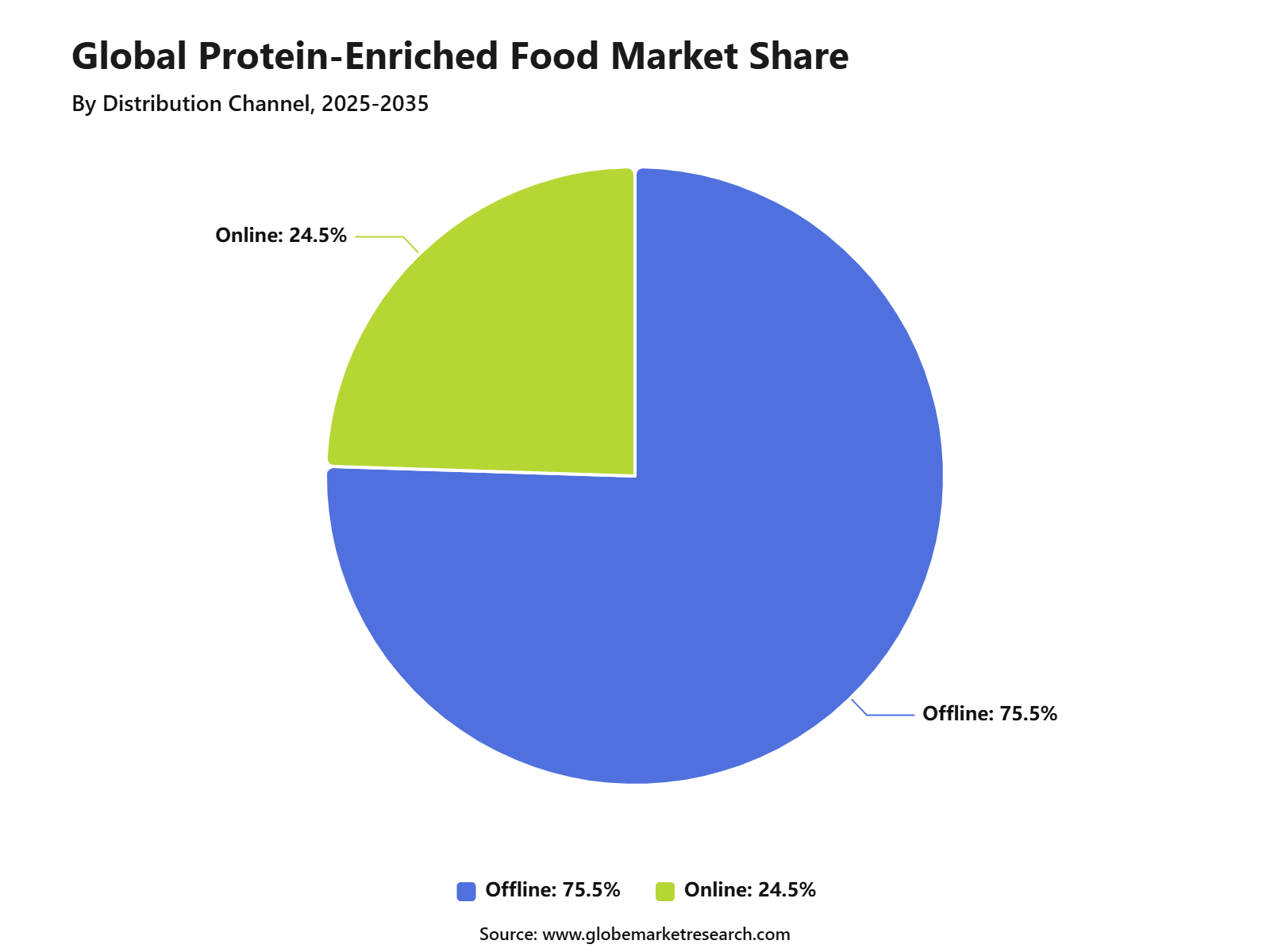 iThe graph shows projected market growth until 2035 based on CAGR analysis. Actual outcomes may vary depending on changing demand, competition, and economic factors.To gain greater insights - request a sample report PDF
By Region
North America accounted for 37.1% share of the Protein-Enriched Food Market, reaching USD 21.4 billion. The region’s leadership is supported by strong fitness culture, high awareness of protein nutrition, and wide adoption of functional foods across daily diets.
The United States and Canada are key contributors due to strong demand for protein bars, fortified snacks, high-protein breakfast foods, dairy products, and plant-based protein foods. Consumers in the region are increasingly using protein-enriched foods for muscle support, weight control, healthy aging, and meal replacement needs.
North America is expected to maintain a strong position as brands expand premium, plant-based, clean-label, and low-calorie protein products. Demand will remain supported by active lifestyles, sports nutrition adoption, and strong retail availability across both mainstream and specialty channels.
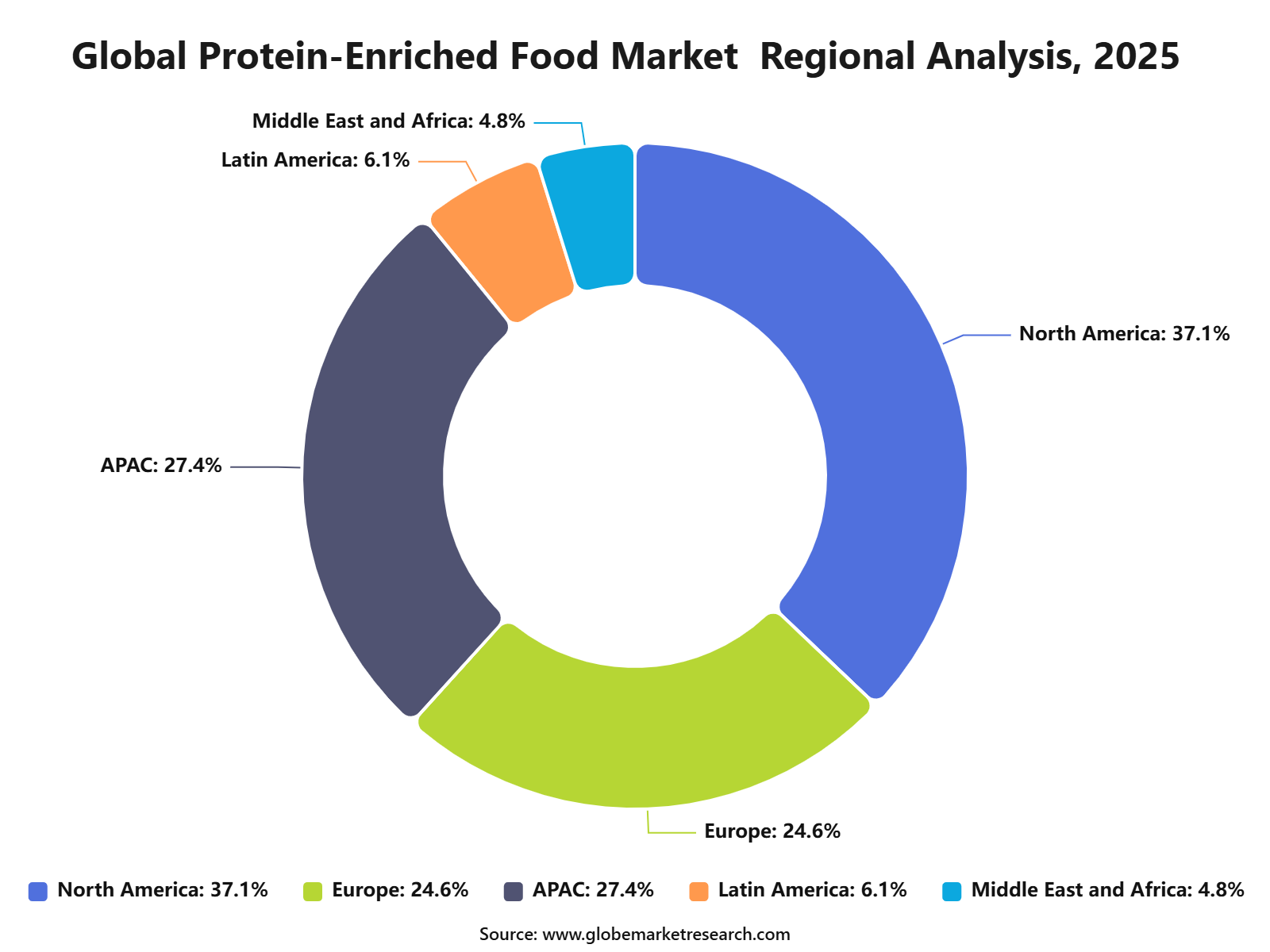 iThe graph shows projected market growth until 2035 based on CAGR analysis. Actual outcomes may vary depending on changing demand, competition, and economic factors.To gain greater insights - request a sample report PDF
Regional Impact Analysis
North America leads the Protein-Enriched Food Market with 37.1% share in 2025, equal to about USD 21.4 billion, supported by strong fitness culture, high protein awareness, mature packaged food retail, and widespread sports nutrition adoption. The U.S. remains the main regional driver due to strong demand for protein bars, snacks, ready meals, dairy protein foods, and clean-label nutrition products.
Europe remains important because of demand for healthy snacks, plant-based protein foods, and premium functional foods. Asia Pacific is expected to build future demand through rising disposable income, urban lifestyles, fitness adoption, and growing interest in convenient high-protein foods.
Impact Factor | Estimated CAGR Impact | Regional Relevance | Market Impact |
|---|---|---|---|
North America market leadership | +2.7% | North America, 37.1% share in 2025 | Leads global value demand. |
U.S. sports nutrition adoption | +1.7% | U.S. | Drives regional growth. |
Canada healthy snacking demand | +1.1% | Canada | Supports premium products. |
Europe plant-based protein trend | +1.0% | Germany, UK, France, Italy | Builds clean-label value. |
Asia Pacific urban protein food growth | +0.9% | China, India, Japan, South Korea | Supports future scale. |
Go-To-Market and Sales Economics
Protein-enriched foods are best commercialized through supermarkets, pharmacies, sports nutrition stores, gyms, convenience retail, e-commerce, and foodservice channels. The strongest products include high-protein yogurt, cereals, bars, bakery items, snacks, pasta, ready meals, and drinks. U.S. e-commerce reached USD 326.7 billion in Q1 2026, supporting subscription and bundle-based selling.
The sales model should focus on clear protein grams, taste, texture, satiety, and daily eating occasions. Protein is now a front-label decision factor, as IFIC’s June 2026 survey found that 42% of U.S. shoppers look for protein information when buying food and beverages. This strengthens shelf communication and pack design.
Large food companies are already using protein platforms to protect growth. Danone reported EUR 6.708 billion in Q1 2026 sales, up 2.7% like-for-like, and stated that high-protein dairy, skyr, and kefir continued to perform strongly. This supports premium positioning in everyday dairy and snackable nutrition.
Risk Factors & Market Barriers
The main barrier is claim accuracy because high-protein foods must match label promises and serving-size claims. FDA states that protein has a Daily Value of 50 grams, while 20% DV or more per serving is considered high. This makes testing, formulation control, and compliant nutrition labeling critical for brand trust.
Overpositioning can also create health-risk concerns. WHO stated in January 2026 that protein intake of 10% to 15% of daily energy is generally sufficient for adults, or about 50 to 75 grams on a 2,000-calorie diet. Excessive intake may create metabolic burden, especially for certain consumers.
Input-cost pressure is another barrier, mainly for whey, milk proteins, eggs, meat proteins, and specialty plant proteins. USDA forecast U.S. milk production at 236.4 billion pounds in 2026 and set the all-milk price forecast at USD 20.70 per cwt. This affects dairy-protein ingredient economics.
Revenue Potential Analysis
Revenue Landscape Across
Revenue is spread across high-protein dairy, protein bars, fortified cereals, protein snacks, ready meals, bakery products, beverages, and plant-based protein foods. Nestlé reported Q1 2026 Food & Snacks organic growth of 4.2%, while Vital Proteins growth was strong within its nutrition portfolio. This shows revenue potential across mainstream and specialist formats.
Dairy remains a strong revenue base because yogurt, skyr, cottage cheese, and milk drinks can deliver protein naturally with familiar taste. Danone’s Essential Dairy and Plant-Based business grew 3.4% in Q1 2026, supported by functional innovation rooted in protein and gut health. This supports premium chilled retail expansion.
Packaged foods are also adding protein to breakfast and snack occasions. General Mills launched Cheerios Protein with 8 grams of protein per serving, responding to demand for higher-protein everyday options. This shows how large brands are using protein enrichment to refresh mature cereal and snack categories.
Financial Impact
Protein-enriched foods can improve financial performance through premium pricing, repeat purchase, stronger shelf productivity, and higher basket value. The strongest returns are expected where protein is combined with convenience, taste, fiber, and low sugar. E-commerce also improves lifetime value through subscriptions, multipacks, and personalized nutrition bundles.
Margins depend on ingredient cost, protein quality, processing complexity, flavor masking, texture systems, packaging, and retailer promotions. FDA rules define “high” claims as 20% or more of the Daily Value per serving and “good source” claims as 10% to 19%. This makes accurate formulation central to financial protection.
The strongest financial impact is expected from brands that avoid generic protein claims and build usage around breakfast, snacking, fitness, active aging, and weight-management support. Nestlé’s Q1 2026 report showed strong growth for Vital Proteins and Pure Encapsulations, while medical nutrition remained robust, proving the value of specialized nutrition-led portfolios.
Drivers Impact Analysis
The Protein-Enriched Food Market is driven by rising demand for high-protein snacks, protein bars, fortified bakery products, dairy-based protein foods, ready meals, breakfast cereals, and active nutrition products. Consumers are using protein-enriched foods for muscle support, weight management, satiety, healthy aging, and everyday wellness.
North America leads the market due to strong fitness culture, high awareness of protein intake, premium grocery spending, and wide availability of protein-based packaged foods. The U.S. remains the key regional contributor because of strong demand from sports nutrition users, busy professionals, aging consumers, and health-focused households.
Impact Factor | Estimated CAGR Impact | Regional Relevance | Market Impact |
|---|---|---|---|
Rising demand for high-protein diets | +2.4% | North America, Europe, Asia Pacific | Drives core market growth. |
Growth in sports and active nutrition | +2.0% | U.S., Canada, UK, Australia | Supports premium demand. |
Increasing focus on weight management | +1.7% | Urban and health-conscious consumers | Builds repeat consumption. |
Expansion of protein snacks and bars | +1.4% | North America and Europe | Adds convenience-led growth. |
Healthy aging and muscle maintenance trend | +1.2% | Developed consumer markets | Supports long-term adoption. |
Restraints Impact Analysis
The market faces restraints from high product pricing, taste and texture issues, and competition from regular foods and protein supplements. Protein-enriched foods must deliver nutrition benefits without compromising flavor, mouthfeel, or affordability.
Another restraint is formulation complexity. Protein ingredients can affect product softness, shelf life, digestion comfort, and clean-label positioning, especially in bakery, snacks, dairy alternatives, and ready-to-eat formats.
Impact Factor | Estimated CAGR Impact | Regional Relevance | Market Impact |
|---|---|---|---|
High premium pricing | -1.1% | Global consumer markets | Limits mass adoption. |
Taste and texture challenges | -1.0% | Snacks, bars, bakery, dairy alternatives | Affects repeat purchase. |
Competition from protein powders | -0.8% | Sports nutrition consumers | Pressures packaged food demand. |
Digestive tolerance concerns | -0.7% | High-protein food users | Affects product acceptance. |
Clean-label formulation limits | -0.6% | North America and Europe | Raises development complexity. |
Opportunities Impact Analysis
Opportunities are strong in protein bars, high-protein breakfast foods, fortified bakery products, dairy protein snacks, plant-based protein foods, protein chips, ready meals, and functional desserts. These categories benefit from consumer demand for convenient nutrition across daily eating occasions.
Higher-value opportunities are also emerging in clean-label protein foods, hybrid plant and dairy protein blends, high-protein kids’ snacks, senior nutrition foods, and personalized nutrition platforms. Brands that combine strong taste, clear protein claims, and convenient formats can capture stronger long-term demand.
Impact Factor | Estimated CAGR Impact | Regional Relevance | Market Impact |
|---|---|---|---|
Protein bar and snack expansion | +2.3% | North America, Europe, Asia Pacific | Builds high-frequency demand. |
High-protein breakfast foods | +1.8% | U.S., Canada, Europe, Japan | Adds daily consumption value. |
Plant-based protein food growth | +1.5% | North America, Europe, urban Asia | Supports clean-label demand. |
Protein-enriched bakery products | +1.3% | Retail and foodservice channels | Expands mainstream reach. |
Senior and healthy aging nutrition | +1.1% | Developed and aging markets | Creates long-term opportunity. |
Challenges Impact Analysis
The main challenge is delivering high protein content while maintaining good taste, texture, and product stability. Consumers expect protein-enriched foods to feel like regular foods, not overly dense, dry, chalky, or artificial.
Another challenge is managing ingredient cost and supply consistency. Whey, casein, soy, pea, rice, egg, and other protein ingredients can vary in price, availability, taste profile, and processing performance.
Impact Factor | Estimated CAGR Impact | Regional Relevance | Market Impact |
|---|---|---|---|
Maintaining taste at high protein levels | -1.0% | Global packaged food brands | Affects repeat purchase. |
Managing protein ingredient cost | -0.9% | Food manufacturers | Pressures margins. |
Improving texture and mouthfeel | -0.8% | Bars, bakery, snacks, desserts | Influences consumer acceptance. |
Avoiding overly processed positioning | -0.6% | Clean-label consumers | Protects brand trust. |
Ensuring supply consistency | -0.5% | Global ingredient buyers | Supports production reliability. |
Market Trend Analysis
The market trend is moving toward high-protein snacks, protein bars, fortified breakfast products, plant-based protein foods, protein-rich dairy items, and clean-label formulations. Consumers increasingly want protein in normal food formats rather than only shakes or powders.
Convenience remains a strong trend because protein-enriched foods are often consumed as meal replacements, workout snacks, office snacks, and breakfast options. North America remains the value leader, while Europe and Asia Pacific are expanding through fitness trends, urban retail, and premium wellness foods.
Impact Factor | Estimated CAGR Impact | Regional Relevance | Market Impact |
|---|---|---|---|
High-protein snacks gain popularity | +2.2% | North America, Europe, Asia Pacific | Leads convenience demand. |
Protein bars remain strong | +1.8% | U.S., Canada, UK, Australia | Supports sports and lifestyle use. |
Plant-based protein foods expand | +1.4% | North America and Europe | Adds clean-label value. |
Protein breakfast products grow | +1.2% | Urban consumer markets | Builds daily usage. |
Dairy protein products gain traction | +1.0% | North America, Europe, Japan | Supports premium nutrition. |
Investor Type Impact Matrix
Investors should focus on protein-enriched food companies with strong product taste, clean-label positioning, reliable ingredient sourcing, retail distribution, and exposure to high-repeat formats such as snacks, bars, breakfast products, and dairy foods. Product quality, affordability, and clear nutrition positioning are key success factors.
Strategic investors can also target protein ingredient suppliers, protein bar manufacturers, fortified bakery producers, plant-based protein food companies, and direct-to-consumer nutrition brands. Companies that make high-protein eating convenient and enjoyable are better positioned for long-term growth.
Investor Type | Estimated CAGR Impact | Regional Relevance | Market Impact |
|---|---|---|---|
Protein-Enriched Food Brands | +2.0% | Global | Expands functional food supply. |
Protein Bar and Snack Manufacturers | +1.6% | North America, Europe, Asia Pacific | Supports high-frequency demand. |
Dairy and Plant Protein Suppliers | +1.3% | U.S., Canada, Europe, Asia Pacific | Builds ingredient strength. |
Fortified Bakery and Breakfast Food Producers | +1.1% | Retail and foodservice markets | Adds mainstream category growth. |
Strategic Food and Nutrition Investors | +0.9% | Global health food markets | Funds product expansion. |
Recent Developments
In February 2026, General Mills introduced new protein cereal and granola options, including Nature Valley protein granola, strengthening its breakfast portfolio around convenient nutrition and higher-protein everyday foods.
In February 2026, Danone reported that its 2025 growth was supported by high-protein, gut-health, infant-formula and medical-nutrition platforms, with Oikos Pro exceeding EUR 1 billion revenue in 2025.
In August 2025, Kellanova expanded Eggo’s protein waffle and pancake range with Buttermilk Vanilla Protein Waffles, Vanilla Protein Pancakes and Blueberry Protein Pancakes, each offering 20% daily protein value.
Competitive Landscape
The market is characterized by intense competition among established players and emerging companies. Strategic partnerships, mergers and acquisitions, and product innovation are key strategies employed by market participants.
Key Market Players
Nestlé S.A.
Danone S.A.
General Mills, Inc.
Kellanova
PepsiCo, Inc.
Abbott Laboratories
Glanbia plc
The Simply Good Foods Company
Mondelez International, Inc.
Post Holdings, Inc.
Hormel Foods Corporation
Tyson Foods, Inc.
Mars, Incorporated
Amul
JBS S.A.
Other Key Players
Research Methodology
This market study is prepared using a combination of primary and secondary research. Primary research includes discussions with manufacturers, suppliers, distributors, consultants, industry experts, and end users. Secondary research covers company reports, government databases, trade associations, technical publications, regulatory sources, and trusted industry documents. The collected information is used to assess market demand, pricing trends, technology adoption, competitive activity, and regional performance.
AI language models are not used as primary data sources, and publicly available AI-generated content is not treated as market evidence. Computational tools may be used to support data processing, translation, data classification, and pattern identification. However, every published assessment is supported by verified sources, human review, and primary market discussions.
Market estimates are developed through top-down and bottom-up approaches and validated using data triangulation. Revenue, production, shipment, pricing, and application-level data are compared across multiple sources. Forecasts consider economic conditions, regulatory changes, investment activity, innovation, supply chain developments, and industry risks. All findings are reviewed through source verification and internal quality checks before publication.
Part I
Source Management & Input Data Standards
Who provides data, how sources are qualified, and what types of evidence are admissible.
Part II
Research Scope & Market Coverage
How we define the markets we assess and the parameters that govern each product.
Part III
Data Collection, Verification & Submission
The mechanics of gathering, cross-checking, and hierarchically ranking evidence.
Part IV
Assessment Determination & Quality Controls
How raw data becomes a published assessment — normalisation, expert judgement, and outlier exclusion.
Part V
Publication, Corrections & Revision
Our publication schedule, corrections policy, and methodology review cycle.
Part VI
Independence, Ethics & Complaints
Conflict-of-interest policies, editorial independence, and how clients raise concerns.
Google · Preferred Sources
Don't miss the latest market research insights and industry updates on Google.
Add Globe Market Research as a preferred source in the Google app to see our reports, analysis, and market stories in your news suggestions.
Meet the Team
This report was prepared by our expert analysts with deep industry knowledge and research experience.
Kimaya brings more than five years of experience in market research, content review, and industry analysis to Globe Market Research. She plays an important role in maintaining the accuracy, clarity, consistency, and relevance of research content across a wide range of industries. Her responsibilities include reviewing market data, segment analysis, competitive landscapes, industry trends, company developments, and strategic insights. Each report is carefully assessed to ensure that the findings are supported by reliable data, presented in a structured format, and aligned with the information needs of business decision-makers. Kimaya has research experience across healthcare, information technology, consumer goods, and several cross-industry domains.
Pratiksha K. is a Senior Research Analyst with more than five years of experience in market research, industry analysis, competitive intelligence, and business strategy. She has contributed to detailed market reports, customized research studies, company profiling, market sizing, trend analysis, and strategic consulting projects for clients across different regions. Her industry expertise covers Chemical and Material, Consumer Goods, Food & Beverages and Energy & Power. She closely evaluates changing customer requirements, technology developments, regulatory conditions, supply chain structures, investment activity, and competitive strategies to provide clear and practical market insights.
Frequently Asked Questions
Related Reports
More in Food and Beverages
Refrigerated Ready Meals Market to Hit USD 355.8 Billion by 2035
Refrigerated Ready Meals Market Size, Share, Analysis By Product (Refrigerated Meals, Frozen Meals, Shelf-Stable Meals, Canned Meals), By Meal Type (Vegetarian, Non-Vegetarian, Vegan), By Distribution Channel (Supermarkets and Hypermarkets, Convenience Stores, Online Retail, Specialty Stores), By Regional Insights, Business plan and Project Report, Investment Opportunities, Profitability, Industry Trends, Leading Companies and Growth Forecasts by 2026-2035
Frozen Desserts Market to Hit USD 298.8 Billion by 2035
Frozen Desserts Market Size, Share, Analysis By Product (Ice Cream, Frozen Yogurt, Gelato, Sorbet, Frozen Cakes, Other Products), By Consumption (Retail Consumption, Foodservice Consumption), By Distribution Channel (Supermarkets and Hypermarkets, Convenience Stores, Specialty Stores, Online Retail), By Regional Insights, Business plan and Project Report, Investment Opportunities, Profitability, Industry Trends, Leading Companies and Growth Forecasts by 2026-2035
Frozen Meat and Seafood Market to Hit USD 181.1 Billion by 2035
Frozen Meat and Seafood Market Size, Share, Analysis By Product (Frozen Meat, Frozen Seafood), By Seafood Form (Whole, Fillets, Processed Seafood, Other Forms), By Seafood End Use (Retail and Household, Foodservice, Industrial), By Regional Insights, Business plan and Project Report, Investment Opportunities, Profitability, Industry Trends, Leading Companies and Growth Forecasts by 2026-2035
Frozen Meals Market to Hit USD 74.2 Billion by 2035
Frozen Meals Market Size, Share, Analysis By Product (Frozen, Chilled, Canned, Shelf-Stable), By Meal Type (Vegetarian, Non-Vegetarian, Vegan), By Distribution Channel (Supermarkets and Hypermarkets, Online Retail, Convenience Stores, Specialty Stores), By Regional Insights, Business plan and Project Report, Investment Opportunities, Profitability, Industry Trends, Leading Companies and Growth Forecasts by 2026-2035