

Revenue, 2025
$ 9.5 Bn
Forecast, 2035
$ 26.7 Bn
CAGR, 2025-2035
10.9%
Report Coverage
Global
Market Size and Forecast
The Global Gluten-Free Food Market was worth USD 9.5 billion in 2025 and is expected to reach USD 26.7 billion by 2035, growing at a CAGR of 10.9% from 2025 to 2035. Based on this growth rate, the market is estimated to reach around USD 11.2 billion in 2026. North America held the largest regional share of 36.2% in 2025, valued at around USD 3.4 billion, supported by strong demand for gluten-free bakery, snacks, cereals, pasta, and health-focused packaged foods.
The Gluten-Free Food Market includes food products made without wheat, barley, rye, or gluten-containing ingredients. These products include gluten-free bread, cookies, pasta, cereals, snacks, ready meals, bakery items, dairy alternatives, and packaged foods. The market is closely linked with celiac disease management, digestive health awareness, clean-label eating, specialty retail, and premium health food channels.
Key Parameter | Report Details |
|---|---|
Market Revenue, 2025 | USD 9.5 Billion |
Projected Revenue, 2035 | USD 26.7 Billion |
CAGR (2025-2035) | 10.9% |
Largest Region | North America (36.2%, USD 3.4 Bn) |
Fastest Growing Region | Asia Pacific |
Market Concentration | Medium |
Base Year | 2025 |
Forecast Period | 2025-2035 |
The market outlook remains strong as consumers increasingly choose gluten-free products for medical, wellness, and lifestyle reasons. Growth can be attributed to rising awareness of gluten intolerance, expanding availability of gluten-free packaged foods, and innovation in taste and texture. The expansion of online grocery platforms, private-label gluten-free ranges, and healthier bakery formulations is expected to support long-term market demand.
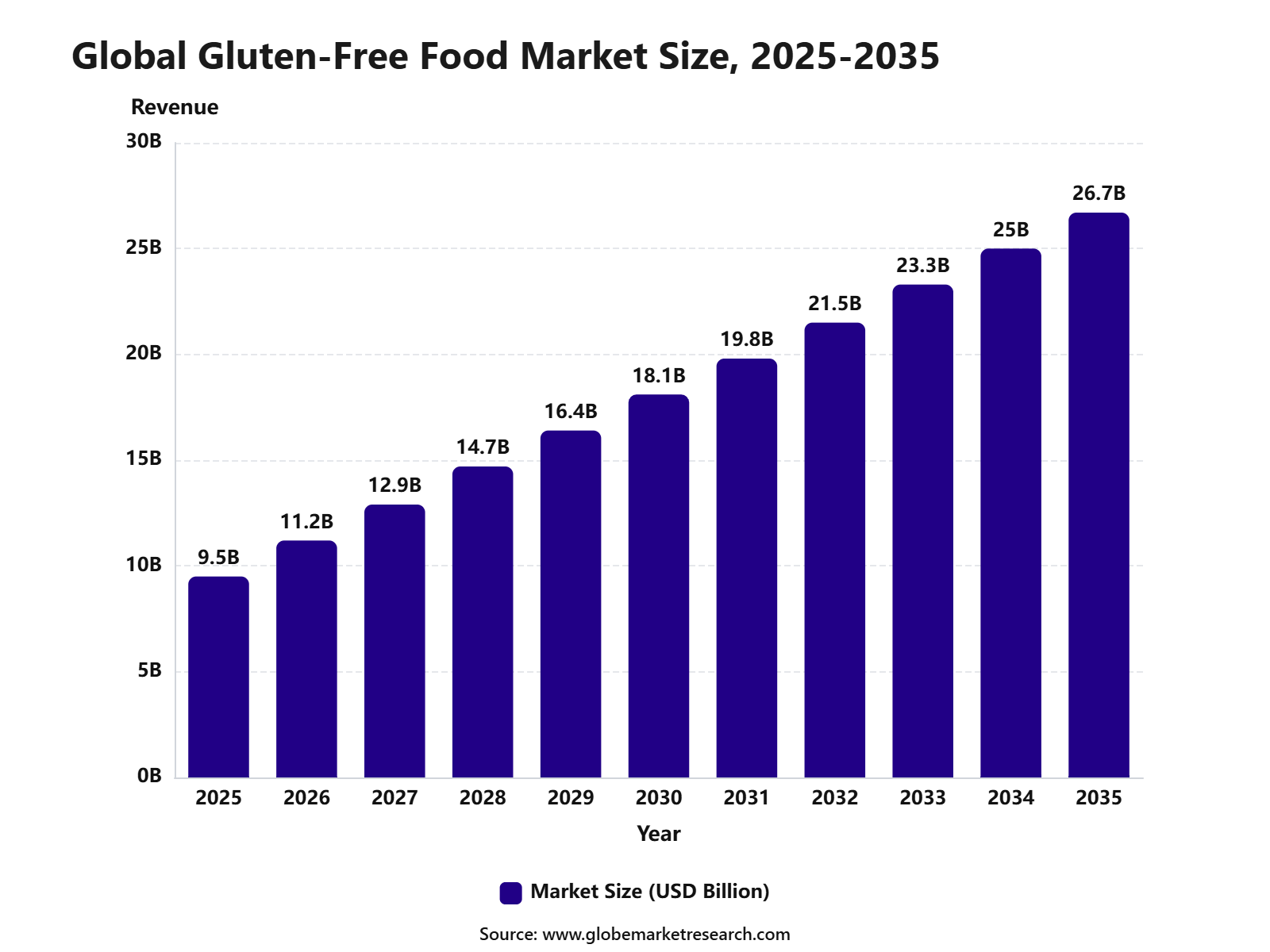 iThe graph shows projected market growth until 2035 based on CAGR analysis. Actual outcomes may vary depending on changing demand, competition, and economic factors.To gain greater insights - request a sample report PDF
Key Market Insights
Bakery products led the product type segment with 31.8% share, supported by strong demand for gluten-free bread, cakes, cookies, pastries, and other baked goods among health-conscious and gluten-sensitive consumers.
Supermarkets and hypermarkets accounted for 32.7% share by distribution channel, driven by wide product availability, organized shelf placement, private-label options, and growing consumer access to gluten-free food products.
North America led the gluten-free food market with 36.2% share, valued at USD 3.4 billion, supported by high awareness of gluten-related disorders, strong clean-label food demand, mature retail networks, and rising adoption of specialty diets.
Top Funding and Investment
Top Investment
In October 2025, Andriani opened its first North American production plant in London, Ontario, with an investment of about CAD 55 million; the facility produces Felicia gluten-free, allergen-free, and GMO-free pasta.
In April 2025, Dr. Schär USA announced a USD 28.0 million investment in its Swedesboro, New Jersey production and office space to expand gluten-free baked goods operations.
In 2026, Karatay Municipality inaugurated the Karatay Bread Factory and Gluten-Free Bread Production Facility with an investment value of TRY 231 million and production capacity of 10,000 loaves per hour.
In June 2025, Juvela launched OAF, supported by a GBP 1.5 million allergen-free bakery investment in South Wales for gluten-free bakery production.
In February 2026, Eshbal acquired Gluten Free Nation assets for USD 736,424.58, adding a Houston-based producer of certified gluten-free breads, rolls, muffins, and baked goods.
Top Funding
In August 2025, Doughlicious raised USD 5.0 million in funding led by Rich Products Ventures and The Angel Group to scale certified gluten-free frozen cookie dough and gelato bites.
In November 2025, Cob Foods raised USD 5.0 million in seed funding led by Novak Djokovic for sorghum-based gluten-free and corn-free snacks.
In April 2026, cadootz! raised over USD 3.0 million in seed funding led by Selva Ventures to expand its certified organic, gluten-free kids’ snack brand.
Acquisition
In February 2025, Flowers Foods acquired Simple Mills for USD 795.0 million in cash; it acquired a certified gluten-free food brand selling crackers, cookies, snack bars, and baking mixes.
In February 2026, Eshbal acquired a 55% interest in Dare to Be Different Foods for CAD 756,000 in shares plus USD 248,000 in cash; it acquired a U.S.-based gluten-free, vegetable-forward food company.
By Product Type
Bakery products accounted for 31.8% share of the Gluten-Free Food Market. This leading position is supported by strong consumer demand for gluten-free bread, cakes, cookies, muffins, pastries, pizza bases, and other daily-use baked goods.
The segment is widely preferred because bakery products are part of regular household consumption and foodservice menus. Demand is driven by consumers with celiac disease, gluten sensitivity, digestive health concerns, and those choosing gluten-free diets as part of a broader wellness lifestyle.
Bakery brands are improving taste, texture, softness, and shelf life by using rice flour, almond flour, corn flour, sorghum, millet, tapioca, and other gluten-free ingredients. This product innovation is expected to keep bakery products as a major category in the market.
By Distribution Channel
Supermarkets and hypermarkets held 32.7% share of the Gluten-Free Food Market. This dominance is supported by strong shelf availability, wider product variety, and the ability to serve both regular grocery buyers and health-focused consumers.
These stores offer gluten-free bakery products, snacks, pasta, breakfast cereals, frozen foods, ready meals, and packaged staples under one roof. Consumers prefer this channel because they can compare brands, read labels, check certification claims, and purchase gluten-free products with regular groceries.
The segment is expected to remain strong as large retailers expand dedicated health food aisles and private-label gluten-free ranges. In-store promotions, product sampling, and better visibility of allergen-free products will continue to support sales through supermarkets and hypermarkets.
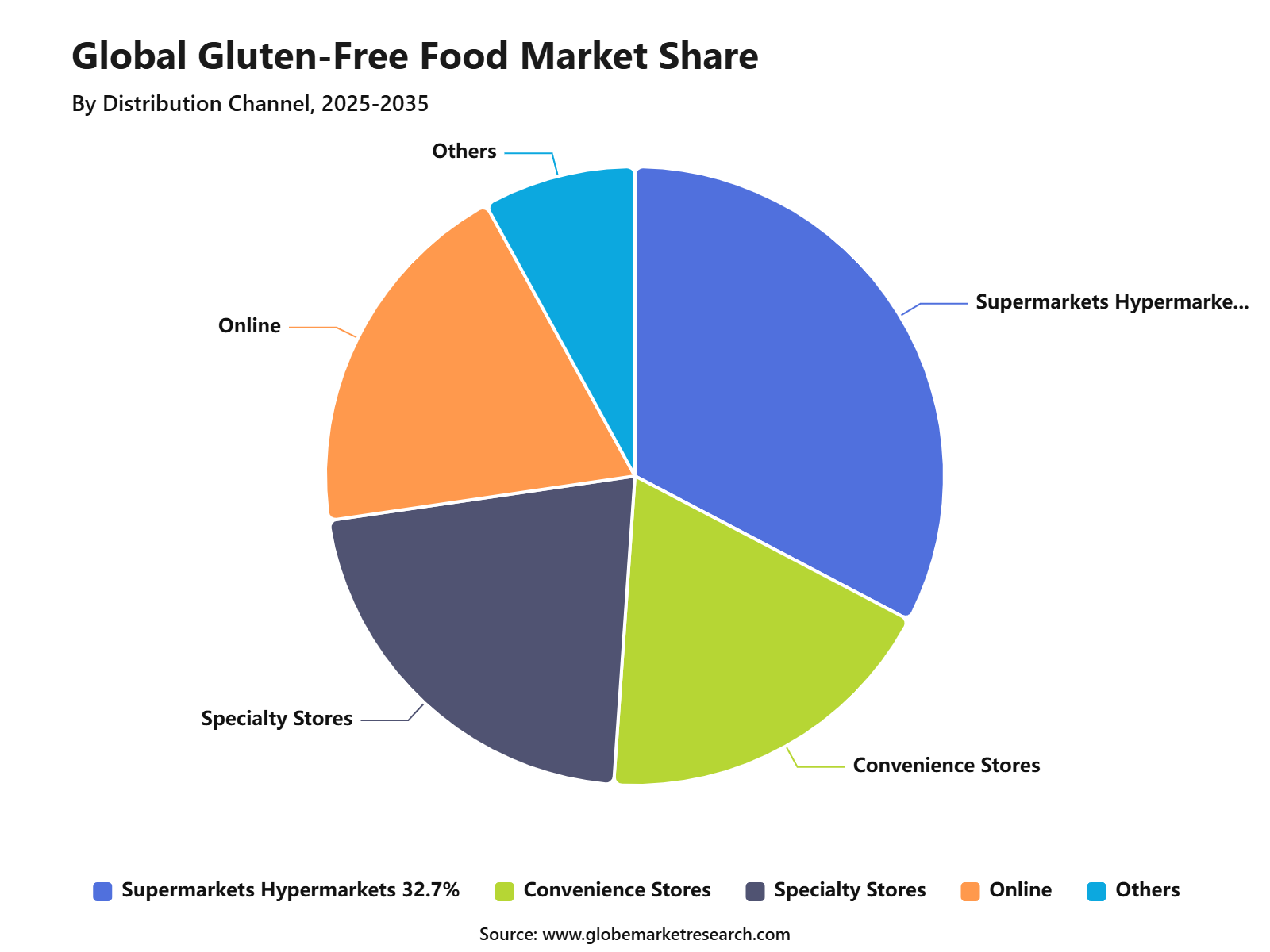 iThe graph shows projected market growth until 2035 based on CAGR analysis. Actual outcomes may vary depending on changing demand, competition, and economic factors.To gain greater insights - request a sample report PDF
By Region
North America accounted for 36.2% share of the Gluten-Free Food Market, reaching USD 3.4 billion. The region’s leadership is supported by high consumer awareness, strong diagnosis rates for gluten-related disorders, and wide availability of gluten-free food products across retail and foodservice channels.
The United States and Canada are key contributors due to strong demand for gluten-free bakery products, snacks, cereals, pasta, frozen foods, and ready-to-eat meals. Consumers in the region are increasingly seeking clean-label, allergen-friendly, and digestive-health-focused food options.
North America is expected to maintain a strong position as brands continue to improve product quality and expand gluten-free choices across mainstream retail. Demand will remain supported by health-conscious consumers, specialty diets, and wider adoption of gluten-free options in restaurants and packaged foods.
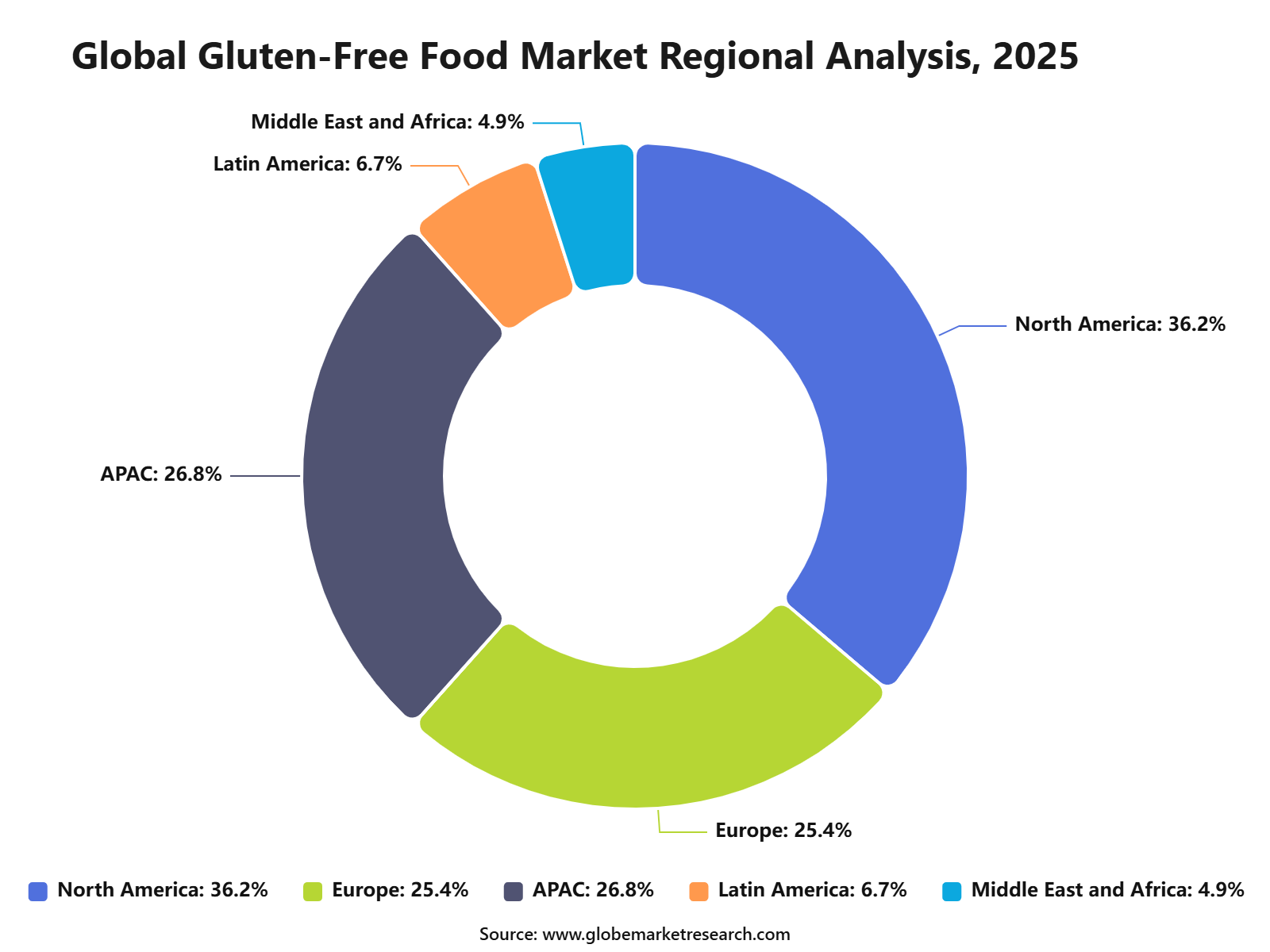 iThe graph shows projected market growth until 2035 based on CAGR analysis. Actual outcomes may vary depending on changing demand, competition, and economic factors.To gain greater insights - request a sample report PDF
Regional Impact Analysis
North America leads the Gluten-Free Food Market with 36.2% share in 2025, equal to about USD 3.4 billion, supported by strong gluten-free awareness, premium grocery spending, wide retail distribution, and trusted labeling systems. The U.S. remains the main regional driver due to strong demand for bakery products, snacks, cereals, pasta, and frozen gluten-free meals.
Europe remains important because of strong food safety standards, allergen labeling awareness, and demand for healthier packaged foods. Asia Pacific is expected to build future demand through rising disposable income, urban retail growth, digestive wellness awareness, and expanding premium food categories.
Impact Factor | Estimated CAGR Impact | Regional Relevance | Market Impact |
|---|---|---|---|
North America market leadership | +3.0% | North America, 36.2% share in 2025 | Leads global value demand. |
U.S. gluten-free retail strength | +1.9% | U.S. | Drives regional growth. |
Canada allergen-safe food demand | +1.2% | Canada | Supports premium products. |
Europe clean-label and allergen trend | +1.1% | Germany, UK, France, Italy | Builds stable value demand. |
Asia Pacific digestive wellness growth | +0.9% | China, India, Japan, South Korea | Supports future expansion |
Go-To-Market and Sales Economics
Gluten-free food is best commercialized through supermarkets, health-food stores, pharmacies, online grocery, foodservice, cafés, and dietitian-linked channels. Demand is medically anchored, as FDA stated in 2026 that around 3 million people in the U.S. have celiac disease, while NIDDK estimates about 1% of people worldwide are affected.
Sales economics are strengthened by certification, cross-contact control, clear labeling, and repeat grocery use across bread, pasta, bakery, snacks, cereals, and frozen foods. The FDA’s gluten-free claim remains voluntary but must meet regulatory requirements, while in 2026 the agency sought information on gluten labeling and cross-contact prevention in packaged foods.
Online grocery and subscription channels can improve discovery for niche gluten-free products. U.S. retail e-commerce sales reached USD 326.7 billion in Q1 2026, up 9.8% year over year, and accounted for 16.9% of total retail sales. This supports gluten-free bundles, pantry refills, and direct brand education.
Risk Factors & Market Barriers
The biggest market barrier is affordability because gluten-free staples are often priced higher than standard products. Coeliac UK states that a weekly gluten-free food shop can cost up to 35% extra, while gluten-free bread is more than four times as expensive on average as gluten-containing bread.
Availability remains a serious barrier, especially outside major supermarkets. A 2026 PubMed-indexed UK follow-up study found an average of only 7.6 gluten-free foods per store, equal to 38.2% of surveyed foods, while regular supermarket availability fell from 90% in 2010 to 70% in 2021.
Compliance risk is high because gluten-free products must manage hidden gluten, shared equipment, oats contamination, and supplier variation. FDA extended its 2026 request for information on gluten ingredient disclosure and cross-contact prevention, showing that clearer disclosure is becoming more important for brands, retailers, and foodservice operators.
Revenue Potential Analysis
Revenue Landscape Across
Revenue is spread across gluten-free bread, pasta, biscuits, cakes, cereals, frozen meals, pizza, snacks, baking mixes, ready-to-eat meals, and foodservice products. Bakery remains important because bread is a daily staple for medically required consumers, but pasta, cereals, and snacks offer stronger repeat-purchase potential through pantry-led household stocking.
Large food companies provide a strong route into mainstream shelves. General Mills reported fiscal 2026 net sales of USD 18.4 billion and stated that fiscal 2027 innovation will focus on consumer benefits such as better-for-you nutrition, fiber, bold flavors, and improved product experience. This supports wider free-from product renovation.
Specialist producers are also expanding capacity and product depth. Dr. Schär reported international expansion, secured Nordic share through Hero’s gluten-free business acquisition, expanded bakery production in Spain, and enhanced its U.S. Swedesboro facility for gluten- and soy-free bread and rolls. This shows demand for dedicated gluten-free manufacturing.
Financial Impact
Gluten-free foods can improve financial performance through premium pricing, strong repeat purchase, and high loyalty among medically required consumers. However, profitability depends on ingredient sourcing, segregation, testing, certification, smaller batch sizes, and retailer fees. Brands that reduce price gaps without weakening safety controls are better placed to widen household penetration.
Cost inflation can pressure both suppliers and consumers. BLS reported that food-at-home prices rose 2.7% year over year in May 2026, while cereals and bakery products rose 1.9%. For gluten-free brands, this increases pressure on rice flour, starches, specialty grains, packaging, logistics, and promotional spending.
The strongest financial impact is expected from companies that combine trusted labeling, dedicated production, affordable private label, and omnichannel distribution. FDA’s 2026 focus on gluten disclosure strengthens the case for better traceability. Retailers that support clear shelf navigation and safe foodservice handling can improve conversion, loyalty, and repeat basket value.
Drivers Impact Analysis
The Gluten-Free Food Market is driven by rising demand from consumers with celiac disease, gluten sensitivity, digestive health concerns, and clean-label food preferences. Gluten-free bakery products, snacks, pasta, cereals, ready meals, and packaged foods are gaining wider acceptance among both medical-need consumers and lifestyle buyers.
North America leads the market due to strong awareness of gluten-free diets, wide supermarket availability, clear labeling practices, and high demand for premium health-focused foods. The U.S. remains the key regional contributor because of strong demand across bakery, snacks, breakfast foods, frozen meals, and online grocery channels.
Impact Factor | Estimated CAGR Impact | Regional Relevance | Market Impact |
|---|---|---|---|
Rising awareness of celiac disease and gluten sensitivity | +2.8% | North America, Europe, Australia | Drives core medical-need demand. |
Growth in digestive health-focused diets | +2.3% | U.S., Canada, Europe | Supports repeat consumption. |
Expansion of gluten-free bakery products | +1.9% | North America and Europe | Builds high-frequency demand. |
Wider retail and online availability | +1.6% | U.S., Canada, UK, Germany | Improves consumer access. |
Clean-label and allergen-free food preference | +1.3% | Developed health food markets | Adds lifestyle demand. |
Restraints Impact Analysis
The market faces restraints from high product pricing, taste and texture limitations, and limited affordability compared with regular food products. Gluten-free products often require alternative flours, binders, stabilizers, and separate production lines, which increases cost.
Another restraint is consumer skepticism in non-medical gluten-free adoption. Some consumers use gluten-free diets as a lifestyle choice, but repeat purchases depend heavily on taste, nutrition quality, product variety, and clear health relevance.
Impact Factor | Estimated CAGR Impact | Regional Relevance | Market Impact |
|---|---|---|---|
High price premium over regular foods | -1.4% | Global consumer markets | Limits mass adoption. |
Taste and texture challenges | -1.2% | Bakery, pasta, snacks | Affects repeat purchase. |
Limited product affordability | -1.0% | Emerging and mass retail markets | Slows wider penetration. |
Nutritional quality concerns | -0.8% | Health-conscious consumers | Affects product trust. |
Cross-contamination risk | -0.7% | Certified gluten-free producers | Raises production complexity. |
Opportunities Impact Analysis
Opportunities are strong in gluten-free bakery products, snacks, pasta, breakfast cereals, frozen foods, ready meals, and clean-label packaged foods. These categories benefit from regular household consumption and demand for convenient gluten-free options.
Higher-value opportunities are also emerging in fortified gluten-free foods, high-fiber gluten-free products, gluten-free kids’ foods, plant-based gluten-free meals, and online subscription models. Brands that improve taste, texture, nutrition, and affordability can capture stronger long-term demand.
Impact Factor | Estimated CAGR Impact | Regional Relevance | Market Impact |
|---|---|---|---|
Gluten-free bakery product expansion | +2.6% | North America, Europe, Asia Pacific | Builds core market value. |
Gluten-free snacks and convenience foods | +2.1% | U.S., Canada, Europe | Supports frequent consumption. |
Fortified and high-fiber gluten-free foods | +1.7% | Developed health food markets | Improves nutrition positioning. |
Gluten-free frozen and ready meals | +1.4% | Urban retail markets | Adds convenience-led demand. |
Online gluten-free grocery platforms | +1.1% | North America and Europe | Expands direct access. |
Challenges Impact Analysis
The main challenge is matching the taste, softness, elasticity, and texture of wheat-based foods. Gluten plays an important role in bakery and pasta structure, so replacing it without lowering product quality remains difficult.
Another challenge is maintaining strict gluten-free certification and preventing cross-contamination. Manufacturers must manage separate sourcing, production, cleaning, testing, packaging, and traceability to protect consumer trust.
Impact Factor | Estimated CAGR Impact | Regional Relevance | Market Impact |
|---|---|---|---|
Replicating wheat-based texture | -1.2% | Bakery and pasta producers | Affects product quality. |
Preventing cross-contamination | -1.0% | Certified gluten-free facilities | Protects brand trust. |
Maintaining clean-label formulations | -0.8% | Premium health food brands | Increases formulation difficulty. |
Managing alternative ingredient cost | -0.7% | Food manufacturers | Pressures margins. |
Ensuring consistent shelf life | -0.6% | Packaged and frozen foods | Supports retail reliability. |
Segment Covered in the Report
By Product Type
Bakery Products
Dairy and Dairy Alternatives
Meats and Meat Alternatives
Condiments
Seasonings and Spreads
Desserts and Ice Creams
Prepared Food
Pasta and Rice
Others
By Distribution Channel
Supermarkets and Hypermarkets
Convenience Stores
Specialty Stores
Online
Others
By Region
North America
Europe
Asia Pacific
Latin America
Middle East and Africa
Market Trend Analysis
The market trend is moving toward gluten-free bakery, gluten-free snacks, clean-label packaged foods, high-fiber formulations, plant-based gluten-free products, and frozen ready meals. Consumers want gluten-free products that taste closer to regular foods while offering better nutrition.
Private-label gluten-free products are also gaining attention because they make the category more accessible to mainstream buyers. North America remains the value leader, while Europe and Asia Pacific are expanding through food allergy awareness, premium grocery retail, and healthier packaged food demand.
Impact Factor | Estimated CAGR Impact | Regional Relevance | Market Impact |
|---|---|---|---|
Gluten-free bakery remains dominant | +2.5% | North America, Europe, Asia Pacific | Leads daily-use demand. |
Clean-label gluten-free products expand | +2.0% | U.S., Canada, Europe | Builds consumer trust. |
Gluten-free snacks gain popularity | +1.7% | Urban and premium consumers | Adds convenience value. |
High-fiber and fortified products rise | +1.3% | Developed health food markets | Improves nutrition appeal. |
Private-label gluten-free foods grow | +1.1% | Supermarkets and online retail | Supports affordability. |
Investor Type Impact Matrix
Investors should focus on gluten-free food companies with strong taste quality, certified production, clean-label positioning, reliable sourcing, and strong retail presence. Product trust, affordability, texture improvement, and repeat purchase are key success factors.
Strategic investors can also target gluten-free bakery producers, snack manufacturers, alternative flour suppliers, certified co-manufacturers, and online gluten-free grocery platforms. Companies that make gluten-free food safer, tastier, and more affordable are better positioned for long-term growth.
Investor Type | Estimated CAGR Impact | Regional Relevance | Market Impact |
|---|---|---|---|
Gluten-Free Food Brands | +2.2% | Global | Expands trusted gluten-free supply. |
Gluten-Free Bakery Producers | +1.8% | North America, Europe, Asia Pacific | Supports high-frequency demand. |
Gluten-Free Snack Manufacturers | +1.5% | U.S., Canada, Europe | Builds convenience-led growth. |
Alternative Flour and Ingredient Suppliers | +1.2% | Global food manufacturing hubs | Improves formulation quality. |
Strategic Food and Retail Investors | +1.0% | Global health food markets | Funds product expansion. |
Recent Developments
In March 2026, General Mills introduced Lucky Charms Unicorn Cotton Candy, a gluten-free cereal made with colors from natural sources, while advancing plans to remove certified colors from U.S. cereals by summer 2026.
In February 2026, Hain Celestial agreed to sell its North America snacks business to Snackruptors for USD 115 million, reducing debt and sharpening focus on higher-margin personal care, beverages and meal categories.
In June 2025, Conagra introduced more than 50 frozen foods, including Udi’s certified gluten-free Chicken Enchiladas with antibiotic-free chicken, extending its gluten-free frozen meal portfolio for family-size convenience occasions nationwide.
Competitive Landscape
The market is characterized by intense competition among established players and emerging companies. Strategic partnerships, mergers and acquisitions, and product innovation are key strategies employed by market participants.
Key Market Players
General Mills, Inc.
Conagra Brands, Inc.
Kellanova
The Kraft Heinz Company
The Hain Celestial Group, Inc.
Dr. Schär AG
Barilla Group
Ecotone
Siete Foods
Siete Foods
Siete Foods
Hero Group
Enjoy Life Foods
Enjoy Life Foods
Amy’s Kitchen, Inc.
Other Key Players
Research Methodology
This market study is prepared using a combination of primary and secondary research. Primary research includes discussions with manufacturers, suppliers, distributors, consultants, industry experts, and end users. Secondary research covers company reports, government databases, trade associations, technical publications, regulatory sources, and trusted industry documents. The collected information is used to assess market demand, pricing trends, technology adoption, competitive activity, and regional performance.
AI language models are not used as primary data sources, and publicly available AI-generated content is not treated as market evidence. Computational tools may be used to support data processing, translation, data classification, and pattern identification. However, every published assessment is supported by verified sources, human review, and primary market discussions.
Market estimates are developed through top-down and bottom-up approaches and validated using data triangulation. Revenue, production, shipment, pricing, and application-level data are compared across multiple sources. Forecasts consider economic conditions, regulatory changes, investment activity, innovation, supply chain developments, and industry risks. All findings are reviewed through source verification and internal quality checks before publication.
Part I
Source Management & Input Data Standards
Who provides data, how sources are qualified, and what types of evidence are admissible.
Part II
Research Scope & Market Coverage
How we define the markets we assess and the parameters that govern each product.
Part III
Data Collection, Verification & Submission
The mechanics of gathering, cross-checking, and hierarchically ranking evidence.
Part IV
Assessment Determination & Quality Controls
How raw data becomes a published assessment — normalisation, expert judgement, and outlier exclusion.
Part V
Publication, Corrections & Revision
Our publication schedule, corrections policy, and methodology review cycle.
Part VI
Independence, Ethics & Complaints
Conflict-of-interest policies, editorial independence, and how clients raise concerns.
Google · Preferred Sources
Don't miss the latest market research insights and industry updates on Google.
Add Globe Market Research as a preferred source in the Google app to see our reports, analysis, and market stories in your news suggestions.
Meet the Team
This report was prepared by our expert analysts with deep industry knowledge and research experience.
Kimaya brings more than five years of experience in market research, content review, and industry analysis to Globe Market Research. She plays an important role in maintaining the accuracy, clarity, consistency, and relevance of research content across a wide range of industries. Her responsibilities include reviewing market data, segment analysis, competitive landscapes, industry trends, company developments, and strategic insights. Each report is carefully assessed to ensure that the findings are supported by reliable data, presented in a structured format, and aligned with the information needs of business decision-makers. Kimaya has research experience across healthcare, information technology, consumer goods, and several cross-industry domains.
Pratiksha K. is a Senior Research Analyst with more than five years of experience in market research, industry analysis, competitive intelligence, and business strategy. She has contributed to detailed market reports, customized research studies, company profiling, market sizing, trend analysis, and strategic consulting projects for clients across different regions. Her industry expertise covers Chemical and Material, Consumer Goods, Food & Beverages and Energy & Power. She closely evaluates changing customer requirements, technology developments, regulatory conditions, supply chain structures, investment activity, and competitive strategies to provide clear and practical market insights.
Frequently Asked Questions
Related Reports
More in Food and Beverages
Refrigerated Ready Meals Market to Hit USD 355.8 Billion by 2035
Refrigerated Ready Meals Market Size, Share, Analysis By Product (Refrigerated Meals, Frozen Meals, Shelf-Stable Meals, Canned Meals), By Meal Type (Vegetarian, Non-Vegetarian, Vegan), By Distribution Channel (Supermarkets and Hypermarkets, Convenience Stores, Online Retail, Specialty Stores), By Regional Insights, Business plan and Project Report, Investment Opportunities, Profitability, Industry Trends, Leading Companies and Growth Forecasts by 2026-2035
Frozen Desserts Market to Hit USD 298.8 Billion by 2035
Frozen Desserts Market Size, Share, Analysis By Product (Ice Cream, Frozen Yogurt, Gelato, Sorbet, Frozen Cakes, Other Products), By Consumption (Retail Consumption, Foodservice Consumption), By Distribution Channel (Supermarkets and Hypermarkets, Convenience Stores, Specialty Stores, Online Retail), By Regional Insights, Business plan and Project Report, Investment Opportunities, Profitability, Industry Trends, Leading Companies and Growth Forecasts by 2026-2035
Frozen Meat and Seafood Market to Hit USD 181.1 Billion by 2035
Frozen Meat and Seafood Market Size, Share, Analysis By Product (Frozen Meat, Frozen Seafood), By Seafood Form (Whole, Fillets, Processed Seafood, Other Forms), By Seafood End Use (Retail and Household, Foodservice, Industrial), By Regional Insights, Business plan and Project Report, Investment Opportunities, Profitability, Industry Trends, Leading Companies and Growth Forecasts by 2026-2035
Frozen Meals Market to Hit USD 74.2 Billion by 2035
Frozen Meals Market Size, Share, Analysis By Product (Frozen, Chilled, Canned, Shelf-Stable), By Meal Type (Vegetarian, Non-Vegetarian, Vegan), By Distribution Channel (Supermarkets and Hypermarkets, Online Retail, Convenience Stores, Specialty Stores), By Regional Insights, Business plan and Project Report, Investment Opportunities, Profitability, Industry Trends, Leading Companies and Growth Forecasts by 2026-2035